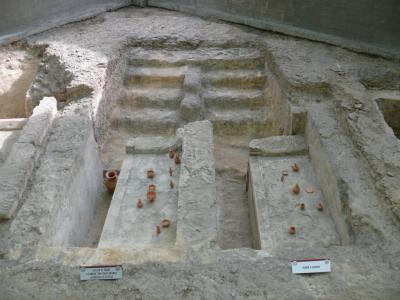


Necropoli - Epoca Magnogreca (Necropolis - Magna Graecia Era), Taranto
The important archaeological area, intercepted and investigated following the functionalisation interventions of the spaces adjacent to the nearby Court of the city, represents the largest sector with funerary use, currently open to visitors, of the Greek polis of Taranto. The space, well organized and intended for tourist use, preserves around one hundred and forty burials attributable to one of the most significant areas of the Taranto necropolis used from the Archaic to the Hellenistic age. At the nodal points of the blocks and at the intersection of the ancient road axes, still visible below the walkways, eight chamber tombs dating back to between the 4th and 3rd centuries BC can be identified, two of which are entirely built with squared blocks of carparo, while the others, equipped with access dromos (corridor), are carved into the rock and are completed in the upper part with regular blocks and projecting frames. The rooms are characterized by the presence, in some cases extremely evident, of traces of the original plaster and colors and preserve the funeral cots on which the body of the deceased was placed at the time of burial. The study of the interesting archaeological context has guaranteed to analyze in detail the urban development of the Greek polis of Taranto, noting how, especially following the 5th century. BC, the areas dedicated to the burial of the deceased are considered almost as living spaces in all respects. The organization of the road axes, as well as the distribution of the burials, absolutely does not appear to be the result of random choices, but seems to respond to specific urban planning and symbolic rules in which the most prestigious tombs are placed in the immediate vicinity of the main road axes. In the framework of knowledge relating to the development of the ancient city of Taranto, the organization of the spaces intended for the necropolis is undoubtedly the best known aspect, perhaps thanks to the high number of tombs studied over the years. For the archaic period, as well as for subsequent ones, the majority of tombs found in the Taranto necropolis are made up of pits dug directly into the earth or dug into the rocky bank, often equipped with a counter-pit useful for facilitating the positioning of the covering slabs. Alongside this typology, which appears to be the most widespread, the presence of chamber tombs of particular monumental value built in imitation of the andròn (an environment present in the aristocratic houses of Taranto intended for the celebration of the symposium) with sarcophagi or funeral beds arranged along the walls in place of the klinai (beds) of the royal house.
Various tombs found in the city of Taranto, both chamber and pit. In particular, we highlight the so-called Tomb of the Athletes (corner of Via Pitagora and Via Crispi) dated between the end of the 6th century and the beginning of the 5th century BC. With a quadrangular plan, it was built, paved and covered in carparo blocks and slabs. Two Doric columns support the roof in the centre. The tomb is equipped with 7 sarcophagi along the walls. In the center are copies of the rich funerary objects composed among other things of the Panathenaic amphora, a prize awarded to the winning athletes during the competitions that characterized the festivals celebrated in Athens in honor of the goddess Athena. ***PH***
Various tombs found in the city of Taranto, both chamber and pit. In particular, we highlight the so-called Tomb of the Athletes (corner of Via Pitagora and Via Crispi) dated between the end of the 6th century and the beginning of the 5th century BC. With a quadrangular plan, it was built, paved and covered in carparo blocks and slabs. Two Doric columns support the roof in the centre. The tomb is equipped with 7 sarcophagi along the walls. In the center are copies of the rich funerary objects composed among other things of the Panathenaic amphora, a prize awarded to the winning athletes during the competitions that characterized the festivals celebrated in Athens in honor of the goddess Athena. ***PH***
Want to visit this sight? Check out these Self-Guided Walking Tours in Taranto. Alternatively, you can download the mobile app "GPSmyCity: Walks in 1K+ Cities" from Apple App Store or Google Play Store. The app turns your mobile device to a personal tour guide and it works offline, so no data plan is needed when traveling abroad.
Download The GPSmyCity App



Necropoli - Epoca Magnogreca (Necropolis - Magna Graecia Era) on Map
Sight Name: Necropoli - Epoca Magnogreca (Necropolis - Magna Graecia Era)
Sight Location: Taranto, Italy (See walking tours in Taranto)
Sight Type: Museum/Gallery
Sight Location: Taranto, Italy (See walking tours in Taranto)
Sight Type: Museum/Gallery
Nearby Sights


Walking Tours in Taranto, Italy

Create Your Own Walk in Taranto
Creating your own self-guided walk in Taranto is easy and fun. Choose the city attractions that you want to see and a walk route map will be created just for you. You can even set your hotel as the start point of the walk.
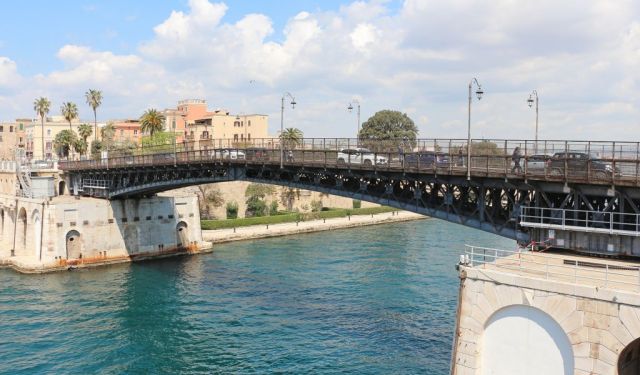
Taranto Introduction Walking Tour
Taranto, the famed “city of the two seas,” sparkles on the Ionian coast of Puglia, framed by the glistening bays of Mar Grande and Mar Piccolo. This isn’t just a pretty port town-it’s a place where history, culture, and postcard-perfect views meet head-on. With its prime Mediterranean location, Taranto has been a hot spot for everyone from ancient Greeks to Roman generals, Byzantine... view more
Tour Duration: 2 Hours
Travel Distance: 2.9 Km or 1.8 Miles
Tour Duration: 2 Hours
Travel Distance: 2.9 Km or 1.8 Miles
City Walks Overview
