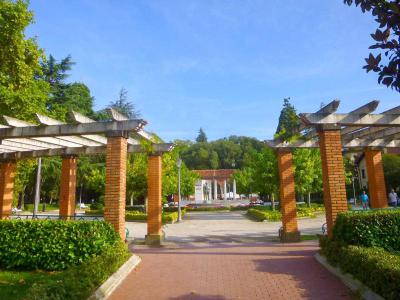


Parque de La Media Luna (Half Moon Park), Pamplona
The Half Moon Park serves as a picturesque gateway to Pamplona from the north. Offering visitors a stunning panoramic vista of the cityscape and the winding bends of the Arga River, the park also provides access to the nearby Fluvial Park, a popular local recreational area. One of the prominent landmarks visible from the park is the Diocesan Seminary, distinguished by its striking façade adorned with a large stained glass cross, designed by the same architect responsible for the creation of Half Moon Park: Víctor Eusa.
Once the site of agricultural threshing floors, the park has been transformed into a charming green space resembling a waning moon. Upon entering the park, visitors are greeted by the statue of King Sancho III the Elder, set against a backdrop of avenues lined with majestic plane trees and a central pond framed by an arched walkway. The park also features a central café, providing a tranquil setting for relaxation and leisure.
Half Moon Park is adorned with a diverse array of tree species, including towering giant sequoias, horse chestnuts, Atlas and Himalayan cedars, weeping sophoras, maples, hackberries, palm trees, and fir trees. These lush greenery and shaded pathways offer a respite from the bustling city streets, inviting visitors to stroll amidst nature's splendor.
Additionally, the park is home to the Monument to Pablo Sarasate, a tribute to the renowned violinist and composer from Pamplona, sculpted by Eduardo Carretero in 1959. As visitors explore the park, they encounter the historic Fortín de San Bartolomé, a defensive bastion dating back to the 18th century, which once played a crucial role in safeguarding the city's eastern flank.
Once the site of agricultural threshing floors, the park has been transformed into a charming green space resembling a waning moon. Upon entering the park, visitors are greeted by the statue of King Sancho III the Elder, set against a backdrop of avenues lined with majestic plane trees and a central pond framed by an arched walkway. The park also features a central café, providing a tranquil setting for relaxation and leisure.
Half Moon Park is adorned with a diverse array of tree species, including towering giant sequoias, horse chestnuts, Atlas and Himalayan cedars, weeping sophoras, maples, hackberries, palm trees, and fir trees. These lush greenery and shaded pathways offer a respite from the bustling city streets, inviting visitors to stroll amidst nature's splendor.
Additionally, the park is home to the Monument to Pablo Sarasate, a tribute to the renowned violinist and composer from Pamplona, sculpted by Eduardo Carretero in 1959. As visitors explore the park, they encounter the historic Fortín de San Bartolomé, a defensive bastion dating back to the 18th century, which once played a crucial role in safeguarding the city's eastern flank.
Want to visit this sight? Check out these Self-Guided Walking Tours in Pamplona. Alternatively, you can download the mobile app "GPSmyCity: Walks in 1K+ Cities" from Apple App Store or Google Play Store. The app turns your mobile device to a personal tour guide and it works offline, so no data plan is needed when traveling abroad.
Download The GPSmyCity App



Parque de La Media Luna (Half Moon Park) on Map
Sight Name: Parque de La Media Luna (Half Moon Park)
Sight Location: Pamplona, Spain (See walking tours in Pamplona)
Sight Type: Park/Outdoor
Sight Location: Pamplona, Spain (See walking tours in Pamplona)
Sight Type: Park/Outdoor
Nearby Sights
Walking Tours in Pamplona, Spain

Create Your Own Walk in Pamplona
Creating your own self-guided walk in Pamplona is easy and fun. Choose the city attractions that you want to see and a walk route map will be created just for you. You can even set your hotel as the start point of the walk.
Pamplona Introduction Walking Tour
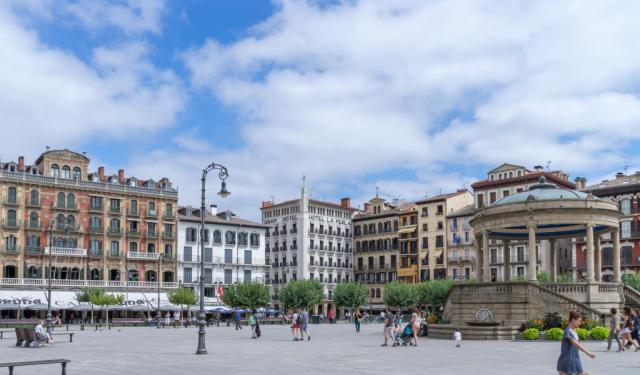
Pamplona, the capital of the autonomous region of Navarre in northern Spain, is one of the oldest cities in the country. Its history spans millennia. Originally a small Vascones settlement known as Iruña, it was transformed into a Roman city named Pompelo by the Roman commander Gnaeus Pompey in 74 BC. Over the centuries, Pamplona witnessed the rise and fall of various powers, from the Visigoths... view more
Tour Duration: 2 Hours
Travel Distance: 2.8 Km or 1.7 Miles
Tour Duration: 2 Hours
Travel Distance: 2.8 Km or 1.7 Miles
City Walks Overview
