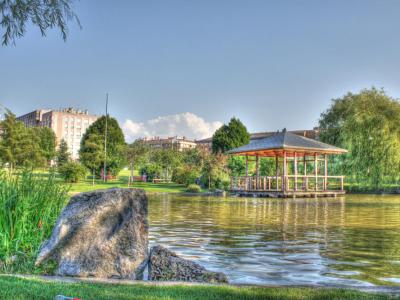


Parque de Yamaguchi (Yamaguchi Park), Pamplona
Park designed by Japanese landscape architects to mark the twinning of Pamplona with Yamaguchi.
Just ten minutes walk from Vuelta del Castillo, down Pio XII or Avenida de Bayona, we find one of the most unique parks in the city. Designed in 1997 by two Japanese landscapers, Yamaguchi Park comes to symbolize the twinning between Pamplona and the Japanese city that gives it its name, evangelized by the Navarrese Saint Francis Xavier. This typical Japanese garden is a tribute to the four seasons, and has 400 trees and more than 600 plants, such as the Japanese cherry tree, ginkgo biloba, weeping willow, swamp cypress, maples, oaks, sequoias and hollies among others. In this park stands the Pamplona Planetarium, and next to it, the Galaxy Garden, a plant replica on a scale of the Milky Way and the only one with similar characteristics in Europe. Its more than 500 bushes symbolize its millions of stars, nebulae, gas clouds and even its -supposed- central supermassive black hole. Its diameter of 30 meters is equivalent to 100,000 light years: the solar system could easily fit on any of its small leaves! Although for centuries it has been the Milky Way that has guided pilgrims to Compostela -Campus Stellae-, it will now be the Camino de Santiago that, after visiting the Garden of the Galaxy, invites us to continue the walk towards the university campuses of Pamplona. The expansion of the city towards the south has managed to combine urban areas with large parks and gardens on the banks of the Elorz and Sadar rivers. The city's two university campuses are also located in this location, combining gardens open to the city with art spaces.
The Yamaguchi Japanese Garden is a Japanese garden and botanical collection of 80,000 m² , which is surrounded by the avenues of Barañáin, Sancho Ramírez, Acella and La Rioja street in the Ermitagaña neighborhood of the city of Pamplona , Foral Community of Navarra, Spain. This Japanese garden is a consequence of the twinning of the Navarrese city of Pamplona in 1980 with the city of Yamaguchi (Japan), which was evangelized by the patron saint of Navarre , Saint Francis Xavier in the 16th century. It is oriental in style and was designed in 1997 by landscapers born in the country of the rising sun, who with their efforts achieved a most unique space, which invites meditation and relaxation, paying tribute to the four seasons. Among its plant collections, the majority are from Japan , trees, shrubs and herbaceous species. The park is a green surface with ornamental elements typical of Japanese culture: a large geyser , a stilt house , a pond with a bridge and waterfall and several Japanese shrub and tree species; which constitute a tribute to the four seasons. The Planetarium is located in this park with different programming and exhibition spaces.
Yamaguchi Park is one of those strange places in a city like Pamplona that, precisely because of its uniqueness, become unique spaces. This little piece of Japan in the middle of Navarra was born from a cultural twinning between the two cultures and allows all visitors to enjoy magical corners such as the lake pagoda, the geysers typical of the gardens of the Asian country and its famous cherry trees that when they bloom offer a very difficult spectacle to see in a northern city like Pamplona.
Pamplona is dotted with beautiful green spots, but none as unique as this 85,000 square meter park, located in one of the most modern areas of the city. Its name recalls the Japanese city of Yamaguchi, a neighbor of Hiroshima and with which Pamplona has been twinned since 1980 in memory of the evangelization of that country by Saint Francis Xavier , patron saint of Navarre. Oriental in style , it was designed in 1997 by Japanese landscapers, so it contains all the elements of a garden imported from the culture of the Rising Sun, with all its pampering, refinements and delicacies. Plants and tree species, some native, coexist with ornamental elements such as the suhama (beach), azumaya (house over the pond), yatsubashi and ishibasi (bridges), taki (waterfall) or the lake geyser , a stream of water that reaches twenty meters high. Walking through this Japanese tribute to the four seasons will make you feel transported to a dream world from which you will not want to wake up. ***PH***
Just ten minutes walk from Vuelta del Castillo, down Pio XII or Avenida de Bayona, we find one of the most unique parks in the city. Designed in 1997 by two Japanese landscapers, Yamaguchi Park comes to symbolize the twinning between Pamplona and the Japanese city that gives it its name, evangelized by the Navarrese Saint Francis Xavier. This typical Japanese garden is a tribute to the four seasons, and has 400 trees and more than 600 plants, such as the Japanese cherry tree, ginkgo biloba, weeping willow, swamp cypress, maples, oaks, sequoias and hollies among others. In this park stands the Pamplona Planetarium, and next to it, the Galaxy Garden, a plant replica on a scale of the Milky Way and the only one with similar characteristics in Europe. Its more than 500 bushes symbolize its millions of stars, nebulae, gas clouds and even its -supposed- central supermassive black hole. Its diameter of 30 meters is equivalent to 100,000 light years: the solar system could easily fit on any of its small leaves! Although for centuries it has been the Milky Way that has guided pilgrims to Compostela -Campus Stellae-, it will now be the Camino de Santiago that, after visiting the Garden of the Galaxy, invites us to continue the walk towards the university campuses of Pamplona. The expansion of the city towards the south has managed to combine urban areas with large parks and gardens on the banks of the Elorz and Sadar rivers. The city's two university campuses are also located in this location, combining gardens open to the city with art spaces.
The Yamaguchi Japanese Garden is a Japanese garden and botanical collection of 80,000 m² , which is surrounded by the avenues of Barañáin, Sancho Ramírez, Acella and La Rioja street in the Ermitagaña neighborhood of the city of Pamplona , Foral Community of Navarra, Spain. This Japanese garden is a consequence of the twinning of the Navarrese city of Pamplona in 1980 with the city of Yamaguchi (Japan), which was evangelized by the patron saint of Navarre , Saint Francis Xavier in the 16th century. It is oriental in style and was designed in 1997 by landscapers born in the country of the rising sun, who with their efforts achieved a most unique space, which invites meditation and relaxation, paying tribute to the four seasons. Among its plant collections, the majority are from Japan , trees, shrubs and herbaceous species. The park is a green surface with ornamental elements typical of Japanese culture: a large geyser , a stilt house , a pond with a bridge and waterfall and several Japanese shrub and tree species; which constitute a tribute to the four seasons. The Planetarium is located in this park with different programming and exhibition spaces.
Yamaguchi Park is one of those strange places in a city like Pamplona that, precisely because of its uniqueness, become unique spaces. This little piece of Japan in the middle of Navarra was born from a cultural twinning between the two cultures and allows all visitors to enjoy magical corners such as the lake pagoda, the geysers typical of the gardens of the Asian country and its famous cherry trees that when they bloom offer a very difficult spectacle to see in a northern city like Pamplona.
Pamplona is dotted with beautiful green spots, but none as unique as this 85,000 square meter park, located in one of the most modern areas of the city. Its name recalls the Japanese city of Yamaguchi, a neighbor of Hiroshima and with which Pamplona has been twinned since 1980 in memory of the evangelization of that country by Saint Francis Xavier , patron saint of Navarre. Oriental in style , it was designed in 1997 by Japanese landscapers, so it contains all the elements of a garden imported from the culture of the Rising Sun, with all its pampering, refinements and delicacies. Plants and tree species, some native, coexist with ornamental elements such as the suhama (beach), azumaya (house over the pond), yatsubashi and ishibasi (bridges), taki (waterfall) or the lake geyser , a stream of water that reaches twenty meters high. Walking through this Japanese tribute to the four seasons will make you feel transported to a dream world from which you will not want to wake up. ***PH***
Want to visit this sight? Check out these Self-Guided Walking Tours in Pamplona. Alternatively, you can download the mobile app "GPSmyCity: Walks in 1K+ Cities" from Apple App Store or Google Play Store. The app turns your mobile device to a personal tour guide and it works offline, so no data plan is needed when traveling abroad.
Download The GPSmyCity App



Parque de Yamaguchi (Yamaguchi Park) on Map
Sight Name: Parque de Yamaguchi (Yamaguchi Park)
Sight Location: Pamplona, Spain (See walking tours in Pamplona)
Sight Type: Park/Outdoor
Sight Location: Pamplona, Spain (See walking tours in Pamplona)
Sight Type: Park/Outdoor
Nearby Sights

Walking Tours in Pamplona, Spain

Create Your Own Walk in Pamplona
Creating your own self-guided walk in Pamplona is easy and fun. Choose the city attractions that you want to see and a walk route map will be created just for you. You can even set your hotel as the start point of the walk.

Pamplona Introduction Walking Tour
Pamplona, the capital of the autonomous region of Navarre in northern Spain, is one of the oldest cities in the country. Its history spans millennia. Originally a small Vascones settlement known as Iruña, it was transformed into a Roman city named Pompelo by the Roman commander Gnaeus Pompey in 74 BC. Over the centuries, Pamplona witnessed the rise and fall of various powers, from the Visigoths... view more
Tour Duration: 2 Hours
Travel Distance: 2.8 Km or 1.7 Miles
Tour Duration: 2 Hours
Travel Distance: 2.8 Km or 1.7 Miles
City Walks Overview
