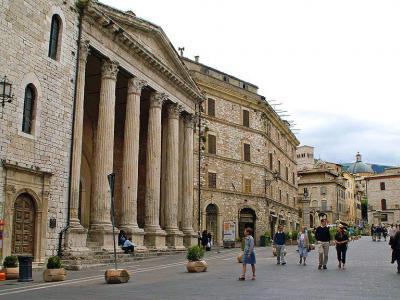


Piazza del Comune (Town Hall Square), Assisi (must see)
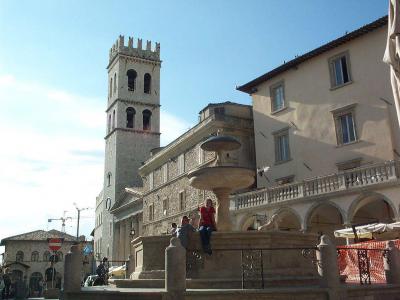
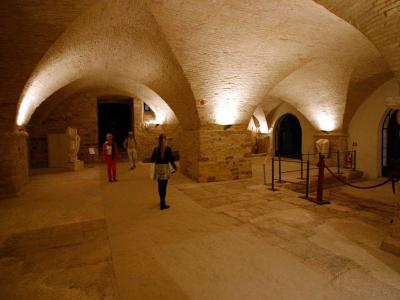
Town Hall Square occupies the civic heart of Assisi, midway between the Basilica of Saint Francis and the upper town. It stands above the remains of Roman Asisium, although scholars have debated whether the site served specifically as the Roman Forum or as an earlier sacred area. Visitors can explore the underground archaeological remains through the entrance near Portica Street, where ancient paving, inscriptions, architectural fragments, and other finds reveal the Roman city hidden beneath medieval Assisi. Walk across the cobblestones towards the south-eastern side of the square to examine the Fountain of the Three Lions.
During the Middle Ages, the square became the centre of political and commercial life. Feudal families initially displayed their influence through tall residential towers, but these gradually gave way to civic buildings associated with the growing merchant class. By the early 14th century, the square had acquired much of its present arrangement, with the People’s Tower beside the ancient temple and municipal buildings occupying the southern and western sides.
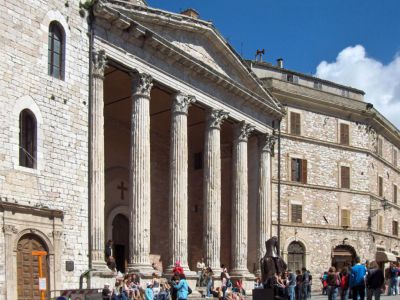
The square’s most recognisable monument is the former Temple of Minerva, built during the second half of the first century BC. Its exceptionally well-preserved façade features six fluted columns with Corinthian capitals. The Roman sanctuary was later converted into the Church of Saint Mary above Minerva, whose richly decorated Baroque interior contrasts sharply with its restrained classical exterior. Pause beneath the temple’s grand Roman portico, just east of the People’s Tower, to examine the ancient fluted columns. Then step inside to contrast the classical façade with the lavish 17th-century Baroque sanctuary.
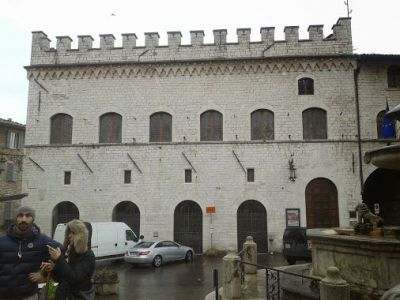
To the west of the Church of Saint Mary above Minerva stand the Captain of the People’s Palace, completed in 1282, and the 47-metre People’s Tower. Opposite, the 14th-century Priors’ Palace forms part of the Town Hall complex. Another notable building is the neo-Gothic former post office, recognisable by its frescoed walls and vaulted ceilings; part of the building now houses the tourist office.
Today, restaurants, cafés, shops, and a central stone fountain make the square a popular place to pause and observe daily life, although dining directly on the square can be expensive. Look out for the Zubboli Bookshop, a local institution founded in 1870, and Bar Minerva, a longstanding favourite for drinks. From here, streets lead uphill towards Assisi Cathedral and the Major Fortress or downhill along Portica Street towards the Basilica of Saint Francis.
During the Middle Ages, the square became the centre of political and commercial life. Feudal families initially displayed their influence through tall residential towers, but these gradually gave way to civic buildings associated with the growing merchant class. By the early 14th century, the square had acquired much of its present arrangement, with the People’s Tower beside the ancient temple and municipal buildings occupying the southern and western sides.
The square’s most recognisable monument is the former Temple of Minerva, built during the second half of the first century BC. Its exceptionally well-preserved façade features six fluted columns with Corinthian capitals. The Roman sanctuary was later converted into the Church of Saint Mary above Minerva, whose richly decorated Baroque interior contrasts sharply with its restrained classical exterior. Pause beneath the temple’s grand Roman portico, just east of the People’s Tower, to examine the ancient fluted columns. Then step inside to contrast the classical façade with the lavish 17th-century Baroque sanctuary.
To the west of the Church of Saint Mary above Minerva stand the Captain of the People’s Palace, completed in 1282, and the 47-metre People’s Tower. Opposite, the 14th-century Priors’ Palace forms part of the Town Hall complex. Another notable building is the neo-Gothic former post office, recognisable by its frescoed walls and vaulted ceilings; part of the building now houses the tourist office.
Today, restaurants, cafés, shops, and a central stone fountain make the square a popular place to pause and observe daily life, although dining directly on the square can be expensive. Look out for the Zubboli Bookshop, a local institution founded in 1870, and Bar Minerva, a longstanding favourite for drinks. From here, streets lead uphill towards Assisi Cathedral and the Major Fortress or downhill along Portica Street towards the Basilica of Saint Francis.
Want to visit this sight? Check out these Self-Guided Walking Tours in Assisi. Alternatively, you can download the mobile app "GPSmyCity: Walks in 1K+ Cities" from Apple App Store or Google Play Store. The app turns your mobile device to a personal tour guide and it works offline, so no data plan is needed when traveling abroad.
Download The GPSmyCity App



Piazza del Comune (Town Hall Square) on Map
Sight Name: Piazza del Comune (Town Hall Square)
Sight Location: Assisi, Italy (See walking tours in Assisi)
Sight Type: Attraction/Landmark
Guide(s) Containing This Sight:
Sight Location: Assisi, Italy (See walking tours in Assisi)
Sight Type: Attraction/Landmark
Guide(s) Containing This Sight:
Nearby Sights

Walking Tours in Assisi, Italy

Create Your Own Walk in Assisi
Creating your own self-guided walk in Assisi is easy and fun. Choose the city attractions that you want to see and a walk route map will be created just for you. You can even set your hotel as the start point of the walk.
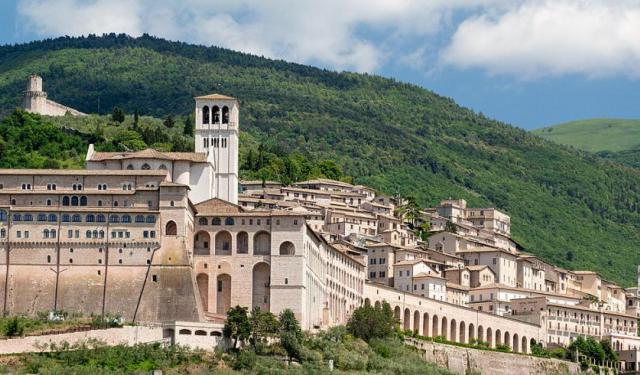
Explore Assisi Medieval Town on Foot
Dante believed that the name Assisi did not fully express the town’s significance. In his poem Paradiso, he suggested that it should instead be called the “East” because Saint Francis rose from its hillside like a new sun.
Assisi stands on the western slope of Mount Subasio, overlooking the Umbrian Valley. Human settlement in the area dates back to prehistoric times, while the town itself... view more
Tour Duration: 2 Hours
Travel Distance: 1.9 Km or 1.2 Miles
Assisi stands on the western slope of Mount Subasio, overlooking the Umbrian Valley. Human settlement in the area dates back to prehistoric times, while the town itself... view more
Tour Duration: 2 Hours
Travel Distance: 1.9 Km or 1.2 Miles
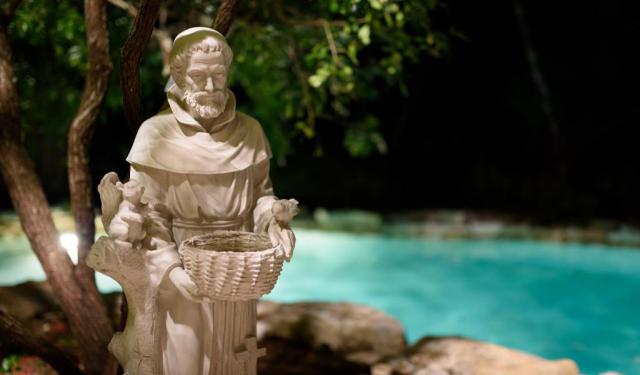
St. Francis' Assisi Walking Tour
Assisi’s identity as the city of Saint Francis began with a merchant’s son who seemed destined for anything but sainthood. Giovanni di Pietro di Bernardone-later known as Francis-was born here in late 1181 or early 1182 into a prosperous cloth-trading family. As a young man, he delighted in fashionable clothes, music, feasting, and dreams of knighthood. Assisi was then a turbulent commune,... view more
Tour Duration: 2 Hours
Travel Distance: 3.2 Km or 2 Miles
Tour Duration: 2 Hours
Travel Distance: 3.2 Km or 2 Miles
City Walks Overview
