

Radcliffe Camera, Oxford (must see)
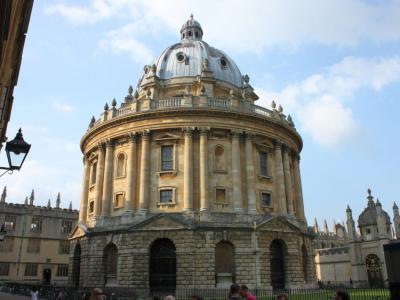
The Radcliffe Camera is one of the most recognizable landmarks in Oxford and a defining feature of the city’s skyline. Despite its name, it is not a camera in the modern sense but the first circular library built in the United Kingdom. In this context, the word camera comes from Latin and means “room” or “chamber.”
The building was funded through a bequest from royal physician and scholar John Radcliffe, who wished to create a library to house scientific materials for the university. Several colleges debated where it should stand, but in the end, an independent site was selected in the centre of Oxford. To make way for the new library, a group of terraced houses, Black Hall, and nearby college outbuildings were demolished to clear the site now known as Radcliffe Square.
Construction began in 1737 and was completed in 1749. Designed in the English Palladian style, the building presents the appearance of three levels. The central highlight of the exterior is the rusticated ground floor, which supports the more decorative upper sections. To find this highlight, walk around the circular base of the building; look for the eight massive stone arches topped with pediments. These were originally designed as an open arcade for the public before being enclosed to provide more storage for the library’s expanding collection. The upper section is marked by pairs of Corinthian columns, while a lantern and lead-covered dome crown the structure.
Inside, the building offers a quiet yet evocative atmosphere focused on the academic past of the university. An open gallery runs around the first floor, and a statue of John Radcliffe by sculptor John Michael Rysbrack stands prominently within the interior. To find this highlight if you are on a tour, look toward the northern side of the ground floor gallery; look for the lifelike marble figure positioned in a grand niche. Carved in 1747, it depicts the physician in his robes, serving as a permanent tribute to the man whose wealth made the library possible.
Originally intended as a scientific library, the building later became part of the Bodleian Library system. In 1912, an underground storage room was added and linked to the Bodleian through a passageway. Above the entire structure, the final notable highlight is the lead-covered dome and lantern. To find this highlight from the square, look toward the very peak of the circular roof; look for the 16-sided lead dome and the stone lantern that sits at the highest point, which was a revolutionary engineering feat for the 18th century.
Today, the Radcliffe Camera contains more than 600,000 books and functions primarily as a reading room for students and researchers. Although the interior is not generally open to the public, visitors can access it by booking an official guided tour through the Bodleian Library. Visitors should note that as this is a working library, silence is strictly enforced, so checking the tour schedule ahead of time is advisable.
The building was funded through a bequest from royal physician and scholar John Radcliffe, who wished to create a library to house scientific materials for the university. Several colleges debated where it should stand, but in the end, an independent site was selected in the centre of Oxford. To make way for the new library, a group of terraced houses, Black Hall, and nearby college outbuildings were demolished to clear the site now known as Radcliffe Square.
Construction began in 1737 and was completed in 1749. Designed in the English Palladian style, the building presents the appearance of three levels. The central highlight of the exterior is the rusticated ground floor, which supports the more decorative upper sections. To find this highlight, walk around the circular base of the building; look for the eight massive stone arches topped with pediments. These were originally designed as an open arcade for the public before being enclosed to provide more storage for the library’s expanding collection. The upper section is marked by pairs of Corinthian columns, while a lantern and lead-covered dome crown the structure.
Inside, the building offers a quiet yet evocative atmosphere focused on the academic past of the university. An open gallery runs around the first floor, and a statue of John Radcliffe by sculptor John Michael Rysbrack stands prominently within the interior. To find this highlight if you are on a tour, look toward the northern side of the ground floor gallery; look for the lifelike marble figure positioned in a grand niche. Carved in 1747, it depicts the physician in his robes, serving as a permanent tribute to the man whose wealth made the library possible.
Originally intended as a scientific library, the building later became part of the Bodleian Library system. In 1912, an underground storage room was added and linked to the Bodleian through a passageway. Above the entire structure, the final notable highlight is the lead-covered dome and lantern. To find this highlight from the square, look toward the very peak of the circular roof; look for the 16-sided lead dome and the stone lantern that sits at the highest point, which was a revolutionary engineering feat for the 18th century.
Today, the Radcliffe Camera contains more than 600,000 books and functions primarily as a reading room for students and researchers. Although the interior is not generally open to the public, visitors can access it by booking an official guided tour through the Bodleian Library. Visitors should note that as this is a working library, silence is strictly enforced, so checking the tour schedule ahead of time is advisable.
Want to visit this sight? Check out these Self-Guided Walking Tours in Oxford. Alternatively, you can download the mobile app "GPSmyCity: Walks in 1K+ Cities" from Apple App Store or Google Play Store. The app turns your mobile device to a personal tour guide and it works offline, so no data plan is needed when traveling abroad.
Download The GPSmyCity App



Radcliffe Camera on Map
Sight Name: Radcliffe Camera
Sight Location: Oxford, England (See walking tours in Oxford)
Sight Type: Attraction/Landmark
Guide(s) Containing This Sight:
Sight Location: Oxford, England (See walking tours in Oxford)
Sight Type: Attraction/Landmark
Guide(s) Containing This Sight:
Nearby Sights
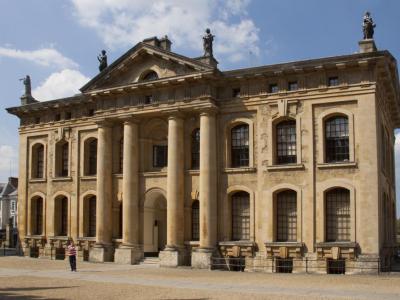
Walking Tours in Oxford, England

Create Your Own Walk in Oxford
Creating your own self-guided walk in Oxford is easy and fun. Choose the city attractions that you want to see and a walk route map will be created just for you. You can even set your hotel as the start point of the walk.

Harry Potter Walk in Oxford
Oxford’s connection with Harry Potter rests on a simple fact: the city already looked like Hogwarts before the cameras arrived. Long before it became associated with wands, robes, and moving staircases, Oxford was known for its medieval colleges, vaulted halls, cloisters, libraries, and enclosed quadrangles. For the filmmakers, it offered a real academic setting that needed little alteration to... view more
Tour Duration: 1 Hour(s)
Travel Distance: 1.0 Km or 0.6 Miles
Tour Duration: 1 Hour(s)
Travel Distance: 1.0 Km or 0.6 Miles
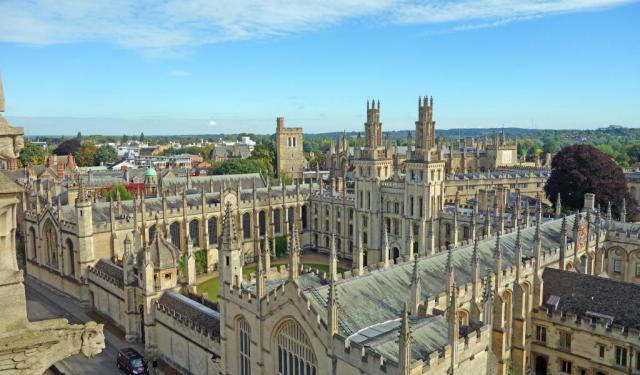
Oxford Downtown Walking Tour
Writer Oscar Wilde, who studied at Magdalen College, Oxford, once remarked that Oxford gave him “the most wonderful years” of his youth.
The city of Oxford has one of the longest and most layered histories in England. Its name comes from the Old English Oxenaforda, meaning “ford of the oxen,” referring to a shallow river crossing where cattle could pass through the water. This crossing... view more
Tour Duration: 2 Hour(s)
Travel Distance: 3.5 Km or 2.2 Miles
The city of Oxford has one of the longest and most layered histories in England. Its name comes from the Old English Oxenaforda, meaning “ford of the oxen,” referring to a shallow river crossing where cattle could pass through the water. This crossing... view more
Tour Duration: 2 Hour(s)
Travel Distance: 3.5 Km or 2.2 Miles
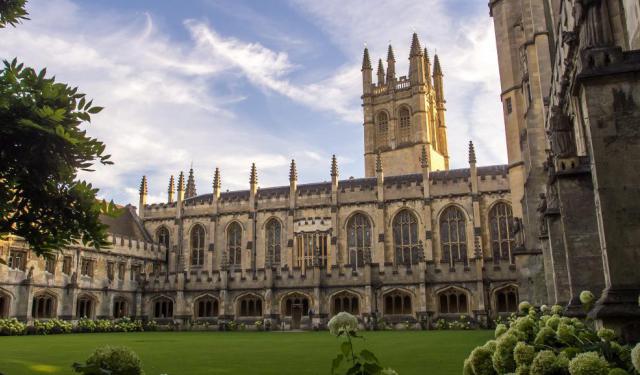
Colleges of Oxford University
During an 1862 summer boat ride along the River Thames, Oxford writer Lewis Carroll invented a fantastical story for Alice, the daughter of the dean of Christ Church, Oxford. That tale would later become Alice's Adventures in Wonderland.
Oxford’s colleges are the heart of the city’s identity, forming one of the oldest and most influential university communities in the world. Their... view more
Tour Duration: 1 Hour(s)
Travel Distance: 1.5 Km or 0.9 Miles
Oxford’s colleges are the heart of the city’s identity, forming one of the oldest and most influential university communities in the world. Their... view more
Tour Duration: 1 Hour(s)
Travel Distance: 1.5 Km or 0.9 Miles