

Radovan's Portal, Trogir
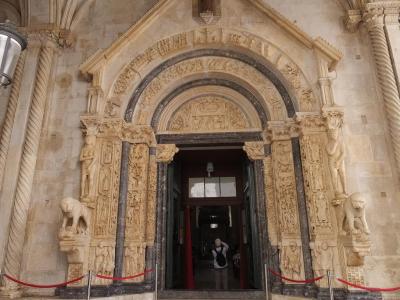
Radovan's portal, serving as the main entrance to the Cathedral of St. Lawrence in Trogir, is recognized as the most significant medieval portal on the eastern Adriatic and one of the finest in Europe. Crafted by Master Radovan, who began his work in 1240 and signed it with "per Raduanum," the portal wasn't fully completed until the 14th century.
It stands as the most monumental example of Romanesque-Gothic architecture in Croatia. This intricate masterpiece features scenes from the First Sin (Adam and Eve) and Redemption (the Nativity), a Christological cycle, various saints and apostles, monthly depictions, hunting scenes, and a blend of Southern Italian and French stylistic influences. Artistically, it is considered among the top European works of its time.
The portal is recessed into the wall, creating a layered effect. Unlike the typical Last Judgment scene found in Western cathedrals, the lunette above the entrance displays the Nativity, representing the promise of salvation. Above the lunette, two arches feature scenes from biblical stories. The most finely crafted elements are attributed directly to Master Radovan, with his workshop finishing the remaining parts. The sculptures on the portal reflect Gothic realism and humanism while maintaining aspects of the earlier Romanesque style.
On either side of the doorway, pillars are decorated with hunting scenes intertwined with plant motifs, giving the impression of a forest environment. The jambs of the portal are intricately carved with zodiac signs and the labors of the months, depicting everyday life with remarkable detail. Flanking the entrance, Adam stands on the right and Eve on the left, both positioned atop lions.
It stands as the most monumental example of Romanesque-Gothic architecture in Croatia. This intricate masterpiece features scenes from the First Sin (Adam and Eve) and Redemption (the Nativity), a Christological cycle, various saints and apostles, monthly depictions, hunting scenes, and a blend of Southern Italian and French stylistic influences. Artistically, it is considered among the top European works of its time.
The portal is recessed into the wall, creating a layered effect. Unlike the typical Last Judgment scene found in Western cathedrals, the lunette above the entrance displays the Nativity, representing the promise of salvation. Above the lunette, two arches feature scenes from biblical stories. The most finely crafted elements are attributed directly to Master Radovan, with his workshop finishing the remaining parts. The sculptures on the portal reflect Gothic realism and humanism while maintaining aspects of the earlier Romanesque style.
On either side of the doorway, pillars are decorated with hunting scenes intertwined with plant motifs, giving the impression of a forest environment. The jambs of the portal are intricately carved with zodiac signs and the labors of the months, depicting everyday life with remarkable detail. Flanking the entrance, Adam stands on the right and Eve on the left, both positioned atop lions.
Want to visit this sight? Check out these Self-Guided Walking Tours in Trogir. Alternatively, you can download the mobile app "GPSmyCity: Walks in 1K+ Cities" from Apple App Store or Google Play Store. The app turns your mobile device to a personal tour guide and it works offline, so no data plan is needed when traveling abroad.
Download The GPSmyCity App



Radovan's Portal on Map
Sight Name: Radovan's Portal
Sight Location: Trogir, Croatia (See walking tours in Trogir)
Sight Type: Attraction/Landmark
Sight Location: Trogir, Croatia (See walking tours in Trogir)
Sight Type: Attraction/Landmark
Nearby Sights
Walking Tours in Trogir, Croatia

Create Your Own Walk in Trogir
Creating your own self-guided walk in Trogir is easy and fun. Choose the city attractions that you want to see and a walk route map will be created just for you. You can even set your hotel as the start point of the walk.
Trogir Introduction Walking Tour
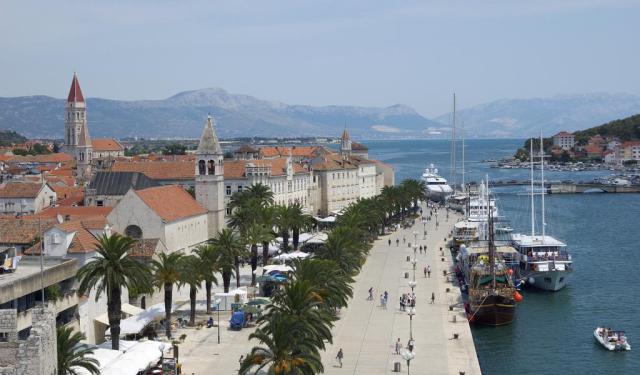
Trogir, a charming small town on the scenic Dalmatian coast of Croatia, boasts 2300 years of continuous urban tradition. Established in the 3rd century BC, throughout its history the town has been influenced by the ancient Greeks, Romans, and Venetians, to mention but a few.
Originally known as Tragurion, its name is derived from the Greek words "tragos" (male goat) and... view more
Tour Duration: 1 Hour(s)
Travel Distance: 0.8 Km or 0.5 Miles
Originally known as Tragurion, its name is derived from the Greek words "tragos" (male goat) and... view more
Tour Duration: 1 Hour(s)
Travel Distance: 0.8 Km or 0.5 Miles