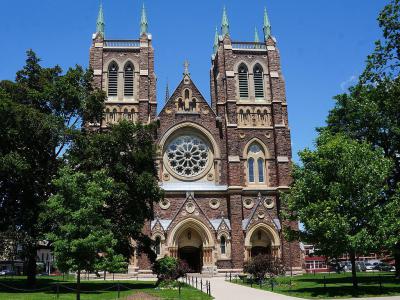


Saint Peter's Cathedral Basilica, London (must see)
Saint Peter’s Cathedral Basilica serves as the seat (cathedra) of the Roman Catholic Diocese and has shaped religious life since the 19th century. The Catholic community was established in 1834, and an early church dedicated to St. Lawrence was destroyed by fire in 1845. The Diocese of London was created in 1856, leading to the church’s role as a cathedral. The present structure was built between 1880 and 1885 and dedicated on June 28, 1885. It was designated a minor basilica in 1961 by Pope John XXIII.
The building was designed by architect Joseph Connolly in a 13th-century French Gothic Revival style. Its limestone exterior is defined by pointed arches, tall windows, and a strong vertical structure. Twin towers frame the main entrance; although included in the original design, they remained incomplete for decades and were finished in 1957-1958.
Inside, the plan follows a long central nave leading to the altar and chancel. Stained glass windows, first installed in 1889 and expanded through the early 20th century, depict scenes from scripture and church tradition. A Casavant pipe organ, installed in 1926, supports both services and concerts. In 1968, following the Second Vatican Council, the interior was adapted with a marble altar replacing the earlier high altar and communion rails.
The basilica continues to function as an active place of worship and a site of public interest. It hosts regular services, major diocesan ceremonies, and seasonal observances. Visitors can enter outside service times to observe the architectural details, examine the stained glass, or attend musical events that make use of the building’s acoustics.
The building was designed by architect Joseph Connolly in a 13th-century French Gothic Revival style. Its limestone exterior is defined by pointed arches, tall windows, and a strong vertical structure. Twin towers frame the main entrance; although included in the original design, they remained incomplete for decades and were finished in 1957-1958.
Inside, the plan follows a long central nave leading to the altar and chancel. Stained glass windows, first installed in 1889 and expanded through the early 20th century, depict scenes from scripture and church tradition. A Casavant pipe organ, installed in 1926, supports both services and concerts. In 1968, following the Second Vatican Council, the interior was adapted with a marble altar replacing the earlier high altar and communion rails.
The basilica continues to function as an active place of worship and a site of public interest. It hosts regular services, major diocesan ceremonies, and seasonal observances. Visitors can enter outside service times to observe the architectural details, examine the stained glass, or attend musical events that make use of the building’s acoustics.
Want to visit this sight? Check out these Self-Guided Walking Tours in London. Alternatively, you can download the mobile app "GPSmyCity: Walks in 1K+ Cities" from Apple App Store or Google Play Store. The app turns your mobile device to a personal tour guide and it works offline, so no data plan is needed when traveling abroad.
Download The GPSmyCity App



Saint Peter's Cathedral Basilica on Map
Sight Name: Saint Peter's Cathedral Basilica
Sight Location: London, Canada (See walking tours in London)
Sight Type: Religious
Guide(s) Containing This Sight:
Sight Location: London, Canada (See walking tours in London)
Sight Type: Religious
Guide(s) Containing This Sight:
Nearby Sights


Walking Tours in London, Ontario

Create Your Own Walk in London
Creating your own self-guided walk in London is easy and fun. Choose the city attractions that you want to see and a walk route map will be created just for you. You can even set your hotel as the start point of the walk.

London Ontario Downtown Walking Tour
Similarly to its English “big brother”, Canadian London has its own St. Paul's Cathedral and Thames River. The city centre features an abundance of lush parks and greenways, including the prominent Victoria Park. Topping the list of the local museums is the Museum London, showcasing regional art and historical artifacts, while the Banting House is recognized worldwide as “The Birthplace... view more
Tour Duration: 2 Hours
Travel Distance: 3.3 Km or 2.1 Miles
Tour Duration: 2 Hours
Travel Distance: 3.3 Km or 2.1 Miles