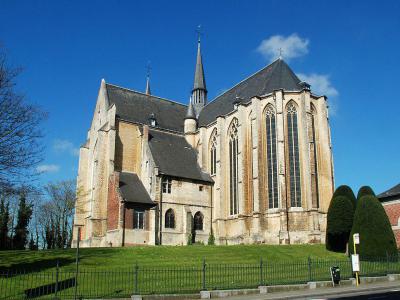


Saint Quentin’s Church, Leuven
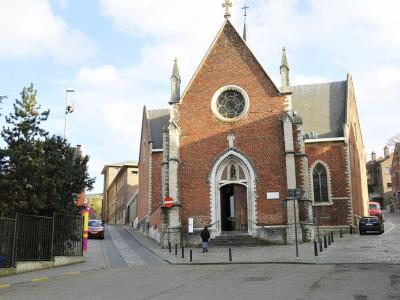
Saint Quentin’s Church, a Roman Catholic church located on Naamsestraat in Leuven, is a remarkable blend of Gothic and Baroque architectural styles. Dedicated to Saint Quentin, a patron invoked against contagious diseases, the church has a rich history as both a parish and a pilgrimage site. Its origins date back to 1222, with its designation as an independent parish in 1252. The church played a vital role in the 16th century as a center of devotion during outbreaks of plague and other illnesses.
The building's Gothic exterior features a cruciform plan with a west tower, a three-aisled nave, and a polygonal choir. Elements of the original 13th-century structure, such as the lower sections of the west tower and adjacent aisles, remain intact. The Baroque entrance portal, added in 1641, adds to its distinctive aesthetic. The materials used in its construction include Ledian limestone, Gobertange limestone, and iron sandstone, while the roof is slate-covered.
Inside, the church showcases exquisite Baroque furnishings, including choir stalls and altars adorned with sculptures by Antwerp artist Jan van Ussel. Highlights include murals from the early 15th century depicting Saint Quentin's legend, a Renaissance-style Last Supper by Leuven city painter Jan Willems (1521), and a series of other religious paintings by artists such as Gaspar de Crayer, Pieter-Jozef Verhaghen, and Artus Wolffort. The church also houses statues of Saint Quentin and the Virgin and Child attributed to Artus Quellinus the Elder.
The southern and northern cross-arms, known as Saint Quentin’s Choir and Our Lady’s Choir, respectively, feature notable Baroque altars. These include paintings such as The Torture of Saint Quentin by Pieter-Jozef Verhaghen and Saint Anna with Plague Saints by Gaspar de Crayer. The altars also contain 17th-century tabernacles from the monastery of the Discalced Carmelites.
The organ, crafted in 1786 by Aegidius-Franciscus Van Peteghem, was relocated to the church during the French occupation. Neo-Gothic stained glass windows, designed by M. Mertens and restored in the 1990s, depict various saints, while modern glasswork by Michel Martens adorns the choir.
Saint Quentin’s Church has undergone numerous restorations, most notably between 1895 and 1914 under architect Pierre Langerock and later in the 20th century. Today, it stands as a testament to Leuven's architectural and religious heritage.
The building's Gothic exterior features a cruciform plan with a west tower, a three-aisled nave, and a polygonal choir. Elements of the original 13th-century structure, such as the lower sections of the west tower and adjacent aisles, remain intact. The Baroque entrance portal, added in 1641, adds to its distinctive aesthetic. The materials used in its construction include Ledian limestone, Gobertange limestone, and iron sandstone, while the roof is slate-covered.
Inside, the church showcases exquisite Baroque furnishings, including choir stalls and altars adorned with sculptures by Antwerp artist Jan van Ussel. Highlights include murals from the early 15th century depicting Saint Quentin's legend, a Renaissance-style Last Supper by Leuven city painter Jan Willems (1521), and a series of other religious paintings by artists such as Gaspar de Crayer, Pieter-Jozef Verhaghen, and Artus Wolffort. The church also houses statues of Saint Quentin and the Virgin and Child attributed to Artus Quellinus the Elder.
The southern and northern cross-arms, known as Saint Quentin’s Choir and Our Lady’s Choir, respectively, feature notable Baroque altars. These include paintings such as The Torture of Saint Quentin by Pieter-Jozef Verhaghen and Saint Anna with Plague Saints by Gaspar de Crayer. The altars also contain 17th-century tabernacles from the monastery of the Discalced Carmelites.
The organ, crafted in 1786 by Aegidius-Franciscus Van Peteghem, was relocated to the church during the French occupation. Neo-Gothic stained glass windows, designed by M. Mertens and restored in the 1990s, depict various saints, while modern glasswork by Michel Martens adorns the choir.
Saint Quentin’s Church has undergone numerous restorations, most notably between 1895 and 1914 under architect Pierre Langerock and later in the 20th century. Today, it stands as a testament to Leuven's architectural and religious heritage.
Want to visit this sight? Check out these Self-Guided Walking Tours in Leuven. Alternatively, you can download the mobile app "GPSmyCity: Walks in 1K+ Cities" from Apple App Store or Google Play Store. The app turns your mobile device to a personal tour guide and it works offline, so no data plan is needed when traveling abroad.
Download The GPSmyCity App



Saint Quentin’s Church on Map
Sight Name: Saint Quentin’s Church
Sight Location: Leuven, Belgium (See walking tours in Leuven)
Sight Type: Religious
Sight Location: Leuven, Belgium (See walking tours in Leuven)
Sight Type: Religious
Nearby Sights
Walking Tours in Leuven, Belgium

Create Your Own Walk in Leuven
Creating your own self-guided walk in Leuven is easy and fun. Choose the city attractions that you want to see and a walk route map will be created just for you. You can even set your hotel as the start point of the walk.
Discover Leuven's Monuments and Statues on Foot
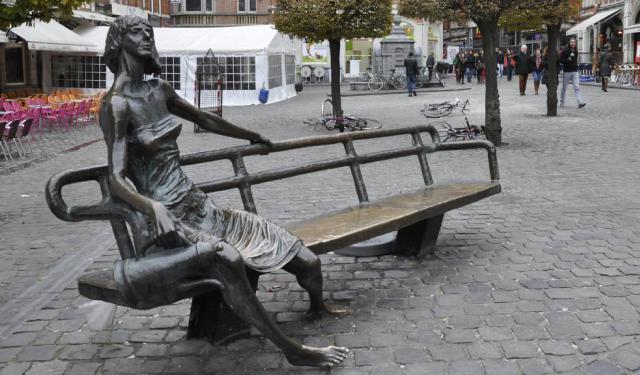
Leuven, Belgium is a city steeped in history and culture, embellished with an assortment of monuments and statues that mirror its abundant heritage. Ranging from age-old landmarks to contemporary sculptures, each of them narrates a tale and contributes to the city's distinct allure. Whether paying tribute to historical luminaries, commemorating artistic triumphs, or simply enhancing the... view more
Tour Duration: 2 Hour(s)
Travel Distance: 2.4 Km or 1.5 Miles
Tour Duration: 2 Hour(s)
Travel Distance: 2.4 Km or 1.5 Miles
Walking Through Leuven's Historic City Center
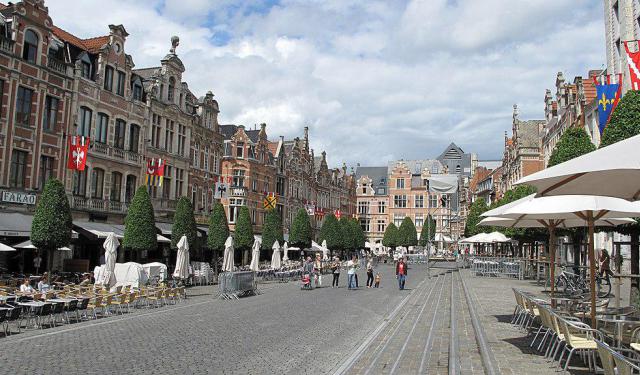
Nestled in the heart of Belgium, the picturesque town of Leuven has no shortage of historic and cultural attractions. Its name is thought to originate from the Old Germanic word "Loven," meaning “to love or praise”, an explanation of which may be found in the Leuven slogan, “Always praise God.”
Leuven's roots date back to 891 when it was first mentioned after a Viking... view more
Tour Duration: 1 Hour(s)
Travel Distance: 1.6 Km or 1 Miles
Leuven's roots date back to 891 when it was first mentioned after a Viking... view more
Tour Duration: 1 Hour(s)
Travel Distance: 1.6 Km or 1 Miles