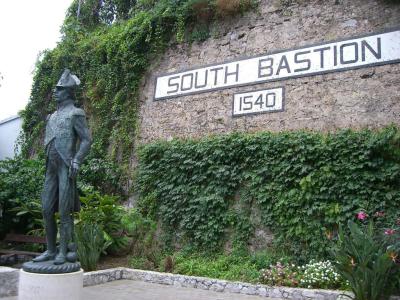


South Bastion, Gibraltar
The South Bastion, constructed circa 1540 under the reign of Philip II of Spain, was part of the original fortifications that guarded the entrance to Gibraltar’s town from the Bay of Gibraltar. Strategically positioned at the western base of the Charles V Wall, this bastion formed a critical lynchpin in the city's defenses. The wall protected the southern limits of the town and stretched upward along the steep slopes of the Rock.
Designed under influence from Italian military engineers like Giovanni Battista Calvi and Giacomo Fratino, the bastion was built upon early Spanish blueprints and enhanced over the following centuries. By 1627, it was known as the “Bastion of Our Lady of the Rosary”. Its thick parapets-over 18 feet thick on the sea-facing side-were built to withstand naval bombardment, and its walls remained a cornerstone of Gibraltar’s defenses.
Over time, British engineers further reinforced the bastion-most notably in 1757, when Lord Tyrawley strengthened its southern flank. In 1870, it was again rebuilt to house powerful 10-inch Rifled Muzzle Loading guns within iron-shielded casemates.
Today, the South Bastion balances maritime heritage with modern life-it houses the Gibraltar College atop its historic ramparts. At its base stands a statue of Admiral Lord Nelson, unveiled in memory of his famous victory-and death-at the Battle of Trafalgar. The sculpture was created by John Doubleday and adds both commemorative weight and visual appeal.
Designed under influence from Italian military engineers like Giovanni Battista Calvi and Giacomo Fratino, the bastion was built upon early Spanish blueprints and enhanced over the following centuries. By 1627, it was known as the “Bastion of Our Lady of the Rosary”. Its thick parapets-over 18 feet thick on the sea-facing side-were built to withstand naval bombardment, and its walls remained a cornerstone of Gibraltar’s defenses.
Over time, British engineers further reinforced the bastion-most notably in 1757, when Lord Tyrawley strengthened its southern flank. In 1870, it was again rebuilt to house powerful 10-inch Rifled Muzzle Loading guns within iron-shielded casemates.
Today, the South Bastion balances maritime heritage with modern life-it houses the Gibraltar College atop its historic ramparts. At its base stands a statue of Admiral Lord Nelson, unveiled in memory of his famous victory-and death-at the Battle of Trafalgar. The sculpture was created by John Doubleday and adds both commemorative weight and visual appeal.
Want to visit this sight? Check out these Self-Guided Walking Tours in Gibraltar. Alternatively, you can download the mobile app "GPSmyCity: Walks in 1K+ Cities" from Apple App Store or Google Play Store. The app turns your mobile device to a personal tour guide and it works offline, so no data plan is needed when traveling abroad.
Download The GPSmyCity App



South Bastion on Map
Sight Name: South Bastion
Sight Location: Gibraltar, Gibraltar (See walking tours in Gibraltar)
Sight Type: Attraction/Landmark
Sight Location: Gibraltar, Gibraltar (See walking tours in Gibraltar)
Sight Type: Attraction/Landmark
Nearby Sights





Walking Tours in Gibraltar, Gibraltar

Create Your Own Walk in Gibraltar
Creating your own self-guided walk in Gibraltar is easy and fun. Choose the city attractions that you want to see and a walk route map will be created just for you. You can even set your hotel as the start point of the walk.
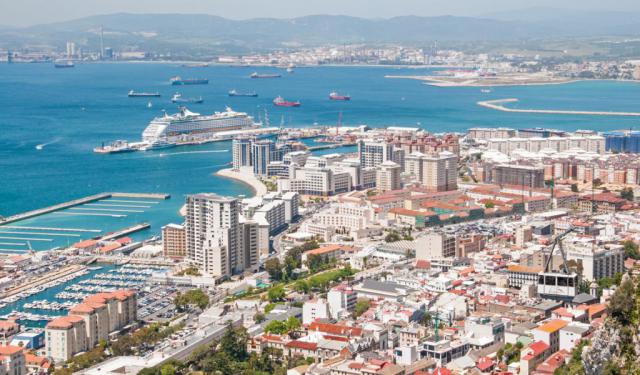
Gibraltar Introduction Walking Tour
“Burn your boats,” ordered the Berber commander Tariq ibn Ziyad as his troops trembled before the towering Rock of Gibraltar in 711 AD. Having just crossed from North Africa with a small army to confront the Visigothic Kingdom, Tariq destroyed his ships to eliminate the option of retreat. With no way back, his men fought with determination and went on to conquer most of the Iberian Peninsula.... view more
Tour Duration: 1 Hour(s)
Travel Distance: 1.9 Km or 1.2 Miles
Tour Duration: 1 Hour(s)
Travel Distance: 1.9 Km or 1.2 Miles
Rock of Gibraltar Walking Tour
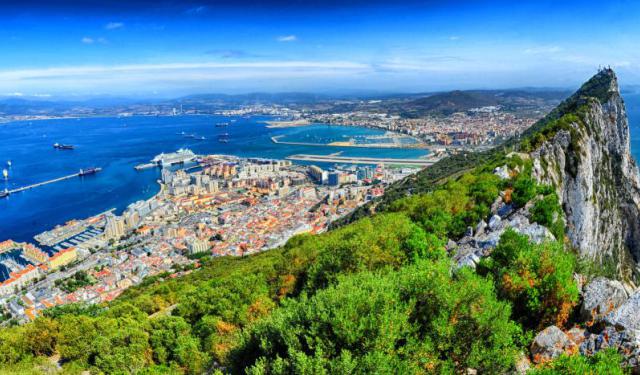
You really can’t avoid the Rock of Gibraltar when visiting the British Overseas Territory on the southern tip of the Iberian Peninsula. Just like the streets lined with British-style red phone booths and historical buildings, this prominent limestone rock formation, overlooking the Strait of Gibraltar from an elevation of 426 meters (1,398 feet) above sea level, creates a distinctive atmosphere... view more
Tour Duration: 2 Hour(s)
Travel Distance: 4.5 Km or 2.8 Miles
Tour Duration: 2 Hour(s)
Travel Distance: 4.5 Km or 2.8 Miles