
Statua di Hasekura Tsunenaga (Statue of Hasekura Tsunenaga), Civitavecchia
Hasekura Tsunenaga (1571 - 7 August 1622) was an important Japanese samurai in the service of Date Masamune, daimyo of Sendai, famous for having conducted numerous embassies that took him around the world. In 1615, during a mission to meet Pope Paul V in Rome, the ambassador landed at the Port of Civitavecchia, where he remained for about two weeks during which he formed a beautiful and profound friendship with the citizens, which is why Civitavecchia is still today twinned with the Japanese city of Ishinomaki. From this port city begins the extraordinary journey of the samurai which we are about to tell you in the words of Roberta Galletta, historian of Civitavecchia and author of the book " La Darsena Romana - Il marina di Civitavecchia". Hasekura Rokuemon Tsunenaga, on 18 October 1615 landed in Civitavecchia, at the time the port of the Papal State, after a long journey that began on 28 October 1613 from the port of Ishinomaki. Two very long years of navigation during which the samurai crossed two oceans, the Pacific and the Atlantic, with the aim of meeting Pope Paul V in Rome. The samurai, born in Japan in 1571, had already led an embassy in Mexico before undertaking this long and important diplomatic action in Europe (1615-1620), which began with his landing in Civitavecchia. Accompanied by the Spanish Father Sotelo and 15 other delegates, Tsunenaga was warmly welcomed by the authorities and citizens of Civitavecchia, before leaving again, after a two-week stay in the city, for Rome. This voyage represents the only diplomatic and political response, during the years of the great navigations, of East Asia to the West. On November 3, the Japanese delegation is finally received by the Pope in the Vatican to bring the message of Date Masamune, who asks Paul V, in a precious letter decorated with gold delivered to the pontiff by Hasekura in person, to open a commercial treaty between Japan and Mexico and sending Christian missionaries to his kingdom. The Pope agrees to send the missionaries, but leaves the decision on the commercial treaty to the King of Spain, the economic question being too thorny in those years of great commercial expansion. Proof of the collaboration is reported in a letter that Paul V wrote to Date Masamune, a copy preserved in the Vatican. The Japanese, the first Orientals to officially enter the city symbol of Christianity, remained in Rome until 4 January 1616, when they left to return to Japan, also bringing a part of Civitavecchia and its port to their land. The importance of this episode is highlighted by the twinning of Civitavecchia with the city of Ishinomaki in 1971, in honor of the ancient friendship that binds the two port cities, so distant yet so close. A statue dedicated to the samurai Hasekura Tsunenaga is located in Viale Guglielmo Marconi near Porta Livorno, a monumental gateway that connects the city with its port. The journey is also an opportunity to mend that relationship between two different and distant worlds which was born so difficult in 1549 and culminated in the tragedy of the 26 Japanese martyrs killed in 1597.
If you pass through Civitavecchia, in Viale Guglielmo Marconi near Porta Livorno, towards the port, you will find a statue depicting a samurai.
If you are preparing to enter from the Livorno gate, the main access point to the city of Civitavecchia arriving by sea, you will find a statue of a Japanese man. What links the port on the Lazio coast with Japan? A king, a mayor, a city hero? None of this, even if his undertaking has epic characteristics for the times in which it occurred. This is the statue of the samurai Hasekura Tsunenaga (1571-1622), a 17th century Japanese diplomat in the service of Date Masamune, daimyo of Sendai. In 1615 he arrived in Italy, landing in Civitavecchia after 2 years of travel. He came from Japan to meet Pope Paul V. He stayed in the port city for two weeks, arousing amazement and making friends with the population. Since 1971 Civitavecchia has been twinned with the Japanese city of Ishinomaki from which the Japanese samurai left in 1613. Since 1991 his statue has welcomed passers-by in Corso Marconi, right near Porta Livorno. ***PH***
If you pass through Civitavecchia, in Viale Guglielmo Marconi near Porta Livorno, towards the port, you will find a statue depicting a samurai.
If you are preparing to enter from the Livorno gate, the main access point to the city of Civitavecchia arriving by sea, you will find a statue of a Japanese man. What links the port on the Lazio coast with Japan? A king, a mayor, a city hero? None of this, even if his undertaking has epic characteristics for the times in which it occurred. This is the statue of the samurai Hasekura Tsunenaga (1571-1622), a 17th century Japanese diplomat in the service of Date Masamune, daimyo of Sendai. In 1615 he arrived in Italy, landing in Civitavecchia after 2 years of travel. He came from Japan to meet Pope Paul V. He stayed in the port city for two weeks, arousing amazement and making friends with the population. Since 1971 Civitavecchia has been twinned with the Japanese city of Ishinomaki from which the Japanese samurai left in 1613. Since 1991 his statue has welcomed passers-by in Corso Marconi, right near Porta Livorno. ***PH***
Statua di Hasekura Tsunenaga (Statue of Hasekura Tsunenaga) on Map
Sight Name: Statua di Hasekura Tsunenaga (Statue of Hasekura Tsunenaga)
Sight Location: Civitavecchia, Italy (See walking tours in Civitavecchia)
Sight Type: Statue/Public Art
Sight Location: Civitavecchia, Italy (See walking tours in Civitavecchia)
Sight Type: Statue/Public Art
Nearby Sights


Walking Tours in Civitavecchia, Italy

Create Your Own Walk in Civitavecchia
Creating your own self-guided walk in Civitavecchia is easy and fun. Choose the city attractions that you want to see and a walk route map will be created just for you. You can even set your hotel as the start point of the walk.
Civitavecchia Introduction Walking Tour
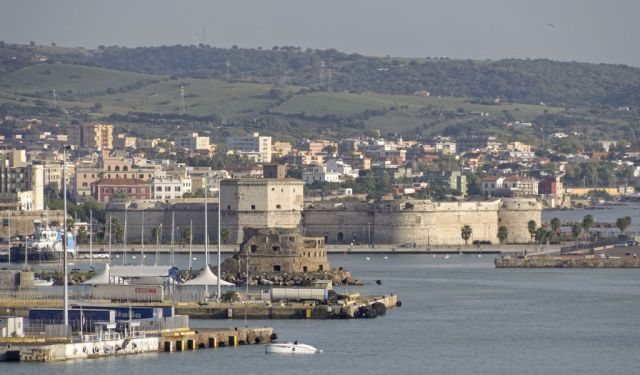
Civitavecchia, meaning "ancient town," is a major port on the Tyrrhenian Sea that historically served as Rome’s maritime gateway. Founded by the Etruscans, it was later developed by Roman Emperor Trajan in the 2nd century and was originally known as Centum Cellae or “Hundred Cells.” The latter name was probably due to the many vaulted "cells" forming the harbor wall, some... view more
Tour Duration: 2 Hours
Travel Distance: 2.2 Km or 1.4 Miles
Tour Duration: 2 Hours
Travel Distance: 2.2 Km or 1.4 Miles