

Trinity College, Oxford (must see)
Trinity College was founded in 1555 by Sir Thomas Pope during the reign of Queen Mary I, though the site has a much older academic history. Oxford’s earliest centres of learning grew from monastery buildings where theology formed the core of study. Trinity now occupies the grounds of Durham College, a monastic institution established in 1268 to educate Benedictine monks.
After the Dissolution of the Monasteries under Henry VIII, the property changed hands before Pope purchased the land and existing buildings to create a new college. Having no children, he hoped his foundation would preserve his memory through the prayers of future generations. His tomb still lies inside the college chapel, beside the altar.
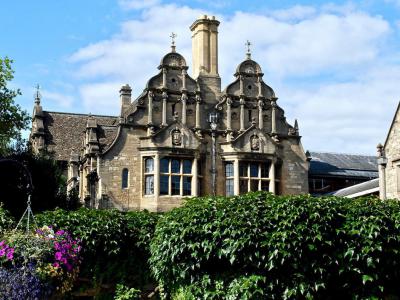
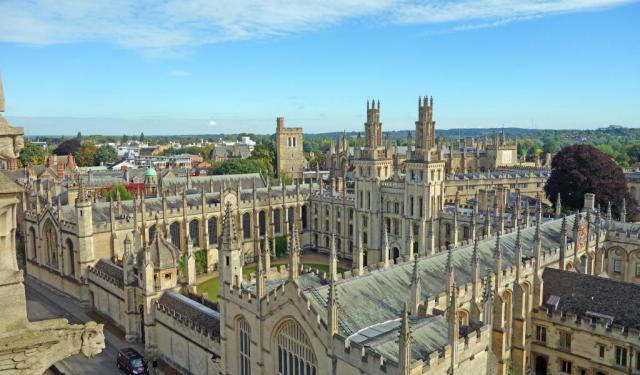
The oldest surviving part of the medieval monastery is the eastern side of Durham Quad, which today houses the college library. Over the centuries, Trinity expanded while preserving a calm and balanced architectural character. The West Tower is decorated with statues representing Astronomy, Geometry, Medicine, and Music. In 1688, a two-storey building designed by Christopher Wren was added to Garden Quad to provide student accommodation, while the neoclassical chapel, designed by Henry Aldrich, followed in 1694.
Set just off Broad Street, Trinity feels quieter than many neighbouring colleges. Visitors enter a sequence of lawns, quadrangles, and gardens that create a sense of separation from Oxford’s busy streets. The main quad is framed by harmonious classical buildings rather than dramatic Gothic façades, giving the college a refined and understated appearance. Behind the main buildings lies an unusually spacious garden with long lawns, mature trees, and seasonal flowerbeds that become especially attractive in spring and summer.
Although Trinity occupies a sizeable footprint, it maintains a relatively small student population of around 400. Originally founded as a men’s college, it became coeducational in 1979. Among its notable alumni are three British prime ministers.
After the Dissolution of the Monasteries under Henry VIII, the property changed hands before Pope purchased the land and existing buildings to create a new college. Having no children, he hoped his foundation would preserve his memory through the prayers of future generations. His tomb still lies inside the college chapel, beside the altar.
The oldest surviving part of the medieval monastery is the eastern side of Durham Quad, which today houses the college library. Over the centuries, Trinity expanded while preserving a calm and balanced architectural character. The West Tower is decorated with statues representing Astronomy, Geometry, Medicine, and Music. In 1688, a two-storey building designed by Christopher Wren was added to Garden Quad to provide student accommodation, while the neoclassical chapel, designed by Henry Aldrich, followed in 1694.
Set just off Broad Street, Trinity feels quieter than many neighbouring colleges. Visitors enter a sequence of lawns, quadrangles, and gardens that create a sense of separation from Oxford’s busy streets. The main quad is framed by harmonious classical buildings rather than dramatic Gothic façades, giving the college a refined and understated appearance. Behind the main buildings lies an unusually spacious garden with long lawns, mature trees, and seasonal flowerbeds that become especially attractive in spring and summer.
Although Trinity occupies a sizeable footprint, it maintains a relatively small student population of around 400. Originally founded as a men’s college, it became coeducational in 1979. Among its notable alumni are three British prime ministers.
Want to visit this sight? Check out these Self-Guided Walking Tours in Oxford. Alternatively, you can download the mobile app "GPSmyCity: Walks in 1K+ Cities" from Apple App Store or Google Play Store. The app turns your mobile device to a personal tour guide and it works offline, so no data plan is needed when traveling abroad.
Download The GPSmyCity App



Trinity College on Map
Sight Name: Trinity College
Sight Location: Oxford, England (See walking tours in Oxford)
Sight Type: Attraction/Landmark
Guide(s) Containing This Sight:
Sight Location: Oxford, England (See walking tours in Oxford)
Sight Type: Attraction/Landmark
Guide(s) Containing This Sight:
Nearby Sights


Walking Tours in Oxford, England

Create Your Own Walk in Oxford
Creating your own self-guided walk in Oxford is easy and fun. Choose the city attractions that you want to see and a walk route map will be created just for you. You can even set your hotel as the start point of the walk.
Colleges of Oxford University
During an 1862 summer boat ride along the River Thames, Oxford writer Lewis Carroll invented a fantastical story for Alice, the daughter of the dean of Christ Church, Oxford. That tale would later become Alice's Adventures in Wonderland.
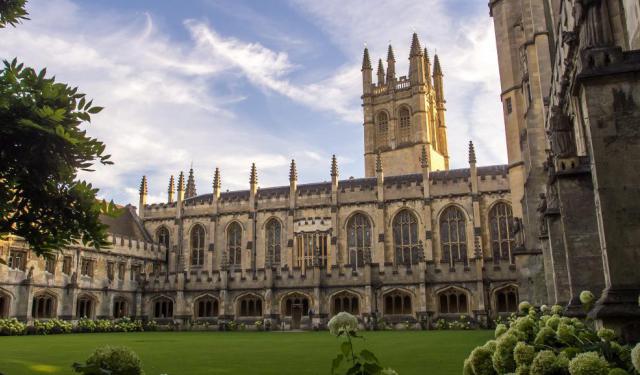
Oxford’s colleges are the heart of the city’s identity, forming one of the oldest and most influential university communities in the world. Their... view more
Tour Duration: 1 Hour(s)
Travel Distance: 1.5 Km or 0.9 Miles
Oxford’s colleges are the heart of the city’s identity, forming one of the oldest and most influential university communities in the world. Their... view more
Tour Duration: 1 Hour(s)
Travel Distance: 1.5 Km or 0.9 Miles
Oxford Downtown Walking Tour
Writer Oscar Wilde, who studied at Magdalen College, Oxford, once remarked that Oxford gave him “the most wonderful years” of his youth.
The city of Oxford has one of the longest and most layered histories in England. Its name comes from the Old English Oxenaforda, meaning “ford of the oxen,” referring to a shallow river crossing where cattle could pass through the water. This crossing... view more
Tour Duration: 2 Hour(s)
Travel Distance: 3.5 Km or 2.2 Miles
The city of Oxford has one of the longest and most layered histories in England. Its name comes from the Old English Oxenaforda, meaning “ford of the oxen,” referring to a shallow river crossing where cattle could pass through the water. This crossing... view more
Tour Duration: 2 Hour(s)
Travel Distance: 3.5 Km or 2.2 Miles

Harry Potter Walk in Oxford
Oxford’s connection with Harry Potter rests on a simple fact: the city already looked like Hogwarts before the cameras arrived. Long before it became associated with wands, robes, and moving staircases, Oxford was known for its medieval colleges, vaulted halls, cloisters, libraries, and enclosed quadrangles. For the filmmakers, it offered a real academic setting that needed little alteration to... view more
Tour Duration: 1 Hour(s)
Travel Distance: 1.0 Km or 0.6 Miles
Tour Duration: 1 Hour(s)
Travel Distance: 1.0 Km or 0.6 Miles