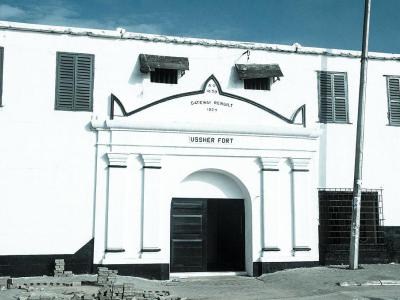
Ussher Fort, Accra
Ussher Fort, originally built by the Dutch in 1649 as Fort Crèvecœur, stands as a significant historical landmark in Accra. Situated east of Accra on a rocky promontory between two lagoons, it is part of the region’s complex colonial history. The fort was among three constructed by Europeans in the 17th century, marking the early days of European trade and exploitation along the Gold Coast.
Fort Crèvecœur was established by the Dutch West India Company, evolving from a modest factory built in 1642 to a fortified structure in 1649. The fort was named after a similarly named Dutch stronghold in ’s-Hertogenbosch, which had played a strategic role in the Siege of 's-Hertogenbosch. Its construction was facilitated by Dutch representative Henry Caerlof, who secured support from the Dey of Fetu. Though it was less imposing than other forts like Elmina or Cape Coast Castle, Fort Crèvecœur contributed significantly to Dutch revenues.
During the 18th century, the fort became a focal point in the Anglo-Dutch rivalry. In 1781, Captain Thomas Shirley of the British Royal Navy attacked and captured Fort Crèvecœur along with other Dutch fortifications during the war between Britain and the Dutch Republic. The fort was destroyed in the conflict but was rebuilt in 1839 by Dutch engineer Hubertus Varlet.
In 1868, the Anglo-Dutch Gold Coast Treaty transferred the fort to British control, and it was renamed Ussher Fort in honor of Herbert Taylor Ussher, the then-administrator of the Gold Coast. The fort, along with other colonial structures, was inscribed on the UNESCO World Heritage List in 1979 due to its role in the trans-Atlantic slave trade and European colonial expansion.
Currently undergoing restoration with support from the European Commission and UNESCO, Ussher Fort is being repurposed as a museum and an International Documentation Centre. It stands as a symbol of Ghana's historical narrative, encapsulating the impact of European colonization and the resilience of the region's heritage.
Fort Crèvecœur was established by the Dutch West India Company, evolving from a modest factory built in 1642 to a fortified structure in 1649. The fort was named after a similarly named Dutch stronghold in ’s-Hertogenbosch, which had played a strategic role in the Siege of 's-Hertogenbosch. Its construction was facilitated by Dutch representative Henry Caerlof, who secured support from the Dey of Fetu. Though it was less imposing than other forts like Elmina or Cape Coast Castle, Fort Crèvecœur contributed significantly to Dutch revenues.
During the 18th century, the fort became a focal point in the Anglo-Dutch rivalry. In 1781, Captain Thomas Shirley of the British Royal Navy attacked and captured Fort Crèvecœur along with other Dutch fortifications during the war between Britain and the Dutch Republic. The fort was destroyed in the conflict but was rebuilt in 1839 by Dutch engineer Hubertus Varlet.
In 1868, the Anglo-Dutch Gold Coast Treaty transferred the fort to British control, and it was renamed Ussher Fort in honor of Herbert Taylor Ussher, the then-administrator of the Gold Coast. The fort, along with other colonial structures, was inscribed on the UNESCO World Heritage List in 1979 due to its role in the trans-Atlantic slave trade and European colonial expansion.
Currently undergoing restoration with support from the European Commission and UNESCO, Ussher Fort is being repurposed as a museum and an International Documentation Centre. It stands as a symbol of Ghana's historical narrative, encapsulating the impact of European colonization and the resilience of the region's heritage.
Ussher Fort on Map
Sight Name: Ussher Fort
Sight Location: Accra, Ghana (See walking tours in Accra)
Sight Type: Attraction/Landmark
Sight Location: Accra, Ghana (See walking tours in Accra)
Sight Type: Attraction/Landmark
Nearby Sights
City Walks Overview
