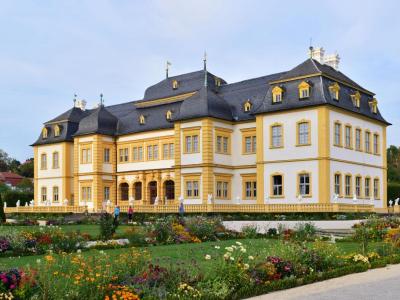


Veitshochheim Schloss (Veitshochheim Castle), Wurzburg
Veitshöchheim Castle was once the summer residence of the Prince-Bishops of Würzburg and later the Kings of Bavaria. The castle is renowned for its surrounding Rococo garden. The earliest part of the castle dates back to 1680-1682, with a hall featuring five arcades from the Prince-Bishops' era preserved on the ground floor. Originally serving as a hunting retreat, the two-story building retains the four bay windows of the older structure. The construction is thought to have involved architect Antonio Petrini and master builder Heinrich Zimmer.
Subsequent additions included two window axes and an upper floor flanked by four corner turrets. In 1753, Balthasar Neumann transformed the castle to its present form by adding side pavilions, a distinctive sweeping roof, and an impressive interior staircase. A balustrade adorned with vases and putti groups by Johann Peter Wagner encircles the entire building. The castle’s floors are all from the Baroque period, and several rooms on the upper floor retain Baroque interiors, including a dining room with gaming tables, a billiards room, a study, a living room, and a bedroom with a retreat, some with later furnishings.
The original stucco work by Antonio Giuseppe Bossi remains in place, and the silk wall coverings have been largely reconstructed in Lyon from original patterns, except for the living room, which still features the original Ikat technique covering. A chapel with a stucco altar showcasing vibrant color transitions by Bossi has also been installed in the stairwell, along with a convertible prayer chair. Original goatskin wallpaper with embossed print and gold ornaments has been preserved in storage to protect it from moisture. A small kitchen intended for food service is also present. Bedrooms on both sides provide access to valet rooms and small balconies that circle the living rooms and lead back to the stairwell.
Subsequent additions included two window axes and an upper floor flanked by four corner turrets. In 1753, Balthasar Neumann transformed the castle to its present form by adding side pavilions, a distinctive sweeping roof, and an impressive interior staircase. A balustrade adorned with vases and putti groups by Johann Peter Wagner encircles the entire building. The castle’s floors are all from the Baroque period, and several rooms on the upper floor retain Baroque interiors, including a dining room with gaming tables, a billiards room, a study, a living room, and a bedroom with a retreat, some with later furnishings.
The original stucco work by Antonio Giuseppe Bossi remains in place, and the silk wall coverings have been largely reconstructed in Lyon from original patterns, except for the living room, which still features the original Ikat technique covering. A chapel with a stucco altar showcasing vibrant color transitions by Bossi has also been installed in the stairwell, along with a convertible prayer chair. Original goatskin wallpaper with embossed print and gold ornaments has been preserved in storage to protect it from moisture. A small kitchen intended for food service is also present. Bedrooms on both sides provide access to valet rooms and small balconies that circle the living rooms and lead back to the stairwell.
Want to visit this sight? Check out these Self-Guided Walking Tours in Wurzburg. Alternatively, you can download the mobile app "GPSmyCity: Walks in 1K+ Cities" from Apple App Store or Google Play Store. The app turns your mobile device to a personal tour guide and it works offline, so no data plan is needed when traveling abroad.
Download The GPSmyCity App



Veitshochheim Schloss (Veitshochheim Castle) on Map
Sight Name: Veitshochheim Schloss (Veitshochheim Castle)
Sight Location: Wurzburg, Germany (See walking tours in Wurzburg)
Sight Type: Attraction/Landmark
Sight Location: Wurzburg, Germany (See walking tours in Wurzburg)
Sight Type: Attraction/Landmark
Nearby Sights

Walking Tours in Wurzburg, Germany

Create Your Own Walk in Wurzburg
Creating your own self-guided walk in Wurzburg is easy and fun. Choose the city attractions that you want to see and a walk route map will be created just for you. You can even set your hotel as the start point of the walk.
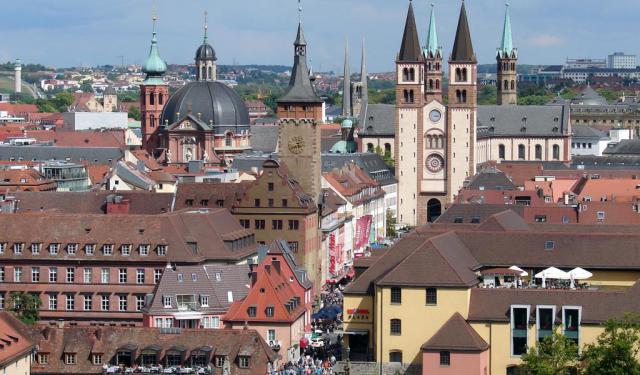
Wurzburg Introduction Walking Tour
The old Franconian episcopal city and university town of Würzburg in the German state of Bavaria boasts a history dating back to the Bronze Age. Originally, the Leistenberg hill presently occupied by Marienberg Fortress was home to a Celtic and later a Roman fort. In the 4th-5th centuries AD, Alamanni settled in the area, followed by the Franks in the 6th-7th centuries.
By 650, Würzburg had... view more
Tour Duration: 2 Hours
Travel Distance: 3 Km or 1.9 Miles
By 650, Würzburg had... view more
Tour Duration: 2 Hours
Travel Distance: 3 Km or 1.9 Miles
City Walks Overview
