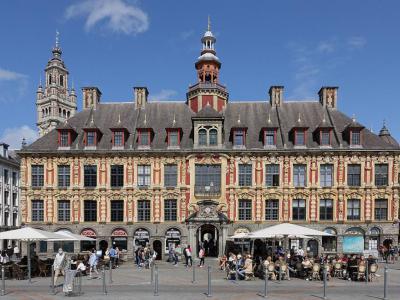


Vieille Bourse (Old Stock Exchange), Lille (must see)
In 1651, the city’s magistrates obtained permission from King Philip IV of Spain to build an exchange where local merchants could conduct business. Julien Destrée a municipal architect, was chosen to bring the project to life, creating a commercial monument inspired partly by the celebrated exchanges of Antwerp and Amsterdam.
The king had authorized the construction of “an exchange for the use of merchants,” surrounded by 24 houses. The city sold 24 plots around the market square to traders, while the municipal authorities financed the galleries, the paving of the courtyard, and the four entrances. Construction proceeded under Destrée’s direction from the spring of 1652 until the autumn of 1653.
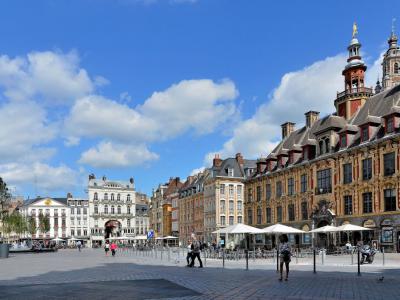
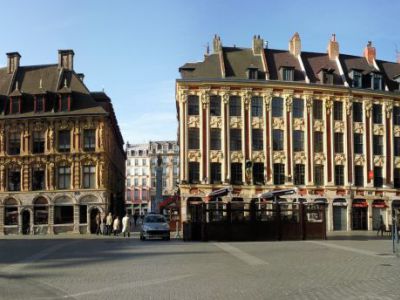
The building is a fine example of 17th-century Flemish Mannerist architecture. Its pilasters, window frames, and columns are richly decorated with garlands of fruit, scrolls, and cornucopias. Above the courtyard rises a small campanile crowned by a gilded figure of Mercury, the Roman god of trade. The elaborate ornamentation reflected Lille’s commercial ambitions at a time when it competed with Flemish cities such as Antwerp, Ghent, and Bruges.
In 1861, a modern securities exchange began operating inside the building. Trading remained limited, however, with only about 3.4 percent of the listed capital changing hands each year. The exchange later moved into the new Chamber of Commerce building, constructed between 1910 and 1921. The older complex consequently became known as the Old Stock Exchange.
The king had authorized the construction of “an exchange for the use of merchants,” surrounded by 24 houses. The city sold 24 plots around the market square to traders, while the municipal authorities financed the galleries, the paving of the courtyard, and the four entrances. Construction proceeded under Destrée’s direction from the spring of 1652 until the autumn of 1653.
The building is a fine example of 17th-century Flemish Mannerist architecture. Its pilasters, window frames, and columns are richly decorated with garlands of fruit, scrolls, and cornucopias. Above the courtyard rises a small campanile crowned by a gilded figure of Mercury, the Roman god of trade. The elaborate ornamentation reflected Lille’s commercial ambitions at a time when it competed with Flemish cities such as Antwerp, Ghent, and Bruges.
In 1861, a modern securities exchange began operating inside the building. Trading remained limited, however, with only about 3.4 percent of the listed capital changing hands each year. The exchange later moved into the new Chamber of Commerce building, constructed between 1910 and 1921. The older complex consequently became known as the Old Stock Exchange.
Want to visit this sight? Check out these Self-Guided Walking Tours in Lille. Alternatively, you can download the mobile app "GPSmyCity: Walks in 1K+ Cities" from Apple App Store or Google Play Store. The app turns your mobile device to a personal tour guide and it works offline, so no data plan is needed when traveling abroad.
Download The GPSmyCity App



Vieille Bourse (Old Stock Exchange) on Map
Sight Name: Vieille Bourse (Old Stock Exchange)
Sight Location: Lille, France (See walking tours in Lille)
Sight Type: Attraction/Landmark
Guide(s) Containing This Sight:
Sight Location: Lille, France (See walking tours in Lille)
Sight Type: Attraction/Landmark
Guide(s) Containing This Sight:
Nearby Sights
Walking Tours in Lille, France

Create Your Own Walk in Lille
Creating your own self-guided walk in Lille is easy and fun. Choose the city attractions that you want to see and a walk route map will be created just for you. You can even set your hotel as the start point of the walk.
Walking Through Lille's Old Town
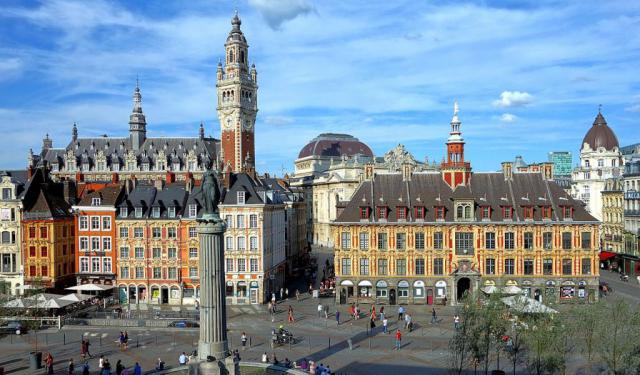
Often called France’s “Capital of Flanders,” Lille and its surroundings belong to the historic region of Romance Flanders. Legend has it that, in AD 620, Salvaert, Prince of Dijon, was passing through the region with his pregnant wife when he was attacked and killed by Phinaert, a local lord known as the Giant. Years later, his son, Lydéric, avenged his father by killing Phinaert and is... view more
Tour Duration: 2 Hours
Travel Distance: 4 Km or 2.5 Miles
Tour Duration: 2 Hours
Travel Distance: 4 Km or 2.5 Miles
Lille's Historical Buildings Tour
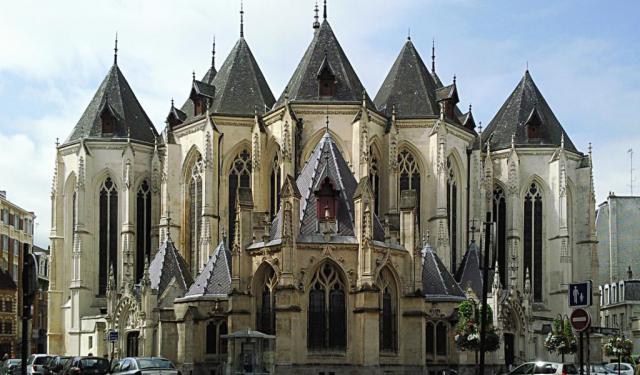
Historically, Lille's architecture differs from that of other French cities. Prior to being invaded by Louis XIV in 1667, Lille was Flemish, which is evident in its red-brick and other structures, quite uncommon for the rest of France.
Among many things, Lille is reputed for its fabulous historic center, abounding in time-honored buildings, palaces, and churches, offering a great deal of... view more
Tour Duration: 2 Hours
Travel Distance: 3.7 Km or 2.3 Miles
Among many things, Lille is reputed for its fabulous historic center, abounding in time-honored buildings, palaces, and churches, offering a great deal of... view more
Tour Duration: 2 Hours
Travel Distance: 3.7 Km or 2.3 Miles