

Highlights of Albi, Albi, France
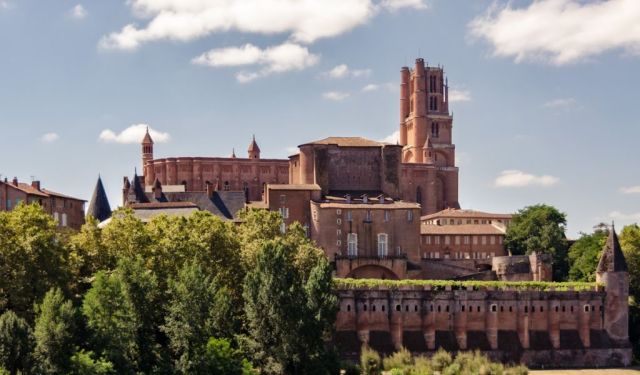
Albi, in the southern France region of Occitanie, is hailed on the World Heritage list as a complete ensemble of urban development dating from the Middle Ages. The height of town’s prosperity and importance falls on the later part of the 13th century, when a powerful local bishop built Palais de la Berbie and commissioned the construction of St Cecilia Cathedral. Albi’s architecture of that and subsequent periods is remarkably well-preserved.
The construction of Basilique Cathédrale Sainte-Cécile was completed in the 15th century. It stakes a claim to being the largest brick building in the world. A quick search of the web suggests that the claim may be suspect, but it makes the cathedral no less stunning.
In fact, I think the cathedral is worth the visit to Albi all by itself. Its painted interior is among the most spectacular that I’ve seen on my travels. The audio guide narration states that the frescoes have so far required no restoration in the 500+ years, and while hard to believe, that fact certainly adds to the jaw-dropping impression.
Nowadays it houses an excellent museum of the works of the favorite local son Henri de Toulouse-Lautrec. Only a couple of rooms of the museum suggest former extravagance of the interior, such as this painted ceiling. ...... (follow the instructions below for accessing the rest of this article).
The construction of Basilique Cathédrale Sainte-Cécile was completed in the 15th century. It stakes a claim to being the largest brick building in the world. A quick search of the web suggests that the claim may be suspect, but it makes the cathedral no less stunning.
In fact, I think the cathedral is worth the visit to Albi all by itself. Its painted interior is among the most spectacular that I’ve seen on my travels. The audio guide narration states that the frescoes have so far required no restoration in the 500+ years, and while hard to believe, that fact certainly adds to the jaw-dropping impression.
Nowadays it houses an excellent museum of the works of the favorite local son Henri de Toulouse-Lautrec. Only a couple of rooms of the museum suggest former extravagance of the interior, such as this painted ceiling. ...... (follow the instructions below for accessing the rest of this article).
How it works: The full article is featured in the app "GPSmyCity: Walks in 1K+ Cities" on Apple App Store and Google Play Store.
Download the app to your mobile device to read the article offline and create a self-guided walking tour to visit the sights featured in this article. The app's navigation functions guide you from one sight to the next. The app works offline, so no data plan is needed when traveling abroad.
Download The GPSmyCity App



Sights Featured in This Article
Guide Name: Highlights of Albi
Guide Location: France » Albi
Guide Type: Self-guided Walking Tour (Insider Tips)
Author: Ilya Burlak
Read it on Author's Website: https://burlaki.com/blog/2017/09/05/chasing-world-heritage-106-albi/
Sight(s) Featured in This Guide:
Guide Location: France » Albi
Guide Type: Self-guided Walking Tour (Insider Tips)
Author: Ilya Burlak
Read it on Author's Website: https://burlaki.com/blog/2017/09/05/chasing-world-heritage-106-albi/
Sight(s) Featured in This Guide:
- Palais de la Berbie
- St Cecilia Cathedral
- Pont Vieux
- Berbie Garden
- Église de la Madeleine
- covered market
- Musée Toulouse-Lautrec
Insider Tips Overview
