Custom Walk in Girona, Spain by hd_mcnally_ef4cd created on 2024-09-30
Guide Location: Spain » Girona
Guide Type: Custom Walk
# of Sights: 7
Tour Duration: 1 Hour(s)
Travel Distance: 1.6 Km or 1 Miles
Share Key: EXACH
Guide Type: Custom Walk
# of Sights: 7
Tour Duration: 1 Hour(s)
Travel Distance: 1.6 Km or 1 Miles
Share Key: EXACH
How It Works
Please retrieve this walk in the GPSmyCity app. Once done, the app will guide you from one tour stop to the next as if you had a personal tour guide. If you created the walk on this website or come to the page via a link, please follow the instructions below to retrieve the walk in the app.
Retrieve This Walk in App
Step 1. Download the app "GPSmyCity: Walks in 1K+ Cities" on Apple App Store or Google Play Store.



Step 2. In the GPSmyCity app, download(or launch) the guide "Girona Map and Walking Tours".
Step 3. Tap the menu button located at upper right corner of the "Walks" screen and select "Retrieve custom walk". Enter the share key: EXACH
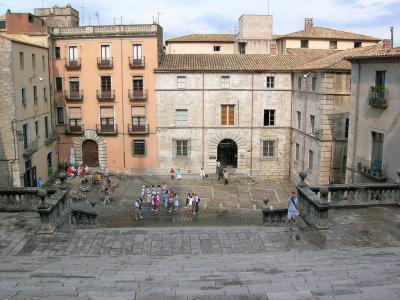
1) Plaza de la Catedral de Girona (Girona Cathedral Square)
Girona Cathedral Square (Plaza de la Catedral de Girona) serves as the dramatic forecourt to one of the city’s most iconic landmarks, the Girona Cathedral. Located at the top of the monumental Baroque staircase, this square offers visitors an impressive first glimpse of the cathedral’s towering façade. The plaza has been a focal point of Girona’s religious and civic life for centuries, evolving alongside the cathedral itself, whose construction began in the 11th century and continued through various architectural styles, including Romanesque, Gothic, and Baroque. Its elevated position provides sweeping views over the surrounding historic quarter, adding to its sense of grandeur.
The square is framed by a mix of historic buildings that complement the cathedral’s imposing presence. Stone facades, wrought-iron balconies, and shaded archways reflect Girona’s layered history, while the open space encourages visitors to pause and take in the details of the cathedral’s design. The famous staircase, completed in the 17th and 18th centuries, is not only a striking feature but also a cinematic backdrop, having appeared in popular films and television series. Seasonal events, religious processions, and cultural gatherings often begin or culminate here, reinforcing its role as a central meeting point in the city.
From the plaza, narrow medieval streets radiate outward, inviting exploration of the Barri Vell (Old Quarter). Cafés and small shops line the nearby lanes, offering spots to rest and enjoy the atmosphere after climbing the steps. Whether admired in the early morning light or illuminated in the evening, Girona Cathedral Square captures the essence of Girona’s blend of history, architecture, and cultural vitality.
The square is framed by a mix of historic buildings that complement the cathedral’s imposing presence. Stone facades, wrought-iron balconies, and shaded archways reflect Girona’s layered history, while the open space encourages visitors to pause and take in the details of the cathedral’s design. The famous staircase, completed in the 17th and 18th centuries, is not only a striking feature but also a cinematic backdrop, having appeared in popular films and television series. Seasonal events, religious processions, and cultural gatherings often begin or culminate here, reinforcing its role as a central meeting point in the city.
From the plaza, narrow medieval streets radiate outward, inviting exploration of the Barri Vell (Old Quarter). Cafés and small shops line the nearby lanes, offering spots to rest and enjoy the atmosphere after climbing the steps. Whether admired in the early morning light or illuminated in the evening, Girona Cathedral Square captures the essence of Girona’s blend of history, architecture, and cultural vitality.
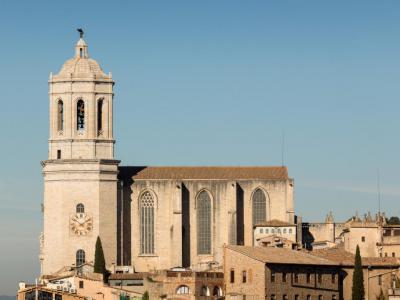
2) Catedral de Girona (Girona Cathedral) (must see)
Resting on one of Girona’s high points, the Girona Cathedral doesn’t so much sit in the skyline as command it. The climb begins with that wide baroque staircase-grand enough to feel ceremonial before you’ve even crossed the threshold.
The story of this cathedral stretches across seven centuries of construction, from the 11th to the 18th, leaving behind an architectural mixture of Romanesque, Gothic, and Baroque. The earliest layer survives in the cloister and Charlemagne Tower, but the main piece arrived in the 14th century: a single Gothic nave, seventy-five feet across. It’s the widest Gothic nave in the world, and second only to St. Peter’s in Rome for sheer span-an audacious feat of stone engineering. By the 18th century, the baroque façade sealed the building’s imposing look.
Step inside, and the contrasts play out in stained glass light, a silver-and-gem altarpiece, and side chapels that balance solemnity with flourish. The bell tower rises with clock and belfry, while the Romanesque cloister to the north, with its trapezoid plan and double columns, gives you a glimpse into an older, quieter rhythm of devotion.
The real treasures sit in the cathedral’s museum: the Tapestry of Creation, a masterpiece of embroidery from the 11th or 12th century; the illuminated Gerona Beatus manuscript from the 10th; and a silver casket crafted for the Caliph Hisham II. Together, they weave a timeline of faith, artistry, and power.
And if the staircase looks familiar-it’s because HBO’s Game of Thrones turned it into the Great Sept of Baelor. Girona Cathedral has been playing host to drama for a thousand years; the cameras were just a bit late to the party.
The story of this cathedral stretches across seven centuries of construction, from the 11th to the 18th, leaving behind an architectural mixture of Romanesque, Gothic, and Baroque. The earliest layer survives in the cloister and Charlemagne Tower, but the main piece arrived in the 14th century: a single Gothic nave, seventy-five feet across. It’s the widest Gothic nave in the world, and second only to St. Peter’s in Rome for sheer span-an audacious feat of stone engineering. By the 18th century, the baroque façade sealed the building’s imposing look.
Step inside, and the contrasts play out in stained glass light, a silver-and-gem altarpiece, and side chapels that balance solemnity with flourish. The bell tower rises with clock and belfry, while the Romanesque cloister to the north, with its trapezoid plan and double columns, gives you a glimpse into an older, quieter rhythm of devotion.
The real treasures sit in the cathedral’s museum: the Tapestry of Creation, a masterpiece of embroidery from the 11th or 12th century; the illuminated Gerona Beatus manuscript from the 10th; and a silver casket crafted for the Caliph Hisham II. Together, they weave a timeline of faith, artistry, and power.
And if the staircase looks familiar-it’s because HBO’s Game of Thrones turned it into the Great Sept of Baelor. Girona Cathedral has been playing host to drama for a thousand years; the cameras were just a bit late to the party.
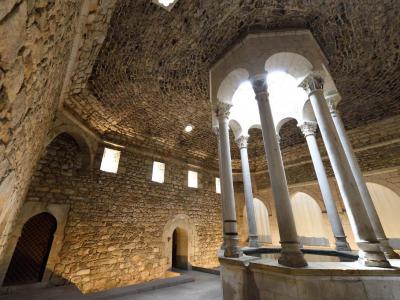
3) Banos Arabes (Arab Baths) (must see)
The Arab Baths of Girona sit a stone’s throw from the cathedral, a medieval spa with a misleading name. Built in 1194 by the city’s Christians-not the Moors-the baths borrow ideas from both Roman engineering and Islamic design but are Romanesque to their core. Step inside and you’re walking through a five-room routine that was as much about community as cleanliness. You start in the apodyterium, the dressing room, crowned by an octagonal pool and slender columns that set the scene. From there it’s a temperature tour: the icy frigidarium, the mild tepidarium, and the steam-filled caldarium, kept hot by an ingenious underfloor system, or hypocaust, that turned the whole place into a medieval wellness center.
The baths ran until the 15th century before slipping into decline. By the 1600s they were folded into a Capuchin convent, pressed into service as a pantry and laundry-hardly glamorous, but that recycling is what kept them intact. By the 19th century, people were calling them “Arab Baths,” a name that stuck more out of romantic fancy than historical accuracy. Careful restorations later returned the complex to something close to its medieval look, and today the interplay of light, stone, and geometry makes the rooms feel like a time capsule.
Pop culture gave the site fresh fame when Game of Thrones rolled into town. The baths doubled as Braavos in Arya Stark’s frantic chase through season six, and they reappeared in Oldtown as Samwell Tarly and Gilly arrived at the Citadel. The medieval stonework proved as camera-ready as any computer-generated castle.
Visitors today can wander the hushed interiors, peer up at the domed skylight, and even climb to the rooftop for views across Girona. The baths are more than a curiosity-they’re a reminder of how medieval Girona blended pragmatism, culture, and a touch of borrowed style into something uniquely its own.
The baths ran until the 15th century before slipping into decline. By the 1600s they were folded into a Capuchin convent, pressed into service as a pantry and laundry-hardly glamorous, but that recycling is what kept them intact. By the 19th century, people were calling them “Arab Baths,” a name that stuck more out of romantic fancy than historical accuracy. Careful restorations later returned the complex to something close to its medieval look, and today the interplay of light, stone, and geometry makes the rooms feel like a time capsule.
Pop culture gave the site fresh fame when Game of Thrones rolled into town. The baths doubled as Braavos in Arya Stark’s frantic chase through season six, and they reappeared in Oldtown as Samwell Tarly and Gilly arrived at the Citadel. The medieval stonework proved as camera-ready as any computer-generated castle.
Visitors today can wander the hushed interiors, peer up at the domed skylight, and even climb to the rooftop for views across Girona. The baths are more than a curiosity-they’re a reminder of how medieval Girona blended pragmatism, culture, and a touch of borrowed style into something uniquely its own.

4) Passeig De La Muralla (Ancient City Walls) (must see)
The Ancient City Walls of Girona are less “old ruins” and more “stone showmen.” Their first chapter begins in 1 B.C., when the Romans sketched out fortifications to guard their settlement. Advance to the 14th century, and those Roman bones were built up into the sprawling medieval ramparts that wrapped around Girona like a suit of armor. They were badly needed-this was a city besieged more than two dozen times, and the walls bore the brunt of it.
By the 19th century, the story took a turn: parts of the walls on the western side were dismantled to let the growing city breathe. The eastern side was simply abandoned. For a while, Girona outgrew its stone corset. But in recent decades, restorers gave the walls back their voice, patching together missing stretches and reopening the walkways.
Now, climbing onto the ramparts is less about survival and more about perspective. From up high, the view spreads across terracotta rooftops, the cathedral’s bell tower, and, if the day is clear, the serrated outline of the Pyrenees. Towers punctuate the route with higher vantage points, while tucked-away gardens and shaded sections provide breathing spaces along the climb. Arrow slits and narrow windows remind you that these walls weren’t built for scenery-they were built to keep Girona standing.
A full circuit takes an hour or two, though there are plenty of access points if you’d rather dip in and out. What you’re walking, though, is not just a wall-it’s two millennia of the city deciding when to defend, when to expand, and when to restore. Few places in Girona stitch past and present together with such clarity underfoot.
By the 19th century, the story took a turn: parts of the walls on the western side were dismantled to let the growing city breathe. The eastern side was simply abandoned. For a while, Girona outgrew its stone corset. But in recent decades, restorers gave the walls back their voice, patching together missing stretches and reopening the walkways.
Now, climbing onto the ramparts is less about survival and more about perspective. From up high, the view spreads across terracotta rooftops, the cathedral’s bell tower, and, if the day is clear, the serrated outline of the Pyrenees. Towers punctuate the route with higher vantage points, while tucked-away gardens and shaded sections provide breathing spaces along the climb. Arrow slits and narrow windows remind you that these walls weren’t built for scenery-they were built to keep Girona standing.
A full circuit takes an hour or two, though there are plenty of access points if you’d rather dip in and out. What you’re walking, though, is not just a wall-it’s two millennia of the city deciding when to defend, when to expand, and when to restore. Few places in Girona stitch past and present together with such clarity underfoot.

5) Torre Gironella (Gironella Tower)
Nestled in the heart of Girona’s historic quarter, Gironella Tower stands as a silent sentinel at the highest point of the ancient Roman walls-known as the Força Vella-just behind the majestic Cathedral and beside the Bishop’s Palace. This evocative ruin, officially recognized as a Cultural Asset of National Interest since April 22, 1949, offers visitors both historical depth and architectural intrigue.
Architecturally, Gironella Tower is a fascinating patchwork of eras: its visible remains include a robust Roman square tower lying partly beneath an embankment, a barrel-vault supporting structure, medieval walls, and later reinforcements. Visitors can still climb the stone stairs into the access courtyard, where the historic “Joana Enríquez Gate” marks one of its most striking features.
Tracing its storied past, the tower’s existence is recorded as early as 994 AD. Around the year 1000, Count Ramon Borrell III incorporated the Roman structure into the new Castle of Gironella, which by 1190 had become officially recognized as such. Over the centuries, it served various roles-including a prison in the 13th century-and was rebuilt after collapsing in 1404, only to be reinforced again in 1462 by Joana Enríquez. Tragically, the tower met its ruin at the hands of Napoleonic forces in 1814.
Today, Gironella Tower remains an evocative waypoint on Girona’s Archaeological Walk. It offers not just sweeping vistas over the Old Quarter, but also an intimate window into a layered past where Roman foundations, medieval fortifications, and modern memory converge. A visit here is both scenic and scholarly-a must for history lovers and curious travelers alike.
Architecturally, Gironella Tower is a fascinating patchwork of eras: its visible remains include a robust Roman square tower lying partly beneath an embankment, a barrel-vault supporting structure, medieval walls, and later reinforcements. Visitors can still climb the stone stairs into the access courtyard, where the historic “Joana Enríquez Gate” marks one of its most striking features.
Tracing its storied past, the tower’s existence is recorded as early as 994 AD. Around the year 1000, Count Ramon Borrell III incorporated the Roman structure into the new Castle of Gironella, which by 1190 had become officially recognized as such. Over the centuries, it served various roles-including a prison in the 13th century-and was rebuilt after collapsing in 1404, only to be reinforced again in 1462 by Joana Enríquez. Tragically, the tower met its ruin at the hands of Napoleonic forces in 1814.
Today, Gironella Tower remains an evocative waypoint on Girona’s Archaeological Walk. It offers not just sweeping vistas over the Old Quarter, but also an intimate window into a layered past where Roman foundations, medieval fortifications, and modern memory converge. A visit here is both scenic and scholarly-a must for history lovers and curious travelers alike.
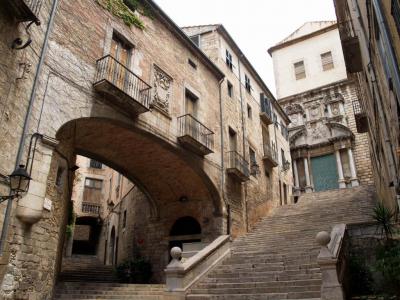
6) Ascent of San Domenec - Braavos Market
The Ascent of Saint Domènec is one of Girona’s most photogenic stairways-and not just because of its Game of Thrones cameo. This stepped street took shape between the 14th and 17th centuries and still feels like a stage set, flanked by Renaissance palaces, the Agullana Palace, and crowned by the imposing baroque front of the Church of Saint Martí Sacosta. Its roots go back even further: the Dominicans planted a convent here in the 13th century, turning the area into both a religious hub and a neighborhood crossroads. Later renovations matched the drama of the church above, leaving us with the elegant, balanced stairway you see today.
Climbing it is a workout, but one softened by the setting. Locals claim it’s impossible to pass without pausing-whether that’s to snap a photo, claim a table at Le Bistrot, whose terrace hides under the arch, or peek into the Ensesa workshop, a favorite during Girona’s annual Temps de Flors festival when flowers spill across the steps.
Then there’s its screen career. Perfume: The Story of a Murderer filmed here back in 2006, but it was HBO’s Game of Thrones that catapulted the stairway into global stardom. Season 6 dressed the steps as a bustling Braavosi marketplace, complete with awnings, baskets, and extras. It’s where Arya Stark, blind and desperate, was chased down by the Waif. The moment that sticks into the fans' minds is her tumble that sent orange-filled baskets flying on the stairs.
Today, the Ascent of Saint Domènec works double duty: a slice of Girona’s architectural story and a pop-culture landmark, equally good for a quiet climb or a re-enactment.
Climbing it is a workout, but one softened by the setting. Locals claim it’s impossible to pass without pausing-whether that’s to snap a photo, claim a table at Le Bistrot, whose terrace hides under the arch, or peek into the Ensesa workshop, a favorite during Girona’s annual Temps de Flors festival when flowers spill across the steps.
Then there’s its screen career. Perfume: The Story of a Murderer filmed here back in 2006, but it was HBO’s Game of Thrones that catapulted the stairway into global stardom. Season 6 dressed the steps as a bustling Braavosi marketplace, complete with awnings, baskets, and extras. It’s where Arya Stark, blind and desperate, was chased down by the Waif. The moment that sticks into the fans' minds is her tumble that sent orange-filled baskets flying on the stairs.
Today, the Ascent of Saint Domènec works double duty: a slice of Girona’s architectural story and a pop-culture landmark, equally good for a quiet climb or a re-enactment.
7) Jewish Quarter and Jewish History Museum (must see)
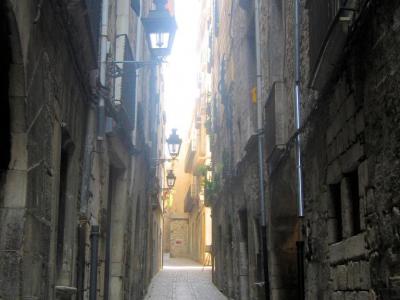
El Call, Girona’s Jewish Quarter, is a labyrinth where history hides in plain sight. Its cobbled alleys and tight stone stairways once held the heartbeat of a Jewish community that flourished here from the 12th to the 15th century. Merchants, craftsmen, and scholars packed these narrow streets, and Girona’s reputation as a centre of learning was cemented by its famed school of Kabbalah. Then came 1492. Spain expelled its Jewish population, leaving behind empty houses and silence where life had once thrived. Yet the quarter endures, every twist of its passageways carrying echoes of that vanished world.
Nestled within this maze is the Museum of Jewish History, housed in what was once a synagogue. Step into its courtyard and you’ll see a bold Star of David carved into the stone-in case you forgot where you are. Inside, eleven rooms unfold the story of Jewish life in Girona and across Catalonia: how families lived, how festivals were celebrated, how medicine, philosophy, and trade were practiced here. Manuscripts, ritual objects, and carefully preserved artifacts breathe life into names that might otherwise be lost. The synagogue also carries the imprint of Nahmanides, the 13th-century rabbi, philosopher, and physician whose wit and wisdom left a mark on Jewish life for generations. What earned him fame was his ability to out-argue kings and out-write just about anyone in medieval Spain. A scale model of the quarter itself helps visitors imagine the district at its height, before its sudden fracture in the late 15th century.
The museum keeps moving forward with new displays and a shop full of books worth carrying home. Yet its real echo is on the streets around it, where every corner is less about sightseeing and more about walking through an archive written in stone, stubbornly refusing to be footnoted into silence.
Nestled within this maze is the Museum of Jewish History, housed in what was once a synagogue. Step into its courtyard and you’ll see a bold Star of David carved into the stone-in case you forgot where you are. Inside, eleven rooms unfold the story of Jewish life in Girona and across Catalonia: how families lived, how festivals were celebrated, how medicine, philosophy, and trade were practiced here. Manuscripts, ritual objects, and carefully preserved artifacts breathe life into names that might otherwise be lost. The synagogue also carries the imprint of Nahmanides, the 13th-century rabbi, philosopher, and physician whose wit and wisdom left a mark on Jewish life for generations. What earned him fame was his ability to out-argue kings and out-write just about anyone in medieval Spain. A scale model of the quarter itself helps visitors imagine the district at its height, before its sudden fracture in the late 15th century.
The museum keeps moving forward with new displays and a shop full of books worth carrying home. Yet its real echo is on the streets around it, where every corner is less about sightseeing and more about walking through an archive written in stone, stubbornly refusing to be footnoted into silence.
