Custom Walk in Rotterdam, Netherlands by johnlbattersby_7e7ae created on 2025-05-04
Guide Location: Netherlands » Rotterdam
Guide Type: Custom Walk
# of Sights: 7
Tour Duration: 4 Hour(s)
Travel Distance: 9.2 Km or 5.7 Miles
Share Key: BEWYY
Guide Type: Custom Walk
# of Sights: 7
Tour Duration: 4 Hour(s)
Travel Distance: 9.2 Km or 5.7 Miles
Share Key: BEWYY
How It Works
Please retrieve this walk in the GPSmyCity app. Once done, the app will guide you from one tour stop to the next as if you had a personal tour guide. If you created the walk on this website or come to the page via a link, please follow the instructions below to retrieve the walk in the app.
Retrieve This Walk in App
Step 1. Download the app "GPSmyCity: Walks in 1K+ Cities" on Apple App Store or Google Play Store.



Step 2. In the GPSmyCity app, download(or launch) the guide "Rotterdam Map and Walking Tours".
Step 3. Tap the menu button located at upper right corner of the "Walks" screen and select "Retrieve custom walk". Enter the share key: BEWYY
1) Erasmusbrug (Erasmus Bridge) (must see)
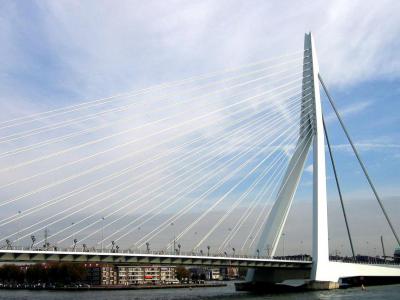
Erasmus Bridge crosses the Nieuwe Mass River. This combination cable-stayed and bascule bridge was completed in 1996. The modern bridge was named after Desiderius Erasmus, a Renaissance humanist and Catholic priest. Erasmus was born in Rotterdam in 1446 and is considered one of the greatest scholars of the northern Renaissance.
Erasmus Bridge is Rotterdam's most iconic landmark and is featured in the city's logo. The bridge is 802 meters (2,631 feet) long. The cable-stayed portion has a 139-meter (456-foot) asymmetrical bent pylon with an eye-catching horizontal base. This striking feature has earned it "The Swan" nickname.
The south portion of the bridge has an 89-meter (292-foot) long bascule bridge to allow large ships to pass under the bridge.
The bridge has been featured in films and events. It was in Jackie Chan's 1998 film Who Am I?. Several planes dramatically flew under the bridge during the 2005 Red Bull Air Race.
Erasmus Bridge is Rotterdam's most iconic landmark and is featured in the city's logo. The bridge is 802 meters (2,631 feet) long. The cable-stayed portion has a 139-meter (456-foot) asymmetrical bent pylon with an eye-catching horizontal base. This striking feature has earned it "The Swan" nickname.
The south portion of the bridge has an 89-meter (292-foot) long bascule bridge to allow large ships to pass under the bridge.
The bridge has been featured in films and events. It was in Jackie Chan's 1998 film Who Am I?. Several planes dramatically flew under the bridge during the 2005 Red Bull Air Race.
2) Molen De Lelie
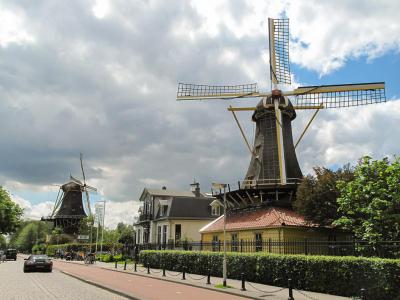
Nestled in the heart of Rotterdam, Molen De Lelie stands as a testament to centuries of history, craftsmanship, and resilience. Originally constructed in 1740 in the old district of Kralingen, the mill was initially named "De Ezel." Over the years, this iconic windmill has undergone transformations, relocations, and restorations, all while playing a vital role in the local community.
The year 1840 marked a significant turning point for Molen De Lelie. It was during this time that the mill was relocated to its present location. Notably, the mill's octagonal posts were extended by 1.5 meters, resulting in a more slender and elegant mill structure. This relocation was a feat of engineering, showcasing the dedication to preserving the mill's legacy.
For many years, De Lelie was a hub of industry, housing six stamping tanks until 1921. However, progress brought change, and an electric motor replaced the sixth cockpit to power a reversing shaft. Despite these modifications, the mill remained an integral part of the community.
In 1970, a significant restoration effort breathed new life into Molen De Lelie. During this restoration, the mill's foundation was renewed, and the structure itself was straightened and lifted. This process not only honored the mill's historical significance but also demonstrated the commitment to its preservation. As part of this restoration, the electric drive that had been introduced in the mill was removed, restoring the mill to its traditional wind-driven mechanism.
Since 1996, the traditional craft of milling has been practiced once again voluntarily at Molen De Lelie, alongside its neighboring mill, De Ster. These mills stand as living examples of the dedication to preserving heritage and craftsmanship. Every second Saturday of the month, Molen De Lelie and De Ster come to life, grinding spices and snuff using time-honored techniques.
The year 1840 marked a significant turning point for Molen De Lelie. It was during this time that the mill was relocated to its present location. Notably, the mill's octagonal posts were extended by 1.5 meters, resulting in a more slender and elegant mill structure. This relocation was a feat of engineering, showcasing the dedication to preserving the mill's legacy.
For many years, De Lelie was a hub of industry, housing six stamping tanks until 1921. However, progress brought change, and an electric motor replaced the sixth cockpit to power a reversing shaft. Despite these modifications, the mill remained an integral part of the community.
In 1970, a significant restoration effort breathed new life into Molen De Lelie. During this restoration, the mill's foundation was renewed, and the structure itself was straightened and lifted. This process not only honored the mill's historical significance but also demonstrated the commitment to its preservation. As part of this restoration, the electric drive that had been introduced in the mill was removed, restoring the mill to its traditional wind-driven mechanism.
Since 1996, the traditional craft of milling has been practiced once again voluntarily at Molen De Lelie, alongside its neighboring mill, De Ster. These mills stand as living examples of the dedication to preserving heritage and craftsmanship. Every second Saturday of the month, Molen De Lelie and De Ster come to life, grinding spices and snuff using time-honored techniques.
3) Molen De Ster
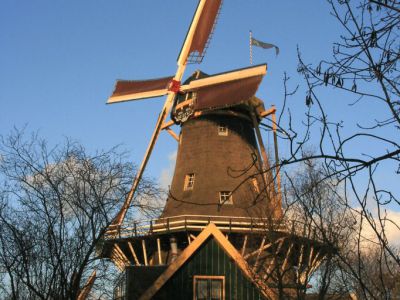
Nestled gracefully on the picturesque banks of the Kralingse Plas in Rotterdam, Molen De Ster stands as a remarkable testament to both the rich history of windmills and the enduring traditions of flavor and fragrance. This 8-sided tower mill, constructed in the year 1866, exudes a nostalgic charm that harks back to a time when windmills were the heartbeat of industry and craftsmanship.
Originally built on the grounds of a previous flour mill that shared its name, the initial De Ster mill met an unfortunate fate when it was ravaged by fire in 1865. Rising from its ashes, the resilient spirit of De Ster was infused with parts salvaged from another windmill, De Stier, which once stood tall in Rijswijk. These combined elements formed the foundation for the new De Ster, breathing life into its sails once more.
The De Ster story is tightly linked to grinding snuff and spices. Today, the windmill persists in this role, preserving ancient traditions. Paired with De Lelie mill, they unite in grinding snuff and spices, giving these mills a distinct identity beyond architecture. De Ster showcases a kollergang, a unique spice-grinding mechanism with five silent stamping vats. Two pairs of grinding stones, smoothed by countless revolutions, epitomize the blend of tradition and innovation in enduring craftsmanship.
However, history has not always been kind to Molen De Ster. On a fateful day in 1962, the mill succumbed to the ravages of fire once again. Yet, like a phoenix rising from the ashes, De Ster was lovingly reconstructed in 1969, a tribute to its significance in the collective memory of Rotterdam.
Originally built on the grounds of a previous flour mill that shared its name, the initial De Ster mill met an unfortunate fate when it was ravaged by fire in 1865. Rising from its ashes, the resilient spirit of De Ster was infused with parts salvaged from another windmill, De Stier, which once stood tall in Rijswijk. These combined elements formed the foundation for the new De Ster, breathing life into its sails once more.
The De Ster story is tightly linked to grinding snuff and spices. Today, the windmill persists in this role, preserving ancient traditions. Paired with De Lelie mill, they unite in grinding snuff and spices, giving these mills a distinct identity beyond architecture. De Ster showcases a kollergang, a unique spice-grinding mechanism with five silent stamping vats. Two pairs of grinding stones, smoothed by countless revolutions, epitomize the blend of tradition and innovation in enduring craftsmanship.
However, history has not always been kind to Molen De Ster. On a fateful day in 1962, the mill succumbed to the ravages of fire once again. Yet, like a phoenix rising from the ashes, De Ster was lovingly reconstructed in 1969, a tribute to its significance in the collective memory of Rotterdam.
4) Kubuswoningen (Cube Houses)
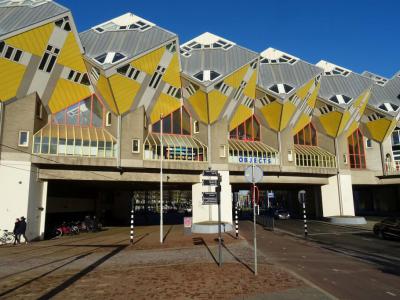
Few buildings capture Rotterdam’s spirit of creativity quite like the Cube Houses, the city’s most playful architectural experiment. Designed by Dutch architect Piet Blom, these yellow cubes seem to balance on their tips, tilted 45 degrees as if defying gravity. Blom’s goal was to create an “urban forest”, where each cube represents a tree and together they form a sculptural canopy above the streets below.
Built in the 1980s as part of a larger urban renewal project, the Cube Houses were conceived in collaboration with city planners who wanted to bring life and imagination back to Rotterdam. Each Cube House rises three stories high. The lower level contains a kitchen and living room, the middle floor holds two bedrooms and a bathroom, and the top level often serves as a small garden, workspace, or viewing area.
The complex also functions as a pedestrian bridge across a busy intersection, maintaining a car-free environment. Around the cubes, visitors will find a lively community of cafés, restaurants, small offices, studios, and even a playground.
Those curious about what life is like inside one of these tilted wonders can visit the Show Cube Museum, which offers a peek into their design and history. And for the truly adventurous, a few of the cubes have been converted into overnight accommodations—perfect for anyone eager to experience Rotterdam from a slightly different angle.
Built in the 1980s as part of a larger urban renewal project, the Cube Houses were conceived in collaboration with city planners who wanted to bring life and imagination back to Rotterdam. Each Cube House rises three stories high. The lower level contains a kitchen and living room, the middle floor holds two bedrooms and a bathroom, and the top level often serves as a small garden, workspace, or viewing area.
The complex also functions as a pedestrian bridge across a busy intersection, maintaining a car-free environment. Around the cubes, visitors will find a lively community of cafés, restaurants, small offices, studios, and even a playground.
Those curious about what life is like inside one of these tilted wonders can visit the Show Cube Museum, which offers a peek into their design and history. And for the truly adventurous, a few of the cubes have been converted into overnight accommodations—perfect for anyone eager to experience Rotterdam from a slightly different angle.
5) Markthal (Market Hall) (must see)
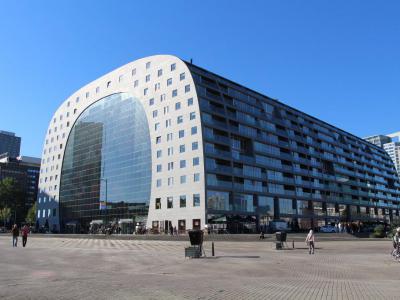
The Market Hall is a multi-use complex that combines apartments, offices, retail spaces, and one of Rotterdam’s most popular markets, all under a single monumental arch. Opened in 2014, the building is celebrated for its dramatic horseshoe-shaped arch and its massive glass facades composed of smaller window panels. A 34-metre high steel cable structure supports these glass walls, making it Europe’s largest cable-supported glass façade. Beneath it lies an extensive underground parking garage that adds to its functional design.
Inside, visitors are greeted by a space of vivid artwork covering the interior arch. Created by Dutch artists Arno Coenen and Iris Roskam, Horn of Plenty depicts giant fruits, vegetables, fish, flowers, and insects in dazzling colour. The digital artwork was so enormous that the artists had to borrow computing power from Pixar Studios. This spectacular mural has earned the Market Hall nicknames such as “The Largest Artwork in the World” and “The Sistine Chapel of Rotterdam”.
During the building’s construction, archaeologists unearthed the remains of a 10th-century farmstead, including a house with two stoves and several fireplaces. A small exhibition beside the central staircases displays these finds, offering visitors a glimpse of Rotterdam’s early settlement history.
Today, the Market Hall stands as the largest indoor market in the Netherlands. It hosts more than 100 produce stalls, 15 food shops, and eight restaurants. Shoppers can browse local cheeses, fresh fish, fruit and vegetables, poultry, flowers, and plants. For those eager to sample their purchases, plenty of indoor seating areas are available—making the Market Hall both a culinary destination and a modern architectural icon.
Inside, visitors are greeted by a space of vivid artwork covering the interior arch. Created by Dutch artists Arno Coenen and Iris Roskam, Horn of Plenty depicts giant fruits, vegetables, fish, flowers, and insects in dazzling colour. The digital artwork was so enormous that the artists had to borrow computing power from Pixar Studios. This spectacular mural has earned the Market Hall nicknames such as “The Largest Artwork in the World” and “The Sistine Chapel of Rotterdam”.
During the building’s construction, archaeologists unearthed the remains of a 10th-century farmstead, including a house with two stoves and several fireplaces. A small exhibition beside the central staircases displays these finds, offering visitors a glimpse of Rotterdam’s early settlement history.
Today, the Market Hall stands as the largest indoor market in the Netherlands. It hosts more than 100 produce stalls, 15 food shops, and eight restaurants. Shoppers can browse local cheeses, fresh fish, fruit and vegetables, poultry, flowers, and plants. For those eager to sample their purchases, plenty of indoor seating areas are available—making the Market Hall both a culinary destination and a modern architectural icon.
6) The Destroyed City
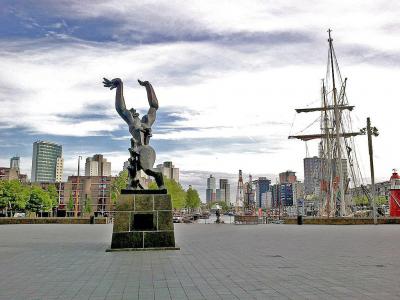
The Destroyed City is a bronze memorial sculpture in Rotterdam. It commemorates the German bombing of Rotterdam on 14 May 1940, which destroyed the medieval center of the city. Unveiled in 1953, it was designated as a Dutch National Monument in 2010. It is the largest sculpture by the Russian-born French sculptor Ossip Zadkine, his best-known work.
The 6.5 meters (21 feet) tall sculpture portrays a human figure by a tree stump. The figure raises its hands, head thrown back as if crying in grief, with a hole in its chest. This absence of a heart symbolizes Rotterdam's center destruction. Zadkine called it "A cry against tyranny's brutality". It's likened to Picasso's Guernica art. The sculpture stands on a 2 meters (6.5 feet) high granite plinth.
Created from 1951-1953 in Paris by Susse Frères foundry, the bronze sculpture was a gift to the city with its location chosen by Zadkine. The donor's identity was revealed in 1978. The modern piece sparked controversy, notably with Jan Tillema, Rotterdam's Director of Public Works, branding it a "demonic scourge." Despite objections, the gift was accepted, and Tillema designed the plinth. The statue's installation, including the plinth, incurred a cost of 24,500 guilders.
On May 15, 1953, Gerard van Walsum, the mayor of Rotterdam, unveiled it on Plein 1940, where it remains by the Maritime Museum Rotterdam. It was shifted 60 meters (200 feet) in 1975 and restored in 2007 after temporary removal for construction in 2005.
The 6.5 meters (21 feet) tall sculpture portrays a human figure by a tree stump. The figure raises its hands, head thrown back as if crying in grief, with a hole in its chest. This absence of a heart symbolizes Rotterdam's center destruction. Zadkine called it "A cry against tyranny's brutality". It's likened to Picasso's Guernica art. The sculpture stands on a 2 meters (6.5 feet) high granite plinth.
Created from 1951-1953 in Paris by Susse Frères foundry, the bronze sculpture was a gift to the city with its location chosen by Zadkine. The donor's identity was revealed in 1978. The modern piece sparked controversy, notably with Jan Tillema, Rotterdam's Director of Public Works, branding it a "demonic scourge." Despite objections, the gift was accepted, and Tillema designed the plinth. The statue's installation, including the plinth, incurred a cost of 24,500 guilders.
On May 15, 1953, Gerard van Walsum, the mayor of Rotterdam, unveiled it on Plein 1940, where it remains by the Maritime Museum Rotterdam. It was shifted 60 meters (200 feet) in 1975 and restored in 2007 after temporary removal for construction in 2005.
7) Witte de Withstraat Street (must see)
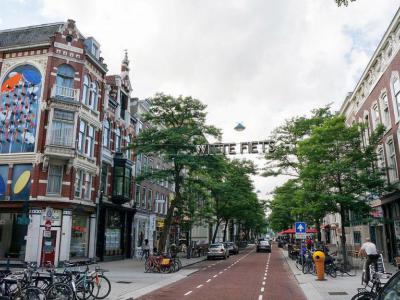
Witte de Withstraat Street, spanning approximately 320 meters, was named after Witte Cornelisz de With, a 17th-century Dutch naval officer. During the 1990s, its transformation into an "Art Axis" — a designated cultural and artistic district linking the Park Museum and the Maritime Museum — helped reshape its identity as one of the city’s cultural and nightlife centres.
Here, you'll find Rotterdam Bazar, a lively restaurant offering international dishes; Vivu, which serves delicious Vietnamese cuisine; and Oliva, known for its Italian fare. For a casual bite, Bagel Bakery is the perfect stop for a bagel and a quick coffee. The highly regarded burger spot Ter Marsch & Co serves some of the Netherlands’ best hamburgers. For a different vibe, the Nieuw Rotterdams Café, housed in a grand former newspaper building, offers a stylish setting for cocktails or dinner.
The shopping scene is as diverse as the food offerings. You'll discover independent boutiques like Betsy Palmer, a well-known shoe shop, and RSI The Attraction, which specializes in adventure gear such as skateboards, snowboards, and kites.
Artists and gallery-goers will feel right at home here, too. Kunstinstituut Melly hosts international exhibitions and educational programs. Other galleries in the area include Ecce Gallery and van Eijk Gallery, which features modern art, ceramics, and sculpture. Around the side streets, you’ll also encounter murals and street-art installations.
In earlier decades, the street had a rougher reputation, once home to less savory cafés and illegal gambling houses in the 1970s. However, its revival has helped shape Witte de Withstraat Street into a hub for art, design, and nightlife energy.
Here, you'll find Rotterdam Bazar, a lively restaurant offering international dishes; Vivu, which serves delicious Vietnamese cuisine; and Oliva, known for its Italian fare. For a casual bite, Bagel Bakery is the perfect stop for a bagel and a quick coffee. The highly regarded burger spot Ter Marsch & Co serves some of the Netherlands’ best hamburgers. For a different vibe, the Nieuw Rotterdams Café, housed in a grand former newspaper building, offers a stylish setting for cocktails or dinner.
The shopping scene is as diverse as the food offerings. You'll discover independent boutiques like Betsy Palmer, a well-known shoe shop, and RSI The Attraction, which specializes in adventure gear such as skateboards, snowboards, and kites.
Artists and gallery-goers will feel right at home here, too. Kunstinstituut Melly hosts international exhibitions and educational programs. Other galleries in the area include Ecce Gallery and van Eijk Gallery, which features modern art, ceramics, and sculpture. Around the side streets, you’ll also encounter murals and street-art installations.
In earlier decades, the street had a rougher reputation, once home to less savory cafés and illegal gambling houses in the 1970s. However, its revival has helped shape Witte de Withstraat Street into a hub for art, design, and nightlife energy.
