Custom Walk in Heidelberg, Germany by jhurley112_ef895 created on 2025-05-27
Guide Location: Germany » Heidelberg
Guide Type: Custom Walk
# of Sights: 6
Tour Duration: 3 Hour(s)
Travel Distance: 6.8 Km or 4.2 Miles
Share Key: RC5JU
Guide Type: Custom Walk
# of Sights: 6
Tour Duration: 3 Hour(s)
Travel Distance: 6.8 Km or 4.2 Miles
Share Key: RC5JU
How It Works
Please retrieve this walk in the GPSmyCity app. Once done, the app will guide you from one tour stop to the next as if you had a personal tour guide. If you created the walk on this website or come to the page via a link, please follow the instructions below to retrieve the walk in the app.
Retrieve This Walk in App
Step 1. Download the app "GPSmyCity: Walks in 1K+ Cities" on Apple App Store or Google Play Store.



Step 2. In the GPSmyCity app, download(or launch) the guide "Heidelberg Map and Walking Tours".
Step 3. Tap the menu button located at upper right corner of the "Walks" screen and select "Retrieve custom walk". Enter the share key: RC5JU
1) Alte Brucke (Old Bridge) (must see)
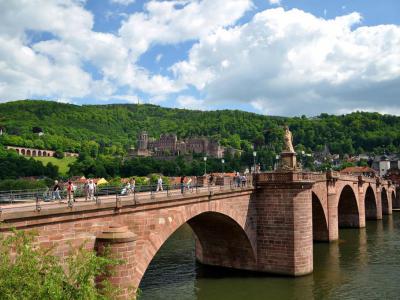
The Old Bridge spans the Neckar River, linking the Old Town with the newer eastern part of the city. Although built in 1788, it is actually one of Heidelberg's newer structures. Historically, there have been eight bridges in this location, with the current one constructed on the foundations of its predecessors. When the Theodor Heuss Bridge was built in 1877, this became known as the "Old Bridge".
The first bridge at this site was built by the Romans in the 1st century, but it collapsed, and it took nearly 1000 years to replace it. A new crossing was constructed in the 13th century when Heidelberg was founded, aligning with its present location near the marketplace. Goethe hailed its beauty as "not equalled by any other in the world", and it certainly provides a classic vista.
In the early days, the Old Bridge marked the border with the Electorate of Mainz and was part of the city's defenses. Several of its early versions were destroyed by ice floes; the seventh survived the Thirty Years' War but was destroyed during the Nine Years' War. The current nine-arch bridge, built with distinctive red sandstone, was completed thereafter, featuring an ancient gate, two towers, and statues of Prince Karl-Theodor and Minerva. During the Second World War, three of its arches were destroyed, and had to be rebuilt.
A monkey statue has been a part of the bridge since the 15th century and remains a tourist attraction. The original statue disappeared during the Nine Years' War and was later replaced; the current one depicts a monkey holding a mirror in one hand. Tourists often place their heads inside the monkey's head, rub the monkey's mirror for luck, and touch its fingers to ensure a return to Heidelberg.
The first bridge at this site was built by the Romans in the 1st century, but it collapsed, and it took nearly 1000 years to replace it. A new crossing was constructed in the 13th century when Heidelberg was founded, aligning with its present location near the marketplace. Goethe hailed its beauty as "not equalled by any other in the world", and it certainly provides a classic vista.
In the early days, the Old Bridge marked the border with the Electorate of Mainz and was part of the city's defenses. Several of its early versions were destroyed by ice floes; the seventh survived the Thirty Years' War but was destroyed during the Nine Years' War. The current nine-arch bridge, built with distinctive red sandstone, was completed thereafter, featuring an ancient gate, two towers, and statues of Prince Karl-Theodor and Minerva. During the Second World War, three of its arches were destroyed, and had to be rebuilt.
A monkey statue has been a part of the bridge since the 15th century and remains a tourist attraction. The original statue disappeared during the Nine Years' War and was later replaced; the current one depicts a monkey holding a mirror in one hand. Tourists often place their heads inside the monkey's head, rub the monkey's mirror for luck, and touch its fingers to ensure a return to Heidelberg.

2) Konigstuhl (King's Throne) (must see)
The Königstuhl, or King's Throne summit, rises 567 meters above Heidelberg, offering an idyllic retreat and commanding panoramic views of the city, the Neckar Valley, and the Rhine Plain. Its cooler temperatures during warmer months provide a refreshing escape from the city below.
Visitors can reach the summit via several routes. From the castle, a steep staircase known as the "Sky Ladder" provides access, as does the funicular railway, which has been in operation since 1907. The funicular runs from the Kornmarkt valley station, through the stations Schloss and Molkenkur, up to the summit. Additionally, bus line 39 operates hourly from Bismarckplatz to Königstuhl from 6:00 AM to 7:00 PM.
Upon reaching the King's Throne, visitors are treated to not only breathtaking vistas but also a range of attractions. The Märchenparadies (Fairy Tale Paradise) leisure park offers enchanting experiences for families across its expansive 48,000-square-meter area. Tinnunculus falconry hosts daily public flight demonstrations, while the renowned state observatory invites visitors to explore the wonders of astronomy.
For hiking enthusiasts, the summit serves as a gateway to numerous scenic trails suitable for all fitness levels. Two notable forest trails, the "Via Naturae" and the "Forest Adventure Path", offer unique experiences amidst the natural beauty of the area. All hiking routes are clearly marked, ensuring a safe and enjoyable outdoor adventure.
Visitors can reach the summit via several routes. From the castle, a steep staircase known as the "Sky Ladder" provides access, as does the funicular railway, which has been in operation since 1907. The funicular runs from the Kornmarkt valley station, through the stations Schloss and Molkenkur, up to the summit. Additionally, bus line 39 operates hourly from Bismarckplatz to Königstuhl from 6:00 AM to 7:00 PM.
Upon reaching the King's Throne, visitors are treated to not only breathtaking vistas but also a range of attractions. The Märchenparadies (Fairy Tale Paradise) leisure park offers enchanting experiences for families across its expansive 48,000-square-meter area. Tinnunculus falconry hosts daily public flight demonstrations, while the renowned state observatory invites visitors to explore the wonders of astronomy.
For hiking enthusiasts, the summit serves as a gateway to numerous scenic trails suitable for all fitness levels. Two notable forest trails, the "Via Naturae" and the "Forest Adventure Path", offer unique experiences amidst the natural beauty of the area. All hiking routes are clearly marked, ensuring a safe and enjoyable outdoor adventure.

3) Bergbahnstation Konigstuhl (Konigstuhl Funicular)
The Heidelberg funicular railways are among the town's most popular tourist attractions, drawing over one million passengers each year. Travelers enjoy spectacular views of Heidelberg and the Neckar Valley as they ride, and each station offers its own scenic vantage point. From the top station at Königstuhl, at over 550 meters, you can even see across the Rhine lowlands to the Palatinate wine route.
At this highest mountain railway station, you can also explore the Via Naturae and the forest adventure trail, which offer a unique way to experience the surrounding forests. Additionally, the area features a falconry and the Fairy Tale Paradise at Königstuhl, making it a great destination for visitors of all ages.
Right at the mountain railway station, visitors can peek into the engine room of the historic railway and visit an exhibition room filled with fascinating exhibits about the history of Heidelberg's streetcars and mountain railways (HSB).
For a quick snack, a kiosk at the station offers a variety of regional products.
At this highest mountain railway station, you can also explore the Via Naturae and the forest adventure trail, which offer a unique way to experience the surrounding forests. Additionally, the area features a falconry and the Fairy Tale Paradise at Königstuhl, making it a great destination for visitors of all ages.
Right at the mountain railway station, visitors can peek into the engine room of the historic railway and visit an exhibition room filled with fascinating exhibits about the history of Heidelberg's streetcars and mountain railways (HSB).
For a quick snack, a kiosk at the station offers a variety of regional products.
4) Schloss Heidelberg (Heidelberg Castle) (must see)
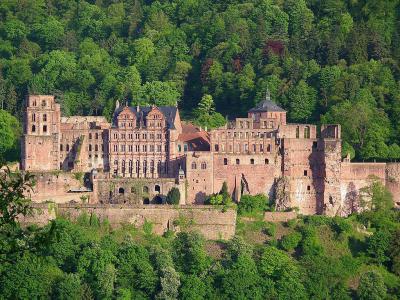
The romantic ruins of this old castle rise over the town, creating a picturesque scene. Built and expanded multiple times between the 13th and 17th centuries, it was originally a heavily fortified Gothic stronghold and the seat of the House of Wittelsbach palatines. In the 16th century, the complex was remodeled into one of Germany's most stunning residences, but its glory was short-lived due to the devastation of the Thirty Years' War and the 1689 war with France, during which most of the structure was destroyed and never rebuilt.
What's most striking here is the architectural variety. The oldest parts still standing date back to the 15th century, though most of the castle was built during the Renaissance in the 16th and 17th centuries when it was the seat of the Palatinate electors. There's an "English wing" built in 1612 by Elector Friedrich V for his teenage Scottish bride, Elizabeth Stuart; its plain, square-window facade stands out against other, more opulent styles. The architectural highlight remains the Renaissance courtyard-harmonious, graceful, and ornate.
Even if you have to wait, make a point of seeing the two-story Great Cask ("Grosses Fass") in the cellar, possibly the world's largest wine barrel, made from 130 oak trees and capable of holding 58,500 gallons. It was used to store wines paid as taxes by wine growers in the Palatinate. Also included in your ticket is the German Pharmacy Museum ("Apotheken-Museum"), where you can see six re-created apothecaries dating back as far as the 17th century, complete with a collection of books, medical instruments and medicine bottles.
In summer there are fireworks displays, on the first Saturday in June and September and the second Saturday in July, to commemorate when the castle went up in flames in 1689, 1693, and 1764 (two of the fires happened during wars with the French, and the last one was caused by lightning). June and July also feature a theater festival, with performances of "The Student Prince" often taking center stage.
Tip:
Skip the hike up the Burgweg and take the Königstuhl Bergbahn (funicular) instead-it's faster and less tiring!
What's most striking here is the architectural variety. The oldest parts still standing date back to the 15th century, though most of the castle was built during the Renaissance in the 16th and 17th centuries when it was the seat of the Palatinate electors. There's an "English wing" built in 1612 by Elector Friedrich V for his teenage Scottish bride, Elizabeth Stuart; its plain, square-window facade stands out against other, more opulent styles. The architectural highlight remains the Renaissance courtyard-harmonious, graceful, and ornate.
Even if you have to wait, make a point of seeing the two-story Great Cask ("Grosses Fass") in the cellar, possibly the world's largest wine barrel, made from 130 oak trees and capable of holding 58,500 gallons. It was used to store wines paid as taxes by wine growers in the Palatinate. Also included in your ticket is the German Pharmacy Museum ("Apotheken-Museum"), where you can see six re-created apothecaries dating back as far as the 17th century, complete with a collection of books, medical instruments and medicine bottles.
In summer there are fireworks displays, on the first Saturday in June and September and the second Saturday in July, to commemorate when the castle went up in flames in 1689, 1693, and 1764 (two of the fires happened during wars with the French, and the last one was caused by lightning). June and July also feature a theater festival, with performances of "The Student Prince" often taking center stage.
Tip:
Skip the hike up the Burgweg and take the Königstuhl Bergbahn (funicular) instead-it's faster and less tiring!
5) Marktplatz (Market Square) (must see)
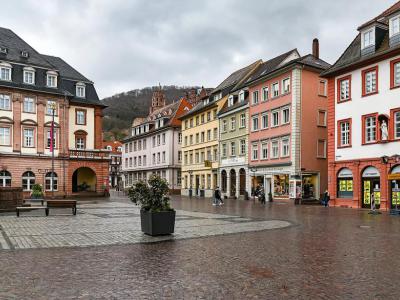
Heidelberg's main square, flanked by the Town Hall ("Rathaus") and the impressive Church of the Holy Spirit ("Heiliggeistkirche"), has been the city's focal point since medieval times. In earlier centuries, it served as the stage for public trials and the grim spectacles of witch burnings and heresy condemnations.
At the heart of the square stands the baroque Hercules Fountain, a testament to the city's resilience in the aftermath of the Thirty Years' War. Crafted by 18th-century artist Heinrich Charrasky, the fountain commemorates the Herculean efforts undertaken to rebuild Heidelberg. Adjacent to it once stood a rotating, hanging cage, serving as a stark reminder of past punishment practices. Those guilty of lesser offenses were incarcerated within, subjected to the scorn of their fellow citizens.
Today, the area bustles with activity, hosting outdoor markets every Wednesday and Saturday. Numerous eateries and cafes line its perimeter, many offering al fresco dining options to soak in the atmosphere. While here, don't miss the opportunity to ascend the church tower for a beautiful panoramic view of the surroundings, available for a small fee.
At the heart of the square stands the baroque Hercules Fountain, a testament to the city's resilience in the aftermath of the Thirty Years' War. Crafted by 18th-century artist Heinrich Charrasky, the fountain commemorates the Herculean efforts undertaken to rebuild Heidelberg. Adjacent to it once stood a rotating, hanging cage, serving as a stark reminder of past punishment practices. Those guilty of lesser offenses were incarcerated within, subjected to the scorn of their fellow citizens.
Today, the area bustles with activity, hosting outdoor markets every Wednesday and Saturday. Numerous eateries and cafes line its perimeter, many offering al fresco dining options to soak in the atmosphere. While here, don't miss the opportunity to ascend the church tower for a beautiful panoramic view of the surroundings, available for a small fee.
6) Bruckentor (Bridge Gate)
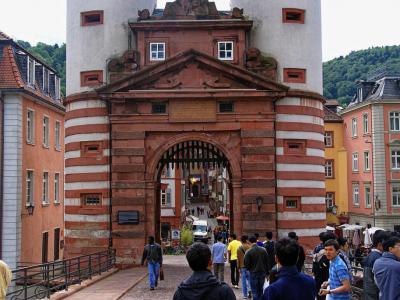
Framing the entrance to the Old Bridge or serving as a picturesque backdrop with the Old Town in the distance, this imposing structure is a true Heidelberg landmark. Originally part of the city's defensive walls, it has stood guard at the northern entrance for centuries, weathering ice floes and fires that ravaged earlier bridges. Close inspection reveals flood marks left by various deluges over the years.
Functioning as both a defensive bastion and a toll collection point, the gate could be securely shut during times of attack, while foreigners seeking passage across the Old Bridge were required to pay a toll. Additionally, it housed guards and even served as a jail, with the eastern tower featuring a spiral staircase leading to the bridge keeper's living quarters, and the western tower containing three detention rooms. Standing at 28 meters (92 feet) tall, these towers miraculously survived the destruction wrought by the French conquest in 1689. In 1788, their original tops replaced with elegant Baroque-style spires.
Today, the gate exudes an unmistakable medieval charm, inviting visitors to step back in time as they meander through Heidelberg's Old Town. For a truly enchanting experience, take a romantic stroll around dusk, and don't forget your camera to capture the views of the Neckar River, the mountains, Heidelberg Castle, and the Old Bridge.
Functioning as both a defensive bastion and a toll collection point, the gate could be securely shut during times of attack, while foreigners seeking passage across the Old Bridge were required to pay a toll. Additionally, it housed guards and even served as a jail, with the eastern tower featuring a spiral staircase leading to the bridge keeper's living quarters, and the western tower containing three detention rooms. Standing at 28 meters (92 feet) tall, these towers miraculously survived the destruction wrought by the French conquest in 1689. In 1788, their original tops replaced with elegant Baroque-style spires.
Today, the gate exudes an unmistakable medieval charm, inviting visitors to step back in time as they meander through Heidelberg's Old Town. For a truly enchanting experience, take a romantic stroll around dusk, and don't forget your camera to capture the views of the Neckar River, the mountains, Heidelberg Castle, and the Old Bridge.
