Custom Walk in Girona, Spain by kingsamui_ca93d created on 2025-05-28
Guide Location: Spain » Girona
Guide Type: Custom Walk
# of Sights: 6
Tour Duration: 1 Hour(s)
Travel Distance: 1.1 Km or 0.7 Miles
Share Key: 4ASR4
Guide Type: Custom Walk
# of Sights: 6
Tour Duration: 1 Hour(s)
Travel Distance: 1.1 Km or 0.7 Miles
Share Key: 4ASR4
How It Works
Please retrieve this walk in the GPSmyCity app. Once done, the app will guide you from one tour stop to the next as if you had a personal tour guide. If you created the walk on this website or come to the page via a link, please follow the instructions below to retrieve the walk in the app.
Retrieve This Walk in App
Step 1. Download the app "GPSmyCity: Walks in 1K+ Cities" on Apple App Store or Google Play Store.



Step 2. In the GPSmyCity app, download(or launch) the guide "Girona Map and Walking Tours".
Step 3. Tap the menu button located at upper right corner of the "Walks" screen and select "Retrieve custom walk". Enter the share key: 4ASR4
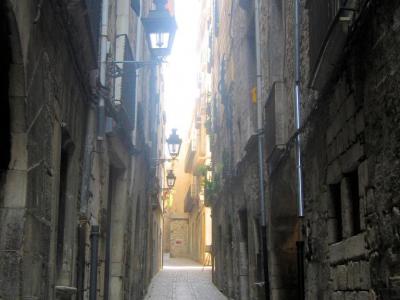
1) Jewish Quarter and Jewish History Museum (must see)
El Call, Girona’s Jewish Quarter, is a labyrinth where history hides in plain sight. Its cobbled alleys and tight stone stairways once held the heartbeat of a Jewish community that flourished here from the 12th to the 15th century. Merchants, craftsmen, and scholars packed these narrow streets, and Girona’s reputation as a centre of learning was cemented by its famed school of Kabbalah. Then came 1492. Spain expelled its Jewish population, leaving behind empty houses and silence where life had once thrived. Yet the quarter endures, every twist of its passageways carrying echoes of that vanished world.
Nestled within this maze is the Museum of Jewish History, housed in what was once a synagogue. Step into its courtyard and you’ll see a bold Star of David carved into the stone-in case you forgot where you are. Inside, eleven rooms unfold the story of Jewish life in Girona and across Catalonia: how families lived, how festivals were celebrated, how medicine, philosophy, and trade were practiced here. Manuscripts, ritual objects, and carefully preserved artifacts breathe life into names that might otherwise be lost. The synagogue also carries the imprint of Nahmanides, the 13th-century rabbi, philosopher, and physician whose wit and wisdom left a mark on Jewish life for generations. What earned him fame was his ability to out-argue kings and out-write just about anyone in medieval Spain. A scale model of the quarter itself helps visitors imagine the district at its height, before its sudden fracture in the late 15th century.
The museum keeps moving forward with new displays and a shop full of books worth carrying home. Yet its real echo is on the streets around it, where every corner is less about sightseeing and more about walking through an archive written in stone, stubbornly refusing to be footnoted into silence.
Nestled within this maze is the Museum of Jewish History, housed in what was once a synagogue. Step into its courtyard and you’ll see a bold Star of David carved into the stone-in case you forgot where you are. Inside, eleven rooms unfold the story of Jewish life in Girona and across Catalonia: how families lived, how festivals were celebrated, how medicine, philosophy, and trade were practiced here. Manuscripts, ritual objects, and carefully preserved artifacts breathe life into names that might otherwise be lost. The synagogue also carries the imprint of Nahmanides, the 13th-century rabbi, philosopher, and physician whose wit and wisdom left a mark on Jewish life for generations. What earned him fame was his ability to out-argue kings and out-write just about anyone in medieval Spain. A scale model of the quarter itself helps visitors imagine the district at its height, before its sudden fracture in the late 15th century.
The museum keeps moving forward with new displays and a shop full of books worth carrying home. Yet its real echo is on the streets around it, where every corner is less about sightseeing and more about walking through an archive written in stone, stubbornly refusing to be footnoted into silence.
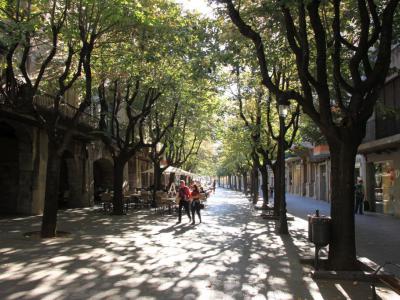
2) Rambla de la Libertad (Freedom Boulevard)
Freedom Boulevard cuts through Girona with the kind of energy that has kept it busy for centuries. Laid out in the 13th century as the town’s market street, it quickly became the economic and social heart of the city. Fast forward to 1869 and a revolutionary gesture changed its name forever: the “Tree of Freedom” was planted here during Spain’s turbulent Six Democratic Years, and the street inherited its present title, swapping old monarchical ties for the spirit of liberal ideals.
The boulevard’s arcaded colonnades still recall the medieval past, when guilds and traders sold their wares beneath the arches. Today those same arcades host shops, restaurants, and cafés, humming with voices and movement. A line of trees and benches runs through the centre, softening the bustle and inviting a catch-a-breath session. Seasonal markets and flower fairs carry on the centuries-old tradition of trade, just with fewer horses and more phone calls.
Along the walk, a few landmarks catch the eye. Norat House, built in 1912, flaunts its Art Nouveau curves, while near the Stone Bridge the Bòlit Contemporary Art Centre brings modern exhibitions into the mix and doubles as the city’s tourist information hub. At the Argenteria Street end, the Trobada Point sculpture places three bronze fingerprints into the pavement-a reminder that this has always been a meeting ground.
This is Girona in shorthand-arches, markets, whispers of the past, and the rhythm of everyday life. Freedom Boulevard may look like a straight line, but it carries centuries in its stride.
The boulevard’s arcaded colonnades still recall the medieval past, when guilds and traders sold their wares beneath the arches. Today those same arcades host shops, restaurants, and cafés, humming with voices and movement. A line of trees and benches runs through the centre, softening the bustle and inviting a catch-a-breath session. Seasonal markets and flower fairs carry on the centuries-old tradition of trade, just with fewer horses and more phone calls.
Along the walk, a few landmarks catch the eye. Norat House, built in 1912, flaunts its Art Nouveau curves, while near the Stone Bridge the Bòlit Contemporary Art Centre brings modern exhibitions into the mix and doubles as the city’s tourist information hub. At the Argenteria Street end, the Trobada Point sculpture places three bronze fingerprints into the pavement-a reminder that this has always been a meeting ground.
This is Girona in shorthand-arches, markets, whispers of the past, and the rhythm of everyday life. Freedom Boulevard may look like a straight line, but it carries centuries in its stride.
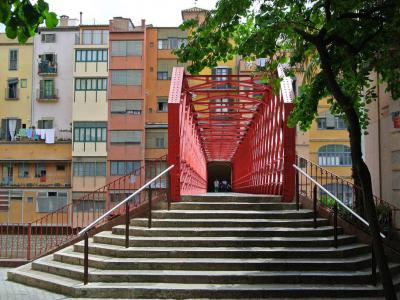
3) Pont de les Peixateries Velles (Eiffel Bridge) (must see)
Stretching across the Onyar River like a bright red exclamation mark is the Eiffel Bridge, Girona’s most photographed walkway. Officially, it’s the Bridge of the Old Fishmongers-locals once hauled their catch nearby-but somewhere along the way, the fish lost out to fame. Built in 1877 by Gustave Eiffel’s workshop, it’s the same engineer who would later bolt together a slightly taller project in Paris. You may have heard of it.
The bridge is all iron lattice, a web of crimson bars that makes you feel as though you’re stepping into a giant piece of geometry homework. It’s only about nine feet wide, and its wooden planks creak just enough underfoot to remind you of its age. At 136 feet long, it doesn’t ask for much walking, but it rewards every step.
Pause midway and the city spills into view: the Onyar flowing beneath you, flanked by a jumble of riverside houses painted in ochres, blues, and pinks-Girona’s most famous postcard in real time. On one side of the bridge lies Freedom Boulevard, a lively strip of shops and cafés that keep the old town buzzing. On the other, the newer part of the city stretches out, with Saint Clara Street leading you straight toward Independence Square.
This isn’t a bridge to cross quickly-it’s a bridge to linger on, to snap a photo or two, and to watch the light play across the river and rooftops. Eiffel built it as a functional crossing; Girona has made it a stage set for daily life.
The bridge is all iron lattice, a web of crimson bars that makes you feel as though you’re stepping into a giant piece of geometry homework. It’s only about nine feet wide, and its wooden planks creak just enough underfoot to remind you of its age. At 136 feet long, it doesn’t ask for much walking, but it rewards every step.
Pause midway and the city spills into view: the Onyar flowing beneath you, flanked by a jumble of riverside houses painted in ochres, blues, and pinks-Girona’s most famous postcard in real time. On one side of the bridge lies Freedom Boulevard, a lively strip of shops and cafés that keep the old town buzzing. On the other, the newer part of the city stretches out, with Saint Clara Street leading you straight toward Independence Square.
This isn’t a bridge to cross quickly-it’s a bridge to linger on, to snap a photo or two, and to watch the light play across the river and rooftops. Eiffel built it as a functional crossing; Girona has made it a stage set for daily life.
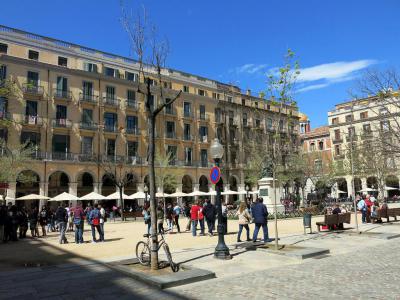
4) Plaza de la Independencia (Independence Square)
Independence Square sits just off the Onyar River, a short step from the Saint Agustí Bridge. The spot once belonged to the old Convent of Saint Agustí, but in the 19th century Girona chose to get itself a civic stage worthy of its name. Speaking of names, it harks back to the War of Spanish Independence, when the city withstood brutal French sieges in 1808 and 1809 and earned its reputation as the place that simply wouldn’t give in.
The architecture has its own quiet discipline: neat neoclassical façades, arcades that march in order around the square, and colonnades that frame the cafés and shops tucked beneath them. At the centre, though, restraint gives way to glory-the Monument to the Defenders of Girona, unveiled in 1894, shows three men locked in battle, a reminder that this square is more than a pretty face. And if you’re after something lighter, look for the “Turtle Boy” fountain at the northern end-a small bronze figure riding a turtle who has charmed generations of Gironins.
For over a century, this has been Girona’s outdoor living room. Its arcades and terraces spill over with chatter, coffee cups, and evening glasses of wine. Benches shaded by trees make it a natural pause point, while the surrounding five-storey buildings give the whole scene a sense of symmetry and elegance. From protests to parades to late-night strolls, the square has always been where Girona gathers.
Today, it’s still the perfect pause between sightseeing stops. Order a cortado, watch the world go by, and then set off-because just beyond these colonnades lie the Onyar’s colourful houses, the city walls, and the cathedral steps waiting for your next climb.
The architecture has its own quiet discipline: neat neoclassical façades, arcades that march in order around the square, and colonnades that frame the cafés and shops tucked beneath them. At the centre, though, restraint gives way to glory-the Monument to the Defenders of Girona, unveiled in 1894, shows three men locked in battle, a reminder that this square is more than a pretty face. And if you’re after something lighter, look for the “Turtle Boy” fountain at the northern end-a small bronze figure riding a turtle who has charmed generations of Gironins.
For over a century, this has been Girona’s outdoor living room. Its arcades and terraces spill over with chatter, coffee cups, and evening glasses of wine. Benches shaded by trees make it a natural pause point, while the surrounding five-storey buildings give the whole scene a sense of symmetry and elegance. From protests to parades to late-night strolls, the square has always been where Girona gathers.
Today, it’s still the perfect pause between sightseeing stops. Order a cortado, watch the world go by, and then set off-because just beyond these colonnades lie the Onyar’s colourful houses, the city walls, and the cathedral steps waiting for your next climb.
5) Casa Maso (Maso House)
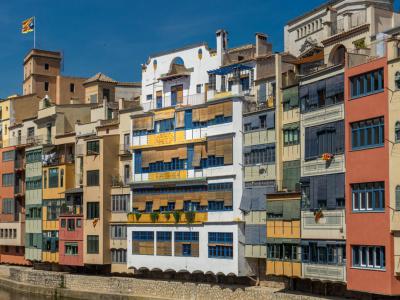
Masó House, perched along Crossbow Street beside the Onyar River, looks like just another of Girona’s riverside façades-until you realize it was the birthplace of Rafael Masó, one of Catalonia’s sharpest architectural minds of the early 20th century. Masó championed Noucentism, a movement that ditched the excesses of Modernism for cleaner lines, Mediterranean calm, and classical balance. His own home became both laboratory and showcase, and today it’s as much a museum as a family residence.
Between 1911 and 1919, Masó stitched together four adjoining houses into one flowing space. From the riverfront you see its distinctive exterior; step inside and you’re dropped straight into the daily life of a well-heeled Catalan household circa 1915. Stained glass, custom woodwork, ceramics, and textiles weren’t mere decoration here-they were Masó’s way of proving art and life should share the same roof. The rooms also display his drawings, models, and personal objects, sketching out a portrait of a man intent on reshaping his city one detail at a time.
Guided tours thread visitors through everything from the dining room and kitchen to the library and bedrooms. Along the way you notice the finer touches-mosaic floors, stained glass windows catching the light, and furnishings designed down to the last curve. Paintings and sculptures from the family’s collection widen the frame, placing Masó’s vision in conversation with the artistic world he inhabited.
For visitors, Masó House isn’t a static museum but a lived-in argument for Noucentism. It ties Girona’s medieval backdrop to its early 20th-century ambitions, while its place among the famous colored houses makes it a landmark in every sense. Step inside, and you’re not just seeing Masó’s work-you’re inhabiting his ideas.
Between 1911 and 1919, Masó stitched together four adjoining houses into one flowing space. From the riverfront you see its distinctive exterior; step inside and you’re dropped straight into the daily life of a well-heeled Catalan household circa 1915. Stained glass, custom woodwork, ceramics, and textiles weren’t mere decoration here-they were Masó’s way of proving art and life should share the same roof. The rooms also display his drawings, models, and personal objects, sketching out a portrait of a man intent on reshaping his city one detail at a time.
Guided tours thread visitors through everything from the dining room and kitchen to the library and bedrooms. Along the way you notice the finer touches-mosaic floors, stained glass windows catching the light, and furnishings designed down to the last curve. Paintings and sculptures from the family’s collection widen the frame, placing Masó’s vision in conversation with the artistic world he inhabited.
For visitors, Masó House isn’t a static museum but a lived-in argument for Noucentism. It ties Girona’s medieval backdrop to its early 20th-century ambitions, while its place among the famous colored houses makes it a landmark in every sense. Step inside, and you’re not just seeing Masó’s work-you’re inhabiting his ideas.
6) Banos Arabes (Arab Baths) (must see)
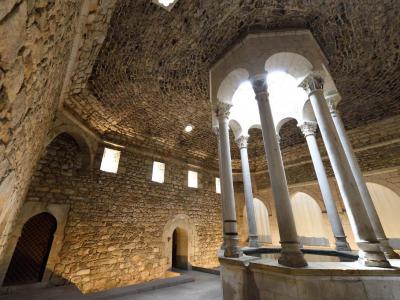
The Arab Baths of Girona sit a stone’s throw from the cathedral, a medieval spa with a misleading name. Built in 1194 by the city’s Christians-not the Moors-the baths borrow ideas from both Roman engineering and Islamic design but are Romanesque to their core. Step inside and you’re walking through a five-room routine that was as much about community as cleanliness. You start in the apodyterium, the dressing room, crowned by an octagonal pool and slender columns that set the scene. From there it’s a temperature tour: the icy frigidarium, the mild tepidarium, and the steam-filled caldarium, kept hot by an ingenious underfloor system, or hypocaust, that turned the whole place into a medieval wellness center.
The baths ran until the 15th century before slipping into decline. By the 1600s they were folded into a Capuchin convent, pressed into service as a pantry and laundry-hardly glamorous, but that recycling is what kept them intact. By the 19th century, people were calling them “Arab Baths,” a name that stuck more out of romantic fancy than historical accuracy. Careful restorations later returned the complex to something close to its medieval look, and today the interplay of light, stone, and geometry makes the rooms feel like a time capsule.
Pop culture gave the site fresh fame when Game of Thrones rolled into town. The baths doubled as Braavos in Arya Stark’s frantic chase through season six, and they reappeared in Oldtown as Samwell Tarly and Gilly arrived at the Citadel. The medieval stonework proved as camera-ready as any computer-generated castle.
Visitors today can wander the hushed interiors, peer up at the domed skylight, and even climb to the rooftop for views across Girona. The baths are more than a curiosity-they’re a reminder of how medieval Girona blended pragmatism, culture, and a touch of borrowed style into something uniquely its own.
The baths ran until the 15th century before slipping into decline. By the 1600s they were folded into a Capuchin convent, pressed into service as a pantry and laundry-hardly glamorous, but that recycling is what kept them intact. By the 19th century, people were calling them “Arab Baths,” a name that stuck more out of romantic fancy than historical accuracy. Careful restorations later returned the complex to something close to its medieval look, and today the interplay of light, stone, and geometry makes the rooms feel like a time capsule.
Pop culture gave the site fresh fame when Game of Thrones rolled into town. The baths doubled as Braavos in Arya Stark’s frantic chase through season six, and they reappeared in Oldtown as Samwell Tarly and Gilly arrived at the Citadel. The medieval stonework proved as camera-ready as any computer-generated castle.
Visitors today can wander the hushed interiors, peer up at the domed skylight, and even climb to the rooftop for views across Girona. The baths are more than a curiosity-they’re a reminder of how medieval Girona blended pragmatism, culture, and a touch of borrowed style into something uniquely its own.
