Custom Walk in Annecy, France by jools_barker29_8ed8e created on 2025-06-05
Guide Location: France » Annecy
Guide Type: Custom Walk
# of Sights: 8
Tour Duration: 2 Hour(s)
Travel Distance: 3 Km or 1.9 Miles
Share Key: 57CV3
Guide Type: Custom Walk
# of Sights: 8
Tour Duration: 2 Hour(s)
Travel Distance: 3 Km or 1.9 Miles
Share Key: 57CV3
How It Works
Please retrieve this walk in the GPSmyCity app. Once done, the app will guide you from one tour stop to the next as if you had a personal tour guide. If you created the walk on this website or come to the page via a link, please follow the instructions below to retrieve the walk in the app.
Retrieve This Walk in App
Step 1. Download the app "GPSmyCity: Walks in 1K+ Cities" on Apple App Store or Google Play Store.



Step 2. In the GPSmyCity app, download(or launch) the guide "Annecy Map and Walking Tours".
Step 3. Tap the menu button located at upper right corner of the "Walks" screen and select "Retrieve custom walk". Enter the share key: 57CV3

1) Palais de l'Isle (Isle Palace) (must see)
The Isle Palace may look like a stone ship but it has tried to be other things. Originally it did not have such an elegant name. The locals refer to it as "The Old Prisons". It sits firmly on a stone island in the River Thiou, in the center of old Annecy.
The palace is a 12th century stronghold rebuilt many times. It has played the roles of river fortress, toll booth, prison, barracks, land registry office, warehouse, mint, Palace of Justice and old age home. Mostly it has been a prison. Today it houses the Center for the Interpretation of Architecture and Heritage (CIAP).
The shape of the island fortress is like a ship seen bow-on. It divides the river into two canals. The late 12th century lower loge houses museum exhibitions. Two small bridges connect to the island. Pass over into the entrance courtyard and find the facade of the castle next to a four-sided tower that holds a spiral staircase.
On the left are the "banches" (counters) of the lawyers from the Palace of Justice days. On the right is the 14th century coin-minting wing and the entrance to the castle. The lower floor has four rooms with vaulted ceilings and arches and it includes the old jail kitchen.
The Tower Loge, once used in the administration of justice, is on the north side of the palace. It has a facade made from river stones and limestone. There three prison cells, a hearing room and the old Court of Justice. The rooms have panels on the history of the town. The 15th century spiral staircase connects to two upper floors.
The palace can be reached via footbridge of Isle Passage. The permanent museum exhibition is concerned with the history and heritage of Annecy. There are audio-visual presentations in French. Combination tickets to both the Isle Palace and Annecy Castle are available.
Why You Should Visit:
There is no other building like it. It affirms Annecy's standing as the "Venice of the Alps."
The palace is a 12th century stronghold rebuilt many times. It has played the roles of river fortress, toll booth, prison, barracks, land registry office, warehouse, mint, Palace of Justice and old age home. Mostly it has been a prison. Today it houses the Center for the Interpretation of Architecture and Heritage (CIAP).
The shape of the island fortress is like a ship seen bow-on. It divides the river into two canals. The late 12th century lower loge houses museum exhibitions. Two small bridges connect to the island. Pass over into the entrance courtyard and find the facade of the castle next to a four-sided tower that holds a spiral staircase.
On the left are the "banches" (counters) of the lawyers from the Palace of Justice days. On the right is the 14th century coin-minting wing and the entrance to the castle. The lower floor has four rooms with vaulted ceilings and arches and it includes the old jail kitchen.
The Tower Loge, once used in the administration of justice, is on the north side of the palace. It has a facade made from river stones and limestone. There three prison cells, a hearing room and the old Court of Justice. The rooms have panels on the history of the town. The 15th century spiral staircase connects to two upper floors.
The palace can be reached via footbridge of Isle Passage. The permanent museum exhibition is concerned with the history and heritage of Annecy. There are audio-visual presentations in French. Combination tickets to both the Isle Palace and Annecy Castle are available.
Why You Should Visit:
There is no other building like it. It affirms Annecy's standing as the "Venice of the Alps."

2) Meyer Le Chocolatier d'Annecy
Nestled in the heart of Annecy’s charming Old Town, Meyer Le Chocolatier is more than a chocolate shop-it's a family legacy that has delighted locals and visitors alike since its founding in 1985. Established by Louis and Huguette Meyer, this chocolate haven has grown into a true institution, now managed by their son Bruno, who oversees production, and his wife Sandrine, who handles sales.
Renovated in 2023, the boutique in Annecy’s city center invites you into a world of indulgence with the irresistible aroma of chocolate. The shelves are brimming with handmade delights: truffles, bars, biscuits, cakes, meringues, and their iconic Roseaux du Lac d’Annecy, a must-try treat. Every creation is crafted with care and expertise in their workshop in nearby Poisy, where their second shop and cutting-edge laboratory are located.
Meyer Chocolatier stands out not only for its exceptional chocolates but also for its personalized creations. From birthdays and weddings to corporate gifts, the Meyers transform chocolate into edible works of art that promise to dazzle both the eyes and the taste buds. Their creative catalog caters to every occasion, making Meyer the perfect destination for unique, heartfelt gifts.
Close to Saint François Church, this delightful boutique is a top destination for luxury chocolate in Annecy, offering a selection of beautifully packaged sweets that make perfect souvenirs or thoughtful presents. Whether you’re treating yourself or someone special, the welcoming team at Meyer is always ready to share their passion for chocolate.
Renovated in 2023, the boutique in Annecy’s city center invites you into a world of indulgence with the irresistible aroma of chocolate. The shelves are brimming with handmade delights: truffles, bars, biscuits, cakes, meringues, and their iconic Roseaux du Lac d’Annecy, a must-try treat. Every creation is crafted with care and expertise in their workshop in nearby Poisy, where their second shop and cutting-edge laboratory are located.
Meyer Chocolatier stands out not only for its exceptional chocolates but also for its personalized creations. From birthdays and weddings to corporate gifts, the Meyers transform chocolate into edible works of art that promise to dazzle both the eyes and the taste buds. Their creative catalog caters to every occasion, making Meyer the perfect destination for unique, heartfelt gifts.
Close to Saint François Church, this delightful boutique is a top destination for luxury chocolate in Annecy, offering a selection of beautifully packaged sweets that make perfect souvenirs or thoughtful presents. Whether you’re treating yourself or someone special, the welcoming team at Meyer is always ready to share their passion for chocolate.
3) Pont des Amours (Bridge of Love) (must see)
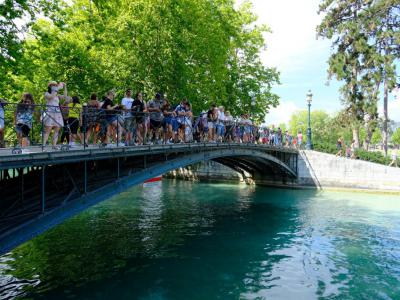
Some say the Public Gardens Footbridge was built simply to connect the Plaquier to the Gardens of Europe. So, why does everyone call it the "Bridge of Love"? There is a popular legend that if two lovers meet in the middle of the bridge and kiss they will stay together forever. Cynics claim it is a favorite place for ladies of the night.
Located on the shores of Lake Annecy by the Vasse Canal, it does provide easy access to the gardens for couples looking for serenity. Whatever the legend, the bridge, to this day, is more than a busy walkway. It is a romantic passage to a trusted trysting place with captivating views of the city, the mountains and the lake.
The first footbridge plans to connect the Lombard Clos (now the Gardens of Europe) with the Plauier esplanade were put forward in 1836. In 1845 Charles-Albert, the King of Piedmont-Sardinia, came to call and a wooden bridge was erected so spectators could view the light show over the canal. The King liked it too.
In 1859 another footbridge replaced the the wooden one. It had three cast iron arches installed by Clude Grandchamp and it was called "public garden footbridge." It was an improvement and it was durable but too low to accommodate boat traffic and it was high maintenance.
At last, in 1907, the city replaced the cast iron bridge with a new iron construction by architect Gaspard Fruauf.
On one side see an esplanade lined with trees. On the other a crystal alpine lake framed by rugged mountains. On a clear summer day people line the rail, enjoying the view of the lake and canal. In Autumn, on a rainy day, the bridge belongs to oneself. The views are fantastic in a different way and thoughts are one's own.
Located on the shores of Lake Annecy by the Vasse Canal, it does provide easy access to the gardens for couples looking for serenity. Whatever the legend, the bridge, to this day, is more than a busy walkway. It is a romantic passage to a trusted trysting place with captivating views of the city, the mountains and the lake.
The first footbridge plans to connect the Lombard Clos (now the Gardens of Europe) with the Plauier esplanade were put forward in 1836. In 1845 Charles-Albert, the King of Piedmont-Sardinia, came to call and a wooden bridge was erected so spectators could view the light show over the canal. The King liked it too.
In 1859 another footbridge replaced the the wooden one. It had three cast iron arches installed by Clude Grandchamp and it was called "public garden footbridge." It was an improvement and it was durable but too low to accommodate boat traffic and it was high maintenance.
At last, in 1907, the city replaced the cast iron bridge with a new iron construction by architect Gaspard Fruauf.
On one side see an esplanade lined with trees. On the other a crystal alpine lake framed by rugged mountains. On a clear summer day people line the rail, enjoying the view of the lake and canal. In Autumn, on a rainy day, the bridge belongs to oneself. The views are fantastic in a different way and thoughts are one's own.
4) Basilique de la Visitation (Visitation Basilica) (must see)
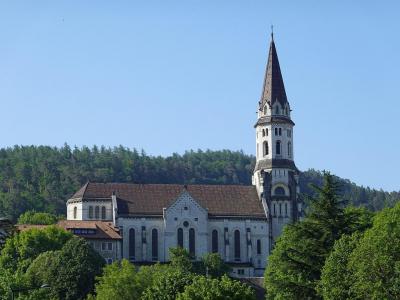
The Basilica of the Visitation dominates the sky from its high rocky seat on the cret du Maure, a peak of the Semnoz massif of south-eastern France. It is an aspiring declaration in stone, visible for miles around the city of Annecy.
Not a medieval edifice, the basilica was started in 1909 and completed in 1930. It was based on the plans of architect Alfred-Henri Recoura. It is connected to the mother house monastery of the Order of the Visitation. The Visitandines order was founded in 1610 by Saint Francis de Sales and Saint Jeanne de Chantal.
The remains of the two saints are in the side naves of the basilica in gilded bronze sarcophagi. The basilica style is typical late 19th century. The bell tower spire reaches a height of 275 feet, topped by a 28 foot cross. The nave is built over a crypt designed by architect Henri Ade.
The vault of the nave is in a semicircular arch. Stained glass windows depict events in the lives of the two celebrated saints. This bell tower actually has bells. It holds a carillon of 38 bells. That's eight tons of bells. One bell, by the name of Marie Francoise, weighs four tons.
Not a medieval edifice, the basilica was started in 1909 and completed in 1930. It was based on the plans of architect Alfred-Henri Recoura. It is connected to the mother house monastery of the Order of the Visitation. The Visitandines order was founded in 1610 by Saint Francis de Sales and Saint Jeanne de Chantal.
The remains of the two saints are in the side naves of the basilica in gilded bronze sarcophagi. The basilica style is typical late 19th century. The bell tower spire reaches a height of 275 feet, topped by a 28 foot cross. The nave is built over a crypt designed by architect Henri Ade.
The vault of the nave is in a semicircular arch. Stained glass windows depict events in the lives of the two celebrated saints. This bell tower actually has bells. It holds a carillon of 38 bells. That's eight tons of bells. One bell, by the name of Marie Francoise, weighs four tons.
5) Château d'Annecy (Annecy Castle) (must see)
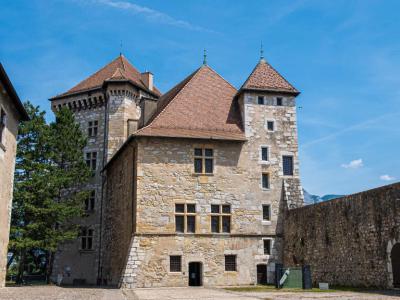
Tucked away beside a lake in the old town of Annecy in the mountains of southeastern France, is the venerable 12th century Chateau d'Annecy. In 1959 it was listed as a historical monument by the Ministry of Culture. The Counts of Geneva and the Dukes of Genvois-Nemours, former tenants of the castle, would be pleased.
Sadly, the castle proved to be a firetrap and it was abandoned in the 17th century. It was repaired soon enough but the glory days of counts and dukes were over. It became a barracks. The castle closed down in 1947 but it was purchased by the town of Annecy in 1953. Et voila! It became a museum.
The castle is divided into towers and loggias called "logis." The Queen's Tower was erected in the twelfth century. Its walls are 13 feet thick. It has aged very well. Together with the Logis Perriere, it houses the Regional Observatory of the Alpine Lakes. The Logis Perriere dates from the 15th century.
Other Logis of the Castle are the Old Logis, the Logis Nemours and Logis Neuf. Besides the observatory, the castle houses the Museum of Alpine Popular Art. The museum collection has sculptures and paintings from surrounding regions. The castle also houses 15th century furniture and photographs and scale models of Alpine architecture.
In the Observatory there are artifacts and evidence of prehistoric lakeside settlements. Exhibits include aquariums holding different species of freshwater fish. There are examples of fishing equipment and boats used in the Alps and a scale model of Lake Annecy and its environs. And yes, there are birds.
Why You Should Visit:
Above all, stunning views of the lake and the surrounding landscape.
Tips:
There is a modest entrance fee. Parking is possible but walking up to the Castle through the old town have its rewards.
Sadly, the castle proved to be a firetrap and it was abandoned in the 17th century. It was repaired soon enough but the glory days of counts and dukes were over. It became a barracks. The castle closed down in 1947 but it was purchased by the town of Annecy in 1953. Et voila! It became a museum.
The castle is divided into towers and loggias called "logis." The Queen's Tower was erected in the twelfth century. Its walls are 13 feet thick. It has aged very well. Together with the Logis Perriere, it houses the Regional Observatory of the Alpine Lakes. The Logis Perriere dates from the 15th century.
Other Logis of the Castle are the Old Logis, the Logis Nemours and Logis Neuf. Besides the observatory, the castle houses the Museum of Alpine Popular Art. The museum collection has sculptures and paintings from surrounding regions. The castle also houses 15th century furniture and photographs and scale models of Alpine architecture.
In the Observatory there are artifacts and evidence of prehistoric lakeside settlements. Exhibits include aquariums holding different species of freshwater fish. There are examples of fishing equipment and boats used in the Alps and a scale model of Lake Annecy and its environs. And yes, there are birds.
Why You Should Visit:
Above all, stunning views of the lake and the surrounding landscape.
Tips:
There is a modest entrance fee. Parking is possible but walking up to the Castle through the old town have its rewards.
6) The Old Town
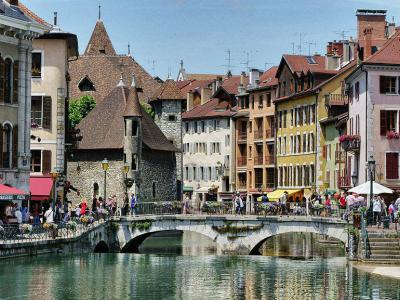
The Old Town of Annecy, often called the "Venice of the Alps," is a stunning medieval gem nestled by the azure waters of Lake Annecy. This picturesque quarter, built around the 14th-century Chateau d’Annecy, is interwoven with canals and the Thiou River, Europe's shortest river at just 3.5 kilometers. These waterways not only give the town its nickname but also lend it a unique charm that visitors can explore on foot. The pedestrian-friendly streets make it an accessible and inviting destination for all.
Annecy's Old Town boasts colorful medieval facades in shades of yellow, pink, and green, many of which were rebuilt in stone after devastating fires in the 15th century. These renovations, encouraged by the Duke of Savoy, created the architectural unity visible today. Stroll along Sainte-Claire Street, the heart of the town, lined with shaded arcades from the Renaissance era. Here, vibrant markets and bustling cafes capture the lively spirit of Annecy.
At the heart of Annecy, the Island Palace (Palais de l’Ile), a 12th-century ship-shaped landmark, sits surrounded by the Thiou River and now houses an architectural heritage center. Overlooking the town, the Annecy Castle (Chateau d’Annecy) offers stunning views and historical exhibits, while the nearby Gardens of Europe provide a peaceful lakeside retreat. For a closer look at Lake Annecy, rent a boat or join a scenic water tour.
Annecy is also home to several notable churches, including the 17th-century Eglise Saint-François de Sales, the 15th-century Eglise Saint-Maurice, and the 19th-century Eglise Notre-Dame-de-Liesse, each showcasing different periods of architectural splendor.
A Sunday visit offers the bonus of a vibrant market that weaves through the Old Town's narrow streets, filling the air with the aroma of fresh produce and local delicacies. For history enthusiasts, Annecy’s roots trace back to the 12th century when its strategic location along the Thiou supported thriving craft industries.
Whether wandering its stone-paved streets, admiring its canals, or enjoying its markets, Annecy’s Old Town is a destination where history, culture, and natural beauty converge.
Annecy's Old Town boasts colorful medieval facades in shades of yellow, pink, and green, many of which were rebuilt in stone after devastating fires in the 15th century. These renovations, encouraged by the Duke of Savoy, created the architectural unity visible today. Stroll along Sainte-Claire Street, the heart of the town, lined with shaded arcades from the Renaissance era. Here, vibrant markets and bustling cafes capture the lively spirit of Annecy.
At the heart of Annecy, the Island Palace (Palais de l’Ile), a 12th-century ship-shaped landmark, sits surrounded by the Thiou River and now houses an architectural heritage center. Overlooking the town, the Annecy Castle (Chateau d’Annecy) offers stunning views and historical exhibits, while the nearby Gardens of Europe provide a peaceful lakeside retreat. For a closer look at Lake Annecy, rent a boat or join a scenic water tour.
Annecy is also home to several notable churches, including the 17th-century Eglise Saint-François de Sales, the 15th-century Eglise Saint-Maurice, and the 19th-century Eglise Notre-Dame-de-Liesse, each showcasing different periods of architectural splendor.
A Sunday visit offers the bonus of a vibrant market that weaves through the Old Town's narrow streets, filling the air with the aroma of fresh produce and local delicacies. For history enthusiasts, Annecy’s roots trace back to the 12th century when its strategic location along the Thiou supported thriving craft industries.
Whether wandering its stone-paved streets, admiring its canals, or enjoying its markets, Annecy’s Old Town is a destination where history, culture, and natural beauty converge.
7) Annecy Cathedral (must see)
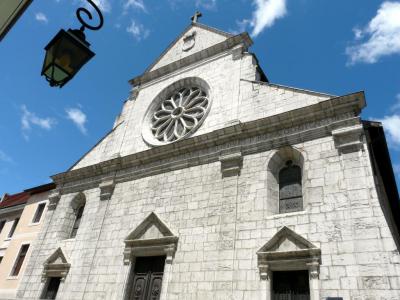
Formally known as the Cathedral of Saint Peter in Chains, Annecy Cathedral was listed as a historic monument in October 1906. The original edifice was built by Jacques Rossel sometime before 1526. It was intended to be a convent of the Celestins but in 1538 it became a haven for Catholic refugees from Calvinism in Geneva.
Saint Francis de Sales held the seat of Bishop there in the 16th century. In 1792, during the time of the French Revolution, the church was miraculously converted into a temple of the Goddess Reason. The Goddess reigned supreme for a time but she was unseated in the Napoleonic era. The status Cathedral was awarded in 1822.
The Renaissance facade of 1535 was adapted from the Roman model of the Church of Sainte-Marie-du-Peuple. The facade masks the basilica aspects of the cathedral. It has Tuscan pilasters under a triangular pediment and a classic Gothic rose window. The bell tower holds two bells by the Paccard Foundry in Sevrier.
There are two pointed arches similar to those of Jacques Rossel installed in 1511 on the tower of Geneva Cathedral. The choir was refurbished in 1775 by architect Giovanni Piacenza. The organ of the Cathedral is by Nicolas-Antoine Lete, organ builder to the King in 1842.
The layout of the Cathedral is similar to a basilica. It has three naves and five bays. The choir is done-over as neoclassical, brightly illuminated by stained glass windows.
The Cathedral is open to the public everyday.
Saint Francis de Sales held the seat of Bishop there in the 16th century. In 1792, during the time of the French Revolution, the church was miraculously converted into a temple of the Goddess Reason. The Goddess reigned supreme for a time but she was unseated in the Napoleonic era. The status Cathedral was awarded in 1822.
The Renaissance facade of 1535 was adapted from the Roman model of the Church of Sainte-Marie-du-Peuple. The facade masks the basilica aspects of the cathedral. It has Tuscan pilasters under a triangular pediment and a classic Gothic rose window. The bell tower holds two bells by the Paccard Foundry in Sevrier.
There are two pointed arches similar to those of Jacques Rossel installed in 1511 on the tower of Geneva Cathedral. The choir was refurbished in 1775 by architect Giovanni Piacenza. The organ of the Cathedral is by Nicolas-Antoine Lete, organ builder to the King in 1842.
The layout of the Cathedral is similar to a basilica. It has three naves and five bays. The choir is done-over as neoclassical, brightly illuminated by stained glass windows.
The Cathedral is open to the public everyday.

8) Le Tetras
Nestled in the heart of Annecy’s charming Old Town, Le Tetras is a delightful pottery shop celebrated as one of the most beautiful of its kind in the region. Small yet exquisitely decorated, this inviting boutique attracts both tourists and locals alike, offering a treasure trove of handcrafted ceramics and pottery.
Le Tetras specializes in traditional glazed pottery, showcasing motifs inspired by Savoie and Haute-Savoie. From hearts and polka dots to mountain pastures, the designs are simple, charming, and full of character. The pieces-ranging from mugs, pitchers, and vases to pots and oven-safe dishes-are crafted by a collective of around ten talented potters. Each item reflects the region’s artistic heritage and the meticulous care of its artisans.
Renowned for its high-quality materials and authentic techniques, Le Tetras guarantees the durability and uniqueness of every creation. The shop embraces an eco-conscious philosophy, using primarily local raw materials to reduce its environmental footprint. This sustainable approach has earned it a loyal following among customers who value responsible craftsmanship.
Situated on Jean-Jacques Rousseau Street, Le Tetras offers a colorful and welcoming atmosphere. Visitors are greeted by a warm staff and displays brimming with vibrant ceramics. Beyond shopping, the store hosts workshops where guests can engage with pottery artisans and learn the craft of ceramic-making.
Open year-round, Le Tetras is not just a shop but an experience-an opportunity to bring home a piece of Annecy’s cultural and artistic soul. Whether it’s a beautifully glazed tea cup or a ceramic pot for aromatic herbs, every item from Le Tétras is a testament to passion and tradition.
Le Tetras specializes in traditional glazed pottery, showcasing motifs inspired by Savoie and Haute-Savoie. From hearts and polka dots to mountain pastures, the designs are simple, charming, and full of character. The pieces-ranging from mugs, pitchers, and vases to pots and oven-safe dishes-are crafted by a collective of around ten talented potters. Each item reflects the region’s artistic heritage and the meticulous care of its artisans.
Renowned for its high-quality materials and authentic techniques, Le Tetras guarantees the durability and uniqueness of every creation. The shop embraces an eco-conscious philosophy, using primarily local raw materials to reduce its environmental footprint. This sustainable approach has earned it a loyal following among customers who value responsible craftsmanship.
Situated on Jean-Jacques Rousseau Street, Le Tetras offers a colorful and welcoming atmosphere. Visitors are greeted by a warm staff and displays brimming with vibrant ceramics. Beyond shopping, the store hosts workshops where guests can engage with pottery artisans and learn the craft of ceramic-making.
Open year-round, Le Tetras is not just a shop but an experience-an opportunity to bring home a piece of Annecy’s cultural and artistic soul. Whether it’s a beautifully glazed tea cup or a ceramic pot for aromatic herbs, every item from Le Tétras is a testament to passion and tradition.
