Custom Walk in Aarhus, Denmark by morrisdana_395d5 created on 2025-08-15
Guide Location: Denmark » Aarhus
Guide Type: Custom Walk
# of Sights: 18
Tour Duration: 4 Hour(s)
Travel Distance: 7.2 Km or 4.5 Miles
Share Key: 5AQFP
Guide Type: Custom Walk
# of Sights: 18
Tour Duration: 4 Hour(s)
Travel Distance: 7.2 Km or 4.5 Miles
Share Key: 5AQFP
How It Works
Please retrieve this walk in the GPSmyCity app. Once done, the app will guide you from one tour stop to the next as if you had a personal tour guide. If you created the walk on this website or come to the page via a link, please follow the instructions below to retrieve the walk in the app.
Retrieve This Walk in App
Step 1. Download the app "GPSmyCity: Walks in 1K+ Cities" on Apple App Store or Google Play Store.



Step 2. In the GPSmyCity app, download(or launch) the guide "Aarhus Map and Walking Tours".
Step 3. Tap the menu button located at upper right corner of the "Walks" screen and select "Retrieve custom walk". Enter the share key: 5AQFP

1) Aarhus cruise berth 129/131
This custom location is created on gpsmycity.com website.
2) Agnete and the Merman
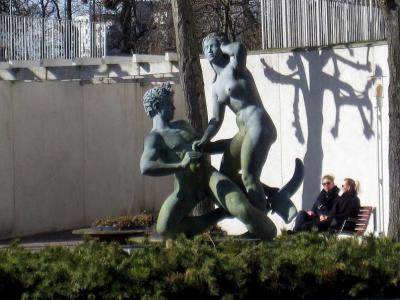
"Agnete and the Merman" (Agnete og Havmanden) is a notable bronze sculpture and fountain situated near the Aarhus City Hall in Park Allé, Aarhus. This intriguing work was sculpted by the Danish artist Johannes Clausen Bjerg and finished in 1940. Inspired by the dramatic and elongated forms characteristic of El Greco's paintings, Bjerg's sculpture offers a robust and slightly exaggerated depiction of human figures, enhancing the drama and motion embodied in the fountain's design.
The sculpture tells the story of Agnete, a woman from Danish folklore, who is seduced by a merman and lives with him under the sea. This narrative is captured in a traditional folk song and has been the subject of literary exploration by notable Danish writers like Adam Oehlenschläger and Hans Christian Andersen. In the sculpture, Agnete's love and eventual departure from the merman and their children are poignantly depicted, adding a layer of emotional depth and cultural resonance to the work.
Originally intended for placement at a swimming pool, the sculpture was instead unveiled on July 1, 1941, at its current location south of the newly built town hall. The sculpture has undergone several renovations, notably in 1955 and again in 1993 when it was temporarily moved to Copenhagen for restoration.
"Agnete and the Merman" is more than just a piece of public art; it actively participates in the cultural life of Aarhus. It is a popular site for city events, especially attracting new students and residents who often celebrate summer by bathing in its fountain, sometimes playfully adding bubble baths. This vibrant engagement with the local community underscores the sculpture's enduring appeal and its role as a focal point in Aarhus's cultural and social activities.
The sculpture tells the story of Agnete, a woman from Danish folklore, who is seduced by a merman and lives with him under the sea. This narrative is captured in a traditional folk song and has been the subject of literary exploration by notable Danish writers like Adam Oehlenschläger and Hans Christian Andersen. In the sculpture, Agnete's love and eventual departure from the merman and their children are poignantly depicted, adding a layer of emotional depth and cultural resonance to the work.
Originally intended for placement at a swimming pool, the sculpture was instead unveiled on July 1, 1941, at its current location south of the newly built town hall. The sculpture has undergone several renovations, notably in 1955 and again in 1993 when it was temporarily moved to Copenhagen for restoration.
"Agnete and the Merman" is more than just a piece of public art; it actively participates in the cultural life of Aarhus. It is a popular site for city events, especially attracting new students and residents who often celebrate summer by bathing in its fountain, sometimes playfully adding bubble baths. This vibrant engagement with the local community underscores the sculpture's enduring appeal and its role as a focal point in Aarhus's cultural and social activities.
3) Den Svangre (Pregnant Woman)
"The Pregnant Woman" (Den Svangre) is a notable public sculpture located in the City Hall Park of Aarhus. This piece is an exemplary work of Danish sculptor Jens Galschiøt, renowned for his art that frequently explores themes of human rights and social justice. The sculpture was initially crafted in granite and unveiled in 1955, but to preserve its integrity, it was later bronzed.
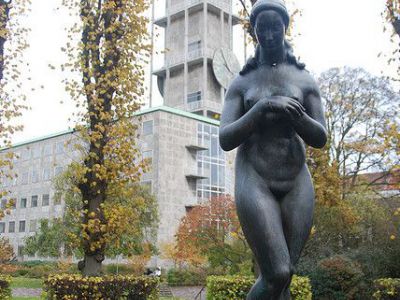
The artwork strikingly depicts a life-size pregnant woman standing with hands resting gently on her belly, a pose that captures the nurturing essence of motherhood and the expectancy of new life. The realistic detailing of the sculpture highlights the physical transformation during pregnancy, celebrating the strength and resilience of expectant mothers. Through its realistic representation, the sculpture emphasizes both the beauty and complexity of pregnancy.
Placed in a vibrant public space, "Den Svangre" serves as more than just a visual piece. It acts as a catalyst for reflection and discussion on broader societal themes such as the role of women, maternal health, and body autonomy. The strategic installation of the sculpture in this busy communal area allows it to engage passersby, provoking thought and discussion on these critical issues.
"Den Svangre" enriches the cultural landscape of Aarhus, illustrating how public art can simultaneously beautify a space and serve as a profound societal commentary. This sculpture is not only a celebration of maternal beauty but also an invitation to contemplate and converse on significant social justice topics, making it a vital part of the community's artistic and cultural heritage.
The artwork strikingly depicts a life-size pregnant woman standing with hands resting gently on her belly, a pose that captures the nurturing essence of motherhood and the expectancy of new life. The realistic detailing of the sculpture highlights the physical transformation during pregnancy, celebrating the strength and resilience of expectant mothers. Through its realistic representation, the sculpture emphasizes both the beauty and complexity of pregnancy.
Placed in a vibrant public space, "Den Svangre" serves as more than just a visual piece. It acts as a catalyst for reflection and discussion on broader societal themes such as the role of women, maternal health, and body autonomy. The strategic installation of the sculpture in this busy communal area allows it to engage passersby, provoking thought and discussion on these critical issues.
"Den Svangre" enriches the cultural landscape of Aarhus, illustrating how public art can simultaneously beautify a space and serve as a profound societal commentary. This sculpture is not only a celebration of maternal beauty but also an invitation to contemplate and converse on significant social justice topics, making it a vital part of the community's artistic and cultural heritage.
4) Concert Hall
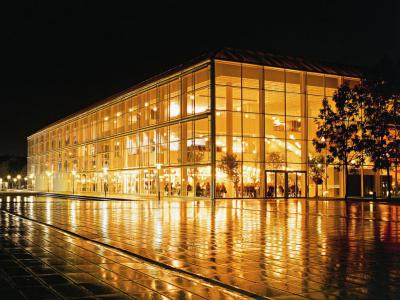
The Concert Hall in Aarhus stands as Scandinavia's largest concert venue and a beacon of cultural vibrancy. Officially opened in 1982, this architectural gem was designed by the local firm Kjær & Richter and later expanded in 2007 to include additional halls and facilities by another local firm, C.F. Møller. Today, it spans an impressive 35,000 square meters, featuring nine concert halls, six stages, and 500 rooms, making it a central hub for musical and cultural education.
Home to the Royal Academy of Music in Aarhus, the Aarhus Symphony Orchestra, and the Danish National Opera, the Concert Hall enriches the musical landscape of the region. It hosts an astounding array of over 1,500 events annually, drawing up to a million guests each year. The diverse programming includes everything from pop, rock, and opera to baroque music, featuring both student performers and international stars.
Not just a venue for music, the Concert Hall of Aarhus offers a wide range of live experiences designed to evoke every emotion-from laughter to tears. Its lineup includes children’s shows, musicals, comedy, dance, theater, and more, alongside traditional concert performances. It also serves as a versatile space for meetings, business events, and conferences. Visitors can enjoy the free activities available, dine at the onsite café, or explore the flavors of the brasserie and cocktail bar, Maestro.
Over the years, the Concert Hall has hosted an impressive list of performers, including Bob Dylan, The Beach Boys, Tina Turner, and Placido Domingo, among others. This rich history of distinguished performances solidifies its reputation as not only a local cultural center but also an important venue on the international music scene.
Home to the Royal Academy of Music in Aarhus, the Aarhus Symphony Orchestra, and the Danish National Opera, the Concert Hall enriches the musical landscape of the region. It hosts an astounding array of over 1,500 events annually, drawing up to a million guests each year. The diverse programming includes everything from pop, rock, and opera to baroque music, featuring both student performers and international stars.
Not just a venue for music, the Concert Hall of Aarhus offers a wide range of live experiences designed to evoke every emotion-from laughter to tears. Its lineup includes children’s shows, musicals, comedy, dance, theater, and more, alongside traditional concert performances. It also serves as a versatile space for meetings, business events, and conferences. Visitors can enjoy the free activities available, dine at the onsite café, or explore the flavors of the brasserie and cocktail bar, Maestro.
Over the years, the Concert Hall has hosted an impressive list of performers, including Bob Dylan, The Beach Boys, Tina Turner, and Placido Domingo, among others. This rich history of distinguished performances solidifies its reputation as not only a local cultural center but also an important venue on the international music scene.
5) Grisebrønden (Well of Pigs)
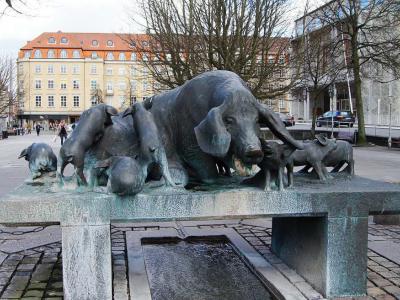
The Grisebrønden, or Well of Pigs, is a notable sculpture located in City Hall Square in Aarhus. This artwork, designed by the Danish sculptor Mogens Bøggild, was originally gifted to the city in 1941 by Ceres, a prominent local brewery. The sculpture represents a significant piece of local culture and history, reflecting both artistic expression and corporate patronage.
Originally crafted in granite, the sculpture became a victim of repeated vandalism, leading to the decision to replace it with a more durable bronze replica in 1992. The replica, which currently stands in the original location, ensures the artwork's continued presence and reduces susceptibility to damage. The original granite sculpture has been relocated to Skejby, a nearby area, where it still exists.
Ceres, the brewery behind the donation, played an essential role in the local economy until the closure and subsequent demolition of its main factory in central Aarhus in 2008. This transition marked the end of an era for Ceres but left a lasting legacy through contributions like the Grisebrønden.
The Well of Pigs not only enhances the urban landscape of Aarhus but also serves as a symbol of the intertwining of art, industry, and community in the city's history.
Originally crafted in granite, the sculpture became a victim of repeated vandalism, leading to the decision to replace it with a more durable bronze replica in 1992. The replica, which currently stands in the original location, ensures the artwork's continued presence and reduces susceptibility to damage. The original granite sculpture has been relocated to Skejby, a nearby area, where it still exists.
Ceres, the brewery behind the donation, played an essential role in the local economy until the closure and subsequent demolition of its main factory in central Aarhus in 2008. This transition marked the end of an era for Ceres but left a lasting legacy through contributions like the Grisebrønden.
The Well of Pigs not only enhances the urban landscape of Aarhus but also serves as a symbol of the intertwining of art, industry, and community in the city's history.
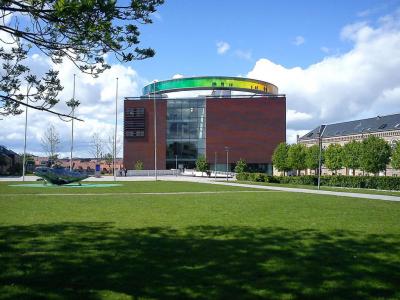
6) ARos Aarhus Kunstmuseum (ARoS Aarhus Art Mseum) (must see)
ARoS Aarhus Art Museum was first established in 1859. A new building was constructed in 2004 to provide space to the various exhibitions. The 10-story tall building was designed by architects Schmidt Hammer Lassen in a Modern architectural style. ARoS Aarhus Art Museum is now one of the largest art museums in Northern Europe.
The museum offers permanent and changing exhibitions. It also has a gift shop, a cafe and a restaurant. One of the most popular features of ARoS Aarhus Art Museum is the skywalk. Your Rainbow, crafted by Olafur Eliasson, offers a 360-degree view. It allows patrons to walk through the art installation and become part of the rainbow.
The permanent exhibit at ARoS Aarhus Art Museum includes art from the Danish Golden Age as well as from artists like Andy Warhol and Roy Lichtenstein. Revolving exhibits feature art, architecture and historical artifacts.
The museum offers permanent and changing exhibitions. It also has a gift shop, a cafe and a restaurant. One of the most popular features of ARoS Aarhus Art Museum is the skywalk. Your Rainbow, crafted by Olafur Eliasson, offers a 360-degree view. It allows patrons to walk through the art installation and become part of the rainbow.
The permanent exhibit at ARoS Aarhus Art Museum includes art from the Danish Golden Age as well as from artists like Andy Warhol and Roy Lichtenstein. Revolving exhibits feature art, architecture and historical artifacts.
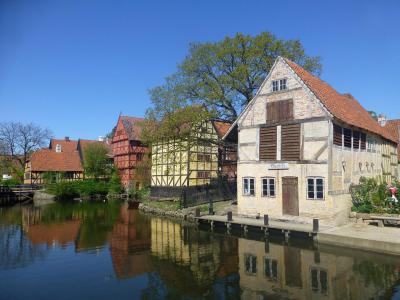
7) Den Gamle By (Old Town Open-Air Museum) (must see)
The Old Town Open-Air Museum in Aarhus was the world's first open-air museum of its kind when it opened in 1914. It focuses on the culture of the town with more than 75 historical buildings decorated in historical style and displaying exhibits of permanent and revolving themes.
The buildings in the Old Town Open-Air Museum cover a wide swath of time. Some were constructed in 1550 while others weren't built until the late-19th century. The buildings were brought in from all over the country and placed in the botanical gardens for the purpose of opening this museum.
Buildings located in the open-air museum include workshops, grocers, shops, historical gardens, a post office, a customs office, a school and a theatre. Museum staff work in historic roles like merchants and blacksmiths.
There are five permanent exhibits in the museum. These include the Danish Clock Museum, the Toy Museum, the Textile Museum, a pottery exhibit and a silverware exhibit. Old Town Open-Air Museum also offers a bakery, a bookstore, diners and cafes.
The buildings in the Old Town Open-Air Museum cover a wide swath of time. Some were constructed in 1550 while others weren't built until the late-19th century. The buildings were brought in from all over the country and placed in the botanical gardens for the purpose of opening this museum.
Buildings located in the open-air museum include workshops, grocers, shops, historical gardens, a post office, a customs office, a school and a theatre. Museum staff work in historic roles like merchants and blacksmiths.
There are five permanent exhibits in the museum. These include the Danish Clock Museum, the Toy Museum, the Textile Museum, a pottery exhibit and a silverware exhibit. Old Town Open-Air Museum also offers a bakery, a bookstore, diners and cafes.
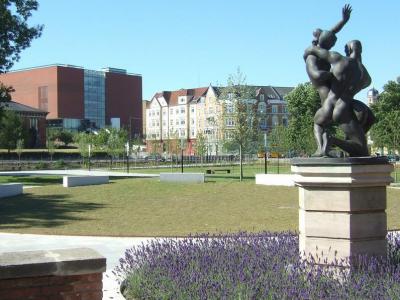
8) Elskovskampen ("The Battle of Love")
"The Battle of Love" (Elskovskampen) is a renowned sculpture situated in Mølleparken in Aarhus. This work, created in 1930 by the celebrated Danish sculptor Johannes Bjerg, powerfully depicts a man and a woman entwined in a dynamic embrace that seamlessly combines elements of struggle and passion. This portrayal not only captures the physical intensity between the two figures but also serves as a metaphor for the complexities inherent in love and relationships.
The sculpture initially included six cupids surrounding the central figures, adding a whimsical element to the depiction. However, these cupids were later relocated to Tivoli Friheden, altering the original ensemble. "The Battle of Love" made a significant impact in the art world upon its presentation by Bjerg in 1922, following its creation during his stay in Italy. Rendered in the art nouveau style, the sculpture features soft, flowing lines that emphasize natural forms and curves, typical of the early 20th-century movement. The choice of material, bronze, and the skillful technique highlight the emotional and thematic depth of the piece.
The significance of "The Battle of Love" is further emphasized by the acclaim it received from the curator of the National Gallery of Denmark, who regarded it as one of the finest creations in contemporary Danish art. Johannes C. Bjerg is also known for other prominent works in Aarhus such as "Agnete and the Merman," "Uffe hin Spage," "Den Svangre," and "Danaide," all of which contribute to his reputation as a key figure in Danish sculpture.
The sculpture initially included six cupids surrounding the central figures, adding a whimsical element to the depiction. However, these cupids were later relocated to Tivoli Friheden, altering the original ensemble. "The Battle of Love" made a significant impact in the art world upon its presentation by Bjerg in 1922, following its creation during his stay in Italy. Rendered in the art nouveau style, the sculpture features soft, flowing lines that emphasize natural forms and curves, typical of the early 20th-century movement. The choice of material, bronze, and the skillful technique highlight the emotional and thematic depth of the piece.
The significance of "The Battle of Love" is further emphasized by the acclaim it received from the curator of the National Gallery of Denmark, who regarded it as one of the finest creations in contemporary Danish art. Johannes C. Bjerg is also known for other prominent works in Aarhus such as "Agnete and the Merman," "Uffe hin Spage," "Den Svangre," and "Danaide," all of which contribute to his reputation as a key figure in Danish sculpture.
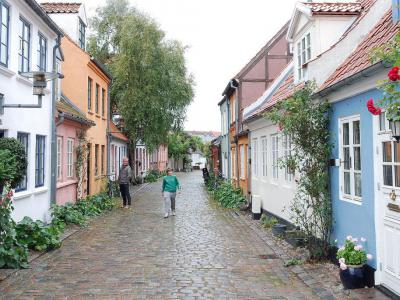
9) Møllestien (The Mill Path) (must see)
The Mill Path is a historic street in Aarhus. It is a cobblestone street with buildings constructed between 1870 and 1885. However, the street itself has been used in Aarhus since the 13th century.
The name "Mill Path" refers to the Aarhus Mill, which was first mentioned in 1289. The mill was located where the former Aarhus Main Library now stands at the western end of the street.
Sadly, the beautiful homes built in the late 19th century mostly fell into disrepair by 1925. The healthy soil that created an excellent basis for farmland because marshy and tenants were unable to maintain upkeep of the homes. Most of the street remained uninhabitable through 1960 when a renovation plan for the street was put together.
Students and artists moved into the neighborhood during the late 20th century. They painted many of the homes in bright colors, giving it the charm that is seen today. Renovations on the street led to many buildings being removed and replaced with modern structures. What is left is interesting architecture that is a favorite among the visitors to Aarhus.
The name "Mill Path" refers to the Aarhus Mill, which was first mentioned in 1289. The mill was located where the former Aarhus Main Library now stands at the western end of the street.
Sadly, the beautiful homes built in the late 19th century mostly fell into disrepair by 1925. The healthy soil that created an excellent basis for farmland because marshy and tenants were unable to maintain upkeep of the homes. Most of the street remained uninhabitable through 1960 when a renovation plan for the street was put together.
Students and artists moved into the neighborhood during the late 20th century. They painted many of the homes in bright colors, giving it the charm that is seen today. Renovations on the street led to many buildings being removed and replaced with modern structures. What is left is interesting architecture that is a favorite among the visitors to Aarhus.
10) Vor Frue Kirke (Church of Our Lady)
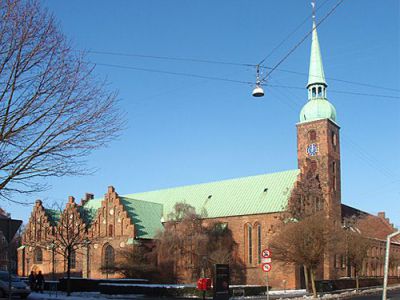
The Church of Our Lady, located in the heart of Aarhus, is a historic structure with origins dating back to the Middle Ages. Originally completed in 1060 AD as a stone crypt church after the destruction of a prior wooden structure, it represents the earliest extant stone church in Scandinavia. This crypt, discovered during renovations in the 1950s, now serves as a unique feature beneath the main building, hosting weekly masses since its restoration and reopening in 1957.
Initially named Saint Nicholas' Church, the site underwent significant transformations, particularly with the establishment of a Dominican priory, Vor Frue Kloster, in 1240, of which the church was a part. This expansion included the addition of a large tower between 1250 and 1500, enhancing its architectural stature. Following the Reformation in Denmark, King Christian III repurposed the surrounding priory buildings into a hospital for the sick and poor and renamed the church to the Church of Our Lady. This marked the church as a central hub for clerical activities in the region.
Further renovations took place in 2000, continuing to preserve and highlight its historical significance. Notably, the crypt-church excavation in the 1950s revealed two graves and 23 coins from the 14th century, providing insights into the church's medieval past. This crypt was originally constructed as a strategic ecclesiastical endeavor by Christian, the first bishop of Aarhus, to counteract the influence of Archbishop Adalbert of Hamburg-Bremen.
Today, the Church of Our Lady stands as a testament to the rich religious and architectural history of Aarhus, bridging past and present with its ancient foundations and continuous role in the community's spiritual life.
Initially named Saint Nicholas' Church, the site underwent significant transformations, particularly with the establishment of a Dominican priory, Vor Frue Kloster, in 1240, of which the church was a part. This expansion included the addition of a large tower between 1250 and 1500, enhancing its architectural stature. Following the Reformation in Denmark, King Christian III repurposed the surrounding priory buildings into a hospital for the sick and poor and renamed the church to the Church of Our Lady. This marked the church as a central hub for clerical activities in the region.
Further renovations took place in 2000, continuing to preserve and highlight its historical significance. Notably, the crypt-church excavation in the 1950s revealed two graves and 23 coins from the 14th century, providing insights into the church's medieval past. This crypt was originally constructed as a strategic ecclesiastical endeavor by Christian, the first bishop of Aarhus, to counteract the influence of Archbishop Adalbert of Hamburg-Bremen.
Today, the Church of Our Lady stands as a testament to the rich religious and architectural history of Aarhus, bridging past and present with its ancient foundations and continuous role in the community's spiritual life.
11) Latinerkvarteret (Latin Quarter)
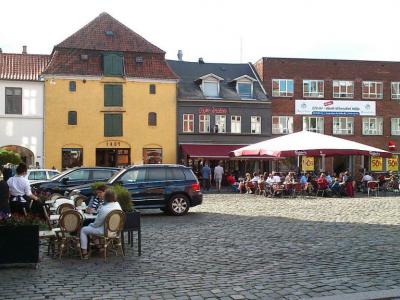
Latin Quarter is a neighborhood in the inner city of Aarhus. It is the oldest part of the city with a history that dates to the 14th century. The oldest houses and buildings in the Latin Quarter were built in the 16th century. One of these is Juuls Gard, which is one of the oldest buildings in the city.
Latin Quarter includes the main square of Pustervig Torv and several streets around the square. The name of the neighborhood was chosen in the 1990s due to the area's resemblance to Paris's Latin Quarter.
The quarter has a large number of shops, cafes and restaurants. It is also known for its active nightlife and entertainment venues. There are a number of small stages throughout the Latin Quarter where live music plays in the evening. Visitors will also find a number of galleries, studios and public art displays.
Latin Quarter includes the main square of Pustervig Torv and several streets around the square. The name of the neighborhood was chosen in the 1990s due to the area's resemblance to Paris's Latin Quarter.
The quarter has a large number of shops, cafes and restaurants. It is also known for its active nightlife and entertainment venues. There are a number of small stages throughout the Latin Quarter where live music plays in the evening. Visitors will also find a number of galleries, studios and public art displays.
12) Åboulevarden (River Boulevard)
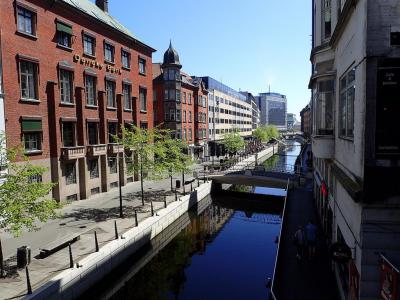
River Boulevard is both a street and a promenade that runs along the Aarhus River. The street runs east to west from Vester Alle to Europaplads. At 975 meters (nearly 3200 feet) long, it is a popular thoroughfare used by pedestrians.
The history of River Boulevard dates to 1477. King Christian I allowed the development of the area near the river. Homes were built and later, in 1674, the alley that ran along the street was widened. River Boulevard itself was built in stages from 1898 to 1934.
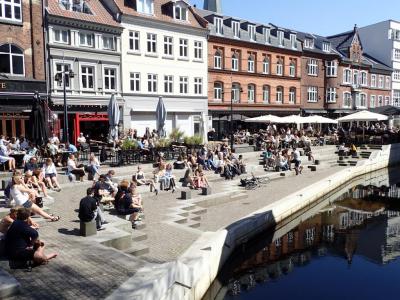
A portion of the Aarhus River was briefly paved to provide room for a wider street and parking. Work to uncover the river began in 2005 and was completed in 2015. A new recreational space was created to celebrate the reopening of the river.
The eastern area of River Boulevard is the most popular for locals and visitors. This section of River Boulevard has a large number of bars and cafes with outdoor seating.
The history of River Boulevard dates to 1477. King Christian I allowed the development of the area near the river. Homes were built and later, in 1674, the alley that ran along the street was widened. River Boulevard itself was built in stages from 1898 to 1934.
A portion of the Aarhus River was briefly paved to provide room for a wider street and parking. Work to uncover the river began in 2005 and was completed in 2015. A new recreational space was created to celebrate the reopening of the river.
The eastern area of River Boulevard is the most popular for locals and visitors. This section of River Boulevard has a large number of bars and cafes with outdoor seating.
13) Sankt Clemens Bridge
Saint Clement Bridge in Aarhus stands as an iconic pedestrian bridge that seamlessly combines history, architecture, and community spirit. Situated in the bustling heart of Aarhus, this bridge spans the serene Aarhus River at Saint Clement Square, linking the city's historic sector with newer developments near the railway station. The bridge's origins trace back over a century to 1881, when it was constructed through public fundraising and significant contributions from local businessman Hans Broge, amidst vigorous debates over costs.
Designed initially by Aarhus's harbor and town engineers, with additional ornamentations by royal building inspector Th. Walther, Saint Clement Bridge has undergone numerous transformations, the most recent being in 1982. This renovation aimed to replace outdated steel structures and brighten the previously dim and gloomy under-bridge area. The redesign was spearheaded by city architect Ole Oestergaard and engineering firm Carl Bro A/S, resulting in a bridge that doubles as a street, matching the breadth of nearby Soendergade. The bridge is supported by concrete columns, while steel columns designed to resemble trees support the adjacent side bridges.
Today, the area beneath Saint Clement Bridge has been revitalized into a vibrant public space. Enhanced lighting and accessibility via stairs or an elevator lead to an intermediate level beneath the main bridge, where visitors can enjoy amenities such as restaurants and bars. The bridge itself offers picturesque views of Aarhus's dynamic skyline and the charming riverside, making it a popular spot for both locals and tourists seeking a scenic and culturally immersive experience. With its unique architectural features and lively under-bridge area, Saint Clement Bridge remains a must-visit landmark in Aarhus.
Designed initially by Aarhus's harbor and town engineers, with additional ornamentations by royal building inspector Th. Walther, Saint Clement Bridge has undergone numerous transformations, the most recent being in 1982. This renovation aimed to replace outdated steel structures and brighten the previously dim and gloomy under-bridge area. The redesign was spearheaded by city architect Ole Oestergaard and engineering firm Carl Bro A/S, resulting in a bridge that doubles as a street, matching the breadth of nearby Soendergade. The bridge is supported by concrete columns, while steel columns designed to resemble trees support the adjacent side bridges.
Today, the area beneath Saint Clement Bridge has been revitalized into a vibrant public space. Enhanced lighting and accessibility via stairs or an elevator lead to an intermediate level beneath the main bridge, where visitors can enjoy amenities such as restaurants and bars. The bridge itself offers picturesque views of Aarhus's dynamic skyline and the charming riverside, making it a popular spot for both locals and tourists seeking a scenic and culturally immersive experience. With its unique architectural features and lively under-bridge area, Saint Clement Bridge remains a must-visit landmark in Aarhus.
14) Aarhus Cathedral (must see)
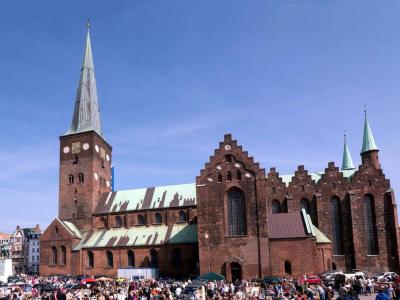
Aarhus Cathedral is a Church of Denmark cathedral that was previously a part of the Roman Catholic church. The Gothic and Romanesque cathedral was completed in 1300 and dedicated to Saint Clement, the patron saint of sailors.
Construction of the church started around 1190. It was built around Saint Clement's church, a timber church built in 1102. The Romanesque architectural style included half-rounded arches, a flat timber ceiling and four chapels.
The cathedral suffered great damage in 1330 when a fire burned much of Aarhus. It was abandoned until 1449 when it was renovated and enlarged. The new design of the church used Gothic vaulting with high windows and a lengthened nave. It is now both the tallest and longest church in Denmark at 305 feet long and 315 feet high. The current, 314-foot tower was built in 1931.
There are more frescoes in Aarhus Cathedral than in any church in the country. They were painted between 1470 and 1520. Likewise, the painting of Saint Christopher and Saint Clement are the tallest in Denmark. The cathedral's one stained glass window was created by Emanuel Vigeland in 1926. At almost 46-feet tall, it is the largest stained glass window in Denmark.
Construction of the church started around 1190. It was built around Saint Clement's church, a timber church built in 1102. The Romanesque architectural style included half-rounded arches, a flat timber ceiling and four chapels.
The cathedral suffered great damage in 1330 when a fire burned much of Aarhus. It was abandoned until 1449 when it was renovated and enlarged. The new design of the church used Gothic vaulting with high windows and a lengthened nave. It is now both the tallest and longest church in Denmark at 305 feet long and 315 feet high. The current, 314-foot tower was built in 1931.
There are more frescoes in Aarhus Cathedral than in any church in the country. They were painted between 1470 and 1520. Likewise, the painting of Saint Christopher and Saint Clement are the tallest in Denmark. The cathedral's one stained glass window was created by Emanuel Vigeland in 1926. At almost 46-feet tall, it is the largest stained glass window in Denmark.
15) Hotel Royal
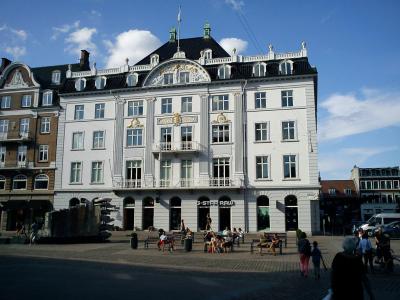
Hotel Royal in Aarhus is a landmark of luxury and historical significance located in the central Indre By neighborhood, with views of Aarhus Cathedral and Store Torv Square. Founded in 1838 by Niels Larsen, the hotel was originally constructed from two Neoclassical-style buildings, one of which was the Kongens Gaard (King's House). It rapidly became a hub for the elite, attracting royalty, politicians, celebrities, and socialites, establishing itself as the city's most prestigious lodging.
The hotel's growth includes several renovations and expansions, notably in 1865, and 1868, and an addition of a new building in 1902 designed by Eggert Achen and Thorkel Møller. Despite changing ownership multiple times since its inception, it has continuously catered to the upper classes. Noteworthy offerings over the years have included stables, a horse-drawn bus service, and even car fueling and cleaning services as transportation evolved.
The hotel's social life has been centered around the Marble Room, built in 1913. Over the decades, this room has hosted a jazz club featuring international artists like Count Basie and Duke Ellington, a cinema, a steakhouse, and a discotheque. In 1991, the space was transformed into the Casino Royale. In terms of architecture, the hotel features an exquisite Neoclassical white facade, and a 1991 renovation introduced an art déco-style entrance reminiscent of early 20th-century Paris metro stations.
Art and culture are deeply embedded in the Hotel Royal's identity. The hotel boasts around 300 artworks, including pieces by renowned artists such as Asger Jorn, Karel Appel, Joan Miró, Wassily Kandinsky, and Polish painter Andrzej Kowalczyk, who is noted for his ceiling paintings in the hotel that depict significant events in Aarhus's history. The walls feature paintings of 53 Danish monarchs, tracing back to Gorm the Old.
Today, Hotel Royal stands as a fusion of historical grandeur and contemporary luxury, making it one of Denmark’s highest-ranked hotels and a testament to its rich cultural heritage and continued appeal to distinguished guests.
The hotel's growth includes several renovations and expansions, notably in 1865, and 1868, and an addition of a new building in 1902 designed by Eggert Achen and Thorkel Møller. Despite changing ownership multiple times since its inception, it has continuously catered to the upper classes. Noteworthy offerings over the years have included stables, a horse-drawn bus service, and even car fueling and cleaning services as transportation evolved.
The hotel's social life has been centered around the Marble Room, built in 1913. Over the decades, this room has hosted a jazz club featuring international artists like Count Basie and Duke Ellington, a cinema, a steakhouse, and a discotheque. In 1991, the space was transformed into the Casino Royale. In terms of architecture, the hotel features an exquisite Neoclassical white facade, and a 1991 renovation introduced an art déco-style entrance reminiscent of early 20th-century Paris metro stations.
Art and culture are deeply embedded in the Hotel Royal's identity. The hotel boasts around 300 artworks, including pieces by renowned artists such as Asger Jorn, Karel Appel, Joan Miró, Wassily Kandinsky, and Polish painter Andrzej Kowalczyk, who is noted for his ceiling paintings in the hotel that depict significant events in Aarhus's history. The walls feature paintings of 53 Danish monarchs, tracing back to Gorm the Old.
Today, Hotel Royal stands as a fusion of historical grandeur and contemporary luxury, making it one of Denmark’s highest-ranked hotels and a testament to its rich cultural heritage and continued appeal to distinguished guests.
16) Juuls Gård (Juul's House)
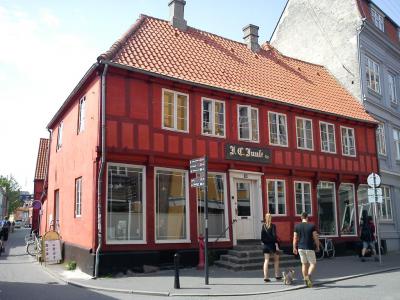
Juul's House is a historic structure located in Aarhus. Constructed in 1629, this building is officially recognized and preserved as part of the national Danish registry of protected buildings and places, under the supervision of the Danish Heritage Agency. It stands as one of the oldest buildings in the city. Since 1842, it has operated as a paint shop, making it the oldest of its kind in Denmark.
Originally constructed as two separate houses around 1600, these buildings were merged into one entity in 1629. For the first 200 years, it served dual functions as both a store and residence, although specific details from this period remain sparse.
In 1830, the building's story shifted when Abraham Lewis, a Jewish merchant, bought it and opened a store. By 1837, financial troubles led to his bankruptcy and imprisonment for debt, after which he vanished from public records. In 1842, I.C. Juul took over, starting a new era by selling various items such as herring, cigars, and cognac, before eventually specializing in imported and mixed paint.
To this day, the establishment continues to operate as a paint shop and retains the Juul name. The building's long history is palpable to visitors, exemplified by a paint bucket autographed by most employees since 1880 and a collection of paint samples spanning a century.
Architecturally, Juul's House is a quintessential example of a half-timbered Renaissance house. The structure features four wings arranged around a central courtyard, each constructed in different periods. The main facade on Mejlgade Street was formed by joining two earlier houses in 1629. The wing along the neighboring property at no. 23 dates back to around 1600, while the main building was erected slightly later. The back building was added in the late 1700s, and in 1851, a lower, narrower wing was built along Graven Street, completing the estate's four-winged layout with its internal courtyard.
Juul's House not only reflects the architectural styles and urban development of its time but also offers a vivid slice of Danish commercial history, preserved within the heart of Aarhus.
Originally constructed as two separate houses around 1600, these buildings were merged into one entity in 1629. For the first 200 years, it served dual functions as both a store and residence, although specific details from this period remain sparse.
In 1830, the building's story shifted when Abraham Lewis, a Jewish merchant, bought it and opened a store. By 1837, financial troubles led to his bankruptcy and imprisonment for debt, after which he vanished from public records. In 1842, I.C. Juul took over, starting a new era by selling various items such as herring, cigars, and cognac, before eventually specializing in imported and mixed paint.
To this day, the establishment continues to operate as a paint shop and retains the Juul name. The building's long history is palpable to visitors, exemplified by a paint bucket autographed by most employees since 1880 and a collection of paint samples spanning a century.
Architecturally, Juul's House is a quintessential example of a half-timbered Renaissance house. The structure features four wings arranged around a central courtyard, each constructed in different periods. The main facade on Mejlgade Street was formed by joining two earlier houses in 1629. The wing along the neighboring property at no. 23 dates back to around 1600, while the main building was erected slightly later. The back building was added in the late 1700s, and in 1851, a lower, narrower wing was built along Graven Street, completing the estate's four-winged layout with its internal courtyard.
Juul's House not only reflects the architectural styles and urban development of its time but also offers a vivid slice of Danish commercial history, preserved within the heart of Aarhus.
17) Aarhus Theater
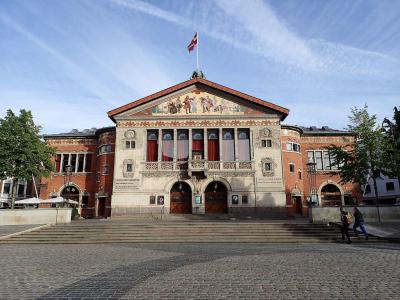
The Aarhus Theater in Aarhus stands as a remarkable example of the Jugend style, reflecting the architectural elegance of the late 19th century. This iconic structure was built in the 1890s following a civic initiative. Designed by the distinguished architect Hack Kampmann, who is also noted for other significant buildings in Aarhus like Marselisborg Slot, the theater was officially inaugurated on September 15, 1900.
Aarhus Theater has been a listed landmark since 1990, preserving its historical and architectural significance. The building captivates with its ornate Jugendstil façade, which invites visitors into a world of cultural richness and artistic splendor. Once inside, the grandeur continues with luxurious decorations including glittering chandeliers, gold-adorned ceilings, and lavish interiors that maintain their original allure, reinforcing the theater's status as a cultural powerhouse in Denmark's second-largest city.
The theater features four stages, collectively accommodating up to 1200 seats, and showcases a variety of performances that highlight its commitment to the arts. Notably, the façade of the theater is adorned with a ceramic mosaic by Karl Hansen-Reistrup, depicting a scene from Ludvig Holberg’s play "Maskerade," a nod to Holberg's legacy as the father of Danish comedy. This choice of decoration underscores the theater's function and its cultural heritage.
The theater's promenade is embellished with stucco scenes from notable Danish musical comedies, enhancing the thematic continuity of Danish theatrical tradition. Additionally, the theater's connection to local heritage is symbolized under its balcony, where the town arms of Aarhus are displayed, featuring maritime and protective symbols that reference both the city's history and its maritime location.
Interestingly, while initial plans by Kampmann included decorating the theater’s roof with classical motifs, these were ultimately replaced by more gothic elements, such as a troll/dragon/gargoyle/devil figure. This element became a topic of local intrigue and speculation, particularly regarding Kampmann’s intentions, though such rumors are often discounted given his extensive work on the neighboring cathedral.
Aarhus Theater has been a listed landmark since 1990, preserving its historical and architectural significance. The building captivates with its ornate Jugendstil façade, which invites visitors into a world of cultural richness and artistic splendor. Once inside, the grandeur continues with luxurious decorations including glittering chandeliers, gold-adorned ceilings, and lavish interiors that maintain their original allure, reinforcing the theater's status as a cultural powerhouse in Denmark's second-largest city.
The theater features four stages, collectively accommodating up to 1200 seats, and showcases a variety of performances that highlight its commitment to the arts. Notably, the façade of the theater is adorned with a ceramic mosaic by Karl Hansen-Reistrup, depicting a scene from Ludvig Holberg’s play "Maskerade," a nod to Holberg's legacy as the father of Danish comedy. This choice of decoration underscores the theater's function and its cultural heritage.
The theater's promenade is embellished with stucco scenes from notable Danish musical comedies, enhancing the thematic continuity of Danish theatrical tradition. Additionally, the theater's connection to local heritage is symbolized under its balcony, where the town arms of Aarhus are displayed, featuring maritime and protective symbols that reference both the city's history and its maritime location.
Interestingly, while initial plans by Kampmann included decorating the theater’s roof with classical motifs, these were ultimately replaced by more gothic elements, such as a troll/dragon/gargoyle/devil figure. This element became a topic of local intrigue and speculation, particularly regarding Kampmann’s intentions, though such rumors are often discounted given his extensive work on the neighboring cathedral.
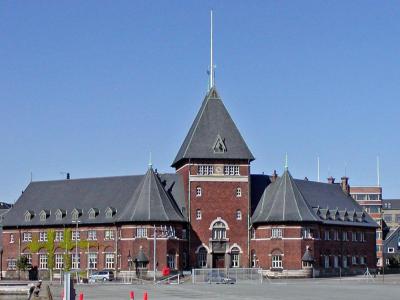
18) Toldboden (Aarhus Custom House)
The Aarhus Custom House stands as a notable architectural landmark on the harbor front of Aarhus. Completed in 1898 and designed by the esteemed royal building inspector Hack Kampmann, this building is often celebrated as one of his finest creations. Kampmann's influence on Aarhus is significant, with other notable designs in the city including the Marselisborg Palace and Aarhus Teater.
Originally built between 1895 and 1897 to serve the Danish state, the Aarhus Custom House is the fourth customs building in the city's history. Its predecessors included structures strategically placed along the Aarhus Å and near the city's port to facilitate maritime and customs activities. Kampmann's design marked a new era, situating the building in a prime location to oversee the bustling harbor area.
The architectural style of the Aarhus Custom House is predominantly National Romanticism, a style that emphasizes folk elements and national identity, which was quite popular in Scandinavia at the turn of the 20th century. After serving its initial purpose until the mid-1990s, the building saw various uses, including a period when it hosted the architecture school and served as a student hostel. In 2004, the Tækker Group acquired the building, undertaking extensive renovations in collaboration with cultural authorities to preserve the distinct Kampmann style. Today, it houses a restaurant, continuing to serve a communal role in Aarhus.
Located in the central part of the city, the Aarhus Custom House not only stands as a testament to the architectural heritage of Hack Kampmann but also symbolizes the historical evolution of civic and commercial life in Aarhus. The preservation and adaptive reuse of this historic building demonstrate a commitment to maintaining cultural heritage while adapting to contemporary uses.
Originally built between 1895 and 1897 to serve the Danish state, the Aarhus Custom House is the fourth customs building in the city's history. Its predecessors included structures strategically placed along the Aarhus Å and near the city's port to facilitate maritime and customs activities. Kampmann's design marked a new era, situating the building in a prime location to oversee the bustling harbor area.
The architectural style of the Aarhus Custom House is predominantly National Romanticism, a style that emphasizes folk elements and national identity, which was quite popular in Scandinavia at the turn of the 20th century. After serving its initial purpose until the mid-1990s, the building saw various uses, including a period when it hosted the architecture school and served as a student hostel. In 2004, the Tækker Group acquired the building, undertaking extensive renovations in collaboration with cultural authorities to preserve the distinct Kampmann style. Today, it houses a restaurant, continuing to serve a communal role in Aarhus.
Located in the central part of the city, the Aarhus Custom House not only stands as a testament to the architectural heritage of Hack Kampmann but also symbolizes the historical evolution of civic and commercial life in Aarhus. The preservation and adaptive reuse of this historic building demonstrate a commitment to maintaining cultural heritage while adapting to contemporary uses.
