Custom Walk in Girona, Spain by marcust_3a483 created on 2025-07-16
Guide Location: Spain » Girona
Guide Type: Custom Walk
# of Sights: 9
Tour Duration: 1 Hour(s)
Travel Distance: 1.1 Km or 0.7 Miles
Share Key: 39T2K
Guide Type: Custom Walk
# of Sights: 9
Tour Duration: 1 Hour(s)
Travel Distance: 1.1 Km or 0.7 Miles
Share Key: 39T2K
How It Works
Please retrieve this walk in the GPSmyCity app. Once done, the app will guide you from one tour stop to the next as if you had a personal tour guide. If you created the walk on this website or come to the page via a link, please follow the instructions below to retrieve the walk in the app.
Retrieve This Walk in App
Step 1. Download the app "GPSmyCity: Walks in 1K+ Cities" on Apple App Store or Google Play Store.



Step 2. In the GPSmyCity app, download(or launch) the guide "Girona Map and Walking Tours".
Step 3. Tap the menu button located at upper right corner of the "Walks" screen and select "Retrieve custom walk". Enter the share key: 39T2K
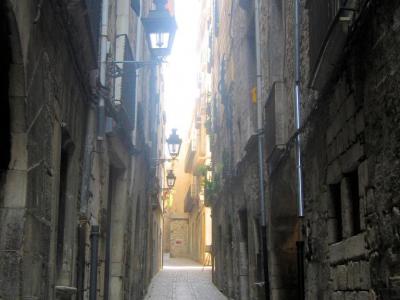
1) Jewish Quarter and Jewish History Museum (must see)
El Call, Girona’s Jewish Quarter, is a labyrinth where history hides in plain sight. Its cobbled alleys and tight stone stairways once held the heartbeat of a Jewish community that flourished here from the 12th to the 15th century. Merchants, craftsmen, and scholars packed these narrow streets, and Girona’s reputation as a centre of learning was cemented by its famed school of Kabbalah. Then came 1492. Spain expelled its Jewish population, leaving behind empty houses and silence where life had once thrived. Yet the quarter endures, every twist of its passageways carrying echoes of that vanished world.
Nestled within this maze is the Museum of Jewish History, housed in what was once a synagogue. Step into its courtyard and you’ll see a bold Star of David carved into the stone-in case you forgot where you are. Inside, eleven rooms unfold the story of Jewish life in Girona and across Catalonia: how families lived, how festivals were celebrated, how medicine, philosophy, and trade were practiced here. Manuscripts, ritual objects, and carefully preserved artifacts breathe life into names that might otherwise be lost. The synagogue also carries the imprint of Nahmanides, the 13th-century rabbi, philosopher, and physician whose wit and wisdom left a mark on Jewish life for generations. What earned him fame was his ability to out-argue kings and out-write just about anyone in medieval Spain. A scale model of the quarter itself helps visitors imagine the district at its height, before its sudden fracture in the late 15th century.
The museum keeps moving forward with new displays and a shop full of books worth carrying home. Yet its real echo is on the streets around it, where every corner is less about sightseeing and more about walking through an archive written in stone, stubbornly refusing to be footnoted into silence.
Nestled within this maze is the Museum of Jewish History, housed in what was once a synagogue. Step into its courtyard and you’ll see a bold Star of David carved into the stone-in case you forgot where you are. Inside, eleven rooms unfold the story of Jewish life in Girona and across Catalonia: how families lived, how festivals were celebrated, how medicine, philosophy, and trade were practiced here. Manuscripts, ritual objects, and carefully preserved artifacts breathe life into names that might otherwise be lost. The synagogue also carries the imprint of Nahmanides, the 13th-century rabbi, philosopher, and physician whose wit and wisdom left a mark on Jewish life for generations. What earned him fame was his ability to out-argue kings and out-write just about anyone in medieval Spain. A scale model of the quarter itself helps visitors imagine the district at its height, before its sudden fracture in the late 15th century.
The museum keeps moving forward with new displays and a shop full of books worth carrying home. Yet its real echo is on the streets around it, where every corner is less about sightseeing and more about walking through an archive written in stone, stubbornly refusing to be footnoted into silence.
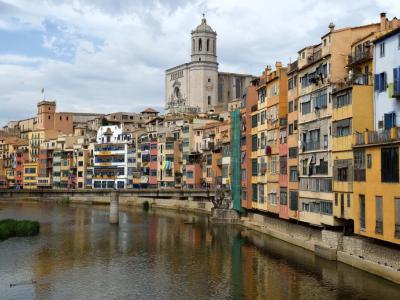
2) Onyar River Colored Houses (must see)
The Onyar River does more than split Girona in two-it frames one of its most photographed scenes. Lining its banks are the famous colored houses, stacked in ochres, pinks, yellows, and reds, their reflections doubling the spectacle in the water below. They weren’t designed as postcard material; in the Middle Ages, people simply built where space allowed-right on the river’s edge. Their facelift came much later, when architect Rafael Masó and a handful of local artists chose a palette that turned practicality into one of Girona’s defining images.
Locals sometimes call them the “Hanging Houses,” as if the buildings were daring you to notice how they cling to the riverbank. Among them sits the Masó House, the birthplace of Masó himself, now preserved as a museum that pulls visitors into his vision of Catalan modernism.
The river doesn’t just separate buildings; it has long marked a boundary between Girona’s medieval Old Town on one side and its modern growth on the other. Crossing one of its bridges is a literal step between eras, and few crossings are more famous than the Eiffel Bridge-built in 1877 by the same workshop that later sent an iron tower into the Paris sky.
If you’re looking for the best view, sunrise and sunset are the golden hours. From the bridges, the houses glow and ripple in the water, and even the most casual stroller turns into a photographer. But these façades aren’t only a backdrop; they’re an introduction. They welcome you into a city where centuries of history cling to the stones as tightly as the houses hug the river.
Locals sometimes call them the “Hanging Houses,” as if the buildings were daring you to notice how they cling to the riverbank. Among them sits the Masó House, the birthplace of Masó himself, now preserved as a museum that pulls visitors into his vision of Catalan modernism.
The river doesn’t just separate buildings; it has long marked a boundary between Girona’s medieval Old Town on one side and its modern growth on the other. Crossing one of its bridges is a literal step between eras, and few crossings are more famous than the Eiffel Bridge-built in 1877 by the same workshop that later sent an iron tower into the Paris sky.
If you’re looking for the best view, sunrise and sunset are the golden hours. From the bridges, the houses glow and ripple in the water, and even the most casual stroller turns into a photographer. But these façades aren’t only a backdrop; they’re an introduction. They welcome you into a city where centuries of history cling to the stones as tightly as the houses hug the river.
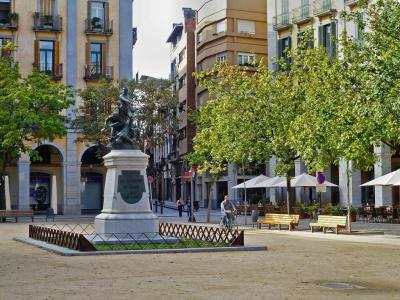
3) Monumento a los Defensores de Girona (Monument to the Defenders of Girona)
The Monument to the Defenders of Girona) stands as a solemn reminder of the city’s resilience during the Peninsular War. Located in the heart of Girona, it commemorates the citizens and soldiers who defended the city during the sieges of 1808 and 1809 against Napoleonic forces. These sieges, marked by extreme hardship, disease, and famine, became a defining chapter in Girona’s history, symbolizing unity and sacrifice. The monument, inaugurated in 1894, was designed to honor that collective bravery and to serve as a lasting tribute for future generations.
The monument’s design features a prominent stone pedestal topped with a bronze figure representing a defiant Girona fighter, weapon in hand, facing outward as if still guarding the city. Around its base are reliefs depicting scenes from the sieges, showing the human cost and determination of the defenders. Inscriptions further evoke the memory of those who perished, blending artistic detail with historical storytelling. The work captures not only the military struggle but also the spirit of civic resistance that defined Girona’s wartime endurance.
Today, the Monument to the Defenders of Girona is both a historical landmark and a place of reflection. Visitors often pause here to learn about the city’s role in the Peninsular War before exploring the surrounding streets and the old city walls, many of which also bear marks from that turbulent period. The site stands as a quiet counterpoint to Girona’s vibrant present, linking its medieval charm and modern life with the courage and sacrifice of its past.
The monument’s design features a prominent stone pedestal topped with a bronze figure representing a defiant Girona fighter, weapon in hand, facing outward as if still guarding the city. Around its base are reliefs depicting scenes from the sieges, showing the human cost and determination of the defenders. Inscriptions further evoke the memory of those who perished, blending artistic detail with historical storytelling. The work captures not only the military struggle but also the spirit of civic resistance that defined Girona’s wartime endurance.
Today, the Monument to the Defenders of Girona is both a historical landmark and a place of reflection. Visitors often pause here to learn about the city’s role in the Peninsular War before exploring the surrounding streets and the old city walls, many of which also bear marks from that turbulent period. The site stands as a quiet counterpoint to Girona’s vibrant present, linking its medieval charm and modern life with the courage and sacrifice of its past.
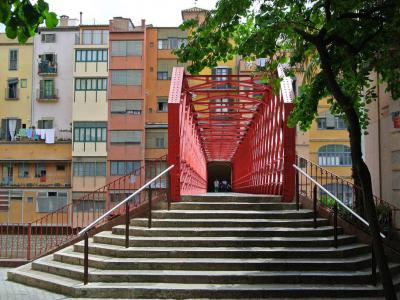
4) Pont de les Peixateries Velles (Eiffel Bridge) (must see)
Stretching across the Onyar River like a bright red exclamation mark is the Eiffel Bridge, Girona’s most photographed walkway. Officially, it’s the Bridge of the Old Fishmongers-locals once hauled their catch nearby-but somewhere along the way, the fish lost out to fame. Built in 1877 by Gustave Eiffel’s workshop, it’s the same engineer who would later bolt together a slightly taller project in Paris. You may have heard of it.
The bridge is all iron lattice, a web of crimson bars that makes you feel as though you’re stepping into a giant piece of geometry homework. It’s only about nine feet wide, and its wooden planks creak just enough underfoot to remind you of its age. At 136 feet long, it doesn’t ask for much walking, but it rewards every step.
Pause midway and the city spills into view: the Onyar flowing beneath you, flanked by a jumble of riverside houses painted in ochres, blues, and pinks-Girona’s most famous postcard in real time. On one side of the bridge lies Freedom Boulevard, a lively strip of shops and cafés that keep the old town buzzing. On the other, the newer part of the city stretches out, with Saint Clara Street leading you straight toward Independence Square.
This isn’t a bridge to cross quickly-it’s a bridge to linger on, to snap a photo or two, and to watch the light play across the river and rooftops. Eiffel built it as a functional crossing; Girona has made it a stage set for daily life.
The bridge is all iron lattice, a web of crimson bars that makes you feel as though you’re stepping into a giant piece of geometry homework. It’s only about nine feet wide, and its wooden planks creak just enough underfoot to remind you of its age. At 136 feet long, it doesn’t ask for much walking, but it rewards every step.
Pause midway and the city spills into view: the Onyar flowing beneath you, flanked by a jumble of riverside houses painted in ochres, blues, and pinks-Girona’s most famous postcard in real time. On one side of the bridge lies Freedom Boulevard, a lively strip of shops and cafés that keep the old town buzzing. On the other, the newer part of the city stretches out, with Saint Clara Street leading you straight toward Independence Square.
This isn’t a bridge to cross quickly-it’s a bridge to linger on, to snap a photo or two, and to watch the light play across the river and rooftops. Eiffel built it as a functional crossing; Girona has made it a stage set for daily life.
5) Rambla de la Libertad (Freedom Boulevard)
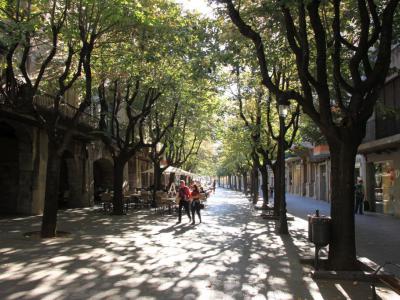
Freedom Boulevard cuts through Girona with the kind of energy that has kept it busy for centuries. Laid out in the 13th century as the town’s market street, it quickly became the economic and social heart of the city. Fast forward to 1869 and a revolutionary gesture changed its name forever: the “Tree of Freedom” was planted here during Spain’s turbulent Six Democratic Years, and the street inherited its present title, swapping old monarchical ties for the spirit of liberal ideals.
The boulevard’s arcaded colonnades still recall the medieval past, when guilds and traders sold their wares beneath the arches. Today those same arcades host shops, restaurants, and cafés, humming with voices and movement. A line of trees and benches runs through the centre, softening the bustle and inviting a catch-a-breath session. Seasonal markets and flower fairs carry on the centuries-old tradition of trade, just with fewer horses and more phone calls.
Along the walk, a few landmarks catch the eye. Norat House, built in 1912, flaunts its Art Nouveau curves, while near the Stone Bridge the Bòlit Contemporary Art Centre brings modern exhibitions into the mix and doubles as the city’s tourist information hub. At the Argenteria Street end, the Trobada Point sculpture places three bronze fingerprints into the pavement-a reminder that this has always been a meeting ground.
This is Girona in shorthand-arches, markets, whispers of the past, and the rhythm of everyday life. Freedom Boulevard may look like a straight line, but it carries centuries in its stride.
The boulevard’s arcaded colonnades still recall the medieval past, when guilds and traders sold their wares beneath the arches. Today those same arcades host shops, restaurants, and cafés, humming with voices and movement. A line of trees and benches runs through the centre, softening the bustle and inviting a catch-a-breath session. Seasonal markets and flower fairs carry on the centuries-old tradition of trade, just with fewer horses and more phone calls.
Along the walk, a few landmarks catch the eye. Norat House, built in 1912, flaunts its Art Nouveau curves, while near the Stone Bridge the Bòlit Contemporary Art Centre brings modern exhibitions into the mix and doubles as the city’s tourist information hub. At the Argenteria Street end, the Trobada Point sculpture places three bronze fingerprints into the pavement-a reminder that this has always been a meeting ground.
This is Girona in shorthand-arches, markets, whispers of the past, and the rhythm of everyday life. Freedom Boulevard may look like a straight line, but it carries centuries in its stride.
6) Ascent of San Domenec - Braavos Market
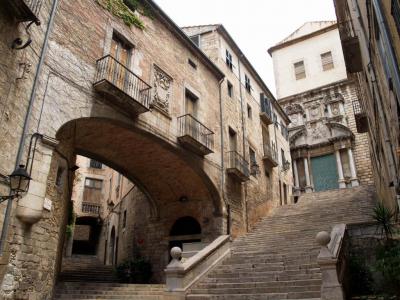
The Ascent of Saint Domènec is one of Girona’s most photogenic stairways-and not just because of its Game of Thrones cameo. This stepped street took shape between the 14th and 17th centuries and still feels like a stage set, flanked by Renaissance palaces, the Agullana Palace, and crowned by the imposing baroque front of the Church of Saint Martí Sacosta. Its roots go back even further: the Dominicans planted a convent here in the 13th century, turning the area into both a religious hub and a neighborhood crossroads. Later renovations matched the drama of the church above, leaving us with the elegant, balanced stairway you see today.
Climbing it is a workout, but one softened by the setting. Locals claim it’s impossible to pass without pausing-whether that’s to snap a photo, claim a table at Le Bistrot, whose terrace hides under the arch, or peek into the Ensesa workshop, a favorite during Girona’s annual Temps de Flors festival when flowers spill across the steps.
Then there’s its screen career. Perfume: The Story of a Murderer filmed here back in 2006, but it was HBO’s Game of Thrones that catapulted the stairway into global stardom. Season 6 dressed the steps as a bustling Braavosi marketplace, complete with awnings, baskets, and extras. It’s where Arya Stark, blind and desperate, was chased down by the Waif. The moment that sticks into the fans' minds is her tumble that sent orange-filled baskets flying on the stairs.
Today, the Ascent of Saint Domènec works double duty: a slice of Girona’s architectural story and a pop-culture landmark, equally good for a quiet climb or a re-enactment.
Climbing it is a workout, but one softened by the setting. Locals claim it’s impossible to pass without pausing-whether that’s to snap a photo, claim a table at Le Bistrot, whose terrace hides under the arch, or peek into the Ensesa workshop, a favorite during Girona’s annual Temps de Flors festival when flowers spill across the steps.
Then there’s its screen career. Perfume: The Story of a Murderer filmed here back in 2006, but it was HBO’s Game of Thrones that catapulted the stairway into global stardom. Season 6 dressed the steps as a bustling Braavosi marketplace, complete with awnings, baskets, and extras. It’s where Arya Stark, blind and desperate, was chased down by the Waif. The moment that sticks into the fans' minds is her tumble that sent orange-filled baskets flying on the stairs.
Today, the Ascent of Saint Domènec works double duty: a slice of Girona’s architectural story and a pop-culture landmark, equally good for a quiet climb or a re-enactment.
7) CaixaForum Girona
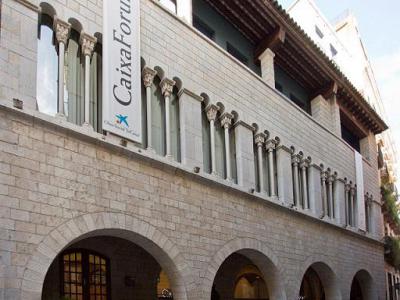
Nestled in the heart of Girona’s historic quarter, CaixaForum Girona offers a compelling blend of medieval architecture and contemporary culture. This cultural center is housed in the venerable La Fontana d’Or-a 13th-century palace once belonging to the noble Sitjar family, built atop a site that housed a mill dating back to 1078. Architectural highlights such as the ground-floor portico, inner courtyard, and distinctive triforium windows have been carefully preserved.
The building itself has a rich and layered history. After a devastating fire in the 15th century, it was reconstructed with limited means. It later became an inn in the 18th century, operating under the name “La Fontana d’Or” during the era when Girona was a key stop for stagecoaches traveling between Barcelona and France. The site continued to host various civic and cultural institutions through the centuries, before undergoing historicist restoration under architect Joan Maria de Ribot i de Balle in the late 20th century, reopening in 1973 as a cultural venue.
In its current incarnation, CaixaForum Girona officially opened in the spring of 2011 as part of a network of CaixaForum centers across Spain, following the absorption of Caixa Girona into “la Caixa”. With roughly 400 square meters of exhibition space located on the ground floor and basement, it showcases a rotating program of temporary exhibitions-from ancient civilizations to modern art, photography, and contemporary plastic arts. A special series titled “Acceso directo” features micro‑exhibitions drawn from the Caixa contemporary art collection.
Visitors will also find versatile facilities and engaging programming. The center includes an auditorium seating 108 guests and a flexible “Espacio 1” that accommodates up to 80 people-ideal for film screenings, lectures, and concerts. Additionally, two classrooms (each holding 30 participants, with one that can be divided) support educational workshops and cultural activities for all ages.
The building itself has a rich and layered history. After a devastating fire in the 15th century, it was reconstructed with limited means. It later became an inn in the 18th century, operating under the name “La Fontana d’Or” during the era when Girona was a key stop for stagecoaches traveling between Barcelona and France. The site continued to host various civic and cultural institutions through the centuries, before undergoing historicist restoration under architect Joan Maria de Ribot i de Balle in the late 20th century, reopening in 1973 as a cultural venue.
In its current incarnation, CaixaForum Girona officially opened in the spring of 2011 as part of a network of CaixaForum centers across Spain, following the absorption of Caixa Girona into “la Caixa”. With roughly 400 square meters of exhibition space located on the ground floor and basement, it showcases a rotating program of temporary exhibitions-from ancient civilizations to modern art, photography, and contemporary plastic arts. A special series titled “Acceso directo” features micro‑exhibitions drawn from the Caixa contemporary art collection.
Visitors will also find versatile facilities and engaging programming. The center includes an auditorium seating 108 guests and a flexible “Espacio 1” that accommodates up to 80 people-ideal for film screenings, lectures, and concerts. Additionally, two classrooms (each holding 30 participants, with one that can be divided) support educational workshops and cultural activities for all ages.
8) Ayuntamiento de Gerona (Girona City Hall)
Welcome to Girona’s historic heartbeat-its City Hall (Ayuntamiento de Gerona), located in the charming Plaza del Vi. This striking building graces part of Catalonia’s protected architectural heritage and captivates visitors with its layered history and evolving style.
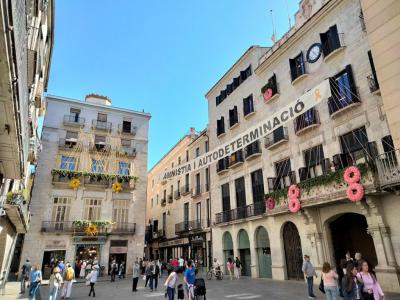
Built around an engaging interior courtyard, the City Hall features a façade accentuated by three grand portals leading into a vaulted vestibule. The ground floor opens into this welcoming space, while the upper stories carry repeating balconies-some modern, others simpler-reflecting various restoration phases. The courtyard contains a vaulted door and decorative dust guard, with the city’s coat of arms etched in stone beneath. Key interior renovations include the main meeting room, refreshed in 1917, the staircase added in 1901, and the restored mayor’s office completed around 1904.
Visually, the building blooms into an eclectic fusion of styles and eras. At the start of the 20th century, parts of the older façade were demolished and replaced with a new, more monumental face, crowned by a large balcony. The site has long held civic importance-earlier serving as the 16th‑century exchange table, and in 1830, the city’s official measuring standards were installed in its courtyard.
For tourists exploring Girona’s Old Town, the City Hall serves not only as a picturesque landmark but also as a tangible chronicle of the city’s administrative and architectural evolution, from medieval roots to modern renovations. Its proximity to other highlights like the Cathedral, the Jewish Quarter, and historic city walls makes it a perfect and enriching stop on any walking tour.
Built around an engaging interior courtyard, the City Hall features a façade accentuated by three grand portals leading into a vaulted vestibule. The ground floor opens into this welcoming space, while the upper stories carry repeating balconies-some modern, others simpler-reflecting various restoration phases. The courtyard contains a vaulted door and decorative dust guard, with the city’s coat of arms etched in stone beneath. Key interior renovations include the main meeting room, refreshed in 1917, the staircase added in 1901, and the restored mayor’s office completed around 1904.
Visually, the building blooms into an eclectic fusion of styles and eras. At the start of the 20th century, parts of the older façade were demolished and replaced with a new, more monumental face, crowned by a large balcony. The site has long held civic importance-earlier serving as the 16th‑century exchange table, and in 1830, the city’s official measuring standards were installed in its courtyard.
For tourists exploring Girona’s Old Town, the City Hall serves not only as a picturesque landmark but also as a tangible chronicle of the city’s administrative and architectural evolution, from medieval roots to modern renovations. Its proximity to other highlights like the Cathedral, the Jewish Quarter, and historic city walls makes it a perfect and enriching stop on any walking tour.
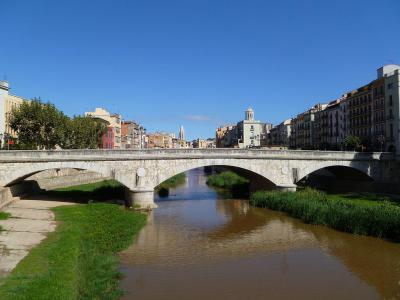
9) Puente de Piedra (Stone Bridge)
The Stone Bridge (Puente de Piedra) is one of Girona’s most recognisable river crossings, spanning the Onyar River with a blend of historical charm and urban functionality. Built in the mid-19th century, it replaced an earlier wooden bridge, offering a more durable and elegant connection between the city’s historic centre and the expanding districts on the opposite bank. Its name reflects both its construction material and its enduring role as a sturdy link in Girona’s urban landscape. Over the years, it has withstood floods, weathering, and the steady rhythm of daily life, becoming an integral part of the city’s riverside scenery.
Architecturally, the bridge features graceful stone arches that rise above the Onyar, offering excellent vantage points for viewing Girona’s colourful riverside façades. The balance of function and form is evident in its straightforward yet harmonious design, which blends well with the surrounding historic buildings. Its relatively low profile ensures that it complements rather than dominates the skyline, making it an ideal spot for photography, especially at sunset, when the warm light reflects off the pastel-toned houses along the riverbanks.
Today, Stone Bridge is more than just a thoroughfare; it is a natural meeting point for locals and visitors. Street musicians often perform here, and seasonal events sometimes make use of the space, adding to its lively atmosphere. Crossing it offers an easy transition from the bustling shops and cafés of the city centre to quieter streets with a more residential feel, making it a pleasant and practical stop on any walking tour of Girona.
Architecturally, the bridge features graceful stone arches that rise above the Onyar, offering excellent vantage points for viewing Girona’s colourful riverside façades. The balance of function and form is evident in its straightforward yet harmonious design, which blends well with the surrounding historic buildings. Its relatively low profile ensures that it complements rather than dominates the skyline, making it an ideal spot for photography, especially at sunset, when the warm light reflects off the pastel-toned houses along the riverbanks.
Today, Stone Bridge is more than just a thoroughfare; it is a natural meeting point for locals and visitors. Street musicians often perform here, and seasonal events sometimes make use of the space, adding to its lively atmosphere. Crossing it offers an easy transition from the bustling shops and cafés of the city centre to quieter streets with a more residential feel, making it a pleasant and practical stop on any walking tour of Girona.
