Custom Walk in Girona, Spain by tpreece64_44286 created on 2025-08-28
Guide Location: Spain » Girona
Guide Type: Custom Walk
# of Sights: 7
Tour Duration: 1 Hour(s)
Travel Distance: 1.5 Km or 0.9 Miles
Share Key: HKYVB
Guide Type: Custom Walk
# of Sights: 7
Tour Duration: 1 Hour(s)
Travel Distance: 1.5 Km or 0.9 Miles
Share Key: HKYVB
How It Works
Please retrieve this walk in the GPSmyCity app. Once done, the app will guide you from one tour stop to the next as if you had a personal tour guide. If you created the walk on this website or come to the page via a link, please follow the instructions below to retrieve the walk in the app.
Retrieve This Walk in App
Step 1. Download the app "GPSmyCity: Walks in 1K+ Cities" on Apple App Store or Google Play Store.



Step 2. In the GPSmyCity app, download(or launch) the guide "Girona Map and Walking Tours".
Step 3. Tap the menu button located at upper right corner of the "Walks" screen and select "Retrieve custom walk". Enter the share key: HKYVB

1) Torre Gironella (Gironella Tower)
Nestled in the heart of Girona’s historic quarter, Gironella Tower stands as a silent sentinel at the highest point of the ancient Roman walls-known as the Força Vella-just behind the majestic Cathedral and beside the Bishop’s Palace. This evocative ruin, officially recognized as a Cultural Asset of National Interest since April 22, 1949, offers visitors both historical depth and architectural intrigue.
Architecturally, Gironella Tower is a fascinating patchwork of eras: its visible remains include a robust Roman square tower lying partly beneath an embankment, a barrel-vault supporting structure, medieval walls, and later reinforcements. Visitors can still climb the stone stairs into the access courtyard, where the historic “Joana Enríquez Gate” marks one of its most striking features.
Tracing its storied past, the tower’s existence is recorded as early as 994 AD. Around the year 1000, Count Ramon Borrell III incorporated the Roman structure into the new Castle of Gironella, which by 1190 had become officially recognized as such. Over the centuries, it served various roles-including a prison in the 13th century-and was rebuilt after collapsing in 1404, only to be reinforced again in 1462 by Joana Enríquez. Tragically, the tower met its ruin at the hands of Napoleonic forces in 1814.
Today, Gironella Tower remains an evocative waypoint on Girona’s Archaeological Walk. It offers not just sweeping vistas over the Old Quarter, but also an intimate window into a layered past where Roman foundations, medieval fortifications, and modern memory converge. A visit here is both scenic and scholarly-a must for history lovers and curious travelers alike.
Architecturally, Gironella Tower is a fascinating patchwork of eras: its visible remains include a robust Roman square tower lying partly beneath an embankment, a barrel-vault supporting structure, medieval walls, and later reinforcements. Visitors can still climb the stone stairs into the access courtyard, where the historic “Joana Enríquez Gate” marks one of its most striking features.
Tracing its storied past, the tower’s existence is recorded as early as 994 AD. Around the year 1000, Count Ramon Borrell III incorporated the Roman structure into the new Castle of Gironella, which by 1190 had become officially recognized as such. Over the centuries, it served various roles-including a prison in the 13th century-and was rebuilt after collapsing in 1404, only to be reinforced again in 1462 by Joana Enríquez. Tragically, the tower met its ruin at the hands of Napoleonic forces in 1814.
Today, Gironella Tower remains an evocative waypoint on Girona’s Archaeological Walk. It offers not just sweeping vistas over the Old Quarter, but also an intimate window into a layered past where Roman foundations, medieval fortifications, and modern memory converge. A visit here is both scenic and scholarly-a must for history lovers and curious travelers alike.
2) Bishop José Cartañà Street - Streets of Braavos
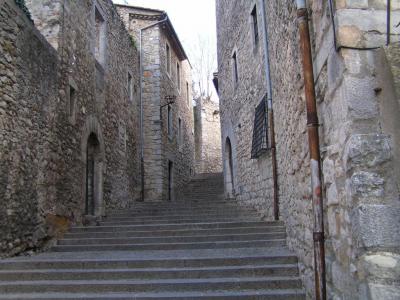
Slip around the back of Girona’s cathedral and you’ll stumble onto Bishop Josep Cartañà Street-a lane that once belonged mostly to locals and pigeons but now doubles as prime Braavos territory. In Game of Thrones Season 6, this is where Arya Stark, blinded and desperate, staggered along the cobbles, begging for alms. The producers hardly touched a thing; the uneven stones, the narrow squeeze of walls, and those shadowy corners were ready-made for Braavos grit.
The street itself begins under an arch beside Apostols’ Square and winds down toward Saint Cristòfol Street. Its name honors Bishop Josep Cartañà, who left his mark on Girona in the 20th century and now rests eternally in the cathedral towering above. Beneath your feet lie Roman foundations, while the walls tell tales of medieval expansions. On paper, it’s a modest side street; in practice, it’s a timeline compressed into a few dozen meters.
For locals, it’s another thread in Girona’s historic fabric. For “Thronies,” it’s Arya’s training ground. The stone steps behind the cathedral gardens have become a pilgrimage site where fans perch, squint into imaginary sunlight, and play the part of a blind girl with more grit than coins. It’s one of the most reenacted moments in town-and perhaps the only spot where you’ll see tourists queuing up to pretend to beg.
That’s the charm of Bishop Cartañà Street: history layered with pop culture, a lane that’s both lived-in and cinematic, where Girona’s past meets fantasy.
The street itself begins under an arch beside Apostols’ Square and winds down toward Saint Cristòfol Street. Its name honors Bishop Josep Cartañà, who left his mark on Girona in the 20th century and now rests eternally in the cathedral towering above. Beneath your feet lie Roman foundations, while the walls tell tales of medieval expansions. On paper, it’s a modest side street; in practice, it’s a timeline compressed into a few dozen meters.
For locals, it’s another thread in Girona’s historic fabric. For “Thronies,” it’s Arya’s training ground. The stone steps behind the cathedral gardens have become a pilgrimage site where fans perch, squint into imaginary sunlight, and play the part of a blind girl with more grit than coins. It’s one of the most reenacted moments in town-and perhaps the only spot where you’ll see tourists queuing up to pretend to beg.
That’s the charm of Bishop Cartañà Street: history layered with pop culture, a lane that’s both lived-in and cinematic, where Girona’s past meets fantasy.
3) Ferran el Catòlic Street and Archaeological Walk - Braavos Port Market
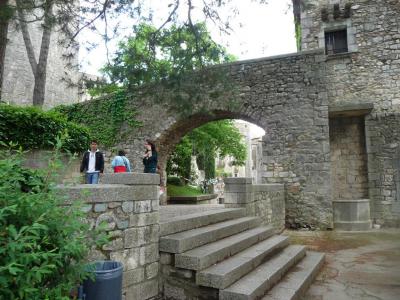
Ferran the Catholic Street borrows its name from Ferdinand II of Aragon, the same Ferdinand history books file under “the Catholic.” Today, this narrow stretch of Girona’s Old Town stitches together two heavyweights: the Archaeological Walk and Cathedral Square. The Walk itself is a time-layered path, first Roman, then Carolingian, later medieval-rebuilt in the 20th century after centuries of decline. Cypress shade, garden walls, watchtowers, and broad city views make it feel like Girona’s open-air scrapbook.
On Ferran the Catholic Street, you see the contrast straight away: stone remnants of those ancient walls leaning against later buildings, history literally jammed up against modern life. The Church of Saint Luke adds another note, reminding passersby that this isn’t just a shortcut between landmarks but a corridor with its own chapters.
And then comes the television twist. Game of Thrones fans know this part of town as Braavos. Arya Stark, hood up and wary, drifts through a market filmed right along the Archaeological Walk and nearby King Street. Jury Square, a few steps away, doubled as the Braavosi theater where Arya spied on the Lannister play. In Girona, though, the square has long served a more grounded role: concerts, performances, public gatherings. Its stone stairways, flanking walls, and the Galligants River give it the same natural backdrop that once lured HBO’s cameras.
With the Monastery of Saint Peter of Galligants only a short stroll away, this corner of Girona packs centuries of cultural weight, or pop-culture, the choice is yours.
On Ferran the Catholic Street, you see the contrast straight away: stone remnants of those ancient walls leaning against later buildings, history literally jammed up against modern life. The Church of Saint Luke adds another note, reminding passersby that this isn’t just a shortcut between landmarks but a corridor with its own chapters.
And then comes the television twist. Game of Thrones fans know this part of town as Braavos. Arya Stark, hood up and wary, drifts through a market filmed right along the Archaeological Walk and nearby King Street. Jury Square, a few steps away, doubled as the Braavosi theater where Arya spied on the Lannister play. In Girona, though, the square has long served a more grounded role: concerts, performances, public gatherings. Its stone stairways, flanking walls, and the Galligants River give it the same natural backdrop that once lured HBO’s cameras.
With the Monastery of Saint Peter of Galligants only a short stroll away, this corner of Girona packs centuries of cultural weight, or pop-culture, the choice is yours.
4) Sant Pere de Galligants Cloister - King's Landing Cloister
Let’s roll into Girona and meet Saint Peter of Galligants, a onetime Benedictine abbey turned archaeological museum since 1857. The name nods to the river that trickles nearby, though the abbey’s story carries a lot more weight than that gentle stream.
The monastery first appeared in 992, just outside Girona’s walls, but time wasn’t kind. Only its church and cloister made it through the centuries. The Romanesque church, finished in 1130, owes its existence to a generous donation from Ramon Berenguer the Great, Count of Barcelona. In retrospective, it's the best thing he could have done.
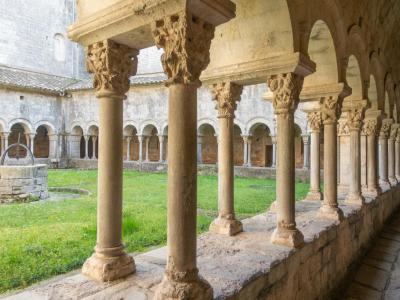
Step into the cloister and you’ll find Catalan Romanesque design at its finest. The northern gallery dates to 1154, with the rest completed in 1190, each capital etched with lions, sirens, and biblical tales. If you’ve seen the cloisters of Saint Cucuphas of Valles or Girona Cathedral, the motifs might feel like distant cousins. In 1931, Spain locked it into the history books by declaring it a national monument.
Of course, pop culture gave it a second wind. Saint Peter doubled as a set in Game of Thrones, most memorably as the entrance to Oldtown’s grand library, where Samwell Tarly hoped to rise as a Maester. It even played the part of a King’s Landing cloister. So, between medieval monks and TV dragons, Saint Peter of Galligants has stepped into more roles than many actors could dream of.
The monastery first appeared in 992, just outside Girona’s walls, but time wasn’t kind. Only its church and cloister made it through the centuries. The Romanesque church, finished in 1130, owes its existence to a generous donation from Ramon Berenguer the Great, Count of Barcelona. In retrospective, it's the best thing he could have done.
Step into the cloister and you’ll find Catalan Romanesque design at its finest. The northern gallery dates to 1154, with the rest completed in 1190, each capital etched with lions, sirens, and biblical tales. If you’ve seen the cloisters of Saint Cucuphas of Valles or Girona Cathedral, the motifs might feel like distant cousins. In 1931, Spain locked it into the history books by declaring it a national monument.
Of course, pop culture gave it a second wind. Saint Peter doubled as a set in Game of Thrones, most memorably as the entrance to Oldtown’s grand library, where Samwell Tarly hoped to rise as a Maester. It even played the part of a King’s Landing cloister. So, between medieval monks and TV dragons, Saint Peter of Galligants has stepped into more roles than many actors could dream of.
5) Galligants Bridge - Braavos Bridge
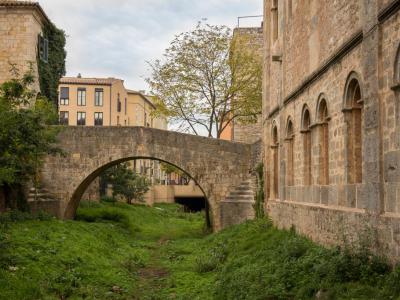
Between Jury Square and the Abbey of Saint Peter of Galligants lies the Galligants Bridge, a hefty sweep of stone named after the river it once spanned. The river today measures a modest 4.5 kilometers, a trickle really, but centuries ago it had enough force to deliver one of Girona’s most destructive floods-four meters of water swallowing whole neighborhoods like Saint Peter and de la Barca. Hard to imagine such a disaster from what now looks more like a stream than a threat.
As part of Girona’s Old Town, the bridge stands as one of the most striking remnants along the Galligants’ old course. The irony is that no water runs under it anymore, since the channel was redirected out of this corner of the city. It’s a bridge without a river, but one that still commands attention.
Hollywood thought so too. When Game of Thrones came calling, the bridge landed a role in season six, episode seven. Here Arya Stark, played by Maisie Williams, pauses in reflection-before being promptly ambushed by a certain dagger-wielding girl disguised as a weary old crone. The sweeping views Arya appears to gaze at? Pure CGI wizardry, complete with a towering 400-foot Titan that never existed outside a computer.
Even the water sequence wasn’t Girona at all, but a harbor in Northern Ireland. Yet, standing on the Galligants Bridge, you can sense why the directors chose it: its stone heft, its Old Town backdrop, and that uncanny knack for turning absence-the missing river-into atmosphere.
As part of Girona’s Old Town, the bridge stands as one of the most striking remnants along the Galligants’ old course. The irony is that no water runs under it anymore, since the channel was redirected out of this corner of the city. It’s a bridge without a river, but one that still commands attention.
Hollywood thought so too. When Game of Thrones came calling, the bridge landed a role in season six, episode seven. Here Arya Stark, played by Maisie Williams, pauses in reflection-before being promptly ambushed by a certain dagger-wielding girl disguised as a weary old crone. The sweeping views Arya appears to gaze at? Pure CGI wizardry, complete with a towering 400-foot Titan that never existed outside a computer.
Even the water sequence wasn’t Girona at all, but a harbor in Northern Ireland. Yet, standing on the Galligants Bridge, you can sense why the directors chose it: its stone heft, its Old Town backdrop, and that uncanny knack for turning absence-the missing river-into atmosphere.
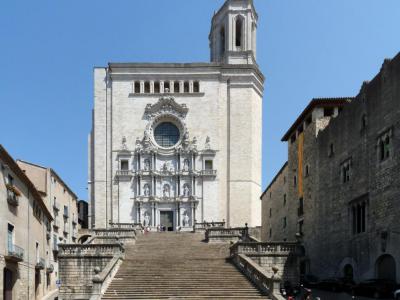
6) Cathedral of Girona Steps - Great Sept of Baelor
Girona Cathedral-formally the Cathedral of Saint Mary-doesn’t so much sit in the Old Town as loom over it from the top of ninety-one unforgiving steps. Those steps are a spectacle in themselves: a grand Baroque staircase that demands good shoes and maybe a quick pause to catch your breath halfway up. But the climb pays off, because at the top stands a building that took seven centuries to finish, mixing Romanesque solidity with Gothic ambition, crowned by the widest Gothic nave on Earth-nearly twenty-three meters across.
That colossal nave and the cathedral’s imposing exterior made it irresistible to movie location scouts. In season six of Game of Thrones, the cathedral masqueraded as the Great Sept of Baelor. The monumental staircase became the stage for Jaime Lannister’s tense standoff with the High Sparrow, complete with 200 extras, armies of Tyrell soldiers, and, yes, a horse specially trained to trot up the stone steps. For viewers, the scene looked like the height of medieval grit; for locals, it was Tuesday in front of the cathedral-plus a few cameras and a lot of armor.
The cathedral cameoed again in the finale of the season, though this time in less flattering fashion-obliterated in Cersei’s fiery coup. Of course, Girona’s most famous church is still very much intact; the explosion was pure special effects. Today, the staircase that once rang with sparrows and Lannisters is back to its old rhythm: tourists puffing their way up, locals ducking around them, and the cathedral presiding over it all with the quiet confidence that has outlasted more than one empire-real and fictional.
That colossal nave and the cathedral’s imposing exterior made it irresistible to movie location scouts. In season six of Game of Thrones, the cathedral masqueraded as the Great Sept of Baelor. The monumental staircase became the stage for Jaime Lannister’s tense standoff with the High Sparrow, complete with 200 extras, armies of Tyrell soldiers, and, yes, a horse specially trained to trot up the stone steps. For viewers, the scene looked like the height of medieval grit; for locals, it was Tuesday in front of the cathedral-plus a few cameras and a lot of armor.
The cathedral cameoed again in the finale of the season, though this time in less flattering fashion-obliterated in Cersei’s fiery coup. Of course, Girona’s most famous church is still very much intact; the explosion was pure special effects. Today, the staircase that once rang with sparrows and Lannisters is back to its old rhythm: tourists puffing their way up, locals ducking around them, and the cathedral presiding over it all with the quiet confidence that has outlasted more than one empire-real and fictional.
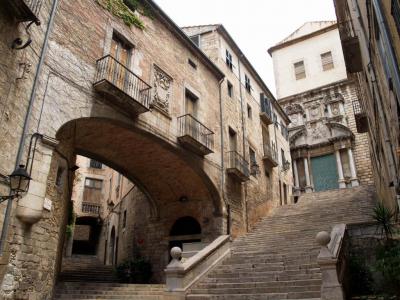
7) Ascent of San Domenec - Braavos Market
The Ascent of Saint Domènec is one of Girona’s most photogenic stairways-and not just because of its Game of Thrones cameo. This stepped street took shape between the 14th and 17th centuries and still feels like a stage set, flanked by Renaissance palaces, the Agullana Palace, and crowned by the imposing baroque front of the Church of Saint Martí Sacosta. Its roots go back even further: the Dominicans planted a convent here in the 13th century, turning the area into both a religious hub and a neighborhood crossroads. Later renovations matched the drama of the church above, leaving us with the elegant, balanced stairway you see today.
Climbing it is a workout, but one softened by the setting. Locals claim it’s impossible to pass without pausing-whether that’s to snap a photo, claim a table at Le Bistrot, whose terrace hides under the arch, or peek into the Ensesa workshop, a favorite during Girona’s annual Temps de Flors festival when flowers spill across the steps.
Then there’s its screen career. Perfume: The Story of a Murderer filmed here back in 2006, but it was HBO’s Game of Thrones that catapulted the stairway into global stardom. Season 6 dressed the steps as a bustling Braavosi marketplace, complete with awnings, baskets, and extras. It’s where Arya Stark, blind and desperate, was chased down by the Waif. The moment that sticks into the fans' minds is her tumble that sent orange-filled baskets flying on the stairs.
Today, the Ascent of Saint Domènec works double duty: a slice of Girona’s architectural story and a pop-culture landmark, equally good for a quiet climb or a re-enactment.
Climbing it is a workout, but one softened by the setting. Locals claim it’s impossible to pass without pausing-whether that’s to snap a photo, claim a table at Le Bistrot, whose terrace hides under the arch, or peek into the Ensesa workshop, a favorite during Girona’s annual Temps de Flors festival when flowers spill across the steps.
Then there’s its screen career. Perfume: The Story of a Murderer filmed here back in 2006, but it was HBO’s Game of Thrones that catapulted the stairway into global stardom. Season 6 dressed the steps as a bustling Braavosi marketplace, complete with awnings, baskets, and extras. It’s where Arya Stark, blind and desperate, was chased down by the Waif. The moment that sticks into the fans' minds is her tumble that sent orange-filled baskets flying on the stairs.
Today, the Ascent of Saint Domènec works double duty: a slice of Girona’s architectural story and a pop-culture landmark, equally good for a quiet climb or a re-enactment.
