Custom Walk in Girona, Spain by martag78_b66d9 created on 2025-10-24
Guide Location: Spain » Girona
Guide Type: Custom Walk
# of Sights: 6
Tour Duration: 1 Hour(s)
Travel Distance: 1.9 Km or 1.2 Miles
Share Key: 4TMAB
Guide Type: Custom Walk
# of Sights: 6
Tour Duration: 1 Hour(s)
Travel Distance: 1.9 Km or 1.2 Miles
Share Key: 4TMAB
How It Works
Please retrieve this walk in the GPSmyCity app. Once done, the app will guide you from one tour stop to the next as if you had a personal tour guide. If you created the walk on this website or come to the page via a link, please follow the instructions below to retrieve the walk in the app.
Retrieve This Walk in App
Step 1. Download the app "GPSmyCity: Walks in 1K+ Cities" on Apple App Store or Google Play Store.



Step 2. In the GPSmyCity app, download(or launch) the guide "Girona Map and Walking Tours".
Step 3. Tap the menu button located at upper right corner of the "Walks" screen and select "Retrieve custom walk". Enter the share key: 4TMAB
1) Onyar River Colored Houses (must see)
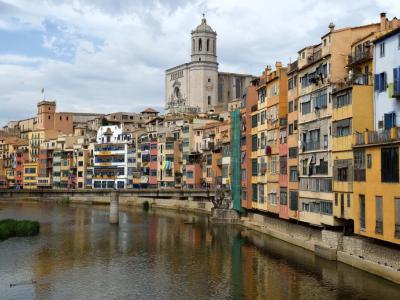
The Onyar River does more than split Girona in two-it frames one of its most photographed scenes. Lining its banks are the famous colored houses, stacked in ochres, pinks, yellows, and reds, their reflections doubling the spectacle in the water below. They weren’t designed as postcard material; in the Middle Ages, people simply built where space allowed-right on the river’s edge. Their facelift came much later, when architect Rafael Masó and a handful of local artists chose a palette that turned practicality into one of Girona’s defining images.
Locals sometimes call them the “Hanging Houses,” as if the buildings were daring you to notice how they cling to the riverbank. Among them sits the Masó House, the birthplace of Masó himself, now preserved as a museum that pulls visitors into his vision of Catalan modernism.
The river doesn’t just separate buildings; it has long marked a boundary between Girona’s medieval Old Town on one side and its modern growth on the other. Crossing one of its bridges is a literal step between eras, and few crossings are more famous than the Eiffel Bridge-built in 1877 by the same workshop that later sent an iron tower into the Paris sky.
If you’re looking for the best view, sunrise and sunset are the golden hours. From the bridges, the houses glow and ripple in the water, and even the most casual stroller turns into a photographer. But these façades aren’t only a backdrop; they’re an introduction. They welcome you into a city where centuries of history cling to the stones as tightly as the houses hug the river.
Locals sometimes call them the “Hanging Houses,” as if the buildings were daring you to notice how they cling to the riverbank. Among them sits the Masó House, the birthplace of Masó himself, now preserved as a museum that pulls visitors into his vision of Catalan modernism.
The river doesn’t just separate buildings; it has long marked a boundary between Girona’s medieval Old Town on one side and its modern growth on the other. Crossing one of its bridges is a literal step between eras, and few crossings are more famous than the Eiffel Bridge-built in 1877 by the same workshop that later sent an iron tower into the Paris sky.
If you’re looking for the best view, sunrise and sunset are the golden hours. From the bridges, the houses glow and ripple in the water, and even the most casual stroller turns into a photographer. But these façades aren’t only a backdrop; they’re an introduction. They welcome you into a city where centuries of history cling to the stones as tightly as the houses hug the river.
2) Jewish Quarter and Jewish History Museum (must see)
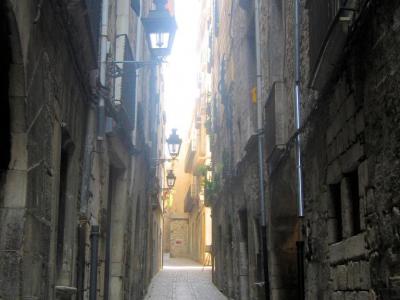
El Call, Girona’s Jewish Quarter, is a labyrinth where history hides in plain sight. Its cobbled alleys and tight stone stairways once held the heartbeat of a Jewish community that flourished here from the 12th to the 15th century. Merchants, craftsmen, and scholars packed these narrow streets, and Girona’s reputation as a centre of learning was cemented by its famed school of Kabbalah. Then came 1492. Spain expelled its Jewish population, leaving behind empty houses and silence where life had once thrived. Yet the quarter endures, every twist of its passageways carrying echoes of that vanished world.
Nestled within this maze is the Museum of Jewish History, housed in what was once a synagogue. Step into its courtyard and you’ll see a bold Star of David carved into the stone-in case you forgot where you are. Inside, eleven rooms unfold the story of Jewish life in Girona and across Catalonia: how families lived, how festivals were celebrated, how medicine, philosophy, and trade were practiced here. Manuscripts, ritual objects, and carefully preserved artifacts breathe life into names that might otherwise be lost. The synagogue also carries the imprint of Nahmanides, the 13th-century rabbi, philosopher, and physician whose wit and wisdom left a mark on Jewish life for generations. What earned him fame was his ability to out-argue kings and out-write just about anyone in medieval Spain. A scale model of the quarter itself helps visitors imagine the district at its height, before its sudden fracture in the late 15th century.
The museum keeps moving forward with new displays and a shop full of books worth carrying home. Yet its real echo is on the streets around it, where every corner is less about sightseeing and more about walking through an archive written in stone, stubbornly refusing to be footnoted into silence.
Nestled within this maze is the Museum of Jewish History, housed in what was once a synagogue. Step into its courtyard and you’ll see a bold Star of David carved into the stone-in case you forgot where you are. Inside, eleven rooms unfold the story of Jewish life in Girona and across Catalonia: how families lived, how festivals were celebrated, how medicine, philosophy, and trade were practiced here. Manuscripts, ritual objects, and carefully preserved artifacts breathe life into names that might otherwise be lost. The synagogue also carries the imprint of Nahmanides, the 13th-century rabbi, philosopher, and physician whose wit and wisdom left a mark on Jewish life for generations. What earned him fame was his ability to out-argue kings and out-write just about anyone in medieval Spain. A scale model of the quarter itself helps visitors imagine the district at its height, before its sudden fracture in the late 15th century.
The museum keeps moving forward with new displays and a shop full of books worth carrying home. Yet its real echo is on the streets around it, where every corner is less about sightseeing and more about walking through an archive written in stone, stubbornly refusing to be footnoted into silence.
3) Banos Arabes (Arab Baths) (must see)
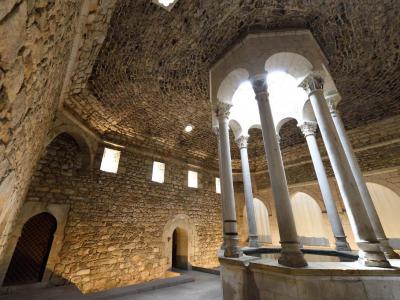
The Arab Baths of Girona sit a stone’s throw from the cathedral, a medieval spa with a misleading name. Built in 1194 by the city’s Christians-not the Moors-the baths borrow ideas from both Roman engineering and Islamic design but are Romanesque to their core. Step inside and you’re walking through a five-room routine that was as much about community as cleanliness. You start in the apodyterium, the dressing room, crowned by an octagonal pool and slender columns that set the scene. From there it’s a temperature tour: the icy frigidarium, the mild tepidarium, and the steam-filled caldarium, kept hot by an ingenious underfloor system, or hypocaust, that turned the whole place into a medieval wellness center.
The baths ran until the 15th century before slipping into decline. By the 1600s they were folded into a Capuchin convent, pressed into service as a pantry and laundry-hardly glamorous, but that recycling is what kept them intact. By the 19th century, people were calling them “Arab Baths,” a name that stuck more out of romantic fancy than historical accuracy. Careful restorations later returned the complex to something close to its medieval look, and today the interplay of light, stone, and geometry makes the rooms feel like a time capsule.
Pop culture gave the site fresh fame when Game of Thrones rolled into town. The baths doubled as Braavos in Arya Stark’s frantic chase through season six, and they reappeared in Oldtown as Samwell Tarly and Gilly arrived at the Citadel. The medieval stonework proved as camera-ready as any computer-generated castle.
Visitors today can wander the hushed interiors, peer up at the domed skylight, and even climb to the rooftop for views across Girona. The baths are more than a curiosity-they’re a reminder of how medieval Girona blended pragmatism, culture, and a touch of borrowed style into something uniquely its own.
The baths ran until the 15th century before slipping into decline. By the 1600s they were folded into a Capuchin convent, pressed into service as a pantry and laundry-hardly glamorous, but that recycling is what kept them intact. By the 19th century, people were calling them “Arab Baths,” a name that stuck more out of romantic fancy than historical accuracy. Careful restorations later returned the complex to something close to its medieval look, and today the interplay of light, stone, and geometry makes the rooms feel like a time capsule.
Pop culture gave the site fresh fame when Game of Thrones rolled into town. The baths doubled as Braavos in Arya Stark’s frantic chase through season six, and they reappeared in Oldtown as Samwell Tarly and Gilly arrived at the Citadel. The medieval stonework proved as camera-ready as any computer-generated castle.
Visitors today can wander the hushed interiors, peer up at the domed skylight, and even climb to the rooftop for views across Girona. The baths are more than a curiosity-they’re a reminder of how medieval Girona blended pragmatism, culture, and a touch of borrowed style into something uniquely its own.
4) Catedral de Girona (Girona Cathedral) (must see)
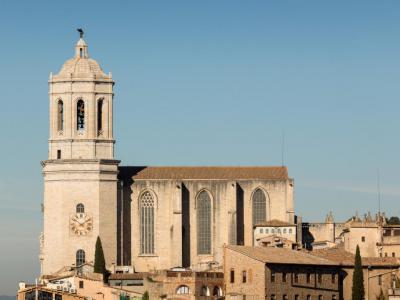
Resting on one of Girona’s high points, the Girona Cathedral doesn’t so much sit in the skyline as command it. The climb begins with that wide baroque staircase-grand enough to feel ceremonial before you’ve even crossed the threshold.
The story of this cathedral stretches across seven centuries of construction, from the 11th to the 18th, leaving behind an architectural mixture of Romanesque, Gothic, and Baroque. The earliest layer survives in the cloister and Charlemagne Tower, but the main piece arrived in the 14th century: a single Gothic nave, seventy-five feet across. It’s the widest Gothic nave in the world, and second only to St. Peter’s in Rome for sheer span-an audacious feat of stone engineering. By the 18th century, the baroque façade sealed the building’s imposing look.
Step inside, and the contrasts play out in stained glass light, a silver-and-gem altarpiece, and side chapels that balance solemnity with flourish. The bell tower rises with clock and belfry, while the Romanesque cloister to the north, with its trapezoid plan and double columns, gives you a glimpse into an older, quieter rhythm of devotion.
The real treasures sit in the cathedral’s museum: the Tapestry of Creation, a masterpiece of embroidery from the 11th or 12th century; the illuminated Gerona Beatus manuscript from the 10th; and a silver casket crafted for the Caliph Hisham II. Together, they weave a timeline of faith, artistry, and power.
And if the staircase looks familiar-it’s because HBO’s Game of Thrones turned it into the Great Sept of Baelor. Girona Cathedral has been playing host to drama for a thousand years; the cameras were just a bit late to the party.
The story of this cathedral stretches across seven centuries of construction, from the 11th to the 18th, leaving behind an architectural mixture of Romanesque, Gothic, and Baroque. The earliest layer survives in the cloister and Charlemagne Tower, but the main piece arrived in the 14th century: a single Gothic nave, seventy-five feet across. It’s the widest Gothic nave in the world, and second only to St. Peter’s in Rome for sheer span-an audacious feat of stone engineering. By the 18th century, the baroque façade sealed the building’s imposing look.
Step inside, and the contrasts play out in stained glass light, a silver-and-gem altarpiece, and side chapels that balance solemnity with flourish. The bell tower rises with clock and belfry, while the Romanesque cloister to the north, with its trapezoid plan and double columns, gives you a glimpse into an older, quieter rhythm of devotion.
The real treasures sit in the cathedral’s museum: the Tapestry of Creation, a masterpiece of embroidery from the 11th or 12th century; the illuminated Gerona Beatus manuscript from the 10th; and a silver casket crafted for the Caliph Hisham II. Together, they weave a timeline of faith, artistry, and power.
And if the staircase looks familiar-it’s because HBO’s Game of Thrones turned it into the Great Sept of Baelor. Girona Cathedral has been playing host to drama for a thousand years; the cameras were just a bit late to the party.

5) Passeig De La Muralla (Ancient City Walls) (must see)
The Ancient City Walls of Girona are less “old ruins” and more “stone showmen.” Their first chapter begins in 1 B.C., when the Romans sketched out fortifications to guard their settlement. Advance to the 14th century, and those Roman bones were built up into the sprawling medieval ramparts that wrapped around Girona like a suit of armor. They were badly needed-this was a city besieged more than two dozen times, and the walls bore the brunt of it.
By the 19th century, the story took a turn: parts of the walls on the western side were dismantled to let the growing city breathe. The eastern side was simply abandoned. For a while, Girona outgrew its stone corset. But in recent decades, restorers gave the walls back their voice, patching together missing stretches and reopening the walkways.
Now, climbing onto the ramparts is less about survival and more about perspective. From up high, the view spreads across terracotta rooftops, the cathedral’s bell tower, and, if the day is clear, the serrated outline of the Pyrenees. Towers punctuate the route with higher vantage points, while tucked-away gardens and shaded sections provide breathing spaces along the climb. Arrow slits and narrow windows remind you that these walls weren’t built for scenery-they were built to keep Girona standing.
A full circuit takes an hour or two, though there are plenty of access points if you’d rather dip in and out. What you’re walking, though, is not just a wall-it’s two millennia of the city deciding when to defend, when to expand, and when to restore. Few places in Girona stitch past and present together with such clarity underfoot.
By the 19th century, the story took a turn: parts of the walls on the western side were dismantled to let the growing city breathe. The eastern side was simply abandoned. For a while, Girona outgrew its stone corset. But in recent decades, restorers gave the walls back their voice, patching together missing stretches and reopening the walkways.
Now, climbing onto the ramparts is less about survival and more about perspective. From up high, the view spreads across terracotta rooftops, the cathedral’s bell tower, and, if the day is clear, the serrated outline of the Pyrenees. Towers punctuate the route with higher vantage points, while tucked-away gardens and shaded sections provide breathing spaces along the climb. Arrow slits and narrow windows remind you that these walls weren’t built for scenery-they were built to keep Girona standing.
A full circuit takes an hour or two, though there are plenty of access points if you’d rather dip in and out. What you’re walking, though, is not just a wall-it’s two millennia of the city deciding when to defend, when to expand, and when to restore. Few places in Girona stitch past and present together with such clarity underfoot.
6) Pont de les Peixateries Velles (Eiffel Bridge) (must see)
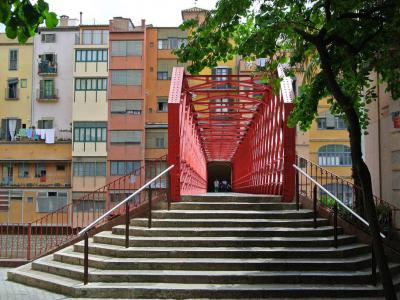
Stretching across the Onyar River like a bright red exclamation mark is the Eiffel Bridge, Girona’s most photographed walkway. Officially, it’s the Bridge of the Old Fishmongers-locals once hauled their catch nearby-but somewhere along the way, the fish lost out to fame. Built in 1877 by Gustave Eiffel’s workshop, it’s the same engineer who would later bolt together a slightly taller project in Paris. You may have heard of it.
The bridge is all iron lattice, a web of crimson bars that makes you feel as though you’re stepping into a giant piece of geometry homework. It’s only about nine feet wide, and its wooden planks creak just enough underfoot to remind you of its age. At 136 feet long, it doesn’t ask for much walking, but it rewards every step.
Pause midway and the city spills into view: the Onyar flowing beneath you, flanked by a jumble of riverside houses painted in ochres, blues, and pinks-Girona’s most famous postcard in real time. On one side of the bridge lies Freedom Boulevard, a lively strip of shops and cafés that keep the old town buzzing. On the other, the newer part of the city stretches out, with Saint Clara Street leading you straight toward Independence Square.
This isn’t a bridge to cross quickly-it’s a bridge to linger on, to snap a photo or two, and to watch the light play across the river and rooftops. Eiffel built it as a functional crossing; Girona has made it a stage set for daily life.
The bridge is all iron lattice, a web of crimson bars that makes you feel as though you’re stepping into a giant piece of geometry homework. It’s only about nine feet wide, and its wooden planks creak just enough underfoot to remind you of its age. At 136 feet long, it doesn’t ask for much walking, but it rewards every step.
Pause midway and the city spills into view: the Onyar flowing beneath you, flanked by a jumble of riverside houses painted in ochres, blues, and pinks-Girona’s most famous postcard in real time. On one side of the bridge lies Freedom Boulevard, a lively strip of shops and cafés that keep the old town buzzing. On the other, the newer part of the city stretches out, with Saint Clara Street leading you straight toward Independence Square.
This isn’t a bridge to cross quickly-it’s a bridge to linger on, to snap a photo or two, and to watch the light play across the river and rooftops. Eiffel built it as a functional crossing; Girona has made it a stage set for daily life.
