Custom Walk in Trondheim, Norway by mengkiesel_c7a35 created on 2025-12-03
Guide Location: Norway » Trondheim
Guide Type: Custom Walk
# of Sights: 6
Tour Duration: 2 Hour(s)
Travel Distance: 4.5 Km or 2.8 Miles
Share Key: BBBAA
Guide Type: Custom Walk
# of Sights: 6
Tour Duration: 2 Hour(s)
Travel Distance: 4.5 Km or 2.8 Miles
Share Key: BBBAA
How It Works
Please retrieve this walk in the GPSmyCity app. Once done, the app will guide you from one tour stop to the next as if you had a personal tour guide. If you created the walk on this website or come to the page via a link, please follow the instructions below to retrieve the walk in the app.
Retrieve This Walk in App
Step 1. Download the app "GPSmyCity: Walks in 1K+ Cities" on Apple App Store or Google Play Store.



Step 2. In the GPSmyCity app, download(or launch) the guide "Trondheim Map and Walking Tours".
Step 3. Tap the menu button located at upper right corner of the "Walks" screen and select "Retrieve custom walk". Enter the share key: BBBAA
1) Pirbadet
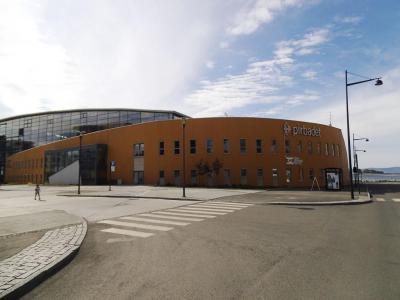
Pirbadet, situated in the scenic backdrop of Trondheim, offers a harmonious fusion of ocean and coastline. As the largest indoor water park in Norway, it stands as a unique attraction along the city's waterfront, boasting unparalleled vistas and a diverse range of aquatic and fitness amenities. Since its inauguration on June 15, 2001, Pirbadet has evolved into a bustling hub for both locals and tourists, attracting around half a million visitors annually.
Beyond being merely a water park, Pirbadet is a comprehensive hub for leisure and fitness pursuits, featuring a cutting-edge gym alongside its extensive water-based attractions. It remains accessible almost daily, with exceptions for select holidays throughout the year.
The water park segment of Pirbadet offers an array of aquatic delights, catering to individuals of all ages and preferences. From a wave pool and whirlpool to a tranquil health pool and a sports pool equipped with diving towers, there's something for everyone. Thrill-seekers can revel in the adrenaline rush of the 100-meter speed slide, complete with immersive sound and light effects, tunnels, and the sensation of gravity-defying excitement. Moreover, the gentle adventure of the flow channel appeals to family members of all ages.
Yet Pirbadet transcends beyond mere slides and pools, boasting wellness amenities such as saunas, a solarium, and a jacuzzi, along with a therapeutic pool tailored to visitors' health and relaxation requirements. For those inclined towards combining fitness with amusement, the climbing wall and sports pool with diving towers offer a unique amalgamation of challenges and enjoyment.
With 37 showers for convenience and a Café/Snack Bar for replenishment and relaxation, Pirbadet ensures guests' comfort and satisfaction, serving as an all-inclusive destination for those in pursuit of both thrills and tranquility.
Beyond being merely a water park, Pirbadet is a comprehensive hub for leisure and fitness pursuits, featuring a cutting-edge gym alongside its extensive water-based attractions. It remains accessible almost daily, with exceptions for select holidays throughout the year.
The water park segment of Pirbadet offers an array of aquatic delights, catering to individuals of all ages and preferences. From a wave pool and whirlpool to a tranquil health pool and a sports pool equipped with diving towers, there's something for everyone. Thrill-seekers can revel in the adrenaline rush of the 100-meter speed slide, complete with immersive sound and light effects, tunnels, and the sensation of gravity-defying excitement. Moreover, the gentle adventure of the flow channel appeals to family members of all ages.
Yet Pirbadet transcends beyond mere slides and pools, boasting wellness amenities such as saunas, a solarium, and a jacuzzi, along with a therapeutic pool tailored to visitors' health and relaxation requirements. For those inclined towards combining fitness with amusement, the climbing wall and sports pool with diving towers offer a unique amalgamation of challenges and enjoyment.
With 37 showers for convenience and a Café/Snack Bar for replenishment and relaxation, Pirbadet ensures guests' comfort and satisfaction, serving as an all-inclusive destination for those in pursuit of both thrills and tranquility.
2) Historic Wharves
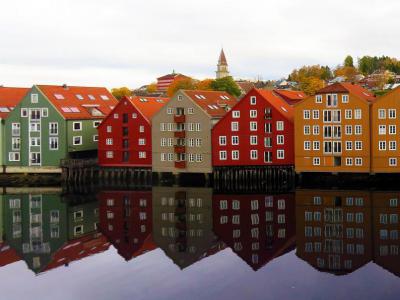
The historic wharfs of Trondheim are known as some of the most distinctive buildings in the city. The buildings stand along both sides of the Nidelven River's channel where they were originally used as storage for such goods as grain, sugar, salt and fish.
The buildings were completed in the 17th century but most were lost in a fire in 1681. The rebuilt wharf buildings were made to look as similar to their ancestors as possible. They were created using the traditional technique of interlocking logs, bare wood interior and simple construction.
The original wharfs were not used as homes but that has changed. Today, most of these colorful buildings are residential houses. Others are art galleries, coffee shops, restaurants and unique boutiques.
The cobbled walking paths make exploring the historic wharfs an easy and beautiful stroll. There are also a number of benches along the paths for those who want to relax. The Old Town Bridge over the Nidelven River is a great spot to get a picturesque view of the historic wharfs from a distance.
The buildings were completed in the 17th century but most were lost in a fire in 1681. The rebuilt wharf buildings were made to look as similar to their ancestors as possible. They were created using the traditional technique of interlocking logs, bare wood interior and simple construction.
The original wharfs were not used as homes but that has changed. Today, most of these colorful buildings are residential houses. Others are art galleries, coffee shops, restaurants and unique boutiques.
The cobbled walking paths make exploring the historic wharfs an easy and beautiful stroll. There are also a number of benches along the paths for those who want to relax. The Old Town Bridge over the Nidelven River is a great spot to get a picturesque view of the historic wharfs from a distance.
3) Bakklandet (must see)
Bakklandet is sometimes referred to as "Old Trondheim." This is inaccurate. The first settlements of Trondheim were in Kalvskinnet. Bakklandet is an area along the river Nidelva, that flows through the city to the fjords and the sea. The Bakklandet area today may be an idyllic tourist mecca, but originally it was a center for trade.
Bakklandet was an open area outside the city. It was first developed in the early 17th century. The city had grown and needed to build across the river Nidelva. Bakklandet became the first suburb of Trondheim. As fate would have it, the Swedes attacked Trondheim in 1658 and they burned Bakklandet to the ground.
In 1681 the city bridge was thrown across the Nidelva, connecting Trondheim to Bakklandet and Kristiansten Fortress. Traffic increased and trade and opportunities with it. Fires remained a problem. Ships were forbidden to store flammable goods on board. Trading houses built piers in Bakklandet. Business grew apace.
The Swedes came back in 1718. This time they did not burn down Bakklandet. Norwegian troops did that, to create a defensive open area around Trondheim. In the wake of the Swedes came reconstruction once more. By 1770 the streets were paved and Bakklandet was back in business.
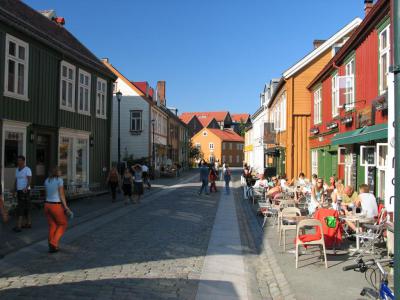
The neighborhood of Bakklandet today is composed of smallish wooden houses and narrow streets. The old warehouse buildings along the river stand in the water on their pilings. Tourists wander over the plank walkways of the Old Town Bridge. They stop to take a look at the view of the town and the river.
Bakklandet was an open area outside the city. It was first developed in the early 17th century. The city had grown and needed to build across the river Nidelva. Bakklandet became the first suburb of Trondheim. As fate would have it, the Swedes attacked Trondheim in 1658 and they burned Bakklandet to the ground.
In 1681 the city bridge was thrown across the Nidelva, connecting Trondheim to Bakklandet and Kristiansten Fortress. Traffic increased and trade and opportunities with it. Fires remained a problem. Ships were forbidden to store flammable goods on board. Trading houses built piers in Bakklandet. Business grew apace.
The Swedes came back in 1718. This time they did not burn down Bakklandet. Norwegian troops did that, to create a defensive open area around Trondheim. In the wake of the Swedes came reconstruction once more. By 1770 the streets were paved and Bakklandet was back in business.
The neighborhood of Bakklandet today is composed of smallish wooden houses and narrow streets. The old warehouse buildings along the river stand in the water on their pilings. Tourists wander over the plank walkways of the Old Town Bridge. They stop to take a look at the view of the town and the river.
4) Gamle Bybro (Old Town Bridge) (must see)
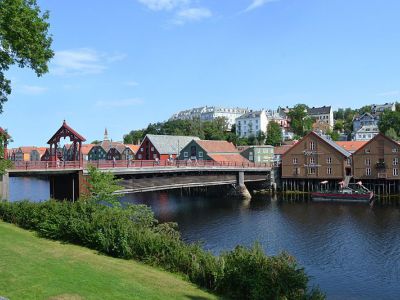
After the great fire of 1681, Johan Caspar von Cicignon, a renowned general and military engineer, built a bridge across the Nidelva river. It led from central Trondheim to the Bakklandet district and Kristiansten Fortress. A military access was necessary to the fortress at this point. The bridge functioned as a guarded city gate until 1816.
The Old Town Bridge was made with wood. The actual bridge today is a reconstruction by municipal engineer Carl Adolf Dahl in 1861. Dahl was the executive engineer of the city for public works in the latter half of the 19th century. Initially there was a sentry guardhouse at each end of the bridge.
King Christian V of Denmark financed the bridge construction himself. It was completed in 1685. Old Town Bridge took the place of the original Elgeseter Bridge nearby. After the Old Town Bridge opened, the Elgeseter Bridge was neglected and allowed to deteriorate and collapse.
One guard house was later demolished but the excise house on the west bank is still extant and in use as a day care center. The carved gates of the Old Town Bridge are the distinctive earmarks of Trondheim. Walk under the gates and take in the view of the fortress and the colorful houses of Bakklandet.
Old Town Bridge has been called the "Gate of Happiness". This is from the waltz lyrics of Norwegian composer Kristian Oskar Hoddo, "Nidelven quiet and beautiful you are." Hoddo wrote the lyrics while contemplating the river from the bridge in 1940. He later became a member of the anti-Nazi resistance. He was executed in Trondheim in 1943.
The Old Town Bridge was made with wood. The actual bridge today is a reconstruction by municipal engineer Carl Adolf Dahl in 1861. Dahl was the executive engineer of the city for public works in the latter half of the 19th century. Initially there was a sentry guardhouse at each end of the bridge.
King Christian V of Denmark financed the bridge construction himself. It was completed in 1685. Old Town Bridge took the place of the original Elgeseter Bridge nearby. After the Old Town Bridge opened, the Elgeseter Bridge was neglected and allowed to deteriorate and collapse.
One guard house was later demolished but the excise house on the west bank is still extant and in use as a day care center. The carved gates of the Old Town Bridge are the distinctive earmarks of Trondheim. Walk under the gates and take in the view of the fortress and the colorful houses of Bakklandet.
Old Town Bridge has been called the "Gate of Happiness". This is from the waltz lyrics of Norwegian composer Kristian Oskar Hoddo, "Nidelven quiet and beautiful you are." Hoddo wrote the lyrics while contemplating the river from the bridge in 1940. He later became a member of the anti-Nazi resistance. He was executed in Trondheim in 1943.
5) Nidaros Cathedral (must see)
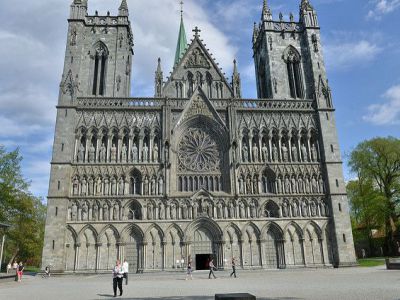
King Olav II reigned in Norway from 1015 to 1028. He is also Saint Olav, the patron saint of Norway. Nidaros Cathedral was built to be the burial site of Saint Olav. It took over 230 years before it was complete in 1300. The cathedral has also served as the coronation site of the kings of Norway.
The cathedral was named Nidaros, after the original name for Trondheim. It was Catholic until 1537, when it was swept up in the Protestant Reformation and taken over by the New Church of Norway. It is the world's northernmost medieval cathedral.
The great stone church can seat 1,850 souls. It shows Gothic and Romanesque architectural influences. In 1814 the cathedral served as a polling station in Norway's first national election.
There were fires in 1327 and again in 1531. In 1708 the cathedral was totally burned down, leaving only the stone walls. In 1719 it was struck by lightning and once more burned.
Restoration began in 1869. It was declared completed in 2001 but maintenance of the structure continues. The west facade of the cathedral is alive with carved figures and animals. Only five of the actual medieval statues have survived intact. Those not unscathed can be found in the Archbishop's Palace museum.
Saint Michael perches at the highest point of the north tower, wings spread while he sticks it to the devil in the form of a dragon. The facade is covered with masks, angels, gargoyles and as many creatures as can be imagined.
The octagon shaped choir and its ambulatory are the oldest parts of the Cathedral. The ambulatory is joined to the choir by a stone screen with three arches. The center arch frames the figure of Christ the Teacher. At the site of the medieval high altar is a silver reliquary holding an arm of Saint Olav.
A second altar is in the intersection of the transept and the nave. The altar holds a modern crucifix commissioned by Norwegian-American immigrants of the 20th century.
Each year Nidaros cathedral is the venue for Olav's Wake, the anniversary of Saint Olav's death.
The cathedral was named Nidaros, after the original name for Trondheim. It was Catholic until 1537, when it was swept up in the Protestant Reformation and taken over by the New Church of Norway. It is the world's northernmost medieval cathedral.
The great stone church can seat 1,850 souls. It shows Gothic and Romanesque architectural influences. In 1814 the cathedral served as a polling station in Norway's first national election.
There were fires in 1327 and again in 1531. In 1708 the cathedral was totally burned down, leaving only the stone walls. In 1719 it was struck by lightning and once more burned.
Restoration began in 1869. It was declared completed in 2001 but maintenance of the structure continues. The west facade of the cathedral is alive with carved figures and animals. Only five of the actual medieval statues have survived intact. Those not unscathed can be found in the Archbishop's Palace museum.
Saint Michael perches at the highest point of the north tower, wings spread while he sticks it to the devil in the form of a dragon. The facade is covered with masks, angels, gargoyles and as many creatures as can be imagined.
The octagon shaped choir and its ambulatory are the oldest parts of the Cathedral. The ambulatory is joined to the choir by a stone screen with three arches. The center arch frames the figure of Christ the Teacher. At the site of the medieval high altar is a silver reliquary holding an arm of Saint Olav.
A second altar is in the intersection of the transept and the nave. The altar holds a modern crucifix commissioned by Norwegian-American immigrants of the 20th century.
Each year Nidaros cathedral is the venue for Olav's Wake, the anniversary of Saint Olav's death.
6) Torvet (Town Square)
Olaf Tryggvason, son of Tryggvi Olafsson, and great grandson of Harald Fairhair, will always be remembered as Olaf I. He is known to have had four wives who brought him good luck. He settled in Ireland but he was lured to Norway to battle Jarl Haakon. He defeated Haakon in the year 996 and became king.
But in 1000 AD Olaf, in turn, was defeated at sea by the Danes, Swedes and Wends. In the battle he was thrown into the sea and was never seen again. His reign by the River Nid in Trondheim was short but busy. He founded Trondheim and its Town Square (Torvet).
Town Square was set up as a place for commerce and events. The city was near destroyed by fire in 1681. Johan Caspar de Cicignon, a renowned general and military engineer, drew up a new layout for the city. The boundaries of the Town Square were set and have remained so to this day. Johan favored the Baroque in anything he built or rebuilt.
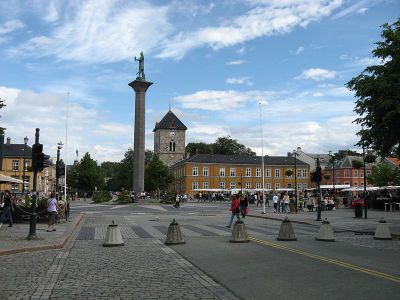
In 1921 Wilhelm Rasmussen, a well known sculptor of Norway, unveiled his monument to King Olaf I. The monument is a 58 foot column in the center of the square. King Olaf stands on a pedestal at the top. The statue doubles as a sundial as drawn on the cobblestones below.
Town Square at one time was bound on three sides by elite mansions of the wealthy. Now Olaf presides over a shopping center and tourists taking their ease.
But in 1000 AD Olaf, in turn, was defeated at sea by the Danes, Swedes and Wends. In the battle he was thrown into the sea and was never seen again. His reign by the River Nid in Trondheim was short but busy. He founded Trondheim and its Town Square (Torvet).
Town Square was set up as a place for commerce and events. The city was near destroyed by fire in 1681. Johan Caspar de Cicignon, a renowned general and military engineer, drew up a new layout for the city. The boundaries of the Town Square were set and have remained so to this day. Johan favored the Baroque in anything he built or rebuilt.
In 1921 Wilhelm Rasmussen, a well known sculptor of Norway, unveiled his monument to King Olaf I. The monument is a 58 foot column in the center of the square. King Olaf stands on a pedestal at the top. The statue doubles as a sundial as drawn on the cobblestones below.
Town Square at one time was bound on three sides by elite mansions of the wealthy. Now Olaf presides over a shopping center and tourists taking their ease.
