Custom Walk in Chicago, Illinois by letitiagray00_38e2e3 created on 2026-03-19
Guide Location: USA » Chicago
Guide Type: Custom Walk
# of Sights: 8
Tour Duration: 1 Hour(s)
Travel Distance: 2.2 Km or 1.4 Miles
Share Key: YG2J7
Guide Type: Custom Walk
# of Sights: 8
Tour Duration: 1 Hour(s)
Travel Distance: 2.2 Km or 1.4 Miles
Share Key: YG2J7
How It Works
Please retrieve this walk in the GPSmyCity app. Once done, the app will guide you from one tour stop to the next as if you had a personal tour guide. If you created the walk on this website or come to the page via a link, please follow the instructions below to retrieve the walk in the app.
Retrieve This Walk in App
Step 1. Download the app "GPSmyCity: Walks in 1K+ Cities" on Apple App Store or Google Play Store.



Step 2. In the GPSmyCity app, download(or launch) the guide "Chicago Map and Walking Tours".
Step 3. Tap the menu button located at upper right corner of the "Walks" screen and select "Retrieve custom walk". Enter the share key: YG2J7
1) Chinatown Gate
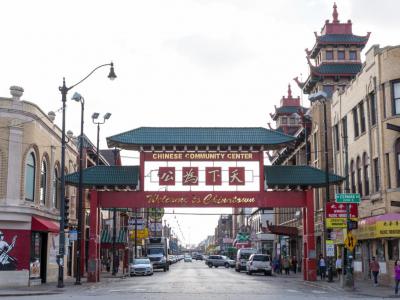
Chicago's vibrant Chinese enclave is fittingly anchored by the Chinatown Gate. Erected in 1975, it was conceived by architect Peter Fung, drawing inspiration from a gate found in Beijing. Its ornate tiles at the pinnacle are hand-painted with characters that convey the message, "The world belongs to the commonwealth". This phrase harkens back to the early 20th century, a pivotal period during China's transition to a republic, while also serving as a tribute to the enduring spirit of Chicago's pioneering Chinese settlers.
The gate stands on South Wentworth Avenue, the main thoroughfare of Chinatown. Along this vibrant street you will find a plethora of restaurants, bakeries, grocery stores, as well as shops specializing in Chinese traditional medicine. In addition to the myriad Chinese dining options, you'll discover a rich tapestry of eateries offering Vietnamese, Thai, and Japanese cuisine, enriching the culinary mosaic.
The gate stands on South Wentworth Avenue, the main thoroughfare of Chinatown. Along this vibrant street you will find a plethora of restaurants, bakeries, grocery stores, as well as shops specializing in Chinese traditional medicine. In addition to the myriad Chinese dining options, you'll discover a rich tapestry of eateries offering Vietnamese, Thai, and Japanese cuisine, enriching the culinary mosaic.
2) Pui Tak Center
In 1912, a substantial number of Chinese residents and business proprietors found themselves displaced from Chicago's downtown South Loop due to new construction projects. In response to this upheaval, the On Leong tong, a "benevolent association", played a pivotal role in the establishment of Chinatown by securing fifty leases in the area for their group members, thus laying the foundation for the future.
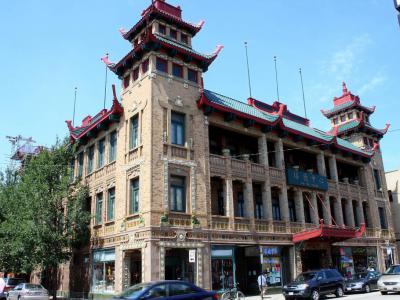
Following the relocation, the On Leong association continued its multifaceted activities across various nearby locations, including running a hostel for immigrants, operating a Chinese-language school, and offering services related to business, employment, and matchmaking. However, when it came to constructing their new edifice, informally known as Chinatown's "City Hall", they sought the expertise of Michaelsen & Rognstad. Although the architects were not well-versed in Chinese architectural traditions, they displayed a keen willingness to learn and adapt. Rognstad took charge of the sculptural program, employing terra-cotta as an excellent substitute for the "liu li" glazed ceramic commonly seen in traditional Chinese architecture. While the building's walls are adorned with polychrome terra-cotta motifs, such as flowers, vases, and moths, the entrance is guarded by lion sculptures, their heads cleverly oriented to face outward, avoiding the symbolic act of turning their backs on each other, which would be considered inauspicious.
Today, the Pui Tak Center, with its striking green-and-red pagoda towers, serves as a hub for various religious, community, and educational initiatives, including adult education, youth programs, music instruction, and services catering to new immigrants. The name "Pui Tak" translates to "building character" or "cultivating virtue" in Chinese, reflecting the center's mission within the community.
Following the relocation, the On Leong association continued its multifaceted activities across various nearby locations, including running a hostel for immigrants, operating a Chinese-language school, and offering services related to business, employment, and matchmaking. However, when it came to constructing their new edifice, informally known as Chinatown's "City Hall", they sought the expertise of Michaelsen & Rognstad. Although the architects were not well-versed in Chinese architectural traditions, they displayed a keen willingness to learn and adapt. Rognstad took charge of the sculptural program, employing terra-cotta as an excellent substitute for the "liu li" glazed ceramic commonly seen in traditional Chinese architecture. While the building's walls are adorned with polychrome terra-cotta motifs, such as flowers, vases, and moths, the entrance is guarded by lion sculptures, their heads cleverly oriented to face outward, avoiding the symbolic act of turning their backs on each other, which would be considered inauspicious.
Today, the Pui Tak Center, with its striking green-and-red pagoda towers, serves as a hub for various religious, community, and educational initiatives, including adult education, youth programs, music instruction, and services catering to new immigrants. The name "Pui Tak" translates to "building character" or "cultivating virtue" in Chinese, reflecting the center's mission within the community.
3) St. Therese Chinese Catholic Church
Following the waning demand for labor during the California gold rush and the construction of the Transcontinental railroad, a significant number of Chinese immigrants embarked on a journey eastward to Chicago. The earliest Chinese settlers primarily hailed from Taishan, a county in the southern province of Kwangtung, and the majority of them adhered to some form of Buddhism or Taoism. Many of them found employment with small import-export enterprises and manufacturing companies, and it wasn't until around 1912 that they began to establish their presence in what is now the Chinatown area.
In 1940, Reverend John T.S. Mao, a native of Nanking, China, leased a storefront at 2302 S. Wentworth and inaugurated Chicago's first Chinese Catholic Church, christening it Saint Therese in honor of the patron saint of missions, as a culmination of prior endeavors to foster a Chinese Catholic community in the city. In 1947, as Chinese immigrants began fleeing from communist China, the church's Mission played a pivotal role by providing free education to their children and addressing their other essential needs.
As the Chinese Catholic population continued to grow, the need for expanded worship space became apparent. The nearby Italian community graciously extended their hospitality by sharing the rectory and basement auditorium of their own church, Santa Maria Incoronata. In 1960, Chinese Catholics officially held their Chinese Mass within the Italian church, and just three years later, the building was formally transferred to them. This transition was a poignant moment for many Italian parishioners who had worshipped at the location; however, today, both groups coexist harmoniously, regularly sharing in worship. While the Italians once hosted the Chinese at Santa Maria Incoronata, the Chinese now reciprocate the gesture by hosting the Italians at Saint Therese.
The ensuing decades leading up to the 21st century have witnessed a transformation in the church's composition. Although still referred to as a Chinese mission, it now proudly represents a "salad bowl" of diverse ethnic origins. Acknowledging its rich heritage and looking forward to its future, this church stands as one of Chicago's most exquisite, a testament to its past and its evolving identity.
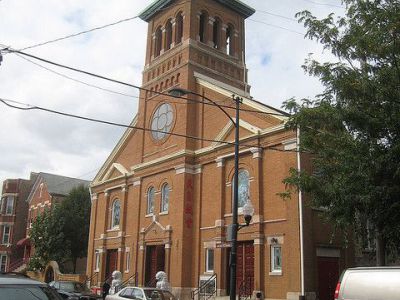
In 2000 and 2001, a comprehensive renovation and refurbishment project breathed new life into the church, shining brighter than ever in its century-long history. During the planning of this ambitious endeavor, great care was taken to preserve the church's cherished traditions while seamlessly incorporating the contemporary. The statues and stained glass windows pay homage to its Italian heritage. Statues of Saint Rocco and Saint Christopher symbolize the towns of Simbario and Ricigliano in Italy, while many stained glass windows honor the patron saints of specific Italian regions. Simultaneously, Chinese influences are prominently featured, with the parish's primary statement written in Chinese above the altar-a character signifying "love". The parish's motto is beautifully inscribed along the columns from right to left, bridging the rich tapestry of its diverse congregation: "Together in Christ, we are one happy family."
In 1940, Reverend John T.S. Mao, a native of Nanking, China, leased a storefront at 2302 S. Wentworth and inaugurated Chicago's first Chinese Catholic Church, christening it Saint Therese in honor of the patron saint of missions, as a culmination of prior endeavors to foster a Chinese Catholic community in the city. In 1947, as Chinese immigrants began fleeing from communist China, the church's Mission played a pivotal role by providing free education to their children and addressing their other essential needs.
As the Chinese Catholic population continued to grow, the need for expanded worship space became apparent. The nearby Italian community graciously extended their hospitality by sharing the rectory and basement auditorium of their own church, Santa Maria Incoronata. In 1960, Chinese Catholics officially held their Chinese Mass within the Italian church, and just three years later, the building was formally transferred to them. This transition was a poignant moment for many Italian parishioners who had worshipped at the location; however, today, both groups coexist harmoniously, regularly sharing in worship. While the Italians once hosted the Chinese at Santa Maria Incoronata, the Chinese now reciprocate the gesture by hosting the Italians at Saint Therese.
The ensuing decades leading up to the 21st century have witnessed a transformation in the church's composition. Although still referred to as a Chinese mission, it now proudly represents a "salad bowl" of diverse ethnic origins. Acknowledging its rich heritage and looking forward to its future, this church stands as one of Chicago's most exquisite, a testament to its past and its evolving identity.
In 2000 and 2001, a comprehensive renovation and refurbishment project breathed new life into the church, shining brighter than ever in its century-long history. During the planning of this ambitious endeavor, great care was taken to preserve the church's cherished traditions while seamlessly incorporating the contemporary. The statues and stained glass windows pay homage to its Italian heritage. Statues of Saint Rocco and Saint Christopher symbolize the towns of Simbario and Ricigliano in Italy, while many stained glass windows honor the patron saints of specific Italian regions. Simultaneously, Chinese influences are prominently featured, with the parish's primary statement written in Chinese above the altar-a character signifying "love". The parish's motto is beautifully inscribed along the columns from right to left, bridging the rich tapestry of its diverse congregation: "Together in Christ, we are one happy family."
4) Chinese Christian Union Church
Established in 1903 by missionaries and converts from the Presbyterian, Congregationalist, and Baptist churches, the Chinese Christian Union Church (CCUC) has a storied history. Initially situated in the Loop Chinatown on Clark Street, the church relocated to the new South Side Chinatown after 1912, following its worshipers. As they distanced themselves from their mainline Protestant roots and embraced an evangelical path, the church embarked on a significant journey. In 1950, groundbreaking ceremonies took place at the corner of 23rd Street and Wentworth Avenue for the construction of the present-day church building, which has remained a cornerstone of Chinatown, serving as a vital religious and social hub ever since.
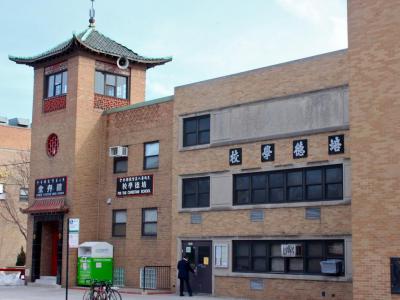
The church's architectural design embraces Asian influences, featuring exquisite brickwork on its exterior. Services are conducted in English, Cantonese, and Mandarin, making it a welcoming spiritual home for recent immigrants from China and Taiwan, as well as American-born Chinese individuals. The church offers a diverse range of programs, including ESL and citizenship courses, alongside prayer groups and ministries, embodying a holistic approach to supporting its members.
The church's architectural design embraces Asian influences, featuring exquisite brickwork on its exterior. Services are conducted in English, Cantonese, and Mandarin, making it a welcoming spiritual home for recent immigrants from China and Taiwan, as well as American-born Chinese individuals. The church offers a diverse range of programs, including ESL and citizenship courses, alongside prayer groups and ministries, embodying a holistic approach to supporting its members.
5) Chinese-American Museum of Chicago
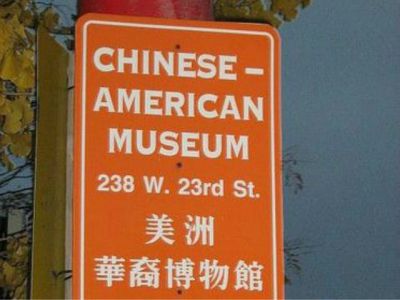
Just a stone's throw from the bustling array of restaurants, bakeries, and grocery stores that define Chinatown's Wentworth Avenue, you'll discover the Chinese-American Museum of Chicago (CAMOC). Flanked by two impressive stone lions, handcrafted by skilled artisans from China's Fujian Province and donated by Chinese officials, CAMOC may easily escape notice if you're not actively seeking it out. Although it occupies a small footprint in the museum world, it conceals within its walls far more than one might anticipate.
Before its inception, Chinatown lacked any museums, and it wasn't until 2005 that CAMOC opened its doors to the public. It's important to note, however, that this museum does not position itself as an authoritative voice on the Chinese-American experience. Instead, it embraces a more intimate approach, one that resonates with the community and serves as an alternate repository for personal histories. Many of the museum's artifacts stem from donations or loans extended by community members and individuals from the surrounding areas, lending an authenticity to the exhibits, from cherished family photographs to personal jewelry sets.
This community-centric focus is evident in the permanent exhibit, housed on the second floor. Notable sections include those featuring trilingual information panels (English, Spanish, Chinese) that narrate the tales of Chinese immigrants, with a particular emphasis on Chicago. Visitors can also delve into the history of the city's Chinatown through an informative timeline that charts the neighborhood's evolution and expansion, while detailing the waves of immigrants who have passed through.
Chinatown is often pigeonholed as a tourist destination renowned solely for its dim sum, bubble tea, and affordable souvenirs. What's too easily overlooked are the people and their histories, along with the diversity of their identities and experiences. Chinatown is undeniably in a state of transition, witnessing an influx of new immigrants and fresh storefronts, inevitably accompanied by those who will depart the neighborhood. CAMOC serves as a guardian of past Chinatowns while remaining open to the emergence of new ones. It not only offers later generations of Chinese-Americans the opportunity to explore their heritage and history but also provides Chinatown and its residents the platform to narrate their story on their own terms and in their own unique manner.
Before its inception, Chinatown lacked any museums, and it wasn't until 2005 that CAMOC opened its doors to the public. It's important to note, however, that this museum does not position itself as an authoritative voice on the Chinese-American experience. Instead, it embraces a more intimate approach, one that resonates with the community and serves as an alternate repository for personal histories. Many of the museum's artifacts stem from donations or loans extended by community members and individuals from the surrounding areas, lending an authenticity to the exhibits, from cherished family photographs to personal jewelry sets.
This community-centric focus is evident in the permanent exhibit, housed on the second floor. Notable sections include those featuring trilingual information panels (English, Spanish, Chinese) that narrate the tales of Chinese immigrants, with a particular emphasis on Chicago. Visitors can also delve into the history of the city's Chinatown through an informative timeline that charts the neighborhood's evolution and expansion, while detailing the waves of immigrants who have passed through.
Chinatown is often pigeonholed as a tourist destination renowned solely for its dim sum, bubble tea, and affordable souvenirs. What's too easily overlooked are the people and their histories, along with the diversity of their identities and experiences. Chinatown is undeniably in a state of transition, witnessing an influx of new immigrants and fresh storefronts, inevitably accompanied by those who will depart the neighborhood. CAMOC serves as a guardian of past Chinatowns while remaining open to the emergence of new ones. It not only offers later generations of Chinese-Americans the opportunity to explore their heritage and history but also provides Chinatown and its residents the platform to narrate their story on their own terms and in their own unique manner.
6) Chinatown Square Plaza
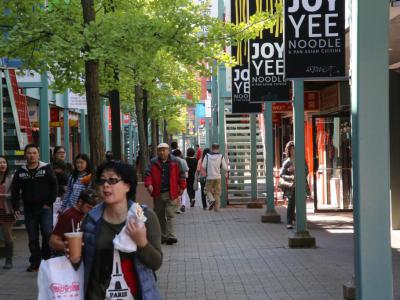
After being confined for an extended period by highways and railroad tracks, Chinatown experienced a significant transformation when the Santa Fe Railroad relinquished its yards north of Archer Avenue. The initial structures to rise on the expansive thirty-acre site were brick retail strips, soon followed by diverse housing options. Fast forward to the present day, and you'll find a sprawling open-air mall occupying this very location. Opened in 1993, the mall is adorned with sculptures of animals, each representing one of the 12 symbols of the Chinese zodiac. Just below these sculptures, informative plaques shed light on the personalities associated with each birth year.
Other noteworthy attractions within the outdoor mall include the twin pagodas, an array of shops and restaurants, and the Chamber of Commerce. Exploring the small grocery stores stocked with exotic spices, a plethora of teas, medicinal herbs, and intriguing vegetables is a delightful experience in itself; however, the true allure of Chinatown Square Plaza lies in its culinary offerings. With over forty dining options to choose from, you'll find yourself spoiled for choice. Additionally, the mall serves as a hub for cultural performances and celebrations, attracting both locals and visitors alike.
Other noteworthy attractions within the outdoor mall include the twin pagodas, an array of shops and restaurants, and the Chamber of Commerce. Exploring the small grocery stores stocked with exotic spices, a plethora of teas, medicinal herbs, and intriguing vegetables is a delightful experience in itself; however, the true allure of Chinatown Square Plaza lies in its culinary offerings. With over forty dining options to choose from, you'll find yourself spoiled for choice. Additionally, the mall serves as a hub for cultural performances and celebrations, attracting both locals and visitors alike.
7) Ping Tom Memorial Park
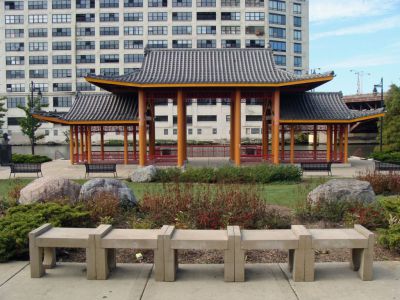
The once-abandoned rail yards lining the Chicago River's edge have been skillfully transformed into a meticulously landscaped park that pays homage to the neighborhood's rich Chinese heritage. Its entrance is marked by four imposing columns, each standing at a towering height of 20 feet and intricately adorned with dragon designs, drawing inspiration from traditional Chinese courtyards.
This green haven takes its name from Chinatown's most revered civic leader, whose bronze bust graces the park's pavilion. Initially envisioned with walled plazas reminiscent of the traditional gardens in Suzhou, China, the park now occupies 12 serene riverside acres. Here, you'll discover a children's playground, meandering walking paths, graceful gingko trees, and a bamboo grove that captures the essence of a Chinese landscape. The park is also home to a fieldhouse and a boathouse, the latter offering kayak rentals during the summer months. For a splendid view of the imposing Chicago skyline to the north, ascend the grand yellow-and-red pagoda. From March through December, you can embark on an affordable and picturesque water taxi ride to the Loop, departing from this location.
A true hidden treasure in Chicago, Ping Tom Park displays its beauty across all seasons and offers a splendid vantage point to admire the city skyline from the south. Don't forget to bring your camera along, as the park's picturesque charm is a sight worth capturing!
This green haven takes its name from Chinatown's most revered civic leader, whose bronze bust graces the park's pavilion. Initially envisioned with walled plazas reminiscent of the traditional gardens in Suzhou, China, the park now occupies 12 serene riverside acres. Here, you'll discover a children's playground, meandering walking paths, graceful gingko trees, and a bamboo grove that captures the essence of a Chinese landscape. The park is also home to a fieldhouse and a boathouse, the latter offering kayak rentals during the summer months. For a splendid view of the imposing Chicago skyline to the north, ascend the grand yellow-and-red pagoda. From March through December, you can embark on an affordable and picturesque water taxi ride to the Loop, departing from this location.
A true hidden treasure in Chicago, Ping Tom Park displays its beauty across all seasons and offers a splendid vantage point to admire the city skyline from the south. Don't forget to bring your camera along, as the park's picturesque charm is a sight worth capturing!
8) Nine Dragon Wall
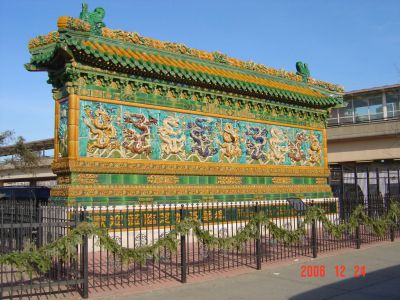
Inspired by the renowned wall within Beijing's Beihai Park, this impressive structure, erected in 2004, features a magnificent display of nine prominent dragons alongside an additional 500 smaller ones, all adorned in vibrant shades of red, gold, and blue, symbolizing the auspicious concept of good fortune. It's noteworthy that in ancient Chinese belief, the number "9" held the highest esteem, and the dragon was considered the essence of all creative forces. The reverence for the number "9" extends to most Chinese art and literature, where it was frequently used to convey profound or auspicious meanings. In mathematics, "9" is unique because any multiple of 9 will always reduce to 9 when its digits are added together. This mathematical property may have contributed to the number's significance.
As a prominent emblem of Chicago's Chinatown, this wall ranks among the four global replicas of the original in Beijing and was actually crafted from imported glazed tiles from China. Such walls are typically found gracing the precincts of imperial Chinese palaces and gardens, as emperors were believed to be the earthly representative of the heavens, and their throne was often referred to as the "Dragon Throne."; however, you'll discover this replica conveniently located near the entrance to Chinatown, adjacent to the "L" stop. If you have an appreciation for Asian architectural aesthetics (and beyond), you'll find this wall to be a truly captivating sight. Although partially enclosed by a gate, you can easily peer over it to capture some great photographs.
As a prominent emblem of Chicago's Chinatown, this wall ranks among the four global replicas of the original in Beijing and was actually crafted from imported glazed tiles from China. Such walls are typically found gracing the precincts of imperial Chinese palaces and gardens, as emperors were believed to be the earthly representative of the heavens, and their throne was often referred to as the "Dragon Throne."; however, you'll discover this replica conveniently located near the entrance to Chinatown, adjacent to the "L" stop. If you have an appreciation for Asian architectural aesthetics (and beyond), you'll find this wall to be a truly captivating sight. Although partially enclosed by a gate, you can easily peer over it to capture some great photographs.
