Custom Walk in Aarhus, Denmark by mibu308_ae3bb4 created on 2026-04-01
Guide Location: Denmark » Aarhus
Guide Type: Custom Walk
# of Sights: 6
Tour Duration: 1 Hour(s)
Travel Distance: 2.1 Km or 1.3 Miles
Share Key: YW8BG
Guide Type: Custom Walk
# of Sights: 6
Tour Duration: 1 Hour(s)
Travel Distance: 2.1 Km or 1.3 Miles
Share Key: YW8BG
How It Works
Please retrieve this walk in the GPSmyCity app. Once done, the app will guide you from one tour stop to the next as if you had a personal tour guide. If you created the walk on this website or come to the page via a link, please follow the instructions below to retrieve the walk in the app.
Retrieve This Walk in App
Step 1. Download the app "GPSmyCity: Walks in 1K+ Cities" on Apple App Store or Google Play Store.



Step 2. In the GPSmyCity app, download(or launch) the guide "Aarhus Map and Walking Tours".
Step 3. Tap the menu button located at upper right corner of the "Walks" screen and select "Retrieve custom walk". Enter the share key: YW8BG
1) Aarhus University
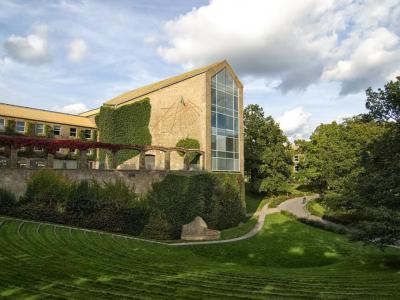
Aarhus University (Aarhus Universitet), founded in 1928, is a prominent public research university located in Aarhus. It is recognized as the largest and the second-oldest university in the country. The university is a member of several prestigious international and European academic associations such as the Coimbra Group, the Guild, the Utrecht Network, and the European University Association, underlining its significant role in the global academic community.
The university's academic structure includes five faculties-Arts, Natural Sciences, Technical Sciences, Health, and Business and Social Sciences-spanning twenty-seven departments. This broad spectrum of disciplines supports a rich environment for research and education, evident in its thirty internationally recognized research centers and fifteen Centres of Excellence funded by the Danish National Research Foundation.
Aarhus University has achieved international acclaim, being ranked among the top 100 universities worldwide. It is also noted for its aesthetic appeal, having been ranked in the top 10 of the most beautiful universities in Europe by Times Higher Education in 2018.
The university has an impressive list of alumni who have made significant contributions in various fields. Notable figures include Bjarne Stroustrup, the inventor of the C++ programming language; Queen Margrethe II of Denmark; Crown Prince Frederik of Denmark; and Anders Fogh Rasmussen, a former Prime Minister of Denmark and Secretary General of NATO. Additionally, the university has ties to Nobel Laureates such as Jens Christian Skou (Chemistry, 1997), who conducted his award-winning research on the Na/K-ATPase at the university, as well as Trygve Haavelmo (Economics, 1989), and Dale T. Mortensen (Economics, 2010), enhancing its reputation as a center of scholarly excellence.
The university's academic structure includes five faculties-Arts, Natural Sciences, Technical Sciences, Health, and Business and Social Sciences-spanning twenty-seven departments. This broad spectrum of disciplines supports a rich environment for research and education, evident in its thirty internationally recognized research centers and fifteen Centres of Excellence funded by the Danish National Research Foundation.
Aarhus University has achieved international acclaim, being ranked among the top 100 universities worldwide. It is also noted for its aesthetic appeal, having been ranked in the top 10 of the most beautiful universities in Europe by Times Higher Education in 2018.
The university has an impressive list of alumni who have made significant contributions in various fields. Notable figures include Bjarne Stroustrup, the inventor of the C++ programming language; Queen Margrethe II of Denmark; Crown Prince Frederik of Denmark; and Anders Fogh Rasmussen, a former Prime Minister of Denmark and Secretary General of NATO. Additionally, the university has ties to Nobel Laureates such as Jens Christian Skou (Chemistry, 1997), who conducted his award-winning research on the Na/K-ATPase at the university, as well as Trygve Haavelmo (Economics, 1989), and Dale T. Mortensen (Economics, 2010), enhancing its reputation as a center of scholarly excellence.
2) Latinerkvarteret (Latin Quarter)
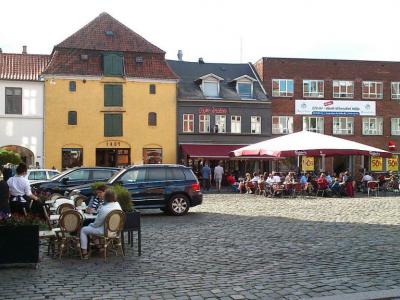
Latin Quarter is a neighborhood in the inner city of Aarhus. It is the oldest part of the city with a history that dates to the 14th century. The oldest houses and buildings in the Latin Quarter were built in the 16th century. One of these is Juuls Gard, which is one of the oldest buildings in the city.
Latin Quarter includes the main square of Pustervig Torv and several streets around the square. The name of the neighborhood was chosen in the 1990s due to the area's resemblance to Paris's Latin Quarter.
The quarter has a large number of shops, cafes and restaurants. It is also known for its active nightlife and entertainment venues. There are a number of small stages throughout the Latin Quarter where live music plays in the evening. Visitors will also find a number of galleries, studios and public art displays.
Latin Quarter includes the main square of Pustervig Torv and several streets around the square. The name of the neighborhood was chosen in the 1990s due to the area's resemblance to Paris's Latin Quarter.
The quarter has a large number of shops, cafes and restaurants. It is also known for its active nightlife and entertainment venues. There are a number of small stages throughout the Latin Quarter where live music plays in the evening. Visitors will also find a number of galleries, studios and public art displays.
3) Aarhus Cathedral (must see)
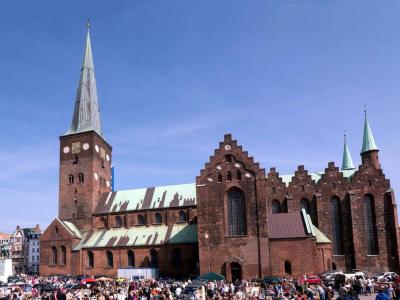
Aarhus Cathedral is a Church of Denmark cathedral that was previously a part of the Roman Catholic church. The Gothic and Romanesque cathedral was completed in 1300 and dedicated to Saint Clement, the patron saint of sailors.
Construction of the church started around 1190. It was built around Saint Clement's church, a timber church built in 1102. The Romanesque architectural style included half-rounded arches, a flat timber ceiling and four chapels.
The cathedral suffered great damage in 1330 when a fire burned much of Aarhus. It was abandoned until 1449 when it was renovated and enlarged. The new design of the church used Gothic vaulting with high windows and a lengthened nave. It is now both the tallest and longest church in Denmark at 305 feet long and 315 feet high. The current, 314-foot tower was built in 1931.
There are more frescoes in Aarhus Cathedral than in any church in the country. They were painted between 1470 and 1520. Likewise, the painting of Saint Christopher and Saint Clement are the tallest in Denmark. The cathedral's one stained glass window was created by Emanuel Vigeland in 1926. At almost 46-feet tall, it is the largest stained glass window in Denmark.
Construction of the church started around 1190. It was built around Saint Clement's church, a timber church built in 1102. The Romanesque architectural style included half-rounded arches, a flat timber ceiling and four chapels.
The cathedral suffered great damage in 1330 when a fire burned much of Aarhus. It was abandoned until 1449 when it was renovated and enlarged. The new design of the church used Gothic vaulting with high windows and a lengthened nave. It is now both the tallest and longest church in Denmark at 305 feet long and 315 feet high. The current, 314-foot tower was built in 1931.
There are more frescoes in Aarhus Cathedral than in any church in the country. They were painted between 1470 and 1520. Likewise, the painting of Saint Christopher and Saint Clement are the tallest in Denmark. The cathedral's one stained glass window was created by Emanuel Vigeland in 1926. At almost 46-feet tall, it is the largest stained glass window in Denmark.
4) Bispetorv (Bishop's Square)
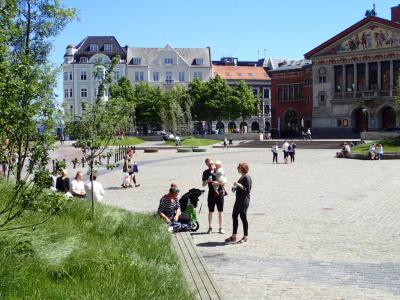
Bishop's Square is a city square near Aarhus Cathedral. It is also located near other well known attractions in Aarhus like the Aarhus Theatre, the Viking Museum and the Latin Quarter neighborhood. It is a wide, open square with plenty of room to roam on the cobbled ground or take advantage of shade from the trees along the southern wall.
The square was renovated in 2016 to create a public space that is used for concerts and gatherings. Prior to this, the square was used as a parking lot. However, it holds a much more important a place in the history of Aarhus.
In the late first century, Bishop's Square was a pagan burial site. Later, it was the seat of the Diocese of Aarhus. Aarhus Cathedral was built near the burial site, which turned the area into a spot that was largely dominated by the clergy. The land was purchased by the city of Aarhus in 1881.
An archaeological dig of the site in the 1960s uncovered many items from the Viking Age and they are now displayed in the Viking Museum near the square.
Bishop's Square is home to a statue of King Christian X atop a horse. During the German occupation of Denmark, Christian became a popular symbol of resistance. He used to ride daily through the streets of Copenhagen unaccompanied by guards and people stood and waved to him. The large statue is located in the grassy area northwest of the open square.
The square was renovated in 2016 to create a public space that is used for concerts and gatherings. Prior to this, the square was used as a parking lot. However, it holds a much more important a place in the history of Aarhus.
In the late first century, Bishop's Square was a pagan burial site. Later, it was the seat of the Diocese of Aarhus. Aarhus Cathedral was built near the burial site, which turned the area into a spot that was largely dominated by the clergy. The land was purchased by the city of Aarhus in 1881.
An archaeological dig of the site in the 1960s uncovered many items from the Viking Age and they are now displayed in the Viking Museum near the square.
Bishop's Square is home to a statue of King Christian X atop a horse. During the German occupation of Denmark, Christian became a popular symbol of resistance. He used to ride daily through the streets of Copenhagen unaccompanied by guards and people stood and waved to him. The large statue is located in the grassy area northwest of the open square.
5) Viking Museum
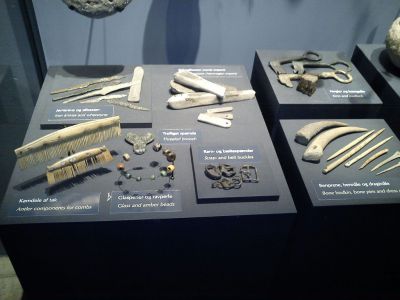
The Viking Museum in Aarhus offers a unique and intimate exploration of the Viking Age right in the heart of the city. Situated underground at Saint Clemens Square, beneath the Nordea bank building, this small museum is a treasure trove of history administered by the Moesgård Museum and supported financially by Aarhus Municipality and Nordea.
Founded in 1968 following archaeological digs from 1963-1964 during the construction of an office building, the museum showcases these excavations. These digs, conducted 3 meters below street level, unearthed Viking Age structures, artifacts, and even parts of a human skeleton. This provides a profound, in-situ experience for visitors, as they stand directly over the site of these historical findings.
The museum's exhibits extend beyond the archaeological finds to provide a broader view of Viking Age Aarhus. Through a mix of original and replicated items, the museum enriches visitors' understanding of the era.
A highlight is the detailed model city of Aarhus as it would have appeared around 980 AD during the reign of Harold Bluetooth, offering a vivid glimpse into the past. Alongside historical narratives, the museum also features newly discovered artifacts and a few replicas for security reasons, as the site is not under constant surveillance.
Moreover, the museum displays a copy of the 'Hørningstenen' runic stone, with the original housed at the Moesgaard Museum. This artifact, discovered in 1849, adds a significant cultural and historical narrative to the Viking Museum's collection, linking it to broader regional histories.
Founded in 1968 following archaeological digs from 1963-1964 during the construction of an office building, the museum showcases these excavations. These digs, conducted 3 meters below street level, unearthed Viking Age structures, artifacts, and even parts of a human skeleton. This provides a profound, in-situ experience for visitors, as they stand directly over the site of these historical findings.
The museum's exhibits extend beyond the archaeological finds to provide a broader view of Viking Age Aarhus. Through a mix of original and replicated items, the museum enriches visitors' understanding of the era.
A highlight is the detailed model city of Aarhus as it would have appeared around 980 AD during the reign of Harold Bluetooth, offering a vivid glimpse into the past. Alongside historical narratives, the museum also features newly discovered artifacts and a few replicas for security reasons, as the site is not under constant surveillance.
Moreover, the museum displays a copy of the 'Hørningstenen' runic stone, with the original housed at the Moesgaard Museum. This artifact, discovered in 1849, adds a significant cultural and historical narrative to the Viking Museum's collection, linking it to broader regional histories.
6) Åboulevarden (River Boulevard)
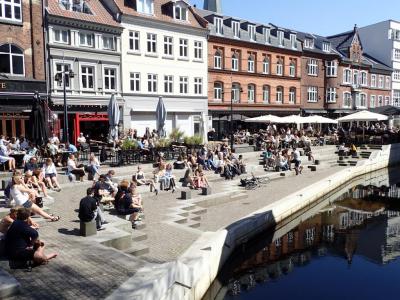
River Boulevard is both a street and a promenade that runs along the Aarhus River. The street runs east to west from Vester Alle to Europaplads. At 975 meters (nearly 3200 feet) long, it is a popular thoroughfare used by pedestrians.
The history of River Boulevard dates to 1477. King Christian I allowed the development of the area near the river. Homes were built and later, in 1674, the alley that ran along the street was widened. River Boulevard itself was built in stages from 1898 to 1934.
A portion of the Aarhus River was briefly paved to provide room for a wider street and parking. Work to uncover the river began in 2005 and was completed in 2015. A new recreational space was created to celebrate the reopening of the river.
The eastern area of River Boulevard is the most popular for locals and visitors. This section of River Boulevard has a large number of bars and cafes with outdoor seating.
The history of River Boulevard dates to 1477. King Christian I allowed the development of the area near the river. Homes were built and later, in 1674, the alley that ran along the street was widened. River Boulevard itself was built in stages from 1898 to 1934.
A portion of the Aarhus River was briefly paved to provide room for a wider street and parking. Work to uncover the river began in 2005 and was completed in 2015. A new recreational space was created to celebrate the reopening of the river.
The eastern area of River Boulevard is the most popular for locals and visitors. This section of River Boulevard has a large number of bars and cafes with outdoor seating.
