Custom Walk in Annecy, France by cote_tanya_86f3f created on 2026-04-04
Guide Location: France » Annecy
Guide Type: Custom Walk
# of Sights: 12
Tour Duration: 2 Hour(s)
Travel Distance: 2.2 Km or 1.4 Miles
Share Key: ZP458
Guide Type: Custom Walk
# of Sights: 12
Tour Duration: 2 Hour(s)
Travel Distance: 2.2 Km or 1.4 Miles
Share Key: ZP458
How It Works
Please retrieve this walk in the GPSmyCity app. Once done, the app will guide you from one tour stop to the next as if you had a personal tour guide. If you created the walk on this website or come to the page via a link, please follow the instructions below to retrieve the walk in the app.
Retrieve This Walk in App
Step 1. Download the app "GPSmyCity: Walks in 1K+ Cities" on Apple App Store or Google Play Store.



Step 2. In the GPSmyCity app, download(or launch) the guide "Annecy Map and Walking Tours".
Step 3. Tap the menu button located at upper right corner of the "Walks" screen and select "Retrieve custom walk". Enter the share key: ZP458
1) Le Pâquier (The Pasture) (must see)
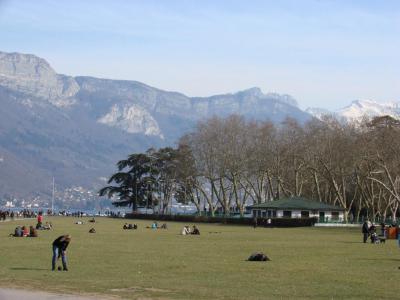
Paquier is the Arpitan word for pasture. In Annecy the Paquier is a huge landscaped meadowland of 18.5 acres. It has an esplanade bordering Lake Annecy offering a stunning view of the lake and mountains. It is part of a network of parks and gardens including the Gardens of Europe, the Imperial Palace gardens and the beach of Old Annecy.
There is a legend, popularized by the writings of Canon Claude-Antoine Ducis. In 1892 he wrote in La Revue Savoisienne that the Paquier was a land grant by the lady Mossiere for the "antics" of the children of Annecy. However, there is no official record of such a donation.
A more likely story is that of Count Bernard VI de Menthon. In 1613 it is recorded that he gave a large part of the Paquier to the children of the city "from a large meadow called Paquier." The count was a colonel of the Annecy regiment. The "children" were actually a "company of knights shooters" practicing archery in the field.
The Paquier included the Gardens of Europe peninsula. It is currently separated from the peninsula by the Vasse canal. The peninsula and the meadow are connected by the iron footbridge, Bridge of Love.
The Paquier stretches along the avenue du Petit-Port by the beach of Albigny with its tree-lined lawn, past the marina to the promenade to Veyrier-du-Lac. On the opposite side of the avenue are buildings and parking lots, shopping and a campsite.
A must attend event of the Paquier is the annual Lake Festival, featuring fireworks and music in august. There have been military olympic events, triathlons, marathons and Tour-de-France races.
There is a legend, popularized by the writings of Canon Claude-Antoine Ducis. In 1892 he wrote in La Revue Savoisienne that the Paquier was a land grant by the lady Mossiere for the "antics" of the children of Annecy. However, there is no official record of such a donation.
A more likely story is that of Count Bernard VI de Menthon. In 1613 it is recorded that he gave a large part of the Paquier to the children of the city "from a large meadow called Paquier." The count was a colonel of the Annecy regiment. The "children" were actually a "company of knights shooters" practicing archery in the field.
The Paquier included the Gardens of Europe peninsula. It is currently separated from the peninsula by the Vasse canal. The peninsula and the meadow are connected by the iron footbridge, Bridge of Love.
The Paquier stretches along the avenue du Petit-Port by the beach of Albigny with its tree-lined lawn, past the marina to the promenade to Veyrier-du-Lac. On the opposite side of the avenue are buildings and parking lots, shopping and a campsite.
A must attend event of the Paquier is the annual Lake Festival, featuring fireworks and music in august. There have been military olympic events, triathlons, marathons and Tour-de-France races.
2) Hotel de Ville (Town Hall)
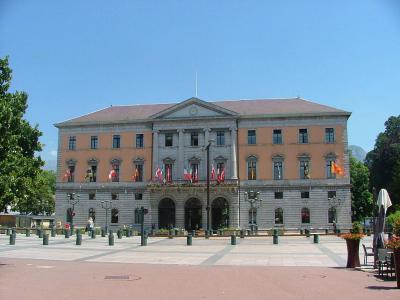
The City Hall (Hotel de Ville) in Annecy, located on the Esplanade de l'Hotel de Ville, is a significant municipal building with a rich history dating back to the 18th century. The original town hall, adjacent to the Notre-Dame-de-Liesse Church on Notre Dame Street, was a four-story structure initially built as a hospital and repurposed for municipal use in 1770. Its design featured a grand forestair, ironwork balconies, and a pediment crowned with an oculus. Notably, a wrought-iron trout symbol-part of Annecy’s municipal coat of arms-adorned the forestair and drew admiration from visitors such as John Ruskin.
By the 1840s, during Annecy's time under the Kingdom of Sardinia, the growing administrative needs prompted the construction of a more substantial town hall. Architect François Justin designed the new building in the Neoclassical style, using ashlar stone. Completed in 1851, the symmetrical façade, featuring a central tetrastyle Ionic portico with a pedimented clock, became an architectural highlight. The interior housed the elegant Salle de Conseil (council chamber), central to Annecy’s governance.
Following the annexation of Savoy by France in 1860 under the Treaty of Turin, the City Hall retained its administrative prominence. In 1995, the area in front of the building, once a car park, was transformed into a landscaped square with a striking water feature designed by Jean-Michel Wilmotte.
A significant chapter in the building’s history unfolded on 14 November 2019, when a fire caused by an electrical fault severely damaged its upper floors and roof. A €30 million restoration project, designed by Pierre-Louis Faloci, is set to begin in March 2025, with completion expected in early 2027. This restoration promises to preserve and modernize the City Hall, ensuring its continued role as a cornerstone of Annecy's civic life.
By the 1840s, during Annecy's time under the Kingdom of Sardinia, the growing administrative needs prompted the construction of a more substantial town hall. Architect François Justin designed the new building in the Neoclassical style, using ashlar stone. Completed in 1851, the symmetrical façade, featuring a central tetrastyle Ionic portico with a pedimented clock, became an architectural highlight. The interior housed the elegant Salle de Conseil (council chamber), central to Annecy’s governance.
Following the annexation of Savoy by France in 1860 under the Treaty of Turin, the City Hall retained its administrative prominence. In 1995, the area in front of the building, once a car park, was transformed into a landscaped square with a striking water feature designed by Jean-Michel Wilmotte.
A significant chapter in the building’s history unfolded on 14 November 2019, when a fire caused by an electrical fault severely damaged its upper floors and roof. A €30 million restoration project, designed by Pierre-Louis Faloci, is set to begin in March 2025, with completion expected in early 2027. This restoration promises to preserve and modernize the City Hall, ensuring its continued role as a cornerstone of Annecy's civic life.
3) Annecy Cathedral (must see)
Formally known as the Cathedral of Saint Peter in Chains, Annecy Cathedral was listed as a historic monument in October 1906. The original edifice was built by Jacques Rossel sometime before 1526. It was intended to be a convent of the Celestins but in 1538 it became a haven for Catholic refugees from Calvinism in Geneva.
Saint Francis de Sales held the seat of Bishop there in the 16th century. In 1792, during the time of the French Revolution, the church was miraculously converted into a temple of the Goddess Reason. The Goddess reigned supreme for a time but she was unseated in the Napoleonic era. The status Cathedral was awarded in 1822.
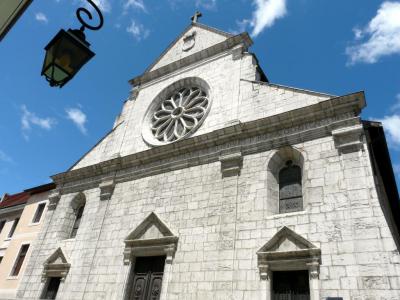
The Renaissance facade of 1535 was adapted from the Roman model of the Church of Sainte-Marie-du-Peuple. The facade masks the basilica aspects of the cathedral. It has Tuscan pilasters under a triangular pediment and a classic Gothic rose window. The bell tower holds two bells by the Paccard Foundry in Sevrier.
There are two pointed arches similar to those of Jacques Rossel installed in 1511 on the tower of Geneva Cathedral. The choir was refurbished in 1775 by architect Giovanni Piacenza. The organ of the Cathedral is by Nicolas-Antoine Lete, organ builder to the King in 1842.
The layout of the Cathedral is similar to a basilica. It has three naves and five bays. The choir is done-over as neoclassical, brightly illuminated by stained glass windows.
The Cathedral is open to the public everyday.
Saint Francis de Sales held the seat of Bishop there in the 16th century. In 1792, during the time of the French Revolution, the church was miraculously converted into a temple of the Goddess Reason. The Goddess reigned supreme for a time but she was unseated in the Napoleonic era. The status Cathedral was awarded in 1822.
The Renaissance facade of 1535 was adapted from the Roman model of the Church of Sainte-Marie-du-Peuple. The facade masks the basilica aspects of the cathedral. It has Tuscan pilasters under a triangular pediment and a classic Gothic rose window. The bell tower holds two bells by the Paccard Foundry in Sevrier.
There are two pointed arches similar to those of Jacques Rossel installed in 1511 on the tower of Geneva Cathedral. The choir was refurbished in 1775 by architect Giovanni Piacenza. The organ of the Cathedral is by Nicolas-Antoine Lete, organ builder to the King in 1842.
The layout of the Cathedral is similar to a basilica. It has three naves and five bays. The choir is done-over as neoclassical, brightly illuminated by stained glass windows.
The Cathedral is open to the public everyday.
4) Au Péché Mignon
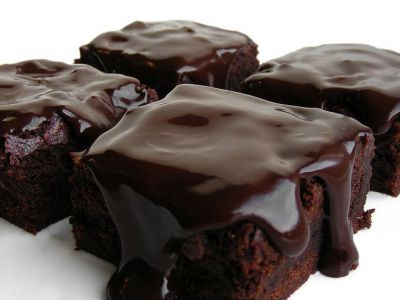
Situated opposite Le Tetras in the picturesque city of Annecy, Au Péché Mignon lives up to its name, translating to "The Sweet Sin." This cozy chocolate boutique is a haven for those with a penchant for indulgent treats. Inside, the shop boasts a mesmerizing selection of handmade chocolate cakes, cookies, sweets, candies, and other luscious delights that tempt even the most disciplined visitors.
With its inviting ambiance and elegant displays, Au Péché Mignon is more than just a store-it’s a celebration of artisanal craftsmanship and the joy of savoring life’s little pleasures. The handmade confections are crafted with care, transforming every bite into a taste of heaven brought down to Earth.
Whether you’re a local looking for a gourmet gift or a tourist wanting to experience Annecy's culinary artistry, Au Péché Mignon promises an unforgettable journey of flavors. Nestled in the city’s charming heart, near its famous canals and cultural landmarks, this boutique is a must-visit destination for anyone seeking the essence of French sweetness and sophistication.
With its inviting ambiance and elegant displays, Au Péché Mignon is more than just a store-it’s a celebration of artisanal craftsmanship and the joy of savoring life’s little pleasures. The handmade confections are crafted with care, transforming every bite into a taste of heaven brought down to Earth.
Whether you’re a local looking for a gourmet gift or a tourist wanting to experience Annecy's culinary artistry, Au Péché Mignon promises an unforgettable journey of flavors. Nestled in the city’s charming heart, near its famous canals and cultural landmarks, this boutique is a must-visit destination for anyone seeking the essence of French sweetness and sophistication.

5) The Morens Bridge
The Morens Bridge, a historical gem of Annecy, spans the scenic Thiou River and serves as a cherished symbol of the city’s medieval past. Its name derives from "murenches," referencing fortifications formed by the city’s houses, while its historical significance dates back to the 13th century when it was known as the Stone Bridge. This distinction arose from its solid stone construction, which set it apart from the wooden bridges of the era and allowed for the transport of heavier carts, making it a critical hub in Annecy’s early development.
Originally constructed to link the city center with the island hosting the iconic Palais de l’Ile, the Morens Bridge played a vital role in Annecy’s defenses and trade. Over the centuries, it has undergone several renovations, including a widening in the 19th century to accommodate increasing traffic. Despite these updates, its medieval character and stone arches have been meticulously preserved, maintaining its architectural and historical charm.
Today, the Morens Bridge is a centerpiece of Annecy’s vibrant old town. The graceful stone arches, supported by robust pillars, frame the Thiou River beautifully, while colorful houses and historic landmarks like the Maison du Savoir and Palais de l’Ile enhance its picturesque appeal. The bridge offers stunning views that attract tourists and photographers from around the world, eager to capture the timeless charm of this medieval structure.
The pedestrian-friendly design makes it a favorite spot for strolls and romantic walks, offering visitors a chance to immerse themselves in the rich history and cultural ambiance of Annecy. More than just a means of crossing the river, the Morens Bridge is a gateway to the past-a must-visit destination for anyone exploring the city’s historical treasures.
Originally constructed to link the city center with the island hosting the iconic Palais de l’Ile, the Morens Bridge played a vital role in Annecy’s defenses and trade. Over the centuries, it has undergone several renovations, including a widening in the 19th century to accommodate increasing traffic. Despite these updates, its medieval character and stone arches have been meticulously preserved, maintaining its architectural and historical charm.
Today, the Morens Bridge is a centerpiece of Annecy’s vibrant old town. The graceful stone arches, supported by robust pillars, frame the Thiou River beautifully, while colorful houses and historic landmarks like the Maison du Savoir and Palais de l’Ile enhance its picturesque appeal. The bridge offers stunning views that attract tourists and photographers from around the world, eager to capture the timeless charm of this medieval structure.
The pedestrian-friendly design makes it a favorite spot for strolls and romantic walks, offering visitors a chance to immerse themselves in the rich history and cultural ambiance of Annecy. More than just a means of crossing the river, the Morens Bridge is a gateway to the past-a must-visit destination for anyone exploring the city’s historical treasures.
6) The Old Town
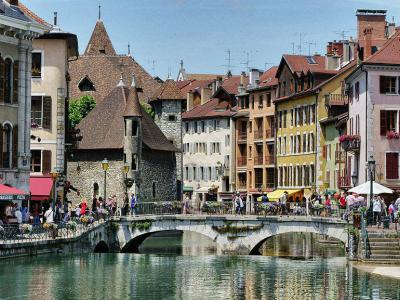
The Old Town of Annecy, often called the "Venice of the Alps," is a stunning medieval gem nestled by the azure waters of Lake Annecy. This picturesque quarter, built around the 14th-century Chateau d’Annecy, is interwoven with canals and the Thiou River, Europe's shortest river at just 3.5 kilometers. These waterways not only give the town its nickname but also lend it a unique charm that visitors can explore on foot. The pedestrian-friendly streets make it an accessible and inviting destination for all.
Annecy's Old Town boasts colorful medieval facades in shades of yellow, pink, and green, many of which were rebuilt in stone after devastating fires in the 15th century. These renovations, encouraged by the Duke of Savoy, created the architectural unity visible today. Stroll along Sainte-Claire Street, the heart of the town, lined with shaded arcades from the Renaissance era. Here, vibrant markets and bustling cafes capture the lively spirit of Annecy.
At the heart of Annecy, the Island Palace (Palais de l’Ile), a 12th-century ship-shaped landmark, sits surrounded by the Thiou River and now houses an architectural heritage center. Overlooking the town, the Annecy Castle (Chateau d’Annecy) offers stunning views and historical exhibits, while the nearby Gardens of Europe provide a peaceful lakeside retreat. For a closer look at Lake Annecy, rent a boat or join a scenic water tour.
Annecy is also home to several notable churches, including the 17th-century Eglise Saint-François de Sales, the 15th-century Eglise Saint-Maurice, and the 19th-century Eglise Notre-Dame-de-Liesse, each showcasing different periods of architectural splendor.
A Sunday visit offers the bonus of a vibrant market that weaves through the Old Town's narrow streets, filling the air with the aroma of fresh produce and local delicacies. For history enthusiasts, Annecy’s roots trace back to the 12th century when its strategic location along the Thiou supported thriving craft industries.
Whether wandering its stone-paved streets, admiring its canals, or enjoying its markets, Annecy’s Old Town is a destination where history, culture, and natural beauty converge.
Annecy's Old Town boasts colorful medieval facades in shades of yellow, pink, and green, many of which were rebuilt in stone after devastating fires in the 15th century. These renovations, encouraged by the Duke of Savoy, created the architectural unity visible today. Stroll along Sainte-Claire Street, the heart of the town, lined with shaded arcades from the Renaissance era. Here, vibrant markets and bustling cafes capture the lively spirit of Annecy.
At the heart of Annecy, the Island Palace (Palais de l’Ile), a 12th-century ship-shaped landmark, sits surrounded by the Thiou River and now houses an architectural heritage center. Overlooking the town, the Annecy Castle (Chateau d’Annecy) offers stunning views and historical exhibits, while the nearby Gardens of Europe provide a peaceful lakeside retreat. For a closer look at Lake Annecy, rent a boat or join a scenic water tour.
Annecy is also home to several notable churches, including the 17th-century Eglise Saint-François de Sales, the 15th-century Eglise Saint-Maurice, and the 19th-century Eglise Notre-Dame-de-Liesse, each showcasing different periods of architectural splendor.
A Sunday visit offers the bonus of a vibrant market that weaves through the Old Town's narrow streets, filling the air with the aroma of fresh produce and local delicacies. For history enthusiasts, Annecy’s roots trace back to the 12th century when its strategic location along the Thiou supported thriving craft industries.
Whether wandering its stone-paved streets, admiring its canals, or enjoying its markets, Annecy’s Old Town is a destination where history, culture, and natural beauty converge.
7) Rue Sainte-Claire (St. Claire Street)
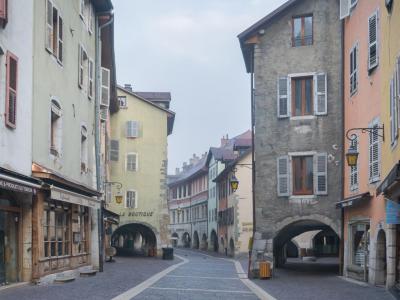
The Saint Claire Street is situated in the district of Sainte Claire, between the banks of the Thiou River and the hillside of Annecy Aastle. The winding, narrow street extends from the small Sepulchre Gate through the Faubourg Sainte Claire and the medieval Sainte Claire Gate with its bell turret.
The Saint Claire Street then leads the way into the Annecy old town and the small Sainte-Claire Square. On the Sainte-Claire Square is the Gallo House. This is an 18th century home named after its architect. The roof is slightly tilted, like a slouch hat. The facade is elaborately ornamented.
The street is lined with arcades of stone, affording shelter to pedestrians in foul weather. The arcades are in the form of arches supported by columns.
Number 18 is the Bagnorea House. The house was built in 1582 and was once the residence of Antoine Favre, President of the Genevois Regional Council. The house was donated by M. Favre to Saint Francois de Sales. In 1607 Favre and Saint Francois started the Academy Florimontane. The Academy concerns itself today with the history of Savoy.
The Sainte-Claire Street morphs into the Isle Street and the tiny Effecheres Square. The Isle Street, in turn, becomes the Perriere Street. The winding Perriere Street gets narrower until it reaches the Perriere Gate. The Perriere Gate in medieval times was the main entrance to old Annecy. It is still part of the castle's walls.
The Saint Claire Street then leads the way into the Annecy old town and the small Sainte-Claire Square. On the Sainte-Claire Square is the Gallo House. This is an 18th century home named after its architect. The roof is slightly tilted, like a slouch hat. The facade is elaborately ornamented.
The street is lined with arcades of stone, affording shelter to pedestrians in foul weather. The arcades are in the form of arches supported by columns.
Number 18 is the Bagnorea House. The house was built in 1582 and was once the residence of Antoine Favre, President of the Genevois Regional Council. The house was donated by M. Favre to Saint Francois de Sales. In 1607 Favre and Saint Francois started the Academy Florimontane. The Academy concerns itself today with the history of Savoy.
The Sainte-Claire Street morphs into the Isle Street and the tiny Effecheres Square. The Isle Street, in turn, becomes the Perriere Street. The winding Perriere Street gets narrower until it reaches the Perriere Gate. The Perriere Gate in medieval times was the main entrance to old Annecy. It is still part of the castle's walls.
8) Château d'Annecy (Annecy Castle) (must see)
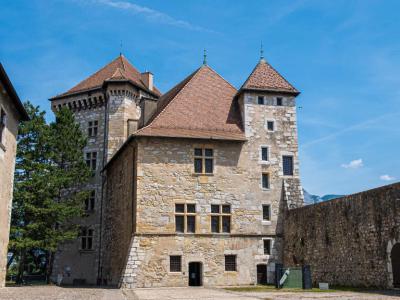
Tucked away beside a lake in the old town of Annecy in the mountains of southeastern France, is the venerable 12th century Chateau d'Annecy. In 1959 it was listed as a historical monument by the Ministry of Culture. The Counts of Geneva and the Dukes of Genvois-Nemours, former tenants of the castle, would be pleased.
Sadly, the castle proved to be a firetrap and it was abandoned in the 17th century. It was repaired soon enough but the glory days of counts and dukes were over. It became a barracks. The castle closed down in 1947 but it was purchased by the town of Annecy in 1953. Et voila! It became a museum.
The castle is divided into towers and loggias called "logis." The Queen's Tower was erected in the twelfth century. Its walls are 13 feet thick. It has aged very well. Together with the Logis Perriere, it houses the Regional Observatory of the Alpine Lakes. The Logis Perriere dates from the 15th century.
Other Logis of the Castle are the Old Logis, the Logis Nemours and Logis Neuf. Besides the observatory, the castle houses the Museum of Alpine Popular Art. The museum collection has sculptures and paintings from surrounding regions. The castle also houses 15th century furniture and photographs and scale models of Alpine architecture.
In the Observatory there are artifacts and evidence of prehistoric lakeside settlements. Exhibits include aquariums holding different species of freshwater fish. There are examples of fishing equipment and boats used in the Alps and a scale model of Lake Annecy and its environs. And yes, there are birds.
Why You Should Visit:
Above all, stunning views of the lake and the surrounding landscape.
Tips:
There is a modest entrance fee. Parking is possible but walking up to the Castle through the old town have its rewards.
Sadly, the castle proved to be a firetrap and it was abandoned in the 17th century. It was repaired soon enough but the glory days of counts and dukes were over. It became a barracks. The castle closed down in 1947 but it was purchased by the town of Annecy in 1953. Et voila! It became a museum.
The castle is divided into towers and loggias called "logis." The Queen's Tower was erected in the twelfth century. Its walls are 13 feet thick. It has aged very well. Together with the Logis Perriere, it houses the Regional Observatory of the Alpine Lakes. The Logis Perriere dates from the 15th century.
Other Logis of the Castle are the Old Logis, the Logis Nemours and Logis Neuf. Besides the observatory, the castle houses the Museum of Alpine Popular Art. The museum collection has sculptures and paintings from surrounding regions. The castle also houses 15th century furniture and photographs and scale models of Alpine architecture.
In the Observatory there are artifacts and evidence of prehistoric lakeside settlements. Exhibits include aquariums holding different species of freshwater fish. There are examples of fishing equipment and boats used in the Alps and a scale model of Lake Annecy and its environs. And yes, there are birds.
Why You Should Visit:
Above all, stunning views of the lake and the surrounding landscape.
Tips:
There is a modest entrance fee. Parking is possible but walking up to the Castle through the old town have its rewards.

9) Palais de l'Isle (Isle Palace) (must see)
The Isle Palace may look like a stone ship but it has tried to be other things. Originally it did not have such an elegant name. The locals refer to it as "The Old Prisons". It sits firmly on a stone island in the River Thiou, in the center of old Annecy.
The palace is a 12th century stronghold rebuilt many times. It has played the roles of river fortress, toll booth, prison, barracks, land registry office, warehouse, mint, Palace of Justice and old age home. Mostly it has been a prison. Today it houses the Center for the Interpretation of Architecture and Heritage (CIAP).
The shape of the island fortress is like a ship seen bow-on. It divides the river into two canals. The late 12th century lower loge houses museum exhibitions. Two small bridges connect to the island. Pass over into the entrance courtyard and find the facade of the castle next to a four-sided tower that holds a spiral staircase.
On the left are the "banches" (counters) of the lawyers from the Palace of Justice days. On the right is the 14th century coin-minting wing and the entrance to the castle. The lower floor has four rooms with vaulted ceilings and arches and it includes the old jail kitchen.
The Tower Loge, once used in the administration of justice, is on the north side of the palace. It has a facade made from river stones and limestone. There three prison cells, a hearing room and the old Court of Justice. The rooms have panels on the history of the town. The 15th century spiral staircase connects to two upper floors.
The palace can be reached via footbridge of Isle Passage. The permanent museum exhibition is concerned with the history and heritage of Annecy. There are audio-visual presentations in French. Combination tickets to both the Isle Palace and Annecy Castle are available.
Why You Should Visit:
There is no other building like it. It affirms Annecy's standing as the "Venice of the Alps."
The palace is a 12th century stronghold rebuilt many times. It has played the roles of river fortress, toll booth, prison, barracks, land registry office, warehouse, mint, Palace of Justice and old age home. Mostly it has been a prison. Today it houses the Center for the Interpretation of Architecture and Heritage (CIAP).
The shape of the island fortress is like a ship seen bow-on. It divides the river into two canals. The late 12th century lower loge houses museum exhibitions. Two small bridges connect to the island. Pass over into the entrance courtyard and find the facade of the castle next to a four-sided tower that holds a spiral staircase.
On the left are the "banches" (counters) of the lawyers from the Palace of Justice days. On the right is the 14th century coin-minting wing and the entrance to the castle. The lower floor has four rooms with vaulted ceilings and arches and it includes the old jail kitchen.
The Tower Loge, once used in the administration of justice, is on the north side of the palace. It has a facade made from river stones and limestone. There three prison cells, a hearing room and the old Court of Justice. The rooms have panels on the history of the town. The 15th century spiral staircase connects to two upper floors.
The palace can be reached via footbridge of Isle Passage. The permanent museum exhibition is concerned with the history and heritage of Annecy. There are audio-visual presentations in French. Combination tickets to both the Isle Palace and Annecy Castle are available.
Why You Should Visit:
There is no other building like it. It affirms Annecy's standing as the "Venice of the Alps."
10) Eglise Saint-Francois (Saint François Church)
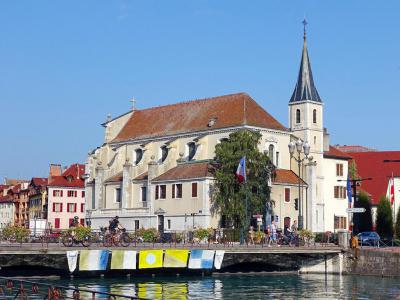
Saint Francis Church was built in 1614. It had its days of glory as the pilgrimage site and resting place of the bodies of Saints Jeanne de Chantal and Francis de Sales. The graves of the two saints were secretly moved from time to time to avoid desecration by revolutionary mobs. At present they are in the Basilica of the Visitation.
After the revolution, the church went through some transformations. It became a barracks, a factory in the 18th century and a venue for workshops in the 19th century. It was finally restored to religious status after the Great War. The church is also called "Church of the Italians" because it is popular with the Italian community of Annecy.
The church sits resolutely on the banks of the Thiou River. It expresses strong lombard and baroque influences. The facade and basic plan are adapted from the 16th century Church of the Gesu in Rome. The facade is in two levels topped by a triangular pediment.
It has a central nave plus three bays and two other naves on each side. The interior is not extravagant but it is well lighted. There are seven baroque altarpieces. The main altarpiece is a rebuilt of the 17th century original which has gone missing.
The church is located in Saint Francis Square. It is open year-round.
After the revolution, the church went through some transformations. It became a barracks, a factory in the 18th century and a venue for workshops in the 19th century. It was finally restored to religious status after the Great War. The church is also called "Church of the Italians" because it is popular with the Italian community of Annecy.
The church sits resolutely on the banks of the Thiou River. It expresses strong lombard and baroque influences. The facade and basic plan are adapted from the 16th century Church of the Gesu in Rome. The facade is in two levels topped by a triangular pediment.
It has a central nave plus three bays and two other naves on each side. The interior is not extravagant but it is well lighted. There are seven baroque altarpieces. The main altarpiece is a rebuilt of the 17th century original which has gone missing.
The church is located in Saint Francis Square. It is open year-round.
11) Jardins de l'Europe (Gardens of Europe) (must see)
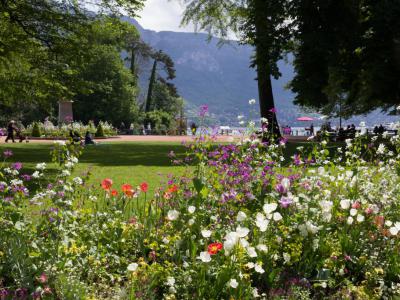
The Gardens of Europe is a sizable park dedicated to the lost art of walking. The gardens and the Town Hall are located on a formerly swampy islet on the shores of Lake Annecy outside the city walls. The park was originally the property of the Asinari family of Lombard banking fame.
In 1563 a canal was excavated from the River Thiou to the Vasse canal, creating two islands. One was used for "health huts" to isolate plague victims. In 1602 the park was set aside as a place for walking by Henry I, Duke of Savoy-Nemours. The land was given to the nuns of the Order of the Visitation, the "Visitandines."
The Visitandines used the land build a chapel and plant vegetables. A wall, over 15 feet high encloses the land. A covered walkway and a drawbridge connects to the town. Come the French Revolution the land was sold to a Geneva businessman who used it in the manufacture of printed fabrics.
The town bought the land back in 1835 and by 1843 changes began to happen. The two islands were transformed into a peninsula and the Isle of Swans. The peninsula and the islet are located at the end of the gardens. A school was built and the new Town Hall.
In 1863 the Duchy of Savoy was annexed by France. The municipal Council made plans to create an English garden by Henri Porreaux. The Gardens of Europe were born. Today the gardens have 250 ginkgo bilobas, a tulip tree, laricio pines and giant sequoias.
The gardens have lots of benches for tired walkers. The marina area has 270 berths located between the Vasse Canal and the Quai de la Tournette. The Bridge of Love crosses the Vasse Canal, connecting the Pasture to the Gardens of Europe.
In the Paquier is a bronze statue of the famous chemist Claude Louis Bethollet. There is also a plaque dedicated to the Emperor Napoleon III. There have been very few plaques dedicated to the unhappy emperor. This one is in memory of a steam packet he promised for the lake.
Why You Should Visit:
The gardens are a serene bucolic setting away from the touristy hubbub in town and the views of the lake and mountains are superb.
In 1563 a canal was excavated from the River Thiou to the Vasse canal, creating two islands. One was used for "health huts" to isolate plague victims. In 1602 the park was set aside as a place for walking by Henry I, Duke of Savoy-Nemours. The land was given to the nuns of the Order of the Visitation, the "Visitandines."
The Visitandines used the land build a chapel and plant vegetables. A wall, over 15 feet high encloses the land. A covered walkway and a drawbridge connects to the town. Come the French Revolution the land was sold to a Geneva businessman who used it in the manufacture of printed fabrics.
The town bought the land back in 1835 and by 1843 changes began to happen. The two islands were transformed into a peninsula and the Isle of Swans. The peninsula and the islet are located at the end of the gardens. A school was built and the new Town Hall.
In 1863 the Duchy of Savoy was annexed by France. The municipal Council made plans to create an English garden by Henri Porreaux. The Gardens of Europe were born. Today the gardens have 250 ginkgo bilobas, a tulip tree, laricio pines and giant sequoias.
The gardens have lots of benches for tired walkers. The marina area has 270 berths located between the Vasse Canal and the Quai de la Tournette. The Bridge of Love crosses the Vasse Canal, connecting the Pasture to the Gardens of Europe.
In the Paquier is a bronze statue of the famous chemist Claude Louis Bethollet. There is also a plaque dedicated to the Emperor Napoleon III. There have been very few plaques dedicated to the unhappy emperor. This one is in memory of a steam packet he promised for the lake.
Why You Should Visit:
The gardens are a serene bucolic setting away from the touristy hubbub in town and the views of the lake and mountains are superb.
12) Pont des Amours (Bridge of Love) (must see)
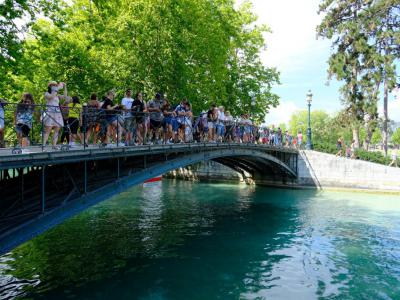
Some say the Public Gardens Footbridge was built simply to connect the Plaquier to the Gardens of Europe. So, why does everyone call it the "Bridge of Love"? There is a popular legend that if two lovers meet in the middle of the bridge and kiss they will stay together forever. Cynics claim it is a favorite place for ladies of the night.
Located on the shores of Lake Annecy by the Vasse Canal, it does provide easy access to the gardens for couples looking for serenity. Whatever the legend, the bridge, to this day, is more than a busy walkway. It is a romantic passage to a trusted trysting place with captivating views of the city, the mountains and the lake.
The first footbridge plans to connect the Lombard Clos (now the Gardens of Europe) with the Plauier esplanade were put forward in 1836. In 1845 Charles-Albert, the King of Piedmont-Sardinia, came to call and a wooden bridge was erected so spectators could view the light show over the canal. The King liked it too.
In 1859 another footbridge replaced the the wooden one. It had three cast iron arches installed by Clude Grandchamp and it was called "public garden footbridge." It was an improvement and it was durable but too low to accommodate boat traffic and it was high maintenance.
At last, in 1907, the city replaced the cast iron bridge with a new iron construction by architect Gaspard Fruauf.
On one side see an esplanade lined with trees. On the other a crystal alpine lake framed by rugged mountains. On a clear summer day people line the rail, enjoying the view of the lake and canal. In Autumn, on a rainy day, the bridge belongs to oneself. The views are fantastic in a different way and thoughts are one's own.
Located on the shores of Lake Annecy by the Vasse Canal, it does provide easy access to the gardens for couples looking for serenity. Whatever the legend, the bridge, to this day, is more than a busy walkway. It is a romantic passage to a trusted trysting place with captivating views of the city, the mountains and the lake.
The first footbridge plans to connect the Lombard Clos (now the Gardens of Europe) with the Plauier esplanade were put forward in 1836. In 1845 Charles-Albert, the King of Piedmont-Sardinia, came to call and a wooden bridge was erected so spectators could view the light show over the canal. The King liked it too.
In 1859 another footbridge replaced the the wooden one. It had three cast iron arches installed by Clude Grandchamp and it was called "public garden footbridge." It was an improvement and it was durable but too low to accommodate boat traffic and it was high maintenance.
At last, in 1907, the city replaced the cast iron bridge with a new iron construction by architect Gaspard Fruauf.
On one side see an esplanade lined with trees. On the other a crystal alpine lake framed by rugged mountains. On a clear summer day people line the rail, enjoying the view of the lake and canal. In Autumn, on a rainy day, the bridge belongs to oneself. The views are fantastic in a different way and thoughts are one's own.
