Custom Walk in George Town, Malaysia by plrobinsoncan_e72434 created on 2026-04-12
Guide Location: Malaysia » George Town
Guide Type: Custom Walk
# of Sights: 6
Tour Duration: 2 Hour(s)
Travel Distance: 4.3 Km or 2.7 Miles
Share Key: DFR6G
Guide Type: Custom Walk
# of Sights: 6
Tour Duration: 2 Hour(s)
Travel Distance: 4.3 Km or 2.7 Miles
Share Key: DFR6G
How It Works
Please retrieve this walk in the GPSmyCity app. Once done, the app will guide you from one tour stop to the next as if you had a personal tour guide. If you created the walk on this website or come to the page via a link, please follow the instructions below to retrieve the walk in the app.
Retrieve This Walk in App
Step 1. Download the app "GPSmyCity: Walks in 1K+ Cities" on Apple App Store or Google Play Store.



Step 2. In the GPSmyCity app, download(or launch) the guide "George Town Map and Walking Tours".
Step 3. Tap the menu button located at upper right corner of the "Walks" screen and select "Retrieve custom walk". Enter the share key: DFR6G

1) Queen Victoria Memorial Clock Tower
The Jubilee Clock Tower, also known as the Queen Victoria Memorial Clock Tower, is the most prominent clock tower on Penang Island. Positioned at the western end of King Edward's Place, adjacent to the Light Street Roundabout housing the Pinang Fountain, it was erected in honor of Queen Victoria's Diamond Jubilee in 1897. Financed by Penang's Chinese tycoon Cheah Chen Eok, the tower also served as a demonstration of his affluence to the British colonial authorities.
The tower rises 60 feet from its base to the center of the clock, symbolizing each year of Queen Victoria's reign, while its total height, including the cupola, reaches 97 feet. Imported from Europe, the clock features opal glass windows, and its belfry once housed five bells that chimed the Westminster quarters.
Although intended as a tribute to Queen Victoria, she never beheld the completed tower, having never visited Penang Island. By the time construction finished in 1902, she had passed away.
During the Second World War, the tower sustained slight damage from Japanese and Allied aerial bombardments of George Town, resulting in a noticeable tilt; however, post-war repairs restored the clock and chimes to their former functionality.
The tower rises 60 feet from its base to the center of the clock, symbolizing each year of Queen Victoria's reign, while its total height, including the cupola, reaches 97 feet. Imported from Europe, the clock features opal glass windows, and its belfry once housed five bells that chimed the Westminster quarters.
Although intended as a tribute to Queen Victoria, she never beheld the completed tower, having never visited Penang Island. By the time construction finished in 1902, she had passed away.
During the Second World War, the tower sustained slight damage from Japanese and Allied aerial bombardments of George Town, resulting in a noticeable tilt; however, post-war repairs restored the clock and chimes to their former functionality.
2) Market Street (Little India)
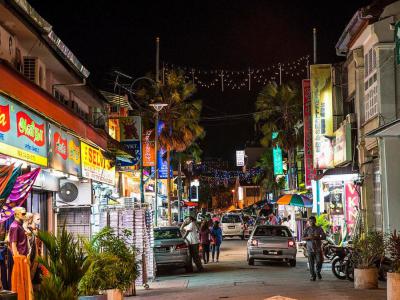
So, if one is in Malaysia, how about a quick trip to India? No? Well how about Little India? It is the same thing, really, without the air fare. Little India is a square shaped area bounded by Queen Street, Market Street, China Street and King Street. Bright colors, loud music, and the aroma of South Indian cuisine. All very unsubtle.
Visit any time after ten am. The place is waking up. Folks shopping for groceries. Some are snacking or having breakfast by the road. The little one-room shops that try to sell everything are open. Newspapers, drinks, shaving cream, tobacco, all sorts of little things to start the day can be had here.
Shops are selling everything, including traditional dress, gold, and costume, jewelry made from semi-precious stones. For Bollywood fans there are more than a few video stores for music and films. Garlands of flowers are available for the gods at Arulmigu Mahamariamman Temple on Queen Street or for shops and street corners.
The aromas of incense, spices and cooking permeate the neighborhood. Snacking is encouraged. Samosas which are filled pastries are tempting. How about a bowl of sweet green bean soup in coconut milk? Coconut juice? Want to buy a saree? Chettiars, money changers, are all over. Don't worry about the pigeons. Drink Malabar Tarik tea.
Visit any time after ten am. The place is waking up. Folks shopping for groceries. Some are snacking or having breakfast by the road. The little one-room shops that try to sell everything are open. Newspapers, drinks, shaving cream, tobacco, all sorts of little things to start the day can be had here.
Shops are selling everything, including traditional dress, gold, and costume, jewelry made from semi-precious stones. For Bollywood fans there are more than a few video stores for music and films. Garlands of flowers are available for the gods at Arulmigu Mahamariamman Temple on Queen Street or for shops and street corners.
The aromas of incense, spices and cooking permeate the neighborhood. Snacking is encouraged. Samosas which are filled pastries are tempting. How about a bowl of sweet green bean soup in coconut milk? Coconut juice? Want to buy a saree? Chettiars, money changers, are all over. Don't worry about the pigeons. Drink Malabar Tarik tea.
3) Campbell Street Market
In the heart of George Town, Campbell Street Market is one of the city's two marketplaces, the other being Chowrasta Market. Dating back to the 1900s, this place springs to life every morning, with vendors spilling onto the northern stretch of Carnavon Street. From fresh produce to dry goods, seafood, and even live poultry, you'll find a bit of everything here.
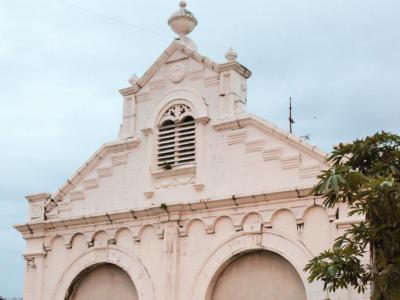
What sets this market apart is its preserved Victorian architecture, featuring two elegant arches topped by a pediment with an arched window. While Chowrasta Market, slightly older, dates back to 1890, it underwent reconstruction in the 1960s, losing some of its historical allure in the process.
Legend has it that the land upon which Campbell Street Market stands was once a Malay cemetery, known as Hutan Mayat, or the "forest of dead bodies" in Malay. To this day, whispers of hauntings linger, with tales of paranormal sightings during the early hours of the morning adding a layer of intrigue.
What sets this market apart is its preserved Victorian architecture, featuring two elegant arches topped by a pediment with an arched window. While Chowrasta Market, slightly older, dates back to 1890, it underwent reconstruction in the 1960s, losing some of its historical allure in the process.
Legend has it that the land upon which Campbell Street Market stands was once a Malay cemetery, known as Hutan Mayat, or the "forest of dead bodies" in Malay. To this day, whispers of hauntings linger, with tales of paranormal sightings during the early hours of the morning adding a layer of intrigue.
4) Chowrasta Market
Chowrasta proudly stands as one of Malaysia's oldest markets and one of two makets in the city center, the other being Campbell Street Market. Here, you'll encounter a treasure trove of the finest produce, from tangy pickled nutmegs to the beloved "tau sar pneah", Penang's signature bean paste pastry.
The site where the market now thrives was once a bustling Indian enclave in George Town, with Tamil settlers from southern India making their mark in the mid-19th century. It was in this vicinity that these industrious folks peddled their wares, including fresh produce and livestock.
In 1890, the George Town Municipal Council erected the original single-storey Chowrasta Market, which later made way for the present-day structure in the 1960s. More recently, between 2013 and 2017, extensive renovations expanded and rejuvenated its facilities.
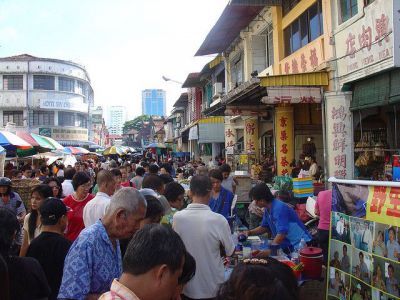
As you step through the Penang Road entrance, prepare to be dazzled by an array of local delights, including nutmegs, durian treats, and traditional balms. Downstairs, the wet market buzzes with activity, while upstairs, time seems to stand still amidst rows of shoe shops, clothing stores, and book emporiums brimming with second-hand publications.
Venture outside, and you'll discover a bustling scene where vendors hawk everything from electronic gadgets to apparel at bargain prices.
The site where the market now thrives was once a bustling Indian enclave in George Town, with Tamil settlers from southern India making their mark in the mid-19th century. It was in this vicinity that these industrious folks peddled their wares, including fresh produce and livestock.
In 1890, the George Town Municipal Council erected the original single-storey Chowrasta Market, which later made way for the present-day structure in the 1960s. More recently, between 2013 and 2017, extensive renovations expanded and rejuvenated its facilities.
As you step through the Penang Road entrance, prepare to be dazzled by an array of local delights, including nutmegs, durian treats, and traditional balms. Downstairs, the wet market buzzes with activity, while upstairs, time seems to stand still amidst rows of shoe shops, clothing stores, and book emporiums brimming with second-hand publications.
Venture outside, and you'll discover a bustling scene where vendors hawk everything from electronic gadgets to apparel at bargain prices.
5) Armenian Street (must see)
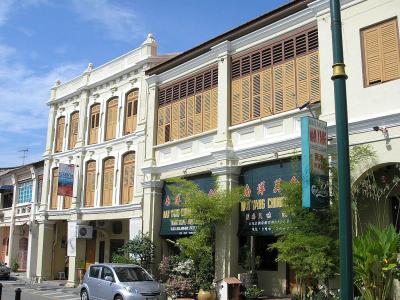
Today there are very few, if any, Armenians on Armenian Street. The Armenian Saint Gregory's Church, established in 1822, was demolished in 1937. All that was left of Armenia on Armenian Street was the name. Originally called Malay Lane, narrow Armenian Street is within the city's UNESCO World Heritage Site.
The Malay neighborhood was gradually replaced by Armenian and Chinese settlers. By 1808 the street was renamed Armenian Street for the community of Armenian traders who lived along the road. The Armenian presence was historically brief. The Chinese had supplanted Armenian settlements with clan houses by the mid 19th century.
The Chinese triads often fought with Malay secret societies. There were fierce clashes on Armenian Street during the 1867 Penang Riots. The turf battles were suppressed by sepoys (Indian infantry) led by the British East India Company.
In 1910 the Chinese revolutionary, Sun Yat-sen, planned his campaign against the Qing dynasty in an Armenian Street townhouse. The house was later converted to the present Sun Yat-Sen Museum.
Armenian Street has some fine shops and street art. Most notable street art is the mural "Kids on Bikes" by Ernest Zacharevic. The style is a la Norman Rockwell. The joy in the mural is infectious. The street once served as a locale for the film Anna and the King with Jodie Foster and Chow Yun-fat.
The Malay neighborhood was gradually replaced by Armenian and Chinese settlers. By 1808 the street was renamed Armenian Street for the community of Armenian traders who lived along the road. The Armenian presence was historically brief. The Chinese had supplanted Armenian settlements with clan houses by the mid 19th century.
The Chinese triads often fought with Malay secret societies. There were fierce clashes on Armenian Street during the 1867 Penang Riots. The turf battles were suppressed by sepoys (Indian infantry) led by the British East India Company.
In 1910 the Chinese revolutionary, Sun Yat-sen, planned his campaign against the Qing dynasty in an Armenian Street townhouse. The house was later converted to the present Sun Yat-Sen Museum.
Armenian Street has some fine shops and street art. Most notable street art is the mural "Kids on Bikes" by Ernest Zacharevic. The style is a la Norman Rockwell. The joy in the mural is infectious. The street once served as a locale for the film Anna and the King with Jodie Foster and Chow Yun-fat.
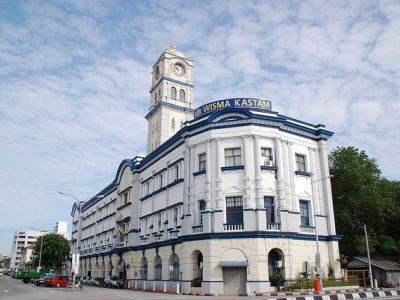
6) Malayan Railway Building and clock tower (Wisma Kastam)
The Malayan Railway Building stands tall and proud along the Weld Quay waterfront, stealing the spotlight with its grand clocktower. Once a railway station – though an odd one with no actual railway – it's a true colonial landmark.
Islanders would swing by the ticket office here to hop on a train from Butterworth across the Penang Channel. Yep, you'd buy your ticket here, then catch a ferry over to Butterworth.
Completed in 1909, this place was the big cheese on Penang Island, with both the largest footprint and the loftiest clocktower around. But it wasn't all smooth sailing – the nearby Chinese community didn't exactly give it a warm welcome, as they felt it blocked their view of the sea from the Kuan Yin Teng Temple. Some even thought the Brits purposely pointed the clock at the temple, sending a not-so-subtle message about their time running out.
Nowadays, you'll find this landmark at the intersection of Weld Quay and China Street Ghaut, doing its duty as the Penang headquarters of the Royal Malaysian Customs Department, hence its Malay name, Wisma Kastam.
Islanders would swing by the ticket office here to hop on a train from Butterworth across the Penang Channel. Yep, you'd buy your ticket here, then catch a ferry over to Butterworth.
Completed in 1909, this place was the big cheese on Penang Island, with both the largest footprint and the loftiest clocktower around. But it wasn't all smooth sailing – the nearby Chinese community didn't exactly give it a warm welcome, as they felt it blocked their view of the sea from the Kuan Yin Teng Temple. Some even thought the Brits purposely pointed the clock at the temple, sending a not-so-subtle message about their time running out.
Nowadays, you'll find this landmark at the intersection of Weld Quay and China Street Ghaut, doing its duty as the Penang headquarters of the Royal Malaysian Customs Department, hence its Malay name, Wisma Kastam.
