Custom Walk in Ankara, Turkey by bb015_b23244 created on 2026-04-30
Guide Location: Turkey » Ankara
Guide Type: Custom Walk
# of Sights: 5
Tour Duration: 2 Hour(s)
Travel Distance: 4.6 Km or 2.9 Miles
Share Key: ALUBK
Guide Type: Custom Walk
# of Sights: 5
Tour Duration: 2 Hour(s)
Travel Distance: 4.6 Km or 2.9 Miles
Share Key: ALUBK
How It Works
Please retrieve this walk in the GPSmyCity app. Once done, the app will guide you from one tour stop to the next as if you had a personal tour guide. If you created the walk on this website or come to the page via a link, please follow the instructions below to retrieve the walk in the app.
Retrieve This Walk in App
Step 1. Download the app "GPSmyCity: Walks in 1K+ Cities" on Apple App Store or Google Play Store.



Step 2. In the GPSmyCity app, download(or launch) the guide "Ankara Map and Walking Tours".
Step 3. Tap the menu button located at upper right corner of the "Walks" screen and select "Retrieve custom walk". Enter the share key: ALUBK
1) Kocatepe Mosque (must see)
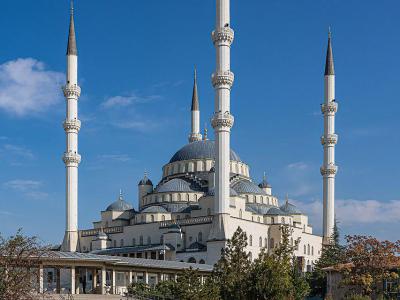
The Kocatepe Mosque stands as the largest mosque in Ankara. Its construction took place over two decades, spanning from 1967 to 1987, in the Kocatepe district within Kızılay. Its imposing size and prominent location have established it as a prominent landmark, visible from nearly every corner of central Ankara.
The concept of erecting the Kocatepe Mosque originated in the 1940s. In 1956, under the leadership of Adnan Menderes, who served as the Prime Minister at that time, land was designated for the mosque project in Ankara. Subsequently, a call for project proposals was issued in 1957. The selected design was characterized by its innovative and contemporary approach. Construction began but was halted at the foundation stage due to considerable criticism from conservative groups who found fault with its modernist aesthetics.
Later, Vedat Dalokay undertook the construction of a modified version of the Kocatepe Mosque. He earned this opportunity after winning an international competition to design the Shah Faisal Masjid in Islamabad, Pakistan, in 1969.
The Kocatepe Mosque boasts the capacity to accommodate up to 100,000 worshippers, solidifying its status as one of the world's largest mosques. It is widely recognized as a masterpiece of modern Islamic architecture. Completed in 1987, this project embodies a neo-classical Ottoman architectural style, blending elements from the Selimiye Mosque in Edirne and the Şehzade and Sultan Ahmet Mosques in Istanbul.
The concept of erecting the Kocatepe Mosque originated in the 1940s. In 1956, under the leadership of Adnan Menderes, who served as the Prime Minister at that time, land was designated for the mosque project in Ankara. Subsequently, a call for project proposals was issued in 1957. The selected design was characterized by its innovative and contemporary approach. Construction began but was halted at the foundation stage due to considerable criticism from conservative groups who found fault with its modernist aesthetics.
Later, Vedat Dalokay undertook the construction of a modified version of the Kocatepe Mosque. He earned this opportunity after winning an international competition to design the Shah Faisal Masjid in Islamabad, Pakistan, in 1969.
The Kocatepe Mosque boasts the capacity to accommodate up to 100,000 worshippers, solidifying its status as one of the world's largest mosques. It is widely recognized as a masterpiece of modern Islamic architecture. Completed in 1987, this project embodies a neo-classical Ottoman architectural style, blending elements from the Selimiye Mosque in Edirne and the Şehzade and Sultan Ahmet Mosques in Istanbul.
2) Çengelhan Rahmi M. Koç Museum (must see)
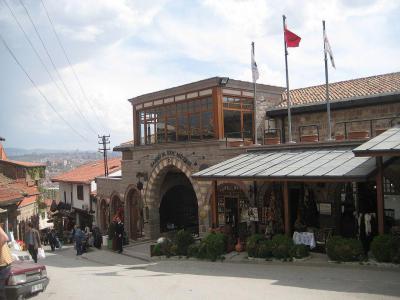
Çengelhan Rahmi M. Koç Museum is a technology museum located in the historic Atpazarı (Horse market) district of Ankara, facing the Ankara Citadel. Positioned at an altitude of 950 meters (3,120 feet), the museum is slightly elevated above the rest of the city.
The museum is housed within the Çengelhan, a historical inn (han) that was constructed in 1523 during the reign of Ottoman Sultan Suleyman I. Originally used as a warehouse for mohair, a specialty of Ankara, it was later owned by the General Directorate of Foundations of Turkey during the Republican era. In 2003, industrialist Rahmi M. Koç rented the building to be used as a museum, and after undergoing restoration, it opened its doors in 2005.
The ground floor of the museum exhibits various machines, road transport vehicles, medicine, and everyday life tools. Additionally, a carpet gallery, agricultural machinery, and pharmaceutical exhibits are located on the lower floor. A brasserie is also available on the ground floor for visitors. On the upper floor, visitors can explore sections dedicated to rail transport items, toys, communications, scientific instruments, maritime, and navigation. The museum also features sections highlighting the city of Ankara, Vehbi Koç, Rahmi Koç's father and one of Turkey's first industrialists, and Mustafa Kemal Atatürk, the founder of modern Turkey.
The museum is housed within the Çengelhan, a historical inn (han) that was constructed in 1523 during the reign of Ottoman Sultan Suleyman I. Originally used as a warehouse for mohair, a specialty of Ankara, it was later owned by the General Directorate of Foundations of Turkey during the Republican era. In 2003, industrialist Rahmi M. Koç rented the building to be used as a museum, and after undergoing restoration, it opened its doors in 2005.
The ground floor of the museum exhibits various machines, road transport vehicles, medicine, and everyday life tools. Additionally, a carpet gallery, agricultural machinery, and pharmaceutical exhibits are located on the lower floor. A brasserie is also available on the ground floor for visitors. On the upper floor, visitors can explore sections dedicated to rail transport items, toys, communications, scientific instruments, maritime, and navigation. The museum also features sections highlighting the city of Ankara, Vehbi Koç, Rahmi Koç's father and one of Turkey's first industrialists, and Mustafa Kemal Atatürk, the founder of modern Turkey.
3) Ankara Citadel (must see)
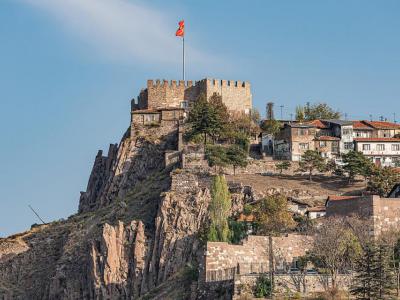
Ankara Citadel is a significant historical site in the city of Ankara. Its construction dates back to the 7th century or later, with the initial fortification built by the Phrygians in the 8th century BC and later reconstructed in 278 BC by the Galatians. Throughout the centuries, the fortress was renovated and rebuilt under the rule of the Roman, Byzantine, Seljuk, and Ottoman empires.
The fortress comprises an inner wall with closely spaced towers that encircle a central area, as well as an outer wall lined with towers. Both walls were constructed using repurposed masonry after the Persian capture and destruction of Ankara in 622 AD. The inner walls may have been built during Constans II's reign, while the outer walls were likely established slightly later.
The Citadel's current appearance is the result of restoration efforts in 1832, funded and managed by Ibrahim Pasha, the son of Ottoman Egypt's governor Mehmed Ali Pasha. During the restoration, fragments of Roman sarcophagi, Latin-inscribed marble slabs, and Roman structure column heads were incorporated into the castle's structure. Today, remnants of the Roman era can still be seen within the towering walls.
Ankara Citadel has become a popular tourist destination in the Turkish capital. Visitors can enjoy exploring the ancient castle walls, walking along cobblestone paths, visiting art studios and world-class museums, watching skilled street performers, relaxing in trendy cafes, and shopping in small stores offering a variety of products.
The fortress comprises an inner wall with closely spaced towers that encircle a central area, as well as an outer wall lined with towers. Both walls were constructed using repurposed masonry after the Persian capture and destruction of Ankara in 622 AD. The inner walls may have been built during Constans II's reign, while the outer walls were likely established slightly later.
The Citadel's current appearance is the result of restoration efforts in 1832, funded and managed by Ibrahim Pasha, the son of Ottoman Egypt's governor Mehmed Ali Pasha. During the restoration, fragments of Roman sarcophagi, Latin-inscribed marble slabs, and Roman structure column heads were incorporated into the castle's structure. Today, remnants of the Roman era can still be seen within the towering walls.
Ankara Citadel has become a popular tourist destination in the Turkish capital. Visitors can enjoy exploring the ancient castle walls, walking along cobblestone paths, visiting art studios and world-class museums, watching skilled street performers, relaxing in trendy cafes, and shopping in small stores offering a variety of products.
4) The Museum of Anatolian Civilizations (must see)
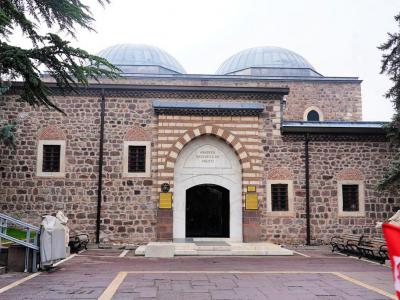
The Museum of Anatolian Civilizations is situated on the southern side of Ankara Castle, in the Atpazarı region of Ankara. The museum is comprised of the ancient Ottoman Mahmut Paşa bazaar storage building and the Kurşunlu Han. Following renovations and repairs (1938-1968), the museum opened its doors to the public as the Ankara Archaeological Museum.
Nowadays, the Kurşunlu Han functions as an administrative building and contains workrooms, a library, a conference hall, a laboratory, and a workshop. The old bazaar building showcases the exhibits. Inside this Ottoman structure, the museum displays a variety of Anatolian archaeological artifacts, ranging from the Paleolithic period to the Ottoman era, in chronological order. The museum also features a vast collection of items unearthed from numerous excavation sites, representing multiple historical periods.
The showcased gold, silver, glass, marble, and bronze works date back to the latter half of the first millennium BC. The coin collections, which include examples from the first minted coins to contemporary times, are considered the museum's unique cultural treasures.
On April 19, 1997, the Museum of Anatolian Civilizations was recognized as the first "European Museum of the Year" in Switzerland, thanks to its historical buildings and deep-rooted past.
Nowadays, the Kurşunlu Han functions as an administrative building and contains workrooms, a library, a conference hall, a laboratory, and a workshop. The old bazaar building showcases the exhibits. Inside this Ottoman structure, the museum displays a variety of Anatolian archaeological artifacts, ranging from the Paleolithic period to the Ottoman era, in chronological order. The museum also features a vast collection of items unearthed from numerous excavation sites, representing multiple historical periods.
The showcased gold, silver, glass, marble, and bronze works date back to the latter half of the first millennium BC. The coin collections, which include examples from the first minted coins to contemporary times, are considered the museum's unique cultural treasures.
On April 19, 1997, the Museum of Anatolian Civilizations was recognized as the first "European Museum of the Year" in Switzerland, thanks to its historical buildings and deep-rooted past.
5) Hacı Bayram Mosque (must see)
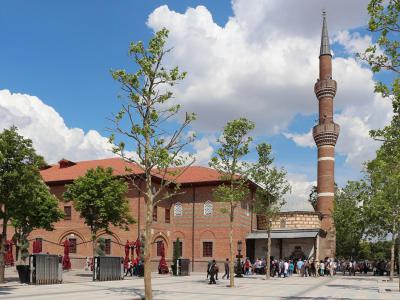
Located near the Ulus District in Ankara, adjacent to the Augustus Temple, the Haci Bayram Mosque was originally constructed in 1427 to honor the Turkish poet, mystic, and founder of the Bayrami Sufi order, Hacı Bayram Veli. The mosque's present architecture is a combination of late 17th and 18th-century styles, with later additions in the north and west.
The rectangularly planned mosque has a two-gallery minaret with a square base and brick frame located on the southeast side of the mausoleum. An inscription in large Arabic calligraphy, reading "In the Name of God, The Most Gracious, The Most Merciful," adorns the southern wall. The central hexagonal rosette is surrounded by six rows of floral decorations. A smaller version of this rosette can be found in the rectangular panel on the annexed section's ceiling to the west.
The mosque's lower-level windows have wrought-iron grates and are rectangular, while the exterior windows have niches comprised of pointed arches. The upper windows feature stained glass bordered by chiseled marble motifs and pointed arches. The Mihrab, indicating the direction of Mecca for prayer, is decorated with a cross-section of stalactites, while the corners feature an elegant inscription from the Koran in five rows on the pediment. The borders of the Mihrab also feature the Koran.
The Haci Bayram Mosque was added to the tentative list of UNESCO World Heritage Sites in Turkey in 2016.
The rectangularly planned mosque has a two-gallery minaret with a square base and brick frame located on the southeast side of the mausoleum. An inscription in large Arabic calligraphy, reading "In the Name of God, The Most Gracious, The Most Merciful," adorns the southern wall. The central hexagonal rosette is surrounded by six rows of floral decorations. A smaller version of this rosette can be found in the rectangular panel on the annexed section's ceiling to the west.
The mosque's lower-level windows have wrought-iron grates and are rectangular, while the exterior windows have niches comprised of pointed arches. The upper windows feature stained glass bordered by chiseled marble motifs and pointed arches. The Mihrab, indicating the direction of Mecca for prayer, is decorated with a cross-section of stalactites, while the corners feature an elegant inscription from the Koran in five rows on the pediment. The borders of the Mihrab also feature the Koran.
The Haci Bayram Mosque was added to the tentative list of UNESCO World Heritage Sites in Turkey in 2016.
