Custom Walk in Taormina, Italy by ljcrone_7b49bc created on 2026-06-13
Guide Location: Italy » Taormina
Guide Type: Custom Walk
# of Sights: 6
Tour Duration: 1 Hour(s)
Travel Distance: 1.5 Km or 0.9 Miles
Share Key: X4HS7
Guide Type: Custom Walk
# of Sights: 6
Tour Duration: 1 Hour(s)
Travel Distance: 1.5 Km or 0.9 Miles
Share Key: X4HS7
How It Works
Please retrieve this walk in the GPSmyCity app. Once done, the app will guide you from one tour stop to the next as if you had a personal tour guide. If you created the walk on this website or come to the page via a link, please follow the instructions below to retrieve the walk in the app.
Retrieve This Walk in App
Step 1. Download the app "GPSmyCity: Walks in 1K+ Cities" on Apple App Store or Google Play Store.



Step 2. In the GPSmyCity app, download(or launch) the guide "Taormina Map and Walking Tours".
Step 3. Tap the menu button located at upper right corner of the "Walks" screen and select "Retrieve custom walk". Enter the share key: X4HS7

1) Corso Umberto (Umberto Street) (must see)
Umberto Street may carry the name of a 19th-century king, but its roots run much deeper than royal vanity projects. It follows the line of the old Greco-Roman road, the Consular Valeria road, stretching neatly between Catania Gate on one side and Messina Gate on the other. For centuries it has served as Taormina’s backbone, first for soldiers and merchants, later for nobles and pilgrims, and now for anyone with a camera or an appetite for gelato.
In medieval times, this was the town’s central spine, with alleys leading to monasteries, chapels, and palaces that announced Taormina’s status under whichever ruler happened to hold Sicily. Its architecture still reads like a roll call of conquerors: Norman arches, Gothic tracery, Renaissance refinements, and Baroque flourishes. The Palace of the Corvaja family, a 15th-century residence that mixes Arab and Norman motifs, is a standout along the route. Look closer and you’ll spot the layers of antiquity as well-the Temple of Jupiter Serapis replaced by the Church of Saint Pancras, or the Roman Odeon now lying hidden beneath the Church of Saint Catherine.
Midway along, April 9th Square opens like a stage set, complete with checkerboard paving and a terrace that frames the Ionian Sea and Mount Etna as though they were painted backdrops. Overlooking it all is the Clock Tower, or Middle Gate, linking the Greco-Roman quarter to the medieval heart of the town.
Today, Umberto Street is equal parts history book and shop window. Designer stores rub shoulders with artisan workshops, while cafés and wine bars spill out onto the flagstones. From dawn until late, the street hums with life, reminding visitors that Taormina has always known how to turn a simple road into the grandest of stages.
In medieval times, this was the town’s central spine, with alleys leading to monasteries, chapels, and palaces that announced Taormina’s status under whichever ruler happened to hold Sicily. Its architecture still reads like a roll call of conquerors: Norman arches, Gothic tracery, Renaissance refinements, and Baroque flourishes. The Palace of the Corvaja family, a 15th-century residence that mixes Arab and Norman motifs, is a standout along the route. Look closer and you’ll spot the layers of antiquity as well-the Temple of Jupiter Serapis replaced by the Church of Saint Pancras, or the Roman Odeon now lying hidden beneath the Church of Saint Catherine.
Midway along, April 9th Square opens like a stage set, complete with checkerboard paving and a terrace that frames the Ionian Sea and Mount Etna as though they were painted backdrops. Overlooking it all is the Clock Tower, or Middle Gate, linking the Greco-Roman quarter to the medieval heart of the town.
Today, Umberto Street is equal parts history book and shop window. Designer stores rub shoulders with artisan workshops, while cafés and wine bars spill out onto the flagstones. From dawn until late, the street hums with life, reminding visitors that Taormina has always known how to turn a simple road into the grandest of stages.
2) Piazza IX Aprile (April 9th Square) (must see)
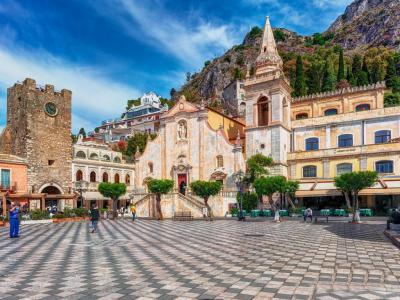
April 9th Square comes with a story that is part history, part blunder. On April 9, 1860, the congregation at Taormina’s Cathedral was told that Giuseppe Garibaldi had landed at Marsala to liberate Sicily from Bourbon rule. The preacher’s announcement sparked jubilation, even though it was completely wrong-Garibaldi would not arrive for another month. The error was so memorable that when Italy’s unification was complete, the square was renamed after the date, preserving the echo of that mistaken cheer.
Before the renaming, it was known as Sant’Agostino Square, after the small Church of Saint Augustine built in 1448. That church still stands, though today it holds books instead of worshippers, serving as the town’s public library. Across the square rises the Church of San Giuseppe, a Baroque confection from the 17th century with a staircase as theatrical as its façade. Completing the ensemble is the medieval Clock Tower, rebuilt in the 1600s after French troops leveled it, once marking the dividing line between Taormina’s Greco-Roman foundations and its medieval quarter.
The square unfolds directly off Umberto Street, halfway between the town’s two historic gates, and has always been a gathering place. Cafés and shops crowd its edges, with artists ready to sketch a visitor’s likeness for the price of a cappuccino. Yet the highlight is the terrace itself: its checkerboard paving leads to a panorama stretching from the Ionian Sea across the Bay of Naxos to Mount Etna’s volcanic peak. Few places capture Taormina’s mix of drama, history, and spectacle as vividly as this plaza.
Before the renaming, it was known as Sant’Agostino Square, after the small Church of Saint Augustine built in 1448. That church still stands, though today it holds books instead of worshippers, serving as the town’s public library. Across the square rises the Church of San Giuseppe, a Baroque confection from the 17th century with a staircase as theatrical as its façade. Completing the ensemble is the medieval Clock Tower, rebuilt in the 1600s after French troops leveled it, once marking the dividing line between Taormina’s Greco-Roman foundations and its medieval quarter.
The square unfolds directly off Umberto Street, halfway between the town’s two historic gates, and has always been a gathering place. Cafés and shops crowd its edges, with artists ready to sketch a visitor’s likeness for the price of a cappuccino. Yet the highlight is the terrace itself: its checkerboard paving leads to a panorama stretching from the Ionian Sea across the Bay of Naxos to Mount Etna’s volcanic peak. Few places capture Taormina’s mix of drama, history, and spectacle as vividly as this plaza.

3) Villa Comunale (Taormina Public Gardens) (must see)
Lady Florence Trevelyan, born in New Castle on Tyne, England, a gardener by profession, was in love. Unfortunately, she was in love with the future King Edward VII of England. This could not be. Queen Victoria sent Florence packing. She settled in Taormina in 1884. She married the Mayor, Salvatore Cacciola, and planted a garden.
Lady Florence Trevelyan was no ordinary gardener. Once she settled in Taormina, she began shaping the town’s landscape with the same flair others reserved for writing novels. Her first venture was the small “Beautiful Island” offshore, where she built a retreat and filled it with exotic species collected on her travels. From there she moved inland, buying hillside plots between Bagnoli Croce and Giardini, laying out gardens that married Mediterranean plants with specimens brought from far-flung corners of the world. To crown her efforts, she scattered the grounds with eccentric “Victorian follies” she dubbed “hives”-brick towers and fanciful structures that borrowed freely from Gothic and Moorish design. Their playful oddity still distinguishes the gardens from more predictable landscapes.
When Florence died in 1907, the municipality inherited her creations and opened them to the public. True to the English landscape tradition, the Villa Comunale was arranged with winding paths, manicured beds, fountains, and shaded corners. Visitors today still wander past palms, cypresses, oleanders, and blooms that shift with the seasons, while the follies stand like whimsical punctuation marks among the greenery. Yet the real showstopper comes from the terraces: sweeping panoramas that take in the Bay of Naxos, the Ionian Sea, and the silhouette of Mount Etna.
More than a century on, the Public Gardens remain a favorite gathering spot. Families stroll, children play, and concerts animate the lawns, all within a setting that balances nature with a dash of eccentric history. In shaping these grounds, Lady Florence left Taormina a gift that feels as alive and unconventional as the woman herself.
Lady Florence Trevelyan was no ordinary gardener. Once she settled in Taormina, she began shaping the town’s landscape with the same flair others reserved for writing novels. Her first venture was the small “Beautiful Island” offshore, where she built a retreat and filled it with exotic species collected on her travels. From there she moved inland, buying hillside plots between Bagnoli Croce and Giardini, laying out gardens that married Mediterranean plants with specimens brought from far-flung corners of the world. To crown her efforts, she scattered the grounds with eccentric “Victorian follies” she dubbed “hives”-brick towers and fanciful structures that borrowed freely from Gothic and Moorish design. Their playful oddity still distinguishes the gardens from more predictable landscapes.
When Florence died in 1907, the municipality inherited her creations and opened them to the public. True to the English landscape tradition, the Villa Comunale was arranged with winding paths, manicured beds, fountains, and shaded corners. Visitors today still wander past palms, cypresses, oleanders, and blooms that shift with the seasons, while the follies stand like whimsical punctuation marks among the greenery. Yet the real showstopper comes from the terraces: sweeping panoramas that take in the Bay of Naxos, the Ionian Sea, and the silhouette of Mount Etna.
More than a century on, the Public Gardens remain a favorite gathering spot. Families stroll, children play, and concerts animate the lawns, all within a setting that balances nature with a dash of eccentric history. In shaping these grounds, Lady Florence left Taormina a gift that feels as alive and unconventional as the woman herself.

4) Teatro Antico di Taormina (Ancient Theatre of Taormina) (must see)
The Ancient Theatre of Taormina, set high on a hillside with sweeping views of Mount Etna and the Ionian Sea, is one of Sicily’s most celebrated monuments. Built in the 3rd century BC under the reign of Hiero II of Syracuse, it followed the typical Greek theatre design, with a semicircular cavea carved into the slope and a simple stage used for drama and religious festivals. Constructing it required immense effort, as more than 100,000 cubic meters of rock were manually removed from the mountain. From the beginning, the theatre was not only a cultural center but also a striking blend of architecture and landscape.
In the Roman period, particularly in the 2nd century AD, the theatre was adapted to suit changing tastes. The modest Greek stage was replaced with a monumental scaenae frons adorned with marble columns and statues, while the orchestra area once used by musicians was transformed for gladiatorial contests. The theatre could seat between 5,000 and 5,400 spectators, arranged in nine sections with porticos. Its scale and acoustics made it a favored venue for performances, while its dramatic setting enhanced every spectacle.
During the Middle Ages, the theatre fell into disrepair, but it never lost its allure. Rediscovered in the 18th and 19th centuries by travelers on the Grand Tour, it became renowned as one of the most beautiful ancient theatres in the world. Writers, painters, and aristocrats immortalized its vistas, cementing Taormina’s reputation as a cultural haven.
Today, the Ancient Theatre remains the second-largest in Sicily and is still in use. Since the 1950s, it has hosted concerts, plays, operas, and film festivals. For visitors, walking through its ruins offers both a journey into Sicily’s Greek and Roman past and an unforgettable panorama where history, myth, and natural beauty come together.
In the Roman period, particularly in the 2nd century AD, the theatre was adapted to suit changing tastes. The modest Greek stage was replaced with a monumental scaenae frons adorned with marble columns and statues, while the orchestra area once used by musicians was transformed for gladiatorial contests. The theatre could seat between 5,000 and 5,400 spectators, arranged in nine sections with porticos. Its scale and acoustics made it a favored venue for performances, while its dramatic setting enhanced every spectacle.
During the Middle Ages, the theatre fell into disrepair, but it never lost its allure. Rediscovered in the 18th and 19th centuries by travelers on the Grand Tour, it became renowned as one of the most beautiful ancient theatres in the world. Writers, painters, and aristocrats immortalized its vistas, cementing Taormina’s reputation as a cultural haven.
Today, the Ancient Theatre remains the second-largest in Sicily and is still in use. Since the 1950s, it has hosted concerts, plays, operas, and film festivals. For visitors, walking through its ruins offers both a journey into Sicily’s Greek and Roman past and an unforgettable panorama where history, myth, and natural beauty come together.

5) Via Teatro Greco (Greek Theatre Street)
Greek Theatre Street is Taormina’s most theatrical approach, guiding visitors from Abbey Square straight to the town’s crown jewel, the Ancient Theatre. Its stones have carried generations of footsteps since Greek and Roman times, when crowds climbed this slope for tragedies, comedies, and later Roman spectacles. Even as centuries passed and rulers changed, the street kept its role as the artery leading into Taormina’s cultural life.
By the 18th and 19th centuries, it had gained a second life as part of the Grand Tour. Poets, painters, and aristocrats wandered here, with Goethe and D.H. Lawrence among those who praised both the ruins and the views that frame them. Their rapturous accounts gave the street an almost literary reputation, binding it to the romantic imagination of Europe.
Landmarks lend the walk its character. The staircase of Timoleon rises in honor of the Corinthian general who once defended the town, staged like a Sicilian answer to Rome’s Spanish Steps and dressed with azaleas each spring. Not far away are the legacies of Taormina’s more recent past: the villa of Lady Florence Trevelyan, who left the town its celebrated gardens; the medieval Corvaja Palace, now housing the Museum of Sicilian Art and Traditions; and Cuseni House, an Art Nouveau villa that hints at Gaudí in its curves. The Hotel Timeo, a 19th-century favorite of visiting elites, still watches over the street with quiet grandeur.
Today, Greek Theatre Street is more than a passage-it is an unfolding sequence of shops, cafés, and glimpses of sea and mountain, with the Ancient Theatre waiting at the end and the fortress of Mount Tauro towering above. It feels less like a walk and more like a rehearsal for the spectacle ahead.
By the 18th and 19th centuries, it had gained a second life as part of the Grand Tour. Poets, painters, and aristocrats wandered here, with Goethe and D.H. Lawrence among those who praised both the ruins and the views that frame them. Their rapturous accounts gave the street an almost literary reputation, binding it to the romantic imagination of Europe.
Landmarks lend the walk its character. The staircase of Timoleon rises in honor of the Corinthian general who once defended the town, staged like a Sicilian answer to Rome’s Spanish Steps and dressed with azaleas each spring. Not far away are the legacies of Taormina’s more recent past: the villa of Lady Florence Trevelyan, who left the town its celebrated gardens; the medieval Corvaja Palace, now housing the Museum of Sicilian Art and Traditions; and Cuseni House, an Art Nouveau villa that hints at Gaudí in its curves. The Hotel Timeo, a 19th-century favorite of visiting elites, still watches over the street with quiet grandeur.
Today, Greek Theatre Street is more than a passage-it is an unfolding sequence of shops, cafés, and glimpses of sea and mountain, with the Ancient Theatre waiting at the end and the fortress of Mount Tauro towering above. It feels less like a walk and more like a rehearsal for the spectacle ahead.
6) Porta Messina (Messina Gate)
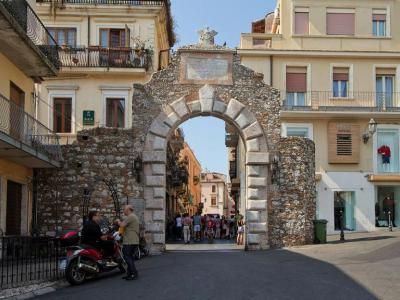
Messina Gate guards the northern end of Taormina’s historic center, a stone arch that has seen both armies and tourists step beneath it. The town’s medieval walls once tied it into a full defensive circuit, fragments of which still show near the Clock Tower and Catania Gate to the south. While that southern gate was last restored in the 15th century, Messina Gate is a later arrival in its current form, rebuilt in 1808 under the Bourbons. Its style is straightforward and stately, marked by the Bourbon coat of arms on the keystone. For a time it bore the name Ferdinand Gate in honor of Ferdinand IV, but after Italian unification locals quickly reverted to the older and more practical title, Messina Gate.
Historically, this was the threshold for anyone arriving from the north. The road from Messina funneled directly through the arch into Taormina, shifting the traveler from countryside quiet into the town’s civic and commercial stage. The arch itself, while simple, carried weight as a boundary marker, a reminder that one was now entering a community both ancient and guarded.
In the present day, Messina Gate frames a different kind of entry. Instead of knights or merchants, visitors stream into Umberto Street, a lively stretch of cafés, shops, and palaces. Just inside, Vittorio Emanuele Square sets the tone with the 17th-century Church of Saint Catherine and the Corvaja Palace rising nearby. The gate no longer needs to defend Taormina, but it still delivers a sense of arrival, the kind that bridges centuries in a single step.
Historically, this was the threshold for anyone arriving from the north. The road from Messina funneled directly through the arch into Taormina, shifting the traveler from countryside quiet into the town’s civic and commercial stage. The arch itself, while simple, carried weight as a boundary marker, a reminder that one was now entering a community both ancient and guarded.
In the present day, Messina Gate frames a different kind of entry. Instead of knights or merchants, visitors stream into Umberto Street, a lively stretch of cafés, shops, and palaces. Just inside, Vittorio Emanuele Square sets the tone with the 17th-century Church of Saint Catherine and the Corvaja Palace rising nearby. The gate no longer needs to defend Taormina, but it still delivers a sense of arrival, the kind that bridges centuries in a single step.
