Custom Walk in Annecy, France by sarahofchrist_94dc88 created on 2026-06-22
Guide Location: France » Annecy
Guide Type: Custom Walk
# of Sights: 10
Tour Duration: 2 Hour(s)
Travel Distance: 2.1 Km or 1.3 Miles
Share Key: NQFLJ
Guide Type: Custom Walk
# of Sights: 10
Tour Duration: 2 Hour(s)
Travel Distance: 2.1 Km or 1.3 Miles
Share Key: NQFLJ
How It Works
Please retrieve this walk in the GPSmyCity app. Once done, the app will guide you from one tour stop to the next as if you had a personal tour guide. If you created the walk on this website or come to the page via a link, please follow the instructions below to retrieve the walk in the app.
Retrieve This Walk in App
Step 1. Download the app "GPSmyCity: Walks in 1K+ Cities" on Apple App Store or Google Play Store.



Step 2. In the GPSmyCity app, download(or launch) the guide "Annecy Map and Walking Tours".
Step 3. Tap the menu button located at upper right corner of the "Walks" screen and select "Retrieve custom walk". Enter the share key: NQFLJ
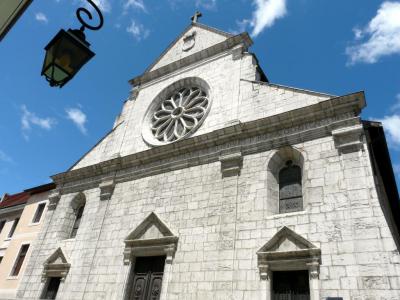
1) Annecy Cathedral (must see)
Formally known as the Cathedral of Saint Peter in Chains, Annecy Cathedral was listed as a historic monument in October 1906. The original edifice was built by Jacques Rossel sometime before 1526. It was intended to be a convent of the Celestins but in 1538 it became a haven for Catholic refugees from Calvinism in Geneva.
Saint Francis de Sales held the seat of Bishop there in the 16th century. In 1792, during the time of the French Revolution, the church was miraculously converted into a temple of the Goddess Reason. The Goddess reigned supreme for a time but she was unseated in the Napoleonic era. The status Cathedral was awarded in 1822.
The Renaissance facade of 1535 was adapted from the Roman model of the Church of Sainte-Marie-du-Peuple. The facade masks the basilica aspects of the cathedral. It has Tuscan pilasters under a triangular pediment and a classic Gothic rose window. The bell tower holds two bells by the Paccard Foundry in Sevrier.
There are two pointed arches similar to those of Jacques Rossel installed in 1511 on the tower of Geneva Cathedral. The choir was refurbished in 1775 by architect Giovanni Piacenza. The organ of the Cathedral is by Nicolas-Antoine Lete, organ builder to the King in 1842.
The layout of the Cathedral is similar to a basilica. It has three naves and five bays. The choir is done-over as neoclassical, brightly illuminated by stained glass windows.
The Cathedral is open to the public everyday.
Saint Francis de Sales held the seat of Bishop there in the 16th century. In 1792, during the time of the French Revolution, the church was miraculously converted into a temple of the Goddess Reason. The Goddess reigned supreme for a time but she was unseated in the Napoleonic era. The status Cathedral was awarded in 1822.
The Renaissance facade of 1535 was adapted from the Roman model of the Church of Sainte-Marie-du-Peuple. The facade masks the basilica aspects of the cathedral. It has Tuscan pilasters under a triangular pediment and a classic Gothic rose window. The bell tower holds two bells by the Paccard Foundry in Sevrier.
There are two pointed arches similar to those of Jacques Rossel installed in 1511 on the tower of Geneva Cathedral. The choir was refurbished in 1775 by architect Giovanni Piacenza. The organ of the Cathedral is by Nicolas-Antoine Lete, organ builder to the King in 1842.
The layout of the Cathedral is similar to a basilica. It has three naves and five bays. The choir is done-over as neoclassical, brightly illuminated by stained glass windows.
The Cathedral is open to the public everyday.
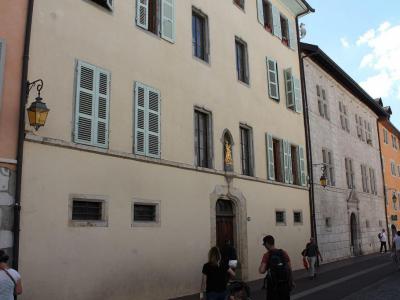
2) Maison Lambert (Lambert House)
To understand the significance of the Lambert House we must go back in time. In the 17th century Switzerland and parts of France were in turmoil. The reformation movement within Christianity has moved into the war phase. The Calvinist faction now controls Geneva. Life is uneasy for the Catholic bishop of Geneva, Francois de Sales.
Finally Francois de Sales is expelled from Geneva. Where to go? He moved to Annecy and took up residence in Lambert House, owned by Pierre de Lambert.
Pierre had just finished with the building of Saint Peters Cathedral. Both buildings are located on the Jean-Jacques Rousseau Street. Francois de Sales moved into Lambert House in 1602 and he resided there for eight years.
Lambert used some of the facade elements from the Cathedral for the facade of his own house. The house has three stories. The facade is plain, with full size windows on the second and third floors. The main entrance has double carved wooden doors flanked by pilasters. Above the doors is a triangular pediment.
The building design is simple but with a minimalist elegance. Bishop de Sales never got the chance to move to the Bishop Palace which was built on the same street near the end of the 18th century.
Finally Francois de Sales is expelled from Geneva. Where to go? He moved to Annecy and took up residence in Lambert House, owned by Pierre de Lambert.
Pierre had just finished with the building of Saint Peters Cathedral. Both buildings are located on the Jean-Jacques Rousseau Street. Francois de Sales moved into Lambert House in 1602 and he resided there for eight years.
Lambert used some of the facade elements from the Cathedral for the facade of his own house. The house has three stories. The facade is plain, with full size windows on the second and third floors. The main entrance has double carved wooden doors flanked by pilasters. Above the doors is a triangular pediment.
The building design is simple but with a minimalist elegance. Bishop de Sales never got the chance to move to the Bishop Palace which was built on the same street near the end of the 18th century.
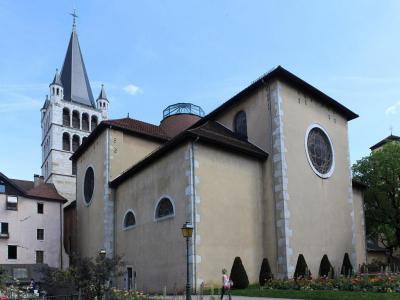
3) Église Notre-Dame-de-Liesse d'Annecy (Notre Dame de Liesse Church)
The Church of Notre-Dame-de-Liesse was founded and constructed in the 14th century by the counts of Geneva, Amedee III and Count Robert. The Count Amedee was hoping to make the church a necropolis for his family. The church was built on the site of an old chapel and a medieval square and hospital. The church was consecrated in 1398.
Everything was more or less fine until the French Revolution. Changes were made. The choir was demolished and the steeple lost its spire and watchtowers. The new regime needed space, they said, for a "Place of Freedom." They were expecting bigger crowds to gather around the "Tree of Freedom."
In 1815, after the disappearance of Napoleon from the European stage, the parishes were re-established. The churches were rebuilt. The present Notre-Dame was built by 1851. Some elements, including the bell tower and the south Gothic window were restored.
The church is in the classic shape of a Latin cross. The nave and aisles have full vaults and there is a central dome. The facade is neoclassical in the Sardinian style of 1846. There are two altars dedicated to Saint Francois de Sales and Our Lady of the Rosary. The high altar dates from 1854.
In front of the church a square called "Place Note Dame" has also been preserved. The square is surrounded by cafes and shops.
Everything was more or less fine until the French Revolution. Changes were made. The choir was demolished and the steeple lost its spire and watchtowers. The new regime needed space, they said, for a "Place of Freedom." They were expecting bigger crowds to gather around the "Tree of Freedom."
In 1815, after the disappearance of Napoleon from the European stage, the parishes were re-established. The churches were rebuilt. The present Notre-Dame was built by 1851. Some elements, including the bell tower and the south Gothic window were restored.
The church is in the classic shape of a Latin cross. The nave and aisles have full vaults and there is a central dome. The facade is neoclassical in the Sardinian style of 1846. There are two altars dedicated to Saint Francois de Sales and Our Lady of the Rosary. The high altar dates from 1854.
In front of the church a square called "Place Note Dame" has also been preserved. The square is surrounded by cafes and shops.
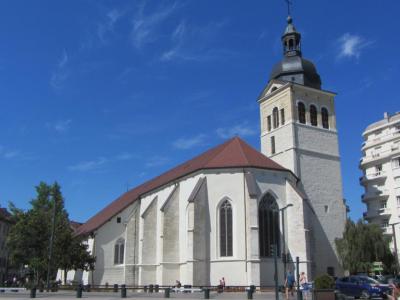
4) Eglise St. Maurice (Saint Maurice Church)
The Church of Saint Maurice was once a chapel of a Dominican convent. The church was constructed by order of Cardinal de Brogny in 1422. At that time it was located on the edge of the old city walls, by a canal connecting the Vasse to the River Thiou. Consecrated in 1445, it was yet unfinished and went by the name of Saint Dominic.
Come the French Revolution, the church was seized, looted and converted into a grain market. Later it was used for a stable. After the Concordat of 1803 it was reinstated as a church and took the name Saint Maurice. The bell tower was restored in 1822. The church was again restored in 2015.
The building is in a lush Savoyard Gothic style. The architect is unknown. Inside the church is the chapel of Notre-Dame-de-Pitie-et-Saint-Michel. The chapel hold the remains of Count Janus de Savoie and his wife, Helene de Luxembourg. The chapel was built in 1478. There is a trompe-l'oeil painting on the left of the choir.
The church was designated a National Monument in 1957.
Come the French Revolution, the church was seized, looted and converted into a grain market. Later it was used for a stable. After the Concordat of 1803 it was reinstated as a church and took the name Saint Maurice. The bell tower was restored in 1822. The church was again restored in 2015.
The building is in a lush Savoyard Gothic style. The architect is unknown. Inside the church is the chapel of Notre-Dame-de-Pitie-et-Saint-Michel. The chapel hold the remains of Count Janus de Savoie and his wife, Helene de Luxembourg. The chapel was built in 1478. There is a trompe-l'oeil painting on the left of the choir.
The church was designated a National Monument in 1957.
5) The Saint François de Sales Memorial
The Saint François de Sales Memorial in Annecy pays tribute to one of the most influential figures in the region’s history, Saint Francis de Sales. Born in 1567 into a religious aristocratic family at the Chateau de Sales, within the Duchy of Savoy, Francis de Sales lived through the tumultuous period of the French Wars of Religion (1562–1598). This era was marked by events like the Saint Bartholomew’s Day Massacre in 1572 and the eventual signing of the Edict of Nantes in 1598, which sought to bring peace between Catholics and Protestants.
After excelling in his studies in Paris and Padua, Francis returned to Annecy to become a priest. His dedication and faith, alongside his companion Louis, led to the conversion of over seventy thousand Calvinists, despite the considerable risks they faced during their mission.
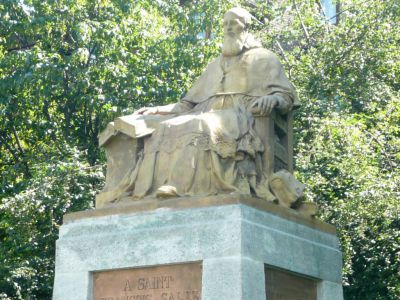
Located at the intersection of Place aux Bois and Rue des Marquisats in Annecy, the memorial features a striking bronze statue of Saint François de Sales. Designed by architect Fleury Raillon, cast by the Fonderie Siot, and sculpted by Descatoire and Jean Weitmenn, the statue was inaugurated on September 14, 1924. The ceremony was presided over by Monseigneur du Bois de la Villerabel, the Bishop of Annecy, and Haut-Savoyard Henry Bordeaux, a member of the French Academy.
The statue portrays Saint François de Sales seated in his episcopal chair, with his right hand resting on one of his books, a nod to his legacy as a great writer and theologian in the French language. Dubbed the "Glory of Savoy and French letters," Saint Francis de Sales remains a beacon of religious tolerance and literary brilliance, celebrated through this enduring monument in the heart of Annecy.
After excelling in his studies in Paris and Padua, Francis returned to Annecy to become a priest. His dedication and faith, alongside his companion Louis, led to the conversion of over seventy thousand Calvinists, despite the considerable risks they faced during their mission.
Located at the intersection of Place aux Bois and Rue des Marquisats in Annecy, the memorial features a striking bronze statue of Saint François de Sales. Designed by architect Fleury Raillon, cast by the Fonderie Siot, and sculpted by Descatoire and Jean Weitmenn, the statue was inaugurated on September 14, 1924. The ceremony was presided over by Monseigneur du Bois de la Villerabel, the Bishop of Annecy, and Haut-Savoyard Henry Bordeaux, a member of the French Academy.
The statue portrays Saint François de Sales seated in his episcopal chair, with his right hand resting on one of his books, a nod to his legacy as a great writer and theologian in the French language. Dubbed the "Glory of Savoy and French letters," Saint Francis de Sales remains a beacon of religious tolerance and literary brilliance, celebrated through this enduring monument in the heart of Annecy.
6) Eglise Saint-Francois (Saint François Church)
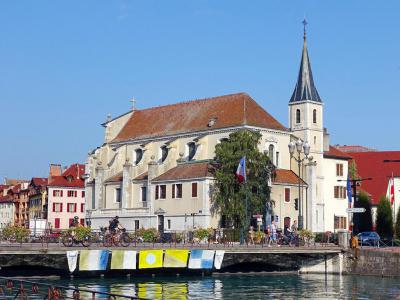
Saint Francis Church was built in 1614. It had its days of glory as the pilgrimage site and resting place of the bodies of Saints Jeanne de Chantal and Francis de Sales. The graves of the two saints were secretly moved from time to time to avoid desecration by revolutionary mobs. At present they are in the Basilica of the Visitation.
After the revolution, the church went through some transformations. It became a barracks, a factory in the 18th century and a venue for workshops in the 19th century. It was finally restored to religious status after the Great War. The church is also called "Church of the Italians" because it is popular with the Italian community of Annecy.
The church sits resolutely on the banks of the Thiou River. It expresses strong lombard and baroque influences. The facade and basic plan are adapted from the 16th century Church of the Gesu in Rome. The facade is in two levels topped by a triangular pediment.
It has a central nave plus three bays and two other naves on each side. The interior is not extravagant but it is well lighted. There are seven baroque altarpieces. The main altarpiece is a rebuilt of the 17th century original which has gone missing.
The church is located in Saint Francis Square. It is open year-round.
After the revolution, the church went through some transformations. It became a barracks, a factory in the 18th century and a venue for workshops in the 19th century. It was finally restored to religious status after the Great War. The church is also called "Church of the Italians" because it is popular with the Italian community of Annecy.
The church sits resolutely on the banks of the Thiou River. It expresses strong lombard and baroque influences. The facade and basic plan are adapted from the 16th century Church of the Gesu in Rome. The facade is in two levels topped by a triangular pediment.
It has a central nave plus three bays and two other naves on each side. The interior is not extravagant but it is well lighted. There are seven baroque altarpieces. The main altarpiece is a rebuilt of the 17th century original which has gone missing.
The church is located in Saint Francis Square. It is open year-round.

7) Palais de l'Isle (Isle Palace) (must see)
The Isle Palace may look like a stone ship but it has tried to be other things. Originally it did not have such an elegant name. The locals refer to it as "The Old Prisons". It sits firmly on a stone island in the River Thiou, in the center of old Annecy.
The palace is a 12th century stronghold rebuilt many times. It has played the roles of river fortress, toll booth, prison, barracks, land registry office, warehouse, mint, Palace of Justice and old age home. Mostly it has been a prison. Today it houses the Center for the Interpretation of Architecture and Heritage (CIAP).
The shape of the island fortress is like a ship seen bow-on. It divides the river into two canals. The late 12th century lower loge houses museum exhibitions. Two small bridges connect to the island. Pass over into the entrance courtyard and find the facade of the castle next to a four-sided tower that holds a spiral staircase.
On the left are the "banches" (counters) of the lawyers from the Palace of Justice days. On the right is the 14th century coin-minting wing and the entrance to the castle. The lower floor has four rooms with vaulted ceilings and arches and it includes the old jail kitchen.
The Tower Loge, once used in the administration of justice, is on the north side of the palace. It has a facade made from river stones and limestone. There three prison cells, a hearing room and the old Court of Justice. The rooms have panels on the history of the town. The 15th century spiral staircase connects to two upper floors.
The palace can be reached via footbridge of Isle Passage. The permanent museum exhibition is concerned with the history and heritage of Annecy. There are audio-visual presentations in French. Combination tickets to both the Isle Palace and Annecy Castle are available.
Why You Should Visit:
There is no other building like it. It affirms Annecy's standing as the "Venice of the Alps."
The palace is a 12th century stronghold rebuilt many times. It has played the roles of river fortress, toll booth, prison, barracks, land registry office, warehouse, mint, Palace of Justice and old age home. Mostly it has been a prison. Today it houses the Center for the Interpretation of Architecture and Heritage (CIAP).
The shape of the island fortress is like a ship seen bow-on. It divides the river into two canals. The late 12th century lower loge houses museum exhibitions. Two small bridges connect to the island. Pass over into the entrance courtyard and find the facade of the castle next to a four-sided tower that holds a spiral staircase.
On the left are the "banches" (counters) of the lawyers from the Palace of Justice days. On the right is the 14th century coin-minting wing and the entrance to the castle. The lower floor has four rooms with vaulted ceilings and arches and it includes the old jail kitchen.
The Tower Loge, once used in the administration of justice, is on the north side of the palace. It has a facade made from river stones and limestone. There three prison cells, a hearing room and the old Court of Justice. The rooms have panels on the history of the town. The 15th century spiral staircase connects to two upper floors.
The palace can be reached via footbridge of Isle Passage. The permanent museum exhibition is concerned with the history and heritage of Annecy. There are audio-visual presentations in French. Combination tickets to both the Isle Palace and Annecy Castle are available.
Why You Should Visit:
There is no other building like it. It affirms Annecy's standing as the "Venice of the Alps."
8) The Old Town
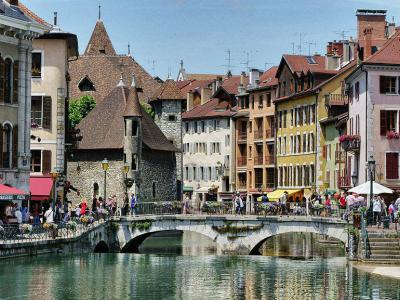
The Old Town of Annecy, often called the "Venice of the Alps," is a stunning medieval gem nestled by the azure waters of Lake Annecy. This picturesque quarter, built around the 14th-century Chateau d’Annecy, is interwoven with canals and the Thiou River, Europe's shortest river at just 3.5 kilometers. These waterways not only give the town its nickname but also lend it a unique charm that visitors can explore on foot. The pedestrian-friendly streets make it an accessible and inviting destination for all.
Annecy's Old Town boasts colorful medieval facades in shades of yellow, pink, and green, many of which were rebuilt in stone after devastating fires in the 15th century. These renovations, encouraged by the Duke of Savoy, created the architectural unity visible today. Stroll along Sainte-Claire Street, the heart of the town, lined with shaded arcades from the Renaissance era. Here, vibrant markets and bustling cafes capture the lively spirit of Annecy.
At the heart of Annecy, the Island Palace (Palais de l’Ile), a 12th-century ship-shaped landmark, sits surrounded by the Thiou River and now houses an architectural heritage center. Overlooking the town, the Annecy Castle (Chateau d’Annecy) offers stunning views and historical exhibits, while the nearby Gardens of Europe provide a peaceful lakeside retreat. For a closer look at Lake Annecy, rent a boat or join a scenic water tour.
Annecy is also home to several notable churches, including the 17th-century Eglise Saint-François de Sales, the 15th-century Eglise Saint-Maurice, and the 19th-century Eglise Notre-Dame-de-Liesse, each showcasing different periods of architectural splendor.
A Sunday visit offers the bonus of a vibrant market that weaves through the Old Town's narrow streets, filling the air with the aroma of fresh produce and local delicacies. For history enthusiasts, Annecy’s roots trace back to the 12th century when its strategic location along the Thiou supported thriving craft industries.
Whether wandering its stone-paved streets, admiring its canals, or enjoying its markets, Annecy’s Old Town is a destination where history, culture, and natural beauty converge.
Annecy's Old Town boasts colorful medieval facades in shades of yellow, pink, and green, many of which were rebuilt in stone after devastating fires in the 15th century. These renovations, encouraged by the Duke of Savoy, created the architectural unity visible today. Stroll along Sainte-Claire Street, the heart of the town, lined with shaded arcades from the Renaissance era. Here, vibrant markets and bustling cafes capture the lively spirit of Annecy.
At the heart of Annecy, the Island Palace (Palais de l’Ile), a 12th-century ship-shaped landmark, sits surrounded by the Thiou River and now houses an architectural heritage center. Overlooking the town, the Annecy Castle (Chateau d’Annecy) offers stunning views and historical exhibits, while the nearby Gardens of Europe provide a peaceful lakeside retreat. For a closer look at Lake Annecy, rent a boat or join a scenic water tour.
Annecy is also home to several notable churches, including the 17th-century Eglise Saint-François de Sales, the 15th-century Eglise Saint-Maurice, and the 19th-century Eglise Notre-Dame-de-Liesse, each showcasing different periods of architectural splendor.
A Sunday visit offers the bonus of a vibrant market that weaves through the Old Town's narrow streets, filling the air with the aroma of fresh produce and local delicacies. For history enthusiasts, Annecy’s roots trace back to the 12th century when its strategic location along the Thiou supported thriving craft industries.
Whether wandering its stone-paved streets, admiring its canals, or enjoying its markets, Annecy’s Old Town is a destination where history, culture, and natural beauty converge.
9) Château d'Annecy (Annecy Castle) (must see)
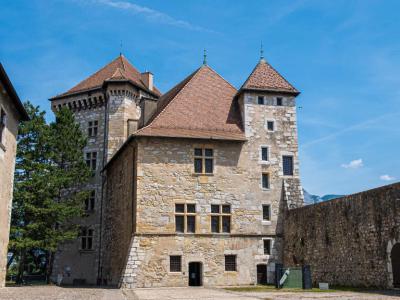
Tucked away beside a lake in the old town of Annecy in the mountains of southeastern France, is the venerable 12th century Chateau d'Annecy. In 1959 it was listed as a historical monument by the Ministry of Culture. The Counts of Geneva and the Dukes of Genvois-Nemours, former tenants of the castle, would be pleased.
Sadly, the castle proved to be a firetrap and it was abandoned in the 17th century. It was repaired soon enough but the glory days of counts and dukes were over. It became a barracks. The castle closed down in 1947 but it was purchased by the town of Annecy in 1953. Et voila! It became a museum.
The castle is divided into towers and loggias called "logis." The Queen's Tower was erected in the twelfth century. Its walls are 13 feet thick. It has aged very well. Together with the Logis Perriere, it houses the Regional Observatory of the Alpine Lakes. The Logis Perriere dates from the 15th century.
Other Logis of the Castle are the Old Logis, the Logis Nemours and Logis Neuf. Besides the observatory, the castle houses the Museum of Alpine Popular Art. The museum collection has sculptures and paintings from surrounding regions. The castle also houses 15th century furniture and photographs and scale models of Alpine architecture.
In the Observatory there are artifacts and evidence of prehistoric lakeside settlements. Exhibits include aquariums holding different species of freshwater fish. There are examples of fishing equipment and boats used in the Alps and a scale model of Lake Annecy and its environs. And yes, there are birds.
Why You Should Visit:
Above all, stunning views of the lake and the surrounding landscape.
Tips:
There is a modest entrance fee. Parking is possible but walking up to the Castle through the old town have its rewards.
Sadly, the castle proved to be a firetrap and it was abandoned in the 17th century. It was repaired soon enough but the glory days of counts and dukes were over. It became a barracks. The castle closed down in 1947 but it was purchased by the town of Annecy in 1953. Et voila! It became a museum.
The castle is divided into towers and loggias called "logis." The Queen's Tower was erected in the twelfth century. Its walls are 13 feet thick. It has aged very well. Together with the Logis Perriere, it houses the Regional Observatory of the Alpine Lakes. The Logis Perriere dates from the 15th century.
Other Logis of the Castle are the Old Logis, the Logis Nemours and Logis Neuf. Besides the observatory, the castle houses the Museum of Alpine Popular Art. The museum collection has sculptures and paintings from surrounding regions. The castle also houses 15th century furniture and photographs and scale models of Alpine architecture.
In the Observatory there are artifacts and evidence of prehistoric lakeside settlements. Exhibits include aquariums holding different species of freshwater fish. There are examples of fishing equipment and boats used in the Alps and a scale model of Lake Annecy and its environs. And yes, there are birds.
Why You Should Visit:
Above all, stunning views of the lake and the surrounding landscape.
Tips:
There is a modest entrance fee. Parking is possible but walking up to the Castle through the old town have its rewards.
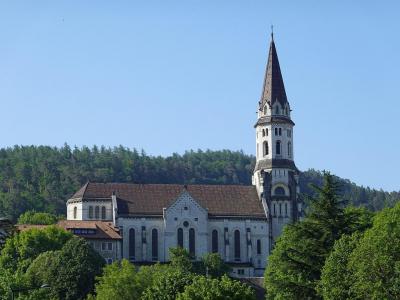
10) Basilique de la Visitation (Visitation Basilica) (must see)
The Basilica of the Visitation dominates the sky from its high rocky seat on the cret du Maure, a peak of the Semnoz massif of south-eastern France. It is an aspiring declaration in stone, visible for miles around the city of Annecy.
Not a medieval edifice, the basilica was started in 1909 and completed in 1930. It was based on the plans of architect Alfred-Henri Recoura. It is connected to the mother house monastery of the Order of the Visitation. The Visitandines order was founded in 1610 by Saint Francis de Sales and Saint Jeanne de Chantal.
The remains of the two saints are in the side naves of the basilica in gilded bronze sarcophagi. The basilica style is typical late 19th century. The bell tower spire reaches a height of 275 feet, topped by a 28 foot cross. The nave is built over a crypt designed by architect Henri Ade.
The vault of the nave is in a semicircular arch. Stained glass windows depict events in the lives of the two celebrated saints. This bell tower actually has bells. It holds a carillon of 38 bells. That's eight tons of bells. One bell, by the name of Marie Francoise, weighs four tons.
Not a medieval edifice, the basilica was started in 1909 and completed in 1930. It was based on the plans of architect Alfred-Henri Recoura. It is connected to the mother house monastery of the Order of the Visitation. The Visitandines order was founded in 1610 by Saint Francis de Sales and Saint Jeanne de Chantal.
The remains of the two saints are in the side naves of the basilica in gilded bronze sarcophagi. The basilica style is typical late 19th century. The bell tower spire reaches a height of 275 feet, topped by a 28 foot cross. The nave is built over a crypt designed by architect Henri Ade.
The vault of the nave is in a semicircular arch. Stained glass windows depict events in the lives of the two celebrated saints. This bell tower actually has bells. It holds a carillon of 38 bells. That's eight tons of bells. One bell, by the name of Marie Francoise, weighs four tons.
