Custom Walk in Aarhus, Denmark by anna_stjernfalk_d622a created on 2026-07-14
Guide Location: Denmark » Aarhus
Guide Type: Custom Walk
# of Sights: 7
Tour Duration: 3 Hour(s)
Travel Distance: 7.5 Km or 4.7 Miles
Share Key: MP6L4
Guide Type: Custom Walk
# of Sights: 7
Tour Duration: 3 Hour(s)
Travel Distance: 7.5 Km or 4.7 Miles
Share Key: MP6L4
How It Works
Please retrieve this walk in the GPSmyCity app. Once done, the app will guide you from one tour stop to the next as if you had a personal tour guide. If you created the walk on this website or come to the page via a link, please follow the instructions below to retrieve the walk in the app.
Retrieve This Walk in App
Step 1. Download the app "GPSmyCity: Walks in 1K+ Cities" on Apple App Store or Google Play Store.



Step 2. In the GPSmyCity app, download(or launch) the guide "Aarhus Map and Walking Tours".
Step 3. Tap the menu button located at upper right corner of the "Walks" screen and select "Retrieve custom walk". Enter the share key: MP6L4
1) Aarhus Central Station
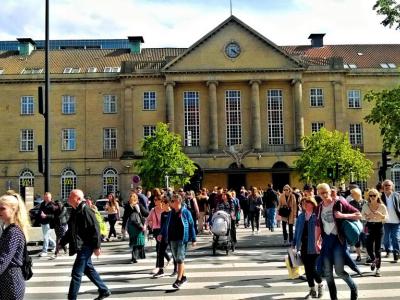
Aarhus Central Station is the principal railway station in Aarhus. This pivotal hub manages an impressive annual footfall of 6.3 million passengers, making it the busiest railway station outside the Copenhagen area. Strategically positioned in the city center, the station borders the Midtbyen and Frederiksbjerg districts, featuring access points from Banegård Square (Banegårdspladsen).
Designed as a through station, it contains four platforms and serves as a key node on the East Jutland railway line. It functions as the terminus for the Grenaa Line and Odder Line. The station offers a range of connections including international routes to Hamburg and Berlin, InterCity services to Aalborg/Frederikshavn and Copenhagen, regional routes throughout Jutland, and light rail services to Grenå and Odder.
The railway's history in Aarhus dates back to 1862 when the first line from Aarhus to Randers was inaugurated, and constructed by the British civil engineering firm Peto, Brassey, and Betts. This initial station, launched on September 2, 1862, was located near Ryesgade, incorporating administration buildings and railway works.
By 1884, due to increasing demand, a larger Neo-Renaissance-style station designed by Thomas Arboe and William August Thulstrup, possibly inspired by Bonn Central Station, was constructed. Continued growth necessitated a third construction phase, and in 1927, the current Aarhus Central Station was erected under the guidance of Danish State Railway architect K.T. Seest as part of a comprehensive area development plan.
Today, the station is not just a transit point but a commercial center as well. It houses a large ticket kiosk, public amenities, a McDonald's, two 7-Elevens, and several other retail outlets. The attached three-story Bruun's Galleri shopping center enriches the station's offering with 93 stores, eateries, cafés, and a substantial underground parking facility. The ground floor’s Bruuns Arkade adds more dining options and dual-level bicycle parking.
Designed as a through station, it contains four platforms and serves as a key node on the East Jutland railway line. It functions as the terminus for the Grenaa Line and Odder Line. The station offers a range of connections including international routes to Hamburg and Berlin, InterCity services to Aalborg/Frederikshavn and Copenhagen, regional routes throughout Jutland, and light rail services to Grenå and Odder.
The railway's history in Aarhus dates back to 1862 when the first line from Aarhus to Randers was inaugurated, and constructed by the British civil engineering firm Peto, Brassey, and Betts. This initial station, launched on September 2, 1862, was located near Ryesgade, incorporating administration buildings and railway works.
By 1884, due to increasing demand, a larger Neo-Renaissance-style station designed by Thomas Arboe and William August Thulstrup, possibly inspired by Bonn Central Station, was constructed. Continued growth necessitated a third construction phase, and in 1927, the current Aarhus Central Station was erected under the guidance of Danish State Railway architect K.T. Seest as part of a comprehensive area development plan.
Today, the station is not just a transit point but a commercial center as well. It houses a large ticket kiosk, public amenities, a McDonald's, two 7-Elevens, and several other retail outlets. The attached three-story Bruun's Galleri shopping center enriches the station's offering with 93 stores, eateries, cafés, and a substantial underground parking facility. The ground floor’s Bruuns Arkade adds more dining options and dual-level bicycle parking.
2) Viking Museum
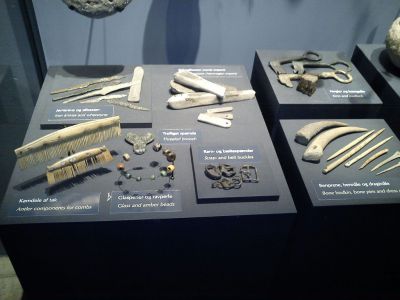
The Viking Museum in Aarhus offers a unique and intimate exploration of the Viking Age right in the heart of the city. Situated underground at Saint Clemens Square, beneath the Nordea bank building, this small museum is a treasure trove of history administered by the Moesgård Museum and supported financially by Aarhus Municipality and Nordea.
Founded in 1968 following archaeological digs from 1963-1964 during the construction of an office building, the museum showcases these excavations. These digs, conducted 3 meters below street level, unearthed Viking Age structures, artifacts, and even parts of a human skeleton. This provides a profound, in-situ experience for visitors, as they stand directly over the site of these historical findings.
The museum's exhibits extend beyond the archaeological finds to provide a broader view of Viking Age Aarhus. Through a mix of original and replicated items, the museum enriches visitors' understanding of the era.
A highlight is the detailed model city of Aarhus as it would have appeared around 980 AD during the reign of Harold Bluetooth, offering a vivid glimpse into the past. Alongside historical narratives, the museum also features newly discovered artifacts and a few replicas for security reasons, as the site is not under constant surveillance.
Moreover, the museum displays a copy of the 'Hørningstenen' runic stone, with the original housed at the Moesgaard Museum. This artifact, discovered in 1849, adds a significant cultural and historical narrative to the Viking Museum's collection, linking it to broader regional histories.
Founded in 1968 following archaeological digs from 1963-1964 during the construction of an office building, the museum showcases these excavations. These digs, conducted 3 meters below street level, unearthed Viking Age structures, artifacts, and even parts of a human skeleton. This provides a profound, in-situ experience for visitors, as they stand directly over the site of these historical findings.
The museum's exhibits extend beyond the archaeological finds to provide a broader view of Viking Age Aarhus. Through a mix of original and replicated items, the museum enriches visitors' understanding of the era.
A highlight is the detailed model city of Aarhus as it would have appeared around 980 AD during the reign of Harold Bluetooth, offering a vivid glimpse into the past. Alongside historical narratives, the museum also features newly discovered artifacts and a few replicas for security reasons, as the site is not under constant surveillance.
Moreover, the museum displays a copy of the 'Hørningstenen' runic stone, with the original housed at the Moesgaard Museum. This artifact, discovered in 1849, adds a significant cultural and historical narrative to the Viking Museum's collection, linking it to broader regional histories.
3) Aarhus Cathedral (must see)
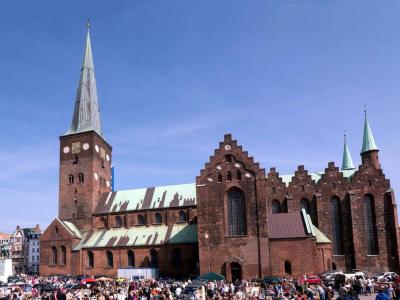
Aarhus Cathedral is a Church of Denmark cathedral that was previously a part of the Roman Catholic church. The Gothic and Romanesque cathedral was completed in 1300 and dedicated to Saint Clement, the patron saint of sailors.
Construction of the church started around 1190. It was built around Saint Clement's church, a timber church built in 1102. The Romanesque architectural style included half-rounded arches, a flat timber ceiling and four chapels.
The cathedral suffered great damage in 1330 when a fire burned much of Aarhus. It was abandoned until 1449 when it was renovated and enlarged. The new design of the church used Gothic vaulting with high windows and a lengthened nave. It is now both the tallest and longest church in Denmark at 305 feet long and 315 feet high. The current, 314-foot tower was built in 1931.
There are more frescoes in Aarhus Cathedral than in any church in the country. They were painted between 1470 and 1520. Likewise, the painting of Saint Christopher and Saint Clement are the tallest in Denmark. The cathedral's one stained glass window was created by Emanuel Vigeland in 1926. At almost 46-feet tall, it is the largest stained glass window in Denmark.
Construction of the church started around 1190. It was built around Saint Clement's church, a timber church built in 1102. The Romanesque architectural style included half-rounded arches, a flat timber ceiling and four chapels.
The cathedral suffered great damage in 1330 when a fire burned much of Aarhus. It was abandoned until 1449 when it was renovated and enlarged. The new design of the church used Gothic vaulting with high windows and a lengthened nave. It is now both the tallest and longest church in Denmark at 305 feet long and 315 feet high. The current, 314-foot tower was built in 1931.
There are more frescoes in Aarhus Cathedral than in any church in the country. They were painted between 1470 and 1520. Likewise, the painting of Saint Christopher and Saint Clement are the tallest in Denmark. The cathedral's one stained glass window was created by Emanuel Vigeland in 1926. At almost 46-feet tall, it is the largest stained glass window in Denmark.
4) Møllestien (The Mill Path) (must see)
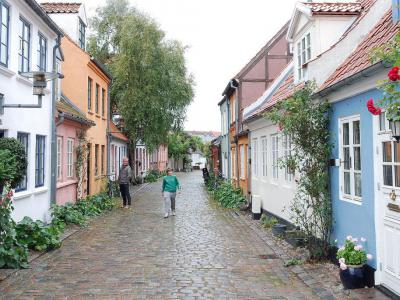
The Mill Path is a historic street in Aarhus. It is a cobblestone street with buildings constructed between 1870 and 1885. However, the street itself has been used in Aarhus since the 13th century.
The name "Mill Path" refers to the Aarhus Mill, which was first mentioned in 1289. The mill was located where the former Aarhus Main Library now stands at the western end of the street.
Sadly, the beautiful homes built in the late 19th century mostly fell into disrepair by 1925. The healthy soil that created an excellent basis for farmland because marshy and tenants were unable to maintain upkeep of the homes. Most of the street remained uninhabitable through 1960 when a renovation plan for the street was put together.
Students and artists moved into the neighborhood during the late 20th century. They painted many of the homes in bright colors, giving it the charm that is seen today. Renovations on the street led to many buildings being removed and replaced with modern structures. What is left is interesting architecture that is a favorite among the visitors to Aarhus.
The name "Mill Path" refers to the Aarhus Mill, which was first mentioned in 1289. The mill was located where the former Aarhus Main Library now stands at the western end of the street.
Sadly, the beautiful homes built in the late 19th century mostly fell into disrepair by 1925. The healthy soil that created an excellent basis for farmland because marshy and tenants were unable to maintain upkeep of the homes. Most of the street remained uninhabitable through 1960 when a renovation plan for the street was put together.
Students and artists moved into the neighborhood during the late 20th century. They painted many of the homes in bright colors, giving it the charm that is seen today. Renovations on the street led to many buildings being removed and replaced with modern structures. What is left is interesting architecture that is a favorite among the visitors to Aarhus.
5) Den Gamle By (Old Town Open-Air Museum) (must see)
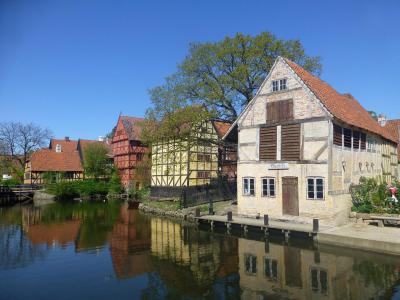
The Old Town Open-Air Museum in Aarhus was the world's first open-air museum of its kind when it opened in 1914. It focuses on the culture of the town with more than 75 historical buildings decorated in historical style and displaying exhibits of permanent and revolving themes.
The buildings in the Old Town Open-Air Museum cover a wide swath of time. Some were constructed in 1550 while others weren't built until the late-19th century. The buildings were brought in from all over the country and placed in the botanical gardens for the purpose of opening this museum.
Buildings located in the open-air museum include workshops, grocers, shops, historical gardens, a post office, a customs office, a school and a theatre. Museum staff work in historic roles like merchants and blacksmiths.
There are five permanent exhibits in the museum. These include the Danish Clock Museum, the Toy Museum, the Textile Museum, a pottery exhibit and a silverware exhibit. Old Town Open-Air Museum also offers a bakery, a bookstore, diners and cafes.
The buildings in the Old Town Open-Air Museum cover a wide swath of time. Some were constructed in 1550 while others weren't built until the late-19th century. The buildings were brought in from all over the country and placed in the botanical gardens for the purpose of opening this museum.
Buildings located in the open-air museum include workshops, grocers, shops, historical gardens, a post office, a customs office, a school and a theatre. Museum staff work in historic roles like merchants and blacksmiths.
There are five permanent exhibits in the museum. These include the Danish Clock Museum, the Toy Museum, the Textile Museum, a pottery exhibit and a silverware exhibit. Old Town Open-Air Museum also offers a bakery, a bookstore, diners and cafes.
6) Infinite Bridge
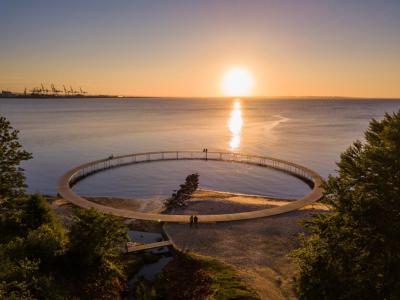
The Infinite Bridge, located in Aarhus, is both a striking architectural achievement and a celebrated piece of public art. Designed by architects Niels Povlsgaard and Johan Gjødes, this circular bathing bridge spirals out into Aarhus Bay from Ballehage Strand, near the Varna Palace and just a few kilometers south of Aarhus city center.
Originally constructed for the ARoS exhibition "Sculpture By The Sea" in 2015, the Infinite Bridge was intended as a temporary installation. Its immediate popularity among visitors and locals alike, however, sparked a movement to make the bridge a permanent fixture. Responding to public demand, the Aarhus City Council in 2017 allocated funds totaling two million kroner for a more durable reconstruction of the bridge, along with an annual budget of 150,000 kroner to dismantle it each autumn and reassemble it in spring.
The bridge was officially re-inaugurated on June 22, 2017, and even hosted a wedding on its first day, highlighting its role as not just an architectural marvel but also a community focal point. Aarhus now offers civil weddings at the bridge, providing couples with unique choices for their ceremony location, whether on the bridge over the water, at its center, or by the beach.
Spanning a diameter of 60 meters and a circumference of 188 meters, the Infinite Bridge is constructed from 4 kilometers of weather-resistant larch planks. It stands securely above the water, supported by 333 meters of pipes driven deep into the seabed. The bridge's 2.4-meter-wide deck offers expansive views and a seamless connection with the surrounding landscape, embodying its name as a seemingly endless loop that blends into the horizon.
Originally constructed for the ARoS exhibition "Sculpture By The Sea" in 2015, the Infinite Bridge was intended as a temporary installation. Its immediate popularity among visitors and locals alike, however, sparked a movement to make the bridge a permanent fixture. Responding to public demand, the Aarhus City Council in 2017 allocated funds totaling two million kroner for a more durable reconstruction of the bridge, along with an annual budget of 150,000 kroner to dismantle it each autumn and reassemble it in spring.
The bridge was officially re-inaugurated on June 22, 2017, and even hosted a wedding on its first day, highlighting its role as not just an architectural marvel but also a community focal point. Aarhus now offers civil weddings at the bridge, providing couples with unique choices for their ceremony location, whether on the bridge over the water, at its center, or by the beach.
Spanning a diameter of 60 meters and a circumference of 188 meters, the Infinite Bridge is constructed from 4 kilometers of weather-resistant larch planks. It stands securely above the water, supported by 333 meters of pipes driven deep into the seabed. The bridge's 2.4-meter-wide deck offers expansive views and a seamless connection with the surrounding landscape, embodying its name as a seemingly endless loop that blends into the horizon.
7) Marselisborg Deer Park
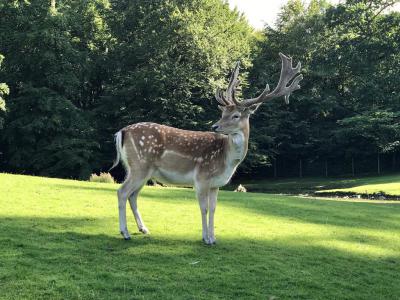
Marselisborg Deer Park (Marselisborg Dyrehave) is a 22-hectare enclosed woodland situated in the northern expanse of the Marselisborg Forests near Aarhus. Unlike typical deer parks designed for hunting, Marselisborg serves more as a miniature safari experience, showcasing native species such as sika deer, roe deer, and wild boars in a natural setting characterized by hilly terrain and sparsely scattered trees.
Established in 1932, the park has been expanded several times and is managed by Aarhus Municipality. It was initially created as a habitat for sika deer to graze on the undulating woodland hills. Over time, the introduction of roe deer and wild boars has diversified the animal population, enhancing the park's ecological dynamics.
Marselisborg Deer Park is open to the public free of charge throughout the year during daylight hours. However, visits are discouraged during certain periods for the safety of both the visitors and the animals. From June to July, the park advises against visits because the female deer are nursing their young calves, making them particularly protective and potentially aggressive. The same applies from September to November, a period marked by mating behaviors where the male deer, especially the sika bucks, can become aggressive due to rutting.
Additionally, the park recommends that visitors avoid the area during stormy weather due to safety concerns posed by old trees, which can drop heavy branches.
By maintaining these precautions, Marselisborg Deer Park ensures the well-being of its wildlife while offering a serene and natural setting for visitors to observe and appreciate local wildlife species in their natural habitat.
Established in 1932, the park has been expanded several times and is managed by Aarhus Municipality. It was initially created as a habitat for sika deer to graze on the undulating woodland hills. Over time, the introduction of roe deer and wild boars has diversified the animal population, enhancing the park's ecological dynamics.
Marselisborg Deer Park is open to the public free of charge throughout the year during daylight hours. However, visits are discouraged during certain periods for the safety of both the visitors and the animals. From June to July, the park advises against visits because the female deer are nursing their young calves, making them particularly protective and potentially aggressive. The same applies from September to November, a period marked by mating behaviors where the male deer, especially the sika bucks, can become aggressive due to rutting.
Additionally, the park recommends that visitors avoid the area during stormy weather due to safety concerns posed by old trees, which can drop heavy branches.
By maintaining these precautions, Marselisborg Deer Park ensures the well-being of its wildlife while offering a serene and natural setting for visitors to observe and appreciate local wildlife species in their natural habitat.
