

Fort of San Diego and Acapulco Historical Museum, Acapulco (must see)
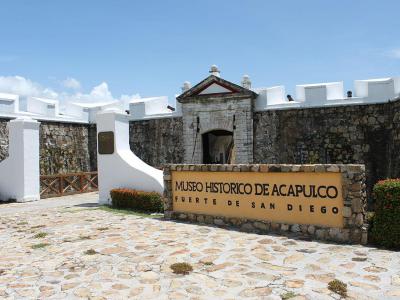
The Fort of San Diego, recognizable for its pentagonal shape, dates back to the 17th century. Built to defend the port and protect valuable cargo arriving by sea, it became one of Spain’s most important strongholds along the Pacific coast. Acapulco was the final stop of the Manila Galleon trade, making the bay a prime target for pirates and foreign fleets.
In 1615, a Dutch fleet attacked Acapulco, causing widespread destruction to both the town and the fort. Later, an earthquake in 1776 severely damaged the structure, but it was rebuilt and fully restored by 1783. The rebuilt fort was redesigned and this was the moment when it took the pentagonal layout-rare in New Spain-to better resist cannon fire and improve defensive lines.
Today, visiting the Fort of San Diego gives you the opportunity to explore the Acapulco Historical Museum, which opened to the public in 1986. Fifteen exhibition rooms guide you through Acapulco’s layered past. During your tour, check out archaeological artifacts from the Mezcala culture, relics from the Manila Galleon trade, exhibits on piracy, and displays related to the Mexican War of Independence. Dedicated sections also explain the fort’s own military role and architectural design.
The museum’s collection offers a comprehensive look at Acapulco’s cultural and commercial development, including impressive displays of early trade connections with Asia dating from 1450 to 1600. All signage is presented in both Spanish and English, so you have clear access to information.
After exploring the museum rooms, don’t forget to admire the beautiful views over Acapulco Bay from the upper terraces, which make the Fort of San Diego one of the city’s most remarkable landmarks.
In 1615, a Dutch fleet attacked Acapulco, causing widespread destruction to both the town and the fort. Later, an earthquake in 1776 severely damaged the structure, but it was rebuilt and fully restored by 1783. The rebuilt fort was redesigned and this was the moment when it took the pentagonal layout-rare in New Spain-to better resist cannon fire and improve defensive lines.
Today, visiting the Fort of San Diego gives you the opportunity to explore the Acapulco Historical Museum, which opened to the public in 1986. Fifteen exhibition rooms guide you through Acapulco’s layered past. During your tour, check out archaeological artifacts from the Mezcala culture, relics from the Manila Galleon trade, exhibits on piracy, and displays related to the Mexican War of Independence. Dedicated sections also explain the fort’s own military role and architectural design.
The museum’s collection offers a comprehensive look at Acapulco’s cultural and commercial development, including impressive displays of early trade connections with Asia dating from 1450 to 1600. All signage is presented in both Spanish and English, so you have clear access to information.
After exploring the museum rooms, don’t forget to admire the beautiful views over Acapulco Bay from the upper terraces, which make the Fort of San Diego one of the city’s most remarkable landmarks.
Want to visit this sight? Check out these Self-Guided Walking Tours in Acapulco. Alternatively, you can download the mobile app "GPSmyCity: Walks in 1K+ Cities" from Apple App Store or Google Play Store. The app turns your mobile device to a personal tour guide and it works offline, so no data plan is needed when traveling abroad.
Download The GPSmyCity App



Fort of San Diego and Acapulco Historical Museum on Map
Sight Name: Fort of San Diego and Acapulco Historical Museum
Sight Location: Acapulco, Mexico (See walking tours in Acapulco)
Sight Type: Museum/Gallery
Guide(s) Containing This Sight:
Sight Location: Acapulco, Mexico (See walking tours in Acapulco)
Sight Type: Museum/Gallery
Guide(s) Containing This Sight:
Nearby Sights





Walking Tours in Acapulco, Mexico

Create Your Own Walk in Acapulco
Creating your own self-guided walk in Acapulco is easy and fun. Choose the city attractions that you want to see and a walk route map will be created just for you. You can even set your hotel as the start point of the walk.
Acapulco's Top Attractions Walking Tour
When the German geographer Alexander von Humboldt arrived in 1803, he called Acapulco “one of the most beautiful harbors in the world.”
Acapulco’s name comes from a Nahuatl word often translated as “place of reeds”, reflecting its early landscape. Long before it became a resort city, Acapulco was home to Nahua-speaking communities and formed part of pre-Hispanic trade networks along... view more
Tour Duration: 2 Hour(s)
Travel Distance: 3.6 Km or 2.2 Miles
Acapulco’s name comes from a Nahuatl word often translated as “place of reeds”, reflecting its early landscape. Long before it became a resort city, Acapulco was home to Nahua-speaking communities and formed part of pre-Hispanic trade networks along... view more
Tour Duration: 2 Hour(s)
Travel Distance: 3.6 Km or 2.2 Miles