

Audio Guide: Acapulco Introduction Walking Tour (Self Guided), Acapulco
When the German geographer Alexander von Humboldt arrived in 1803, he called Acapulco “one of the most beautiful harbors in the world.”
Acapulco’s name comes from a Nahuatl word often translated as “place of reeds”, reflecting its early landscape. Long before it became a resort city, Acapulco was home to Nahua-speaking communities and formed part of pre-Hispanic trade networks along the Pacific coast. Its naturally sheltered bay, deep enough for large vessels, made it an ideal maritime hub even in pre-colonial times.
Spanish forces reached the area in the early 1530s, recognizing both its strategic location and its protected harbor. From the late 16th century onward, it served as the Mexican terminal of the Manila Galleon trade, linking Asia and the Americas across the Pacific. For over 250 years, luxury goods such as silk, porcelain, and spices flowed into New Spain, the colonial Spanish territories in North and Central America, the Caribbean and the Philippines.
Following Mexico’s independence in 1821, Acapulco remained an important maritime gateway, though the galleon trade had already ended. The city developed slowly through the 19th century, shaped by regional instability and conflicts during the Reform War and the French Intervention. Its economy relied on coastal commerce, fishing, and small-scale agriculture.
In the mid-20th century, new infrastructure—including a highway to Mexico City—opened Acapulco to tourism. By the 1940s and 1950s, the bay had become a magnet for international glamour, drawing film stars, politicians, and wealthy travelers.
A walk through Acapulco’s historic center reveals a blend of colonial traces and coastal atmosphere. Visitors encounter the Plaza Álvarez, shaded by palms and lined with cafes, facing the Our Lady of Solitude Cathedral, with its domed, Byzantine-inspired towers. Nearby streets lead to market stalls, souvenir shops, and colorful murals capturing local culture. Not far away stands the star-shaped Fort of San Diego, overlooking the bay. The waterfront promenade offers sea views, passing boats, and echoes of Acapulco’s golden age.
And just as Humboldt once stood here in awe, you may find that Acapulco’s harbor still has the power to astonish—beautiful, storied, and ever alive with movement.
Acapulco’s name comes from a Nahuatl word often translated as “place of reeds”, reflecting its early landscape. Long before it became a resort city, Acapulco was home to Nahua-speaking communities and formed part of pre-Hispanic trade networks along the Pacific coast. Its naturally sheltered bay, deep enough for large vessels, made it an ideal maritime hub even in pre-colonial times.
Spanish forces reached the area in the early 1530s, recognizing both its strategic location and its protected harbor. From the late 16th century onward, it served as the Mexican terminal of the Manila Galleon trade, linking Asia and the Americas across the Pacific. For over 250 years, luxury goods such as silk, porcelain, and spices flowed into New Spain, the colonial Spanish territories in North and Central America, the Caribbean and the Philippines.
Following Mexico’s independence in 1821, Acapulco remained an important maritime gateway, though the galleon trade had already ended. The city developed slowly through the 19th century, shaped by regional instability and conflicts during the Reform War and the French Intervention. Its economy relied on coastal commerce, fishing, and small-scale agriculture.
In the mid-20th century, new infrastructure—including a highway to Mexico City—opened Acapulco to tourism. By the 1940s and 1950s, the bay had become a magnet for international glamour, drawing film stars, politicians, and wealthy travelers.
A walk through Acapulco’s historic center reveals a blend of colonial traces and coastal atmosphere. Visitors encounter the Plaza Álvarez, shaded by palms and lined with cafes, facing the Our Lady of Solitude Cathedral, with its domed, Byzantine-inspired towers. Nearby streets lead to market stalls, souvenir shops, and colorful murals capturing local culture. Not far away stands the star-shaped Fort of San Diego, overlooking the bay. The waterfront promenade offers sea views, passing boats, and echoes of Acapulco’s golden age.
And just as Humboldt once stood here in awe, you may find that Acapulco’s harbor still has the power to astonish—beautiful, storied, and ever alive with movement.
How it works: Download the app "GPSmyCity: Walks in 1K+ Cities" from Apple App Store or Google Play Store to your mobile phone or tablet. The app turns your mobile device into a personal tour guide and its built-in GPS navigation functions guide you from one tour stop to next. The app works offline, so no data plan is needed when traveling abroad.
Acapulco Introduction Walking Tour Map
Guide Name: Acapulco Introduction Walking Tour
Guide Location: Mexico » Acapulco (See other walking tours in Acapulco)
Guide Type: Self-guided Walking Tour (Sightseeing)
# of Attractions: 9
Tour Duration: 2 Hour(s)
Travel Distance: 3.6 Km or 2.2 Miles
Author: irenes
Sight(s) Featured in This Guide:
Guide Location: Mexico » Acapulco (See other walking tours in Acapulco)
Guide Type: Self-guided Walking Tour (Sightseeing)
# of Attractions: 9
Tour Duration: 2 Hour(s)
Travel Distance: 3.6 Km or 2.2 Miles
Author: irenes
Sight(s) Featured in This Guide:
- Fort of San Diego and Acapulco Historical Museum
- House of the Masks
- Catedral de Nuestra Senora de la Soledad (Our Lady of Solitude Cathedral)
- Zocalo (Plaza Alvarez)
- Tlacopanocha Beach
- Costera Miguel Aleman Avenue
- Diego Rivera Mural
- Sinfonia del Mar (Symphony of the Sea)
- La Quebrada (The Gulch Cliff Divers)
1) Fort of San Diego and Acapulco Historical Museum (must see)
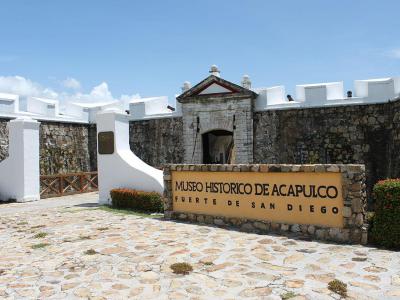
The Fort of San Diego, recognizable for its pentagonal shape, dates back to the 17th century. Built to defend the port and protect valuable cargo arriving by sea, it became one of Spain’s most important strongholds along the Pacific coast. Acapulco was the final stop of the Manila Galleon trade, making the bay a prime target for pirates and foreign fleets.
In 1615, a Dutch fleet attacked Acapulco, causing widespread destruction to both the town and the fort. Later, an earthquake in 1776 severely damaged the structure, but it was rebuilt and fully restored by 1783. The rebuilt fort was redesigned and this was the moment when it took the pentagonal layout—rare in New Spain—to better resist cannon fire and improve defensive lines.
Today, visiting the Fort of San Diego gives you the opportunity to explore the Acapulco Historical Museum, which opened to the public in 1986. Fifteen exhibition rooms guide you through Acapulco’s layered past. During your tour, check out archaeological artifacts from the Mezcala culture, relics from the Manila Galleon trade, exhibits on piracy, and displays related to the Mexican War of Independence. Dedicated sections also explain the fort’s own military role and architectural design.
The museum’s collection offers a comprehensive look at Acapulco’s cultural and commercial development, including impressive displays of early trade connections with Asia dating from 1450 to 1600. All signage is presented in both Spanish and English, so you have clear access to information.
After exploring the museum rooms, don’t forget to admire the beautiful views over Acapulco Bay from the upper terraces, which make the Fort of San Diego one of the city’s most remarkable landmarks.
In 1615, a Dutch fleet attacked Acapulco, causing widespread destruction to both the town and the fort. Later, an earthquake in 1776 severely damaged the structure, but it was rebuilt and fully restored by 1783. The rebuilt fort was redesigned and this was the moment when it took the pentagonal layout—rare in New Spain—to better resist cannon fire and improve defensive lines.
Today, visiting the Fort of San Diego gives you the opportunity to explore the Acapulco Historical Museum, which opened to the public in 1986. Fifteen exhibition rooms guide you through Acapulco’s layered past. During your tour, check out archaeological artifacts from the Mezcala culture, relics from the Manila Galleon trade, exhibits on piracy, and displays related to the Mexican War of Independence. Dedicated sections also explain the fort’s own military role and architectural design.
The museum’s collection offers a comprehensive look at Acapulco’s cultural and commercial development, including impressive displays of early trade connections with Asia dating from 1450 to 1600. All signage is presented in both Spanish and English, so you have clear access to information.
After exploring the museum rooms, don’t forget to admire the beautiful views over Acapulco Bay from the upper terraces, which make the Fort of San Diego one of the city’s most remarkable landmarks.
2) House of the Masks
The Mask Museum is a remarkable testament to Mexican artistry and cultural expression. Originally built as a traditional Mexican-style residence, this historic building has since been transformed into a captivating museum dedicated to one of the country’s most symbolic art forms: the mask. Today, it houses over 500 pieces, each reflecting a different region, ritual, or artistic tradition.
The museum’s collection spans a wide range of styles and purposes. Visitors will find ceremonial masks used in pre-Hispanic religious rites, characters from popular festivals, and theatrical masks inspired by regional dance traditions. Some pieces are made from carved wood and painted by hand, while others incorporate leather, clay, layered paper, or even animal hair. Many masks represent animals, deities, or mythic figures, revealing the deep interplay between art, identity, and storytelling in Mexican culture.
One of the museum’s highlights is its emphasis on living tradition. Several masks come from communities that still use them today during events such as the Dance of the Concheros, the Dance of the Little Old Men, or the famous Devils' Dance. Each object has its own symbolism, often tied to ideas of transformation, protection, or spiritual presence.
The museum’s collection spans a wide range of styles and purposes. Visitors will find ceremonial masks used in pre-Hispanic religious rites, characters from popular festivals, and theatrical masks inspired by regional dance traditions. Some pieces are made from carved wood and painted by hand, while others incorporate leather, clay, layered paper, or even animal hair. Many masks represent animals, deities, or mythic figures, revealing the deep interplay between art, identity, and storytelling in Mexican culture.
One of the museum’s highlights is its emphasis on living tradition. Several masks come from communities that still use them today during events such as the Dance of the Concheros, the Dance of the Little Old Men, or the famous Devils' Dance. Each object has its own symbolism, often tied to ideas of transformation, protection, or spiritual presence.
3) Catedral de Nuestra Senora de la Soledad (Our Lady of Solitude Cathedral) (must see)
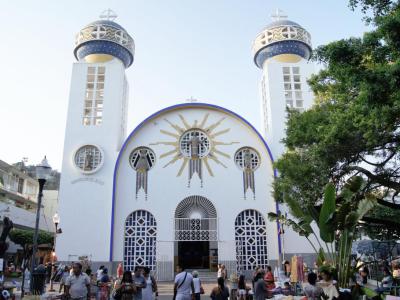
Originally constructed in the 1950s, Our Lady of Solitude Cathedral is one of Acapulco’s most recognizable landmarks. Its architecture blends Moorish, Spanish, and local influences, giving it a distinctive look uncommon in Mexican coastal cities. Remarkably, the building was first created as a film set before being adapted into a functioning place of worship. It was officially designated as Acapulco’s cathedral in 1958.
When visiting the cathedral, please pay attention to its blue-tiled dome in the center and the two Byzantine-style towers, which give it an appearance reminiscent of Mediterranean and Islamic architecture. Because of its unusual style, some visitors mistakenly thought the church was a mosque. Another feature you will notice is the facade, decorated with blue and gold mosaics and tiles. One much-photographed detail is the star-shaped lantern atop the dome.
After you admire its architecture, come inside to see the blue tiles and golden mosaics above and around the main altar, inside the dome, and along decorative panels behind liturgical elements. One of the key devotional items is the image of Our Lady of Solitude—the cathedral’s namesake—which sits behind the main altar, set against a deep-blue background and centered under the dome. Along the transept and side walls, you will see statues of various saints, including Saint Jude, Saint Anthony of Padua, and the Sacred Heart of Jesus.
Tip:
An excellent vocal choir performs during Sunday services—an ideal moment to experience the cathedral both musically and spiritually.
When visiting the cathedral, please pay attention to its blue-tiled dome in the center and the two Byzantine-style towers, which give it an appearance reminiscent of Mediterranean and Islamic architecture. Because of its unusual style, some visitors mistakenly thought the church was a mosque. Another feature you will notice is the facade, decorated with blue and gold mosaics and tiles. One much-photographed detail is the star-shaped lantern atop the dome.
After you admire its architecture, come inside to see the blue tiles and golden mosaics above and around the main altar, inside the dome, and along decorative panels behind liturgical elements. One of the key devotional items is the image of Our Lady of Solitude—the cathedral’s namesake—which sits behind the main altar, set against a deep-blue background and centered under the dome. Along the transept and side walls, you will see statues of various saints, including Saint Jude, Saint Anthony of Padua, and the Sacred Heart of Jesus.
Tip:
An excellent vocal choir performs during Sunday services—an ideal moment to experience the cathedral both musically and spiritually.
4) Zocalo (Plaza Alvarez) (must see)
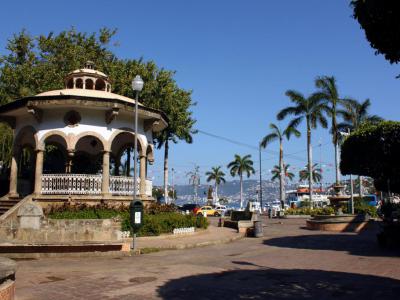
Long before the beaches and hotel towers, the city gathered around Plaza Álvarez, the city’s main public square. The plaza dates back to the 19th century and was officially named after Juan Álvarez, a key figure in Mexico’s independence and later president of the Republic.
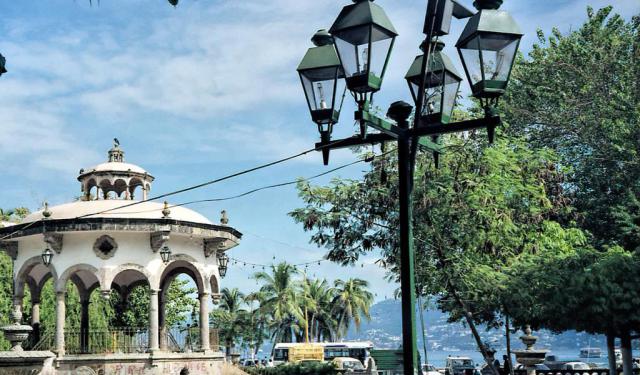
One of the square’s characteristics is the shade provided by a canopy of trees, dotted with fountains and benches. Craft and souvenir stalls line portions of the square, selling locally made goods and regional artworks. Street-food vendors and cafes join the mix, immersing you in the rhythm of everyday Acapulcan life. In the mid-20th century, the plaza was a favorite hangout for Hollywood stars vacationing in Acapulco.
As you wander across the square, you’ll likely find yourself drawn to the small cluster of cafés and eateries that line its edges. Mi Piacci Italian Café is one of the long-standing favorites. From the central open area, look toward the northern side of the plaza, where a row of cafés and small shops borders the shaded edge. Mi Piacci sits along this perimeter, facing the trees and fountains.
Take a moment to look at the bronze statue of General Juan Álvarez at the center of the square, the 19th-century independence hero after whom the plaza is named. On Friday evenings from 6 to 8 pm, come here to see how the square comes alive with live orchestra music and ballroom dancing. And don’t forget to stroll over to the boardwalk—it’s just steps away and perfect for watching the bay shift colors at sunset.
One of the square’s characteristics is the shade provided by a canopy of trees, dotted with fountains and benches. Craft and souvenir stalls line portions of the square, selling locally made goods and regional artworks. Street-food vendors and cafes join the mix, immersing you in the rhythm of everyday Acapulcan life. In the mid-20th century, the plaza was a favorite hangout for Hollywood stars vacationing in Acapulco.
As you wander across the square, you’ll likely find yourself drawn to the small cluster of cafés and eateries that line its edges. Mi Piacci Italian Café is one of the long-standing favorites. From the central open area, look toward the northern side of the plaza, where a row of cafés and small shops borders the shaded edge. Mi Piacci sits along this perimeter, facing the trees and fountains.
Take a moment to look at the bronze statue of General Juan Álvarez at the center of the square, the 19th-century independence hero after whom the plaza is named. On Friday evenings from 6 to 8 pm, come here to see how the square comes alive with live orchestra music and ballroom dancing. And don’t forget to stroll over to the boardwalk—it’s just steps away and perfect for watching the bay shift colors at sunset.
5) Tlacopanocha Beach
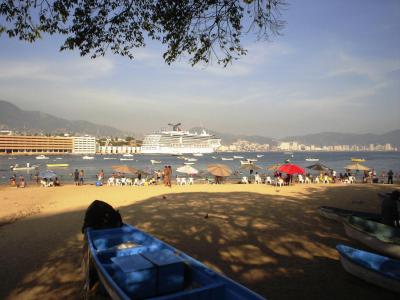
Tlacopanocha Beach offers a charm distinct from the city’s more commercially popular beaches. This small stretch of sand is an integral part of Acapulco Tradicional, a district known for preserving the historic character of the port. While Tlacopanocha may not be the top choice for swimming due to its modest size and busy surroundings, it serves as an important hub for bay cruises and a vantage point for observing local maritime activity.
It is easily accessible for visitors exploring Acapulco’s traditional center, spanning approximately 100 meters. Despite its urban backdrop, the water is calm, with gentle waves similar to those at nearby Caleta and Caletilla beaches—an appealing feature for families with children or older adults seeking a peaceful beach experience without traveling far from central amenities.
Tlacopanocha is also a focal point for local fishermen. A variety of boats—ranging from small outboard vessels to larger sport-fishing yachts—are often moored nearby. Visitors can watch fishermen bring in their catch or even join fishing trips, creating a more immersive experience than the typical day at the beach.
It is easily accessible for visitors exploring Acapulco’s traditional center, spanning approximately 100 meters. Despite its urban backdrop, the water is calm, with gentle waves similar to those at nearby Caleta and Caletilla beaches—an appealing feature for families with children or older adults seeking a peaceful beach experience without traveling far from central amenities.
Tlacopanocha is also a focal point for local fishermen. A variety of boats—ranging from small outboard vessels to larger sport-fishing yachts—are often moored nearby. Visitors can watch fishermen bring in their catch or even join fishing trips, creating a more immersive experience than the typical day at the beach.
6) Costera Miguel Aleman Avenue (must see)
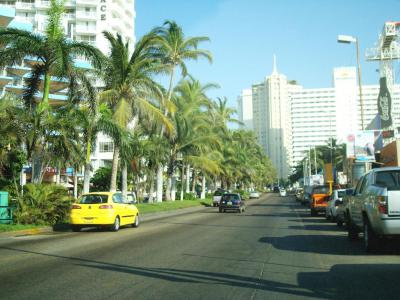
If you want to feel the local atmosphere of Acapulco, visit Costera Miguel Alemán Avenue, the main road that leads you through the port of Acapulco. Along its 12.2-kilometer stretch, you can explore the traditional neighborhoods of the old port alongside the modern hotel zones that later defined the city’s international fame. As the principal coastal boulevard, it offers views of the bay and serves as the backbone of Acapulco’s urban and tourist life.
Along the avenue, you encounter a dense concentration of hotels, high-rise condominiums, restaurants, nightclubs, shopping centers, supermarkets, and other essential services. If you continue east along Costera Miguel Alemán, you’ll see Manzanillo Beach on your right, to the south, opening into a sheltered curve of sand where fishing boats rest along the shore.
A little farther east on the same side, Fisherman’s Walk continues along the waterfront, giving you close-up views of daily port life and the boats coming in and out. People with a sweet tooth may want to visit Dulcemare, a small beachfront café known for its ice creams, pastries, and casual snacks. To get there, simply keep walking eastward along Fisherman’s Walk, staying on the right-hand, seaside edge of the promenade. As soon as you notice the line of small waterfront stalls and businesses above the sand, look for the café’s sign.
The avenue was officially named in honor of President Miguel Alemán Valdés, whose administration invested heavily in tourism infrastructure. The construction of the Costera as we know it began in earnest in 1947, when the first major rock cuts were made to set a permanent route. The new segment, built nearly at sea level, dramatically improved access to the traditional beach district, enabling the rapid development of the hotel zone and solidifying Costera Miguel Alemán as one of Mexico’s most famous coastal boulevards.
Along the avenue, you encounter a dense concentration of hotels, high-rise condominiums, restaurants, nightclubs, shopping centers, supermarkets, and other essential services. If you continue east along Costera Miguel Alemán, you’ll see Manzanillo Beach on your right, to the south, opening into a sheltered curve of sand where fishing boats rest along the shore.
A little farther east on the same side, Fisherman’s Walk continues along the waterfront, giving you close-up views of daily port life and the boats coming in and out. People with a sweet tooth may want to visit Dulcemare, a small beachfront café known for its ice creams, pastries, and casual snacks. To get there, simply keep walking eastward along Fisherman’s Walk, staying on the right-hand, seaside edge of the promenade. As soon as you notice the line of small waterfront stalls and businesses above the sand, look for the café’s sign.
The avenue was officially named in honor of President Miguel Alemán Valdés, whose administration invested heavily in tourism infrastructure. The construction of the Costera as we know it began in earnest in 1947, when the first major rock cuts were made to set a permanent route. The new segment, built nearly at sea level, dramatically improved access to the traditional beach district, enabling the rapid development of the hotel zone and solidifying Costera Miguel Alemán as one of Mexico’s most famous coastal boulevards.
7) Diego Rivera Mural (must see)
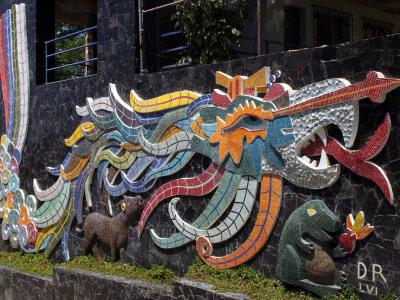
You want to see one of Acapulco’s most cherished cultural treasures? Then go visit the Diego Rivera Mural. Created in 1956, it was installed on the facade of a house in the traditional neighborhood of La Quebrada. The mural immediately draws attention with its vivid colors and meticulous craftsmanship. It is composed of thousands of stones, seashells, and multicolored mosaics, assembled directly onto the curved surface of the building.
Its creator, Diego Rivera, was one of Mexico’s most influential artists—renowned for his monumental murals, political themes, and bold, modernist style. Rivera designed this monumental work as a gift for his close friend and patron, actress Dolores Olmedo, during a period when he frequently visited Acapulco to recover his health and enjoy the Pacific climate.
At the center of the mural is Quetzalcóatl, often called the Feathered Serpent—a major god in ancient Mexican cultures. He represents wisdom, creativity, and the renewal of life. Rivera shows him as a large snake with colorful feathers, a combination that symbolized both the earth— the serpent and the sky— the feathers. As you admire it, you can see the way Rivera arranges the colors and curves makes the figure appear as if it is lifting from the wall.
Surrounding Quetzalcóatl is a striking sphinx—a creature more commonly associated with Egyptian mythology. Rivera introduced this figure deliberately, blending Mesoamerican and Mediterranean iconography to highlight the parallels he saw between the world’s ancient civilizations.
Another interesting fact is that this piece is one of Rivera’s final major works, created only a year before his death in 1957. Unlike his well-known frescoes in Mexico City, Detroit, or San Francisco, this mural exists in a private residential setting, on "House of the Winds", which adds to its unique charm. Despite its location, you can check out the mural from the street.
Its creator, Diego Rivera, was one of Mexico’s most influential artists—renowned for his monumental murals, political themes, and bold, modernist style. Rivera designed this monumental work as a gift for his close friend and patron, actress Dolores Olmedo, during a period when he frequently visited Acapulco to recover his health and enjoy the Pacific climate.
At the center of the mural is Quetzalcóatl, often called the Feathered Serpent—a major god in ancient Mexican cultures. He represents wisdom, creativity, and the renewal of life. Rivera shows him as a large snake with colorful feathers, a combination that symbolized both the earth— the serpent and the sky— the feathers. As you admire it, you can see the way Rivera arranges the colors and curves makes the figure appear as if it is lifting from the wall.
Surrounding Quetzalcóatl is a striking sphinx—a creature more commonly associated with Egyptian mythology. Rivera introduced this figure deliberately, blending Mesoamerican and Mediterranean iconography to highlight the parallels he saw between the world’s ancient civilizations.
Another interesting fact is that this piece is one of Rivera’s final major works, created only a year before his death in 1957. Unlike his well-known frescoes in Mexico City, Detroit, or San Francisco, this mural exists in a private residential setting, on "House of the Winds", which adds to its unique charm. Despite its location, you can check out the mural from the street.
8) Sinfonia del Mar (Symphony of the Sea)
For the ones interested in broad views over the Pacific, check Symphony of the Sea—a historic open-air amphitheater. Built in the mid-20th century, it was designed as a cultural venue during the period when Acapulco was emerging as an international resort. Although performances are held here from time to time, most visitors come for the scenery rather than the stage events.
Located close to the famous La Quebrada Cliffs, Symphony of the Sea provides a convenient vantage point for observing the coastline. The elevated terraces allow clear views of the bay, the cliffs, and the open ocean. A curiosity worth noting is that the amphitheater’s name was inspired not by music, but by the sound of the waves echoing from below, which early visitors described as resembling a natural “symphony”.
The site also reflects Acapulco’s mid-century push to combine cultural attractions with outdoor public spaces. Over the years, it has hosted everything from community events to small concerts and civic ceremonies, though today it functions mainly as a viewpoint.
Tip:
Both the seating and the sunset are free to enjoy. Arriving about an hour before sunset allows time to take in the nearby cliffs before the light begins to change.
Located close to the famous La Quebrada Cliffs, Symphony of the Sea provides a convenient vantage point for observing the coastline. The elevated terraces allow clear views of the bay, the cliffs, and the open ocean. A curiosity worth noting is that the amphitheater’s name was inspired not by music, but by the sound of the waves echoing from below, which early visitors described as resembling a natural “symphony”.
The site also reflects Acapulco’s mid-century push to combine cultural attractions with outdoor public spaces. Over the years, it has hosted everything from community events to small concerts and civic ceremonies, though today it functions mainly as a viewpoint.
Tip:
Both the seating and the sunset are free to enjoy. Arriving about an hour before sunset allows time to take in the nearby cliffs before the light begins to change.
9) La Quebrada (The Gulch Cliff Divers) (must see)
Have you ever thought that somewhere in the world there are skilled professionals captivating audiences each day with breathtaking displays of courage—diving from towering cliffs straight into the open sea? The Gulch Cliff Divers are exactly that: a group of highly trained high divers who perform daily shows for the public, leaping from heights of approximately 35 meters. Each dive demands precise timing and expert judgment, as the divers must wait for the perfect moment to jump, coordinating their descent with the incoming waves to avoid serious injury.
The depth of the water in the “Gulch” varies dramatically, ranging from 6 to 16 feet depending on the waves, with an average depth of about 12 feet. Despite these constantly changing conditions, the cliff divers demonstrate exceptional control and bravery, executing their dives with impressive precision. Spectators not only witness the breathtaking jumps but also enjoy the natural beauty of the surrounding landscape, where pelicans are often seen diving for fish in the waters below.
The Gulch Cliff Divers have been thrilling audiences since 1934 and have become one of Acapulco’s most iconic attractions. Their international fame grew after appearing in the 1963 film "Fun in Acapulco" starring Elvis Presley, which introduced their extraordinary talent to viewers around the world. Today, visitors to Acapulco can still experience the unforgettable spectacle of The Gulch Cliff Divers—an event that blends adrenaline, skill, and the dramatic backdrop of the Mexican coastline.
Tip:
You can watch the divers for free from the roadside, pay a small fee to view the divers from a lower platform, or choose the premium option at La Perla restaurant for an elevated vantage point. There are performances during the day as well as a nighttime session.
The depth of the water in the “Gulch” varies dramatically, ranging from 6 to 16 feet depending on the waves, with an average depth of about 12 feet. Despite these constantly changing conditions, the cliff divers demonstrate exceptional control and bravery, executing their dives with impressive precision. Spectators not only witness the breathtaking jumps but also enjoy the natural beauty of the surrounding landscape, where pelicans are often seen diving for fish in the waters below.
The Gulch Cliff Divers have been thrilling audiences since 1934 and have become one of Acapulco’s most iconic attractions. Their international fame grew after appearing in the 1963 film "Fun in Acapulco" starring Elvis Presley, which introduced their extraordinary talent to viewers around the world. Today, visitors to Acapulco can still experience the unforgettable spectacle of The Gulch Cliff Divers—an event that blends adrenaline, skill, and the dramatic backdrop of the Mexican coastline.
Tip:
You can watch the divers for free from the roadside, pay a small fee to view the divers from a lower platform, or choose the premium option at La Perla restaurant for an elevated vantage point. There are performances during the day as well as a nighttime session.
The Most Popular Cities
/ view all