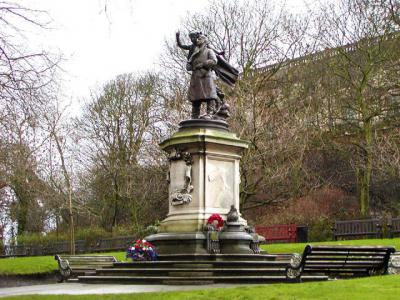


Albert Ball V.C. Statue, Nottingham
The Albert Ball V.C. Statue stands proudly in the gardens of Nottingham Castle, honoring one of Britain’s most celebrated First World War flying aces. This striking bronze sculpture, created by artist Henry Poole and unveiled in 1921, commemorates Captain Albert Ball, VC, DSO & Two Bars, MC-a Nottingham-born pilot whose bravery and skill earned him widespread acclaim, including praise from the Red Baron himself.
The memorial features Ball in full flying uniform, gazing skyward, his hands resting on his belt. Behind him, a robed female allegorical figure-symbolizing "Air"-places one hand on his shoulder and gestures upward with the other. This composition echoes religious imagery of ascension and sainthood, blending heroism with the spiritual. The figure stands on a Portland stone pedestal, designed by Edwin Alfred Rickards, adorned with bronze reliefs of Ball’s S.E.5a biplane flying over trenches and clouds. Inscriptions on the plinth include the Royal Air Force motto: Per ardua ad astra-“By labor to the stars.”
Born in 1896, Ball joined the Sherwood Foresters before transferring to the Royal Flying Corps, where he rapidly distinguished himself with 44 confirmed victories. Posthumously awarded the Victoria Cross after he died in 1917, he is also remembered with French and Russian honors. The statue, commissioned by Nottingham City Council and funded through public subscription, is now Grade I listed, surrounded by other notable memorials on the castle grounds.
A symbol of courage and national pride, the statue even inspired the song Brave Captain by progressive rock band Big Big Train, a nod to a local hero who soared, quite literally, to the stars.
The memorial features Ball in full flying uniform, gazing skyward, his hands resting on his belt. Behind him, a robed female allegorical figure-symbolizing "Air"-places one hand on his shoulder and gestures upward with the other. This composition echoes religious imagery of ascension and sainthood, blending heroism with the spiritual. The figure stands on a Portland stone pedestal, designed by Edwin Alfred Rickards, adorned with bronze reliefs of Ball’s S.E.5a biplane flying over trenches and clouds. Inscriptions on the plinth include the Royal Air Force motto: Per ardua ad astra-“By labor to the stars.”
Born in 1896, Ball joined the Sherwood Foresters before transferring to the Royal Flying Corps, where he rapidly distinguished himself with 44 confirmed victories. Posthumously awarded the Victoria Cross after he died in 1917, he is also remembered with French and Russian honors. The statue, commissioned by Nottingham City Council and funded through public subscription, is now Grade I listed, surrounded by other notable memorials on the castle grounds.
A symbol of courage and national pride, the statue even inspired the song Brave Captain by progressive rock band Big Big Train, a nod to a local hero who soared, quite literally, to the stars.
Want to visit this sight? Check out these Self-Guided Walking Tours in Nottingham. Alternatively, you can download the mobile app "GPSmyCity: Walks in 1K+ Cities" from Apple App Store or Google Play Store. The app turns your mobile device to a personal tour guide and it works offline, so no data plan is needed when traveling abroad.
Download The GPSmyCity App



Albert Ball V.C. Statue on Map
Sight Name: Albert Ball V.C. Statue
Sight Location: Nottingham, England (See walking tours in Nottingham)
Sight Type: Attraction/Landmark
Sight Location: Nottingham, England (See walking tours in Nottingham)
Sight Type: Attraction/Landmark
Nearby Sights
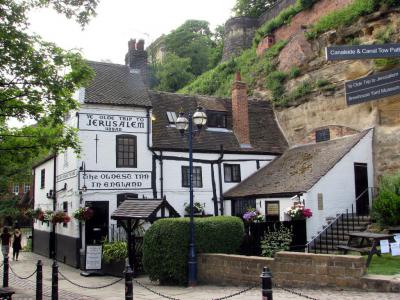
Walking Tours in Nottingham, England

Create Your Own Walk in Nottingham
Creating your own self-guided walk in Nottingham is easy and fun. Choose the city attractions that you want to see and a walk route map will be created just for you. You can even set your hotel as the start point of the walk.
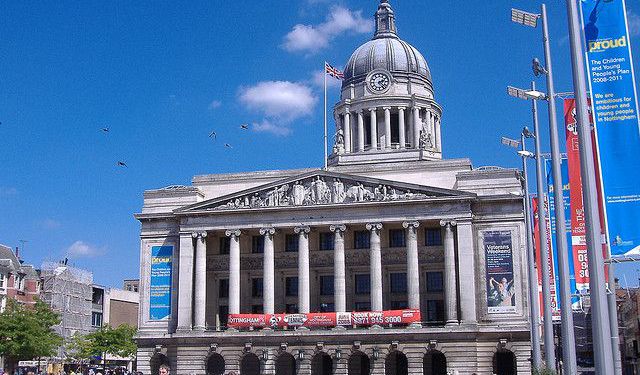
Nottingham's Historical Buildings Tour
Given the variety of architectural styles and designs in Nottingham, England, it is safe to call it the city of contrasts. The tapestry of historical buildings found here, each weaving a unique story of the city's past, is quite rich and worthy of attention.
Among these architectural treasures is the Bell Inn, a charming establishment steeped in history and character. Its traditional... view more
Tour Duration: 2 Hours
Travel Distance: 3.9 Km or 2.4 Miles
Among these architectural treasures is the Bell Inn, a charming establishment steeped in history and character. Its traditional... view more
Tour Duration: 2 Hours
Travel Distance: 3.9 Km or 2.4 Miles
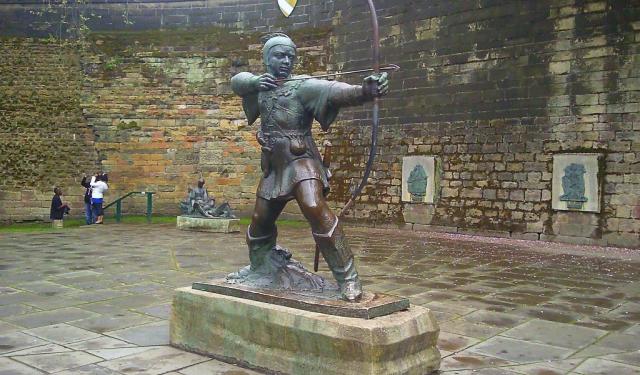
Robin Hood Trail
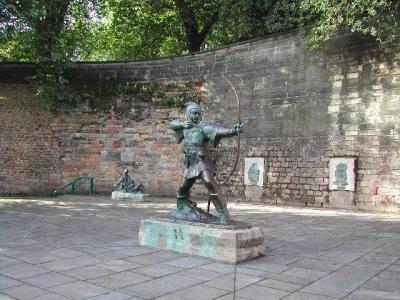
There's hardly anyone on this planet who hasn't heard of Robin Hood. Apparently, a Saxon nobleman born in 1160 in Loxley, this hero of numerous ballads, some dating back as far as the 14th century, earned fame by robbing from the rich and giving it back to the poor. A skilled archer and sword fighter as he was, Robin Hood famously defended villagers from attacks by corrupt noblemen,... view more
Tour Duration: 1 Hour
Travel Distance: 1.5 Km or 0.9 Miles
Tour Duration: 1 Hour
Travel Distance: 1.5 Km or 0.9 Miles
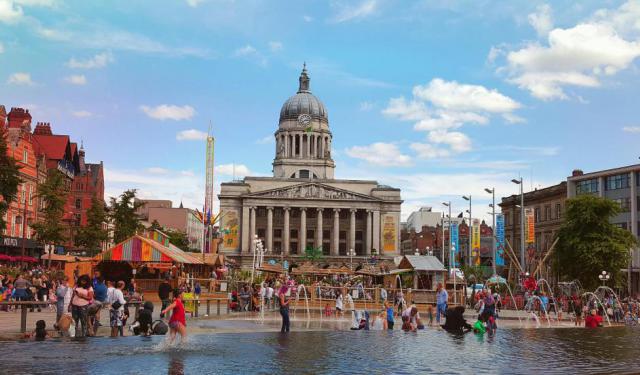
Nottingham's Historic City Center Walking Tour
Nottingham was known only as "The Place of Caves" in 600 AD. A Saxon chief named Snot ruled "Snotingaham", or, "the home of Snot's people." It was part of Danelaw in the 7th century, administered from a stone Hall on High Pavement, the first street of Nottingham.
In 1068 Norman invaders built a wooden motte-and-bailey fortress on a high sandstone promontory.... view more
Tour Duration: 2 Hours
Travel Distance: 2.5 Km or 1.6 Miles
In 1068 Norman invaders built a wooden motte-and-bailey fortress on a high sandstone promontory.... view more
Tour Duration: 2 Hours
Travel Distance: 2.5 Km or 1.6 Miles