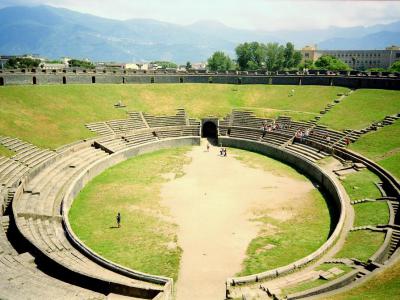


Amphitheater, Pompei
The Amphitheater of Pompeii, built around 70 BC, is the oldest surviving Roman amphitheater and one of the earliest known stone arenas in the Roman world. Originally known as the Spectacula, it was funded by two wealthy local officials, Quinctius Valgus and Marcius Porcius, after Pompeii became a Roman colony. With room for roughly 20,000 spectators, it could hold more people than the city itself.
Walk forward from the perimeter gates into the main body of the structure to find the centre of the arena floor. Here, ancient architects dug directly into the ground to form the central performance space. Historic accounts describe the arena as the site of fierce gladiator fights, ceremonies, animal hunts, and athletic contests. Unlike later Roman amphitheaters, it lacked elaborate underground trapdoors and service corridors.
For the next highlight, exit the interior and go around the outside of the building to the massive support walls along the western and eastern perimeters. Built directly into the outer support structures are the double-tiered external staircases. Their symmetrical stone steps, supported by heavy stone arches, allowed thousands of ordinary citizens to ascend directly to the highest seating rows without bottlenecking. The stonework here is a beautifully preserved example of practical Republican-era construction.
While the original gladiator frescoes that once decorated the interior parapet wall flaked away shortly after their discovery in 1815, detailed artist sketches recorded their appearance. Meanwhile, a famous separate fresco depicting the infamous stadium riot of AD 59-when a violent brawl between Pompeians and visitors from nearby Nuceria led Rome to ban gladiator games for several years-is preserved at the National Archaeological Museum of Naples.
Last but not least, the primary stone tunnel housed in the surviving lower walls is also worth seeing. As you enter the amphitheater grounds through the massive stone archway of the outer defensive wall, look to your right to find the Crypta Main Entrance Vault. This was the official gateway into the arena and the path through which gladiators entered before a match.
Walk forward from the perimeter gates into the main body of the structure to find the centre of the arena floor. Here, ancient architects dug directly into the ground to form the central performance space. Historic accounts describe the arena as the site of fierce gladiator fights, ceremonies, animal hunts, and athletic contests. Unlike later Roman amphitheaters, it lacked elaborate underground trapdoors and service corridors.
For the next highlight, exit the interior and go around the outside of the building to the massive support walls along the western and eastern perimeters. Built directly into the outer support structures are the double-tiered external staircases. Their symmetrical stone steps, supported by heavy stone arches, allowed thousands of ordinary citizens to ascend directly to the highest seating rows without bottlenecking. The stonework here is a beautifully preserved example of practical Republican-era construction.
While the original gladiator frescoes that once decorated the interior parapet wall flaked away shortly after their discovery in 1815, detailed artist sketches recorded their appearance. Meanwhile, a famous separate fresco depicting the infamous stadium riot of AD 59-when a violent brawl between Pompeians and visitors from nearby Nuceria led Rome to ban gladiator games for several years-is preserved at the National Archaeological Museum of Naples.
Last but not least, the primary stone tunnel housed in the surviving lower walls is also worth seeing. As you enter the amphitheater grounds through the massive stone archway of the outer defensive wall, look to your right to find the Crypta Main Entrance Vault. This was the official gateway into the arena and the path through which gladiators entered before a match.
Want to visit this sight? Check out these Self-Guided Walking Tours in Pompei. Alternatively, you can download the mobile app "GPSmyCity: Walks in 1K+ Cities" from Apple App Store or Google Play Store. The app turns your mobile device to a personal tour guide and it works offline, so no data plan is needed when traveling abroad.
Download The GPSmyCity App



Amphitheater on Map
Sight Name: Amphitheater
Sight Location: Pompei, Italy (See walking tours in Pompei)
Sight Type: Attraction/Landmark
Guide(s) Containing This Sight:
Sight Location: Pompei, Italy (See walking tours in Pompei)
Sight Type: Attraction/Landmark
Guide(s) Containing This Sight:
Nearby Sights

Walking Tours in Pompei, Italy

Create Your Own Walk in Pompei
Creating your own self-guided walk in Pompei is easy and fun. Choose the city attractions that you want to see and a walk route map will be created just for you. You can even set your hotel as the start point of the walk.
Pompeii Introduction Walk I
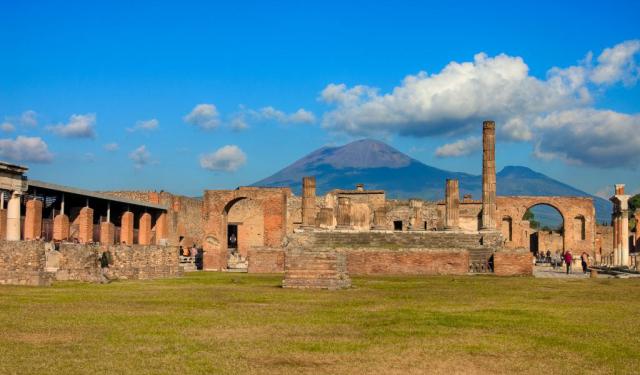
Modern-day Pompei is best known for its ancient predecessor, the Roman city of Pompeii, that fell victim to the massive eruption of Mount Vesuvius in 79 AD. The ruins of Pompeii, first uncovered in the late 18th century, were declared a World Heritage Site by UNESCO in 1997. Presently, this is one of the most popular tourist attractions in Italy, drawing annually up to 2.5 million visitors.
The... view more
Tour Duration: 2 Hours
Travel Distance: 2 Km or 1.2 Miles
The... view more
Tour Duration: 2 Hours
Travel Distance: 2 Km or 1.2 Miles
Pompeii Introduction Walk II
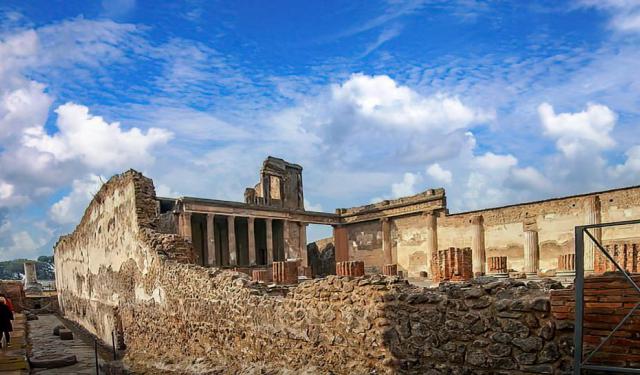
Frozen at the moment it was buried under the thick blanket of ash and pumice, the city of Pompeii (now excavated) remains a unique window into the past, offering a snapshot of everyday life back in the 1st century AD Roman Empire. Aside from causing quick and unexpected death to the city, the huge eruption of Vesuvius in 79 AD did have one positive outcome - it preserved everything (properties,... view more
Tour Duration: 3 Hours
Travel Distance: 2.3 Km or 1.4 Miles
Tour Duration: 3 Hours
Travel Distance: 2.3 Km or 1.4 Miles