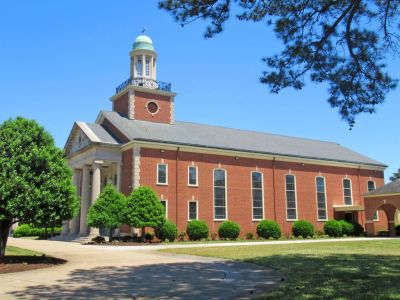


Annunciation Cathedral, Norfolk
The Annunciation Greek Orthodox Cathedral's history stretches back to the early Greek immigrants in the city, including two of the earliest ones, John Gretes and George Christopoulos, who arrived around the turn of the 20th century. Their work laid the foundation for a lasting Greek Orthodox community in the city. By March 1911, the congregation welcomed their first resident priest, Rev. Fr. George Smyrnakis, and began to hold services regularly at a borrowed location.
In 1913, the community acquired its own building, and by 1955, they had completed construction of the current church, followed by the addition of the Hellenic Center in 1959, built to serve the congregation's growing needs, providing space for gatherings beyond worship. Today-after nearly a century of spiritual and cultural growth-the cathedral serves over five hundred families and continues to flourish as a center of Orthodox life in the region.
Architecturally, the Cathedral is distinguished by its fusion of Byzantine-inspired design and American ecclesiastical architecture. The building showcases a dome sitting atop a Greek-cross floor plan, where the main arms of the structure form a cross shape. The interior is enriched by an iconostasis-a decorative partition covered with icons separating the nave from the sanctuary.
One of the cathedral's defining events is the Norfolk Greek Festival, one of Virginia’s largest ethnic celebrations. What began in the early 1950s as a modest weekend bazaar hosted by the Hellenic Women’s Club has blossomed into a much-anticipated cultural event that features authentic Greek cuisine like moussaka, gyros, and baklava, alongside live music, traditional dance, and a marketplace.
In 1913, the community acquired its own building, and by 1955, they had completed construction of the current church, followed by the addition of the Hellenic Center in 1959, built to serve the congregation's growing needs, providing space for gatherings beyond worship. Today-after nearly a century of spiritual and cultural growth-the cathedral serves over five hundred families and continues to flourish as a center of Orthodox life in the region.
Architecturally, the Cathedral is distinguished by its fusion of Byzantine-inspired design and American ecclesiastical architecture. The building showcases a dome sitting atop a Greek-cross floor plan, where the main arms of the structure form a cross shape. The interior is enriched by an iconostasis-a decorative partition covered with icons separating the nave from the sanctuary.
One of the cathedral's defining events is the Norfolk Greek Festival, one of Virginia’s largest ethnic celebrations. What began in the early 1950s as a modest weekend bazaar hosted by the Hellenic Women’s Club has blossomed into a much-anticipated cultural event that features authentic Greek cuisine like moussaka, gyros, and baklava, alongside live music, traditional dance, and a marketplace.
Want to visit this sight? Check out these Self-Guided Walking Tours in Norfolk. Alternatively, you can download the mobile app "GPSmyCity: Walks in 1K+ Cities" from Apple App Store or Google Play Store. The app turns your mobile device to a personal tour guide and it works offline, so no data plan is needed when traveling abroad.
Download The GPSmyCity App



Annunciation Cathedral on Map
Sight Name: Annunciation Cathedral
Sight Location: Norfolk, USA (See walking tours in Norfolk)
Sight Type: Religious
Sight Location: Norfolk, USA (See walking tours in Norfolk)
Sight Type: Religious
Nearby Sights

Walking Tours in Norfolk, Virginia

Create Your Own Walk in Norfolk
Creating your own self-guided walk in Norfolk is easy and fun. Choose the city attractions that you want to see and a walk route map will be created just for you. You can even set your hotel as the start point of the walk.
Norfolk Introduction Walking Tour
The Southern forces were left dumbfounded when one of their own, Norfolk native Mary Louvestre, revealed their plans to the Union government. Mary's act gave the Union navy an upper hand in the sea battle against Confederate ships.
In 1636, English colonists established a small settlement along the Elizabeth River, recognizing the area’s natural deep-water harbor as a vital asset for... view more
Tour Duration: 2 Hours
Travel Distance: 3 Km or 1.9 Miles
In 1636, English colonists established a small settlement along the Elizabeth River, recognizing the area’s natural deep-water harbor as a vital asset for... view more
Tour Duration: 2 Hours
Travel Distance: 3 Km or 1.9 Miles
City Walks Overview
