

Aqueduc et Moulins de Barbegal (Barbegal Aqueduct and Mills), Arles
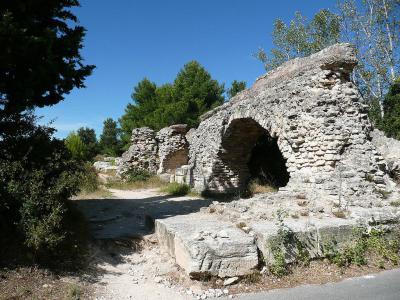
The Barbegal Aqueduct and Mills is an extraordinary archaeological site, often described as the most impressive concentration of mechanical power from the ancient world. This ingenious complex once used the force of flowing water to grind grain into flour, standing as a remarkable example of Roman technological skill.
Constructed in the early 2nd century AD, the Barbegal installation ingeniously diverted water from the aqueducts of the Alpilles to power a massive flour milling operation. Two aqueduct branches converged just north of the site and, through a carefully controlled sluice system, fed the water to a cascade of 16 overshot water wheels arranged in two parallel rows of eight, descending steeply along the hillside. The downward flow transferred power sequentially, driving the millstones with impressive efficiency.
Estimates suggest that the mills could produce approximately 4.5 tons of flour per day, enough to feed between 12,000 and perhaps up to 40,000 inhabitants of ancient Arles. Today, the site stands as an evocative ruin, where the remains of water channels, foundational masonry, and a stone staircase-once enabling mill operators to ascend the slope-still endure in the Provencal landscape.
Constructed in the early 2nd century AD, the Barbegal installation ingeniously diverted water from the aqueducts of the Alpilles to power a massive flour milling operation. Two aqueduct branches converged just north of the site and, through a carefully controlled sluice system, fed the water to a cascade of 16 overshot water wheels arranged in two parallel rows of eight, descending steeply along the hillside. The downward flow transferred power sequentially, driving the millstones with impressive efficiency.
Estimates suggest that the mills could produce approximately 4.5 tons of flour per day, enough to feed between 12,000 and perhaps up to 40,000 inhabitants of ancient Arles. Today, the site stands as an evocative ruin, where the remains of water channels, foundational masonry, and a stone staircase-once enabling mill operators to ascend the slope-still endure in the Provencal landscape.
Want to visit this sight? Check out these Self-Guided Walking Tours in Arles. Alternatively, you can download the mobile app "GPSmyCity: Walks in 1K+ Cities" from Apple App Store or Google Play Store. The app turns your mobile device to a personal tour guide and it works offline, so no data plan is needed when traveling abroad.
Download The GPSmyCity App



Aqueduc et Moulins de Barbegal (Barbegal Aqueduct and Mills) on Map
Sight Name: Aqueduc et Moulins de Barbegal (Barbegal Aqueduct and Mills)
Sight Location: Arles, France (See walking tours in Arles)
Sight Type: Attraction/Landmark
Sight Location: Arles, France (See walking tours in Arles)
Sight Type: Attraction/Landmark
Nearby Sights


Walking Tours in Arles, France

Create Your Own Walk in Arles
Creating your own self-guided walk in Arles is easy and fun. Choose the city attractions that you want to see and a walk route map will be created just for you. You can even set your hotel as the start point of the walk.
Arles Introduction Walking Tour
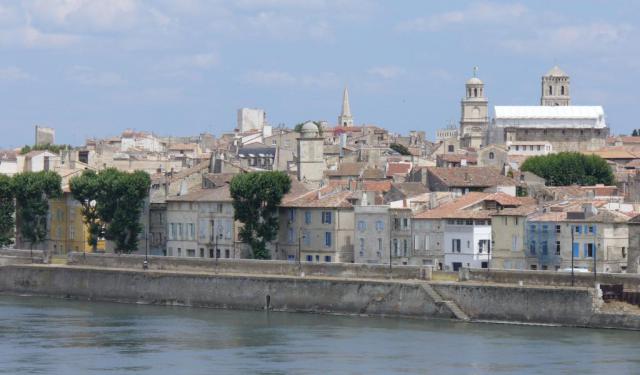
While living in Arles, Vincent van Gogh wrote to his brother Theo about the “soft and tender light” of the region. Although he called the town home for only 15 months, this brief period became the most productive of his career, yielding more than 300 works.
The town’s name comes from the ancient Ligurian and Celtic term Arelate, meaning “the dwelling by the marshes,” a nod to its... view more
Tour Duration: 1 Hour(s)
Travel Distance: 1.3 Km or 0.8 Miles
The town’s name comes from the ancient Ligurian and Celtic term Arelate, meaning “the dwelling by the marshes,” a nod to its... view more
Tour Duration: 1 Hour(s)
Travel Distance: 1.3 Km or 0.8 Miles
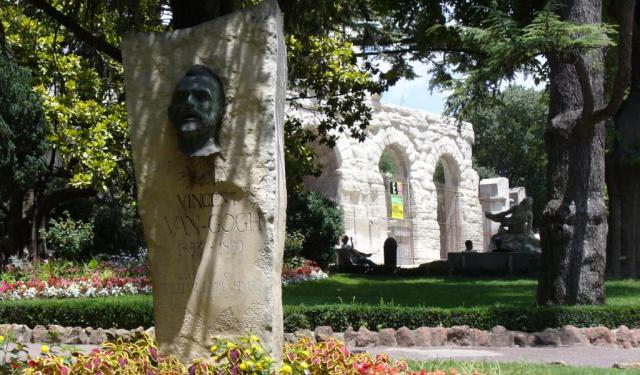
Vincent van Gogh Walking Tour
"There's no place quite like it for painters. It's so beautiful and peaceful..." These words, reportedly attributed to Vincent van Gogh, emphasize the beauty and exceptional qualities of Arles with which the renowned Dutch painter had a special connection.
Vincent van Gogh moved to this town in 1888, after having worked in Paris for two years. In the late 19th century,... view more
Tour Duration: 1 Hour(s)
Travel Distance: 2.1 Km or 1.3 Miles
Vincent van Gogh moved to this town in 1888, after having worked in Paris for two years. In the late 19th century,... view more
Tour Duration: 1 Hour(s)
Travel Distance: 2.1 Km or 1.3 Miles