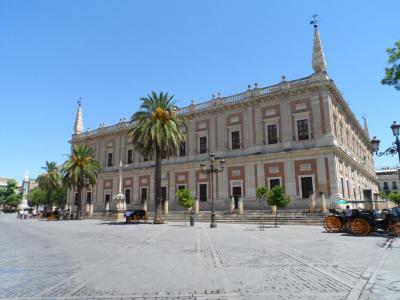


Archivo General de Indias (Archive of the Indies), Seville
The Archive of the Indies is one of Seville’s most historically significant buildings and an essential place for understanding Spain’s global empire. The archive preserves documents related to Spain’s overseas territories and the administration of its vast colonial network.
The building itself predates the archive. It was originally constructed in the late 16th century during the reign of King Philip II of Spain as the House of Trade Merchants, a place where merchants gathered to conduct business connected with trade between Spain and the Americas. Designed in the restrained style of the Spanish Renaissance, the structure is organized around a spacious central courtyard surrounded by elegant arcaded galleries. Seville was chosen for this purpose because the city served for centuries as Spain’s principal-and at one time exclusive-port for commerce with the New World.
In 1785, King Charles III decided to centralize the enormous volume of documents related to Spain’s overseas empire. He transformed the former merchants’ exchange into a state archive dedicated to preserving records from Spain’s territories in the Americas and beyond.
A highlight of the building is the Grand Red Marble Staircase. Added in the late 18th century, it was designed to provide a majestic transition from the former merchants' courtyard to the scholarly world of the archives above. Pay attention to the rich, deep colors of the stone and the intricate patterns on the floor landings. The way the natural light falls from the windows onto the polished marble makes it the most photographed architectural feature in the building. To find it, look for the signs to the upper floor while you are on the ground floor.
As soon as you reach the top of the staircase you will find the second highlight of the building. The series of long, high-ceilinged galleries represent 80 million pages of history. Look at the shelving units, which are made of Cuban mahogany. If you look at the thousands of uniform boxes on the shelves, you are looking at more than five miles of continuous history. Be sure to check the rotating glass display cases in the center of these halls; this is where the archive displays high-value treasures, such as original hand-drawn maps of the New World and letters signed by the Conquistadors.
One particularly memorable display on the ground floor features a 1616 cannon recovered from the Spanish ship, a treasure-laden vessel that sank in a storm while returning from Havana.
The building itself predates the archive. It was originally constructed in the late 16th century during the reign of King Philip II of Spain as the House of Trade Merchants, a place where merchants gathered to conduct business connected with trade between Spain and the Americas. Designed in the restrained style of the Spanish Renaissance, the structure is organized around a spacious central courtyard surrounded by elegant arcaded galleries. Seville was chosen for this purpose because the city served for centuries as Spain’s principal-and at one time exclusive-port for commerce with the New World.
In 1785, King Charles III decided to centralize the enormous volume of documents related to Spain’s overseas empire. He transformed the former merchants’ exchange into a state archive dedicated to preserving records from Spain’s territories in the Americas and beyond.
A highlight of the building is the Grand Red Marble Staircase. Added in the late 18th century, it was designed to provide a majestic transition from the former merchants' courtyard to the scholarly world of the archives above. Pay attention to the rich, deep colors of the stone and the intricate patterns on the floor landings. The way the natural light falls from the windows onto the polished marble makes it the most photographed architectural feature in the building. To find it, look for the signs to the upper floor while you are on the ground floor.
As soon as you reach the top of the staircase you will find the second highlight of the building. The series of long, high-ceilinged galleries represent 80 million pages of history. Look at the shelving units, which are made of Cuban mahogany. If you look at the thousands of uniform boxes on the shelves, you are looking at more than five miles of continuous history. Be sure to check the rotating glass display cases in the center of these halls; this is where the archive displays high-value treasures, such as original hand-drawn maps of the New World and letters signed by the Conquistadors.
One particularly memorable display on the ground floor features a 1616 cannon recovered from the Spanish ship, a treasure-laden vessel that sank in a storm while returning from Havana.
Want to visit this sight? Check out these Self-Guided Walking Tours in Seville. Alternatively, you can download the mobile app "GPSmyCity: Walks in 1K+ Cities" from Apple App Store or Google Play Store. The app turns your mobile device to a personal tour guide and it works offline, so no data plan is needed when traveling abroad.
Download The GPSmyCity App



Archivo General de Indias (Archive of the Indies) on Map
Sight Name: Archivo General de Indias (Archive of the Indies)
Sight Location: Seville, Spain (See walking tours in Seville)
Sight Type: Attraction/Landmark
Guide(s) Containing This Sight:
Sight Location: Seville, Spain (See walking tours in Seville)
Sight Type: Attraction/Landmark
Guide(s) Containing This Sight:
Nearby Sights
Walking Tours in Seville, Spain

Create Your Own Walk in Seville
Creating your own self-guided walk in Seville is easy and fun. Choose the city attractions that you want to see and a walk route map will be created just for you. You can even set your hotel as the start point of the walk.
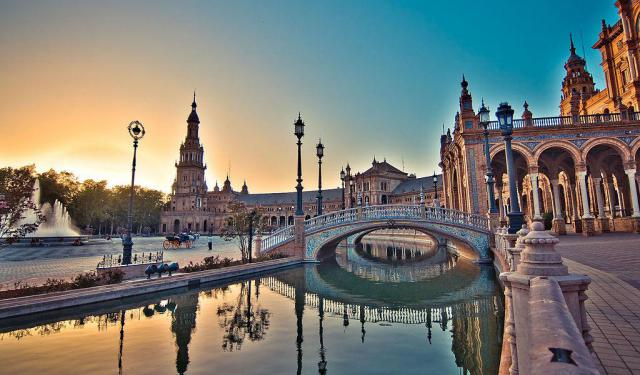
Seville's Top Attractions Walking Tour
19th-century American writer Washington Irving noted that in Seville “the past lingers like perfume.”
Seville is the largest city and provincial capital of Andalusia, located on the banks of the Guadalquivir River. Ancient tradition credits the city’s foundation to Hercules. Historically, early Phoenician settlers called the site Hisbaal, invoking the god Baal, a name later Latinised by... view more
Tour Duration: 2 Hour(s)
Travel Distance: 4.9 Km or 3 Miles
Seville is the largest city and provincial capital of Andalusia, located on the banks of the Guadalquivir River. Ancient tradition credits the city’s foundation to Hercules. Historically, early Phoenician settlers called the site Hisbaal, invoking the god Baal, a name later Latinised by... view more
Tour Duration: 2 Hour(s)
Travel Distance: 4.9 Km or 3 Miles
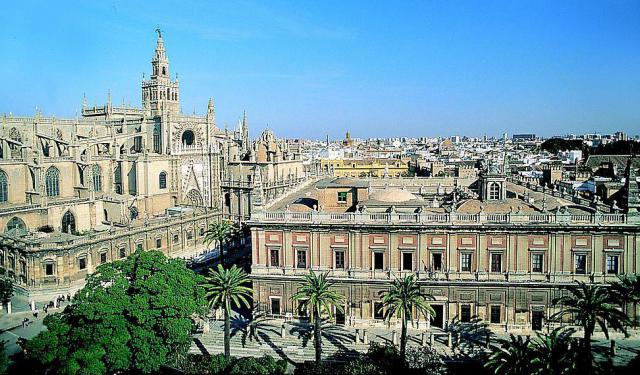
Seville Old Town Walking Tour
In his famous book Don Quixote, Spanish writer Miguel de Cervantes referred to Seville as a city where the bustle of life never seemed to stop.
Old Seville, the historic heart of the Andalusian capital, reflects more than two thousand years of cultural layers. The area developed along the banks of the Guadalquivir River, which for centuries connected the city to the wider Mediterranean world.... view more
Tour Duration: 1 Hour(s)
Travel Distance: 2.4 Km or 1.5 Miles
Old Seville, the historic heart of the Andalusian capital, reflects more than two thousand years of cultural layers. The area developed along the banks of the Guadalquivir River, which for centuries connected the city to the wider Mediterranean world.... view more
Tour Duration: 1 Hour(s)
Travel Distance: 2.4 Km or 1.5 Miles
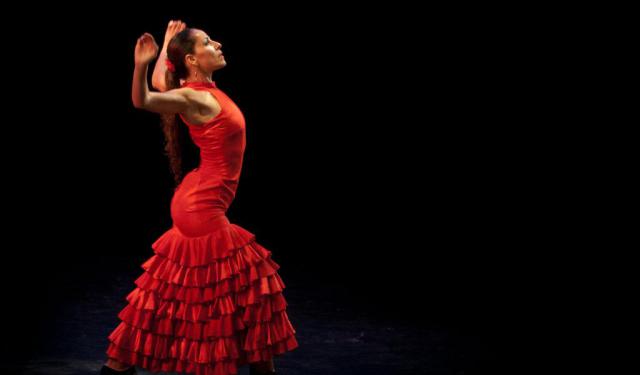
Flamenco Walking Tour
They say if it's Flamenco – it's Andalusia, and if it's Andalusia – it's all about Seville. Indeed, with its roots deeply embedded in the Andalusian culture, Seville is a prime destination for experiencing the essence of Flamenco and is largely considered to be the home of this fiery dance.
Flamenco sites are found all over the city – in bars, theaters, or specialized... view more
Tour Duration: 1 Hour(s)
Travel Distance: 2.7 Km or 1.7 Miles
Flamenco sites are found all over the city – in bars, theaters, or specialized... view more
Tour Duration: 1 Hour(s)
Travel Distance: 2.7 Km or 1.7 Miles
Useful Travel Guides for Planning Your Trip

16 Uniquely Spanish Things to Buy in Seville
Immortalized by Gioachino Rossini in his famous The Barber of Seville opera, the city of Seville is a major historic and cultural sight adorning the face of modern Spain. Much of the city's character is reflected in the locally-made products that can make for a great gift or trip memento...