

Augustusbrücke (Augustus Bridge), Dresden
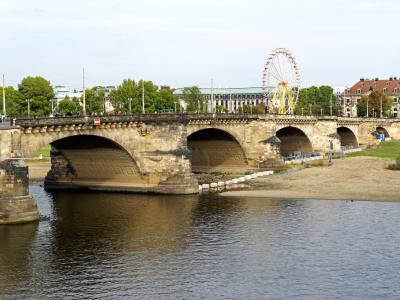
Augustus Bridge is one of Dresden’s most historic crossings of the River Elbe, connecting the Old Town on the left bank with Dresden’s New Town on the right. A wooden bridge was recorded here as early as 1275, followed by a stone bridge with 25 pillars in 1287. For centuries, it formed an important trade route, while tolls collected at the nearby customs house provided a major source of revenue for the Saxon Wettin rulers.
The bridge was named after Augustus the Strong, who commissioned a major reconstruction when the medieval structure could no longer handle increasing traffic. Built between 1727 and 1731, the Baroque bridge was 402 metres long and featured 12 arches supported by 11 pillars.
A pillar of this Baroque bridge partially collapsed during severe flooding of the Elbe in 1845 and was subsequently repaired. Due to increasing modern river traffic, the bridge was completely demolished in 1907 and replaced between 1907 and 1910 by a wider, reinforced-concrete structure clad in sandstone, featuring just nine arches. This newer bridge survived the 1945 Allied bombing raids relatively intact but was deliberately blown up by retreating German troops on 7 May 1945, just before the end of the war. It was subsequently restored after the war.
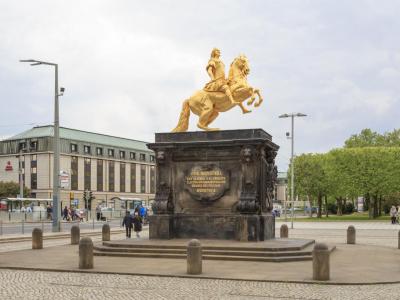
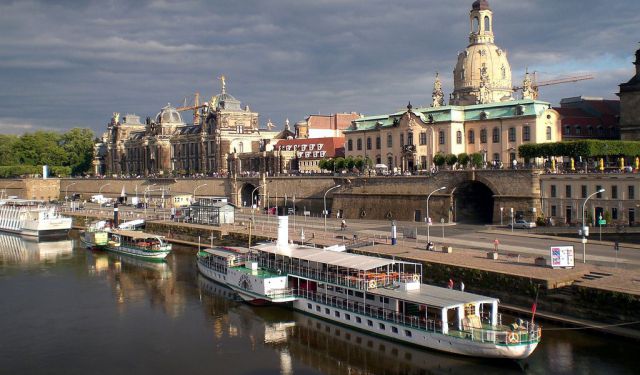
For tourists, the bridge is particularly rewarding for its panoramic views of Dresden’s skyline. Looking towards the Old Town, you can see the Church of Our Lady, the Cathedral, the Royal Palace, and Brühl’s Terrace, while the New Town side opens towards the Golden Rider and Main Street.
The bridge was named after Augustus the Strong, who commissioned a major reconstruction when the medieval structure could no longer handle increasing traffic. Built between 1727 and 1731, the Baroque bridge was 402 metres long and featured 12 arches supported by 11 pillars.
A pillar of this Baroque bridge partially collapsed during severe flooding of the Elbe in 1845 and was subsequently repaired. Due to increasing modern river traffic, the bridge was completely demolished in 1907 and replaced between 1907 and 1910 by a wider, reinforced-concrete structure clad in sandstone, featuring just nine arches. This newer bridge survived the 1945 Allied bombing raids relatively intact but was deliberately blown up by retreating German troops on 7 May 1945, just before the end of the war. It was subsequently restored after the war.
For tourists, the bridge is particularly rewarding for its panoramic views of Dresden’s skyline. Looking towards the Old Town, you can see the Church of Our Lady, the Cathedral, the Royal Palace, and Brühl’s Terrace, while the New Town side opens towards the Golden Rider and Main Street.
Want to visit this sight? Check out these Self-Guided Walking Tours in Dresden. Alternatively, you can download the mobile app "GPSmyCity: Walks in 1K+ Cities" from Apple App Store or Google Play Store. The app turns your mobile device to a personal tour guide and it works offline, so no data plan is needed when traveling abroad.
Download The GPSmyCity App



Augustusbrücke (Augustus Bridge) on Map
Sight Name: Augustusbrücke (Augustus Bridge)
Sight Location: Dresden, Germany (See walking tours in Dresden)
Sight Type: Attraction/Landmark
Guide(s) Containing This Sight:
Sight Location: Dresden, Germany (See walking tours in Dresden)
Sight Type: Attraction/Landmark
Guide(s) Containing This Sight:
Nearby Sights
Walking Tours in Dresden, Germany

Create Your Own Walk in Dresden
Creating your own self-guided walk in Dresden is easy and fun. Choose the city attractions that you want to see and a walk route map will be created just for you. You can even set your hotel as the start point of the walk.
Dresden's Architectural Jewels
If there is one thing Dresden is particularly famous for, it is the magnificent architecture. Although known primarily for its Baroque buildings, the city has several other architectural styles present too, such as Renaissance, Historicism, Modernism and Post-modernism.
Much of downtown Dresden was destroyed in February 1945 by Allied bombing, which in turn prompted the rebuilding of the... view more
Tour Duration: 1 Hour
Travel Distance: 1.9 Km or 1.2 Miles
Much of downtown Dresden was destroyed in February 1945 by Allied bombing, which in turn prompted the rebuilding of the... view more
Tour Duration: 1 Hour
Travel Distance: 1.9 Km or 1.2 Miles
A Walk Through Dresden's Historic Old Town
Dresden’s reputation as a city of art and architecture has earned it the nickname “Florence on the Elbe.”
Dresden, the capital of Saxony, lies on the banks of the River Elbe in eastern Germany. The area may have been settled by Neolithic communities as early as 7500 BC, but Dresden’s documented history begins much later. The city developed within the Margraviate of Meissen, a territory... view more
Tour Duration: 2 Hours
Travel Distance: 2.5 Km or 1.6 Miles
Dresden, the capital of Saxony, lies on the banks of the River Elbe in eastern Germany. The area may have been settled by Neolithic communities as early as 7500 BC, but Dresden’s documented history begins much later. The city developed within the Margraviate of Meissen, a territory... view more
Tour Duration: 2 Hours
Travel Distance: 2.5 Km or 1.6 Miles
Exploring Dresden New Town on Foot
Dresden’s New Town occupies the northern bank of the Elbe, directly opposite the historic Old Town. Despite its name, it is far from new. The area was settled in the Middle Ages and was historically known as Old Dresden. It was incorporated into Dresden in 1549 under Elector Moritz but remained a relatively modest settlement for centuries compared with the more prestigious city on the opposite... view more
Tour Duration: 1 Hour
Travel Distance: 2.2 Km or 1.4 Miles
Tour Duration: 1 Hour
Travel Distance: 2.2 Km or 1.4 Miles