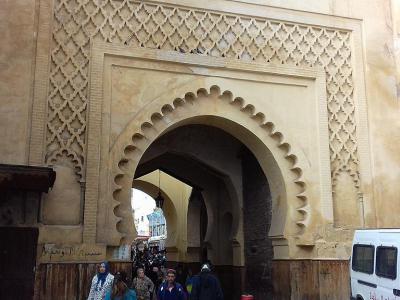


Bab Semmarine (Gate of the Farriers), Fes
The ruling Marinid sultans of Fes did not trust the local residents of the old city, Fes el-Bali. In 1276, when sultan Abu Yusuf Ya'qub built Fes el-Jdid to be his royal city he made sure it was to be well fortified. The walls facing the old city were double walls. Where there is a wall there has to be a gate. Sultan Yusuf's gate was Bab Smarine.
The name Bab Smarine means "Gate of the Farriers." It so happened farrier's shops for good hoofkeeping were conveniently located near the gate. Bab Smarine was initially the southern entrance to the city. In time the Jewish quarter (the "Mellah") occupied the southside and the gate ended within the city walls.
As a defensive feature, the gate at first had a bent entrance. During the French occupation the inner walls were opened up. Today the gate has a double archway entrance adjusted to accept motor traffic. The outer facade is adorned with blind polylobed arches and the Moroccan motifs called darj-wa-ktaf within a rectangular border.
The original entrance is flanked by defensive towers. Inside the passage is a side door which once gave access to the royal palace. The gate leads to the Grande Rue ("Great Street"). The street once led to the main market and the Royal Palace. Now residential buildings have replaced the market, grain silos and warehouses.
The name Bab Smarine means "Gate of the Farriers." It so happened farrier's shops for good hoofkeeping were conveniently located near the gate. Bab Smarine was initially the southern entrance to the city. In time the Jewish quarter (the "Mellah") occupied the southside and the gate ended within the city walls.
As a defensive feature, the gate at first had a bent entrance. During the French occupation the inner walls were opened up. Today the gate has a double archway entrance adjusted to accept motor traffic. The outer facade is adorned with blind polylobed arches and the Moroccan motifs called darj-wa-ktaf within a rectangular border.
The original entrance is flanked by defensive towers. Inside the passage is a side door which once gave access to the royal palace. The gate leads to the Grande Rue ("Great Street"). The street once led to the main market and the Royal Palace. Now residential buildings have replaced the market, grain silos and warehouses.
Want to visit this sight? Check out these Self-Guided Walking Tours in Fes. Alternatively, you can download the mobile app "GPSmyCity: Walks in 1K+ Cities" from Apple App Store or Google Play Store. The app turns your mobile device to a personal tour guide and it works offline, so no data plan is needed when traveling abroad.
Download The GPSmyCity App



Bab Semmarine (Gate of the Farriers) on Map
Sight Name: Bab Semmarine (Gate of the Farriers)
Sight Location: Fes, Morocco (See walking tours in Fes)
Sight Type: Attraction/Landmark
Sight Location: Fes, Morocco (See walking tours in Fes)
Sight Type: Attraction/Landmark
Nearby Sights
Walking Tours in Fes, Morocco

Create Your Own Walk in Fes
Creating your own self-guided walk in Fes is easy and fun. Choose the city attractions that you want to see and a walk route map will be created just for you. You can even set your hotel as the start point of the walk.
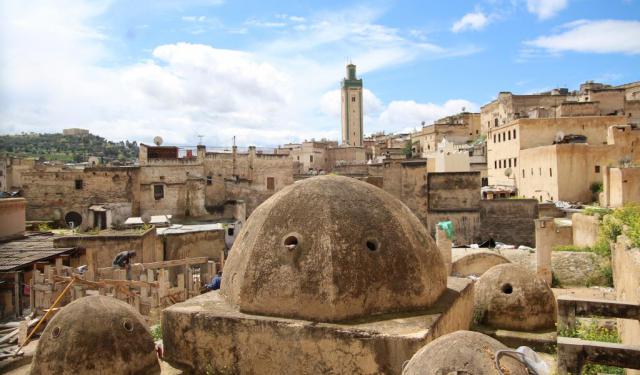
Fes Old Town Walking Tour
Fes-also known as Fez-is an ancient Moroccan city gathered around the Fes River like it’s been holding a long, serious conversation for over a thousand years. People have called it the “Mecca of the West” and the “Athens of Africa,” which is a lot of pressure for one place.
Its story began in 789, when Idris I-an Arab emir and founder of the Idrisid dynasty-established the city,... view more
Tour Duration: 2 Hour(s)
Travel Distance: 3.7 Km or 2.3 Miles
Its story began in 789, when Idris I-an Arab emir and founder of the Idrisid dynasty-established the city,... view more
Tour Duration: 2 Hour(s)
Travel Distance: 3.7 Km or 2.3 Miles
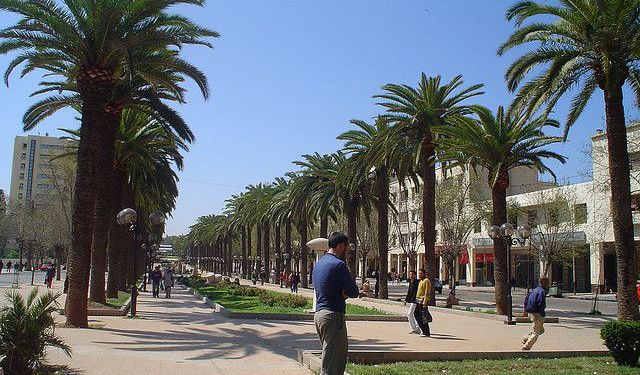
Fes New Town Walking Tour
While the Old Town-or Medina, as they call it-twists and turns on its own terms, the Ville Nouvelle, or the New Town of Fes, does things differently. Created by the French in the early 20th century and developed mainly in the 1910s, this district was designed to bring order, space, and modern infrastructure to the city. Wide streets replaced narrow lanes, open squares replaced hidden courtyards,... view more
Tour Duration: 1 Hour(s)
Travel Distance: 2.7 Km or 1.7 Miles
Tour Duration: 1 Hour(s)
Travel Distance: 2.7 Km or 1.7 Miles