

Audio Guide: Fes New Town Walking Tour (Self Guided), Fes
While the Old Town—or Medina, as they call it—twists and turns on its own terms, the Ville Nouvelle, or the New Town of Fes, does things differently. Created by the French in the early 20th century and developed mainly in the 1910s, this district was designed to bring order, space, and modern infrastructure to the city. Wide streets replaced narrow lanes, open squares replaced hidden courtyards, and buildings began facing outward toward public life. At first, the area was meant for foreigners and wealthier Moroccans, while the Medina continued to carry the city’s deep historical and cultural weight.
Despite its calmer rhythm and cleaner lines, the New Town is not a side note to local life. It has grown into the most populated part of the city and functions as a practical, lived-in neighborhood rather than a showcase. For many residents, it represents a forward-looking version of Fes—less maze, more movement. Over the years, major investment has reshaped the area, giving it a confident, functional character that contrasts sharply with the Medina without trying to replace it.
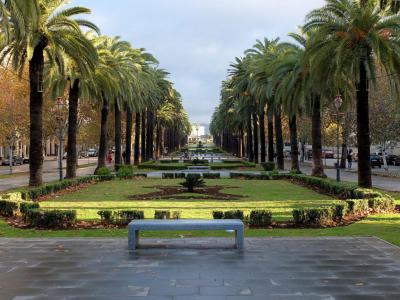
The heart of this transformation runs along Avenue Hassan II, once known as Avenue de France. This broad boulevard sets the tone, with arcaded buildings, cafés, shops, cinemas, hotels, and government offices lining both sides. Palm trees, fountains, flower beds, and manicured lawns soften the scale, turning the avenue into a space where business, daily errands, and social life overlap naturally. It’s a place where the city slows down just enough to breathe.
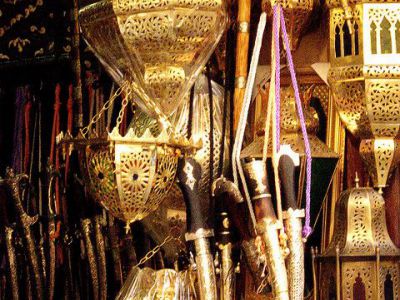
Just off the main avenue, the Artisanal Centre brings tradition into this modern setting. Craftspeople work here with clay, wood, metal, and textiles, using techniques rooted in centuries of practice. The difference is the setting: organized, open, and easy to navigate, offering a clear window into Morocco’s craft heritage without the crowds of the Medina.
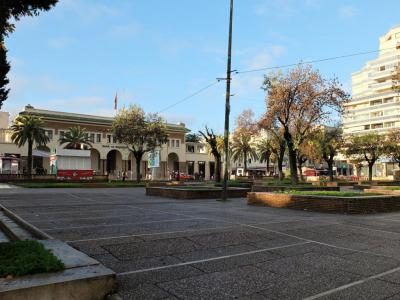
The New Town’s public squares reinforce its open layout. Florence Square, originally designed as a garden, works as a quiet pause between busy streets, while Resistance Square carries a more serious tone, recalling Morocco’s struggle for independence through its name and central fountain.
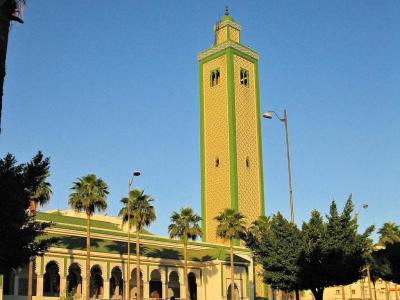
Religious life has its place in the New Town, too. The Imam Malik Mosque stands out with a simpler design than the Medina’s historic mosques, reflecting the district’s modern character while staying grounded in tradition.
To understand Fes as a living city, not just a historical monument, the New Town is essential. This self-guided tour invites you to explore its streets and spaces, revealing how Fes keeps moving forward without letting go of where it came from.
Despite its calmer rhythm and cleaner lines, the New Town is not a side note to local life. It has grown into the most populated part of the city and functions as a practical, lived-in neighborhood rather than a showcase. For many residents, it represents a forward-looking version of Fes—less maze, more movement. Over the years, major investment has reshaped the area, giving it a confident, functional character that contrasts sharply with the Medina without trying to replace it.
The heart of this transformation runs along Avenue Hassan II, once known as Avenue de France. This broad boulevard sets the tone, with arcaded buildings, cafés, shops, cinemas, hotels, and government offices lining both sides. Palm trees, fountains, flower beds, and manicured lawns soften the scale, turning the avenue into a space where business, daily errands, and social life overlap naturally. It’s a place where the city slows down just enough to breathe.
Just off the main avenue, the Artisanal Centre brings tradition into this modern setting. Craftspeople work here with clay, wood, metal, and textiles, using techniques rooted in centuries of practice. The difference is the setting: organized, open, and easy to navigate, offering a clear window into Morocco’s craft heritage without the crowds of the Medina.
The New Town’s public squares reinforce its open layout. Florence Square, originally designed as a garden, works as a quiet pause between busy streets, while Resistance Square carries a more serious tone, recalling Morocco’s struggle for independence through its name and central fountain.
Religious life has its place in the New Town, too. The Imam Malik Mosque stands out with a simpler design than the Medina’s historic mosques, reflecting the district’s modern character while staying grounded in tradition.
To understand Fes as a living city, not just a historical monument, the New Town is essential. This self-guided tour invites you to explore its streets and spaces, revealing how Fes keeps moving forward without letting go of where it came from.
How it works: Download the app "GPSmyCity: Walks in 1K+ Cities" from Apple App Store or Google Play Store to your mobile phone or tablet. The app turns your mobile device into a personal tour guide and its built-in GPS navigation functions guide you from one tour stop to next. The app works offline, so no data plan is needed when traveling abroad.
Fes New Town Walking Tour Map
Guide Name: Fes New Town Walking Tour
Guide Location: Morocco » Fes (See other walking tours in Fes)
Guide Type: Self-guided Walking Tour (Sightseeing)
# of Attractions: 5
Tour Duration: 1 Hour(s)
Travel Distance: 2.7 Km or 1.7 Miles
Author: leticia
Sight(s) Featured in This Guide:
Guide Location: Morocco » Fes (See other walking tours in Fes)
Guide Type: Self-guided Walking Tour (Sightseeing)
# of Attractions: 5
Tour Duration: 1 Hour(s)
Travel Distance: 2.7 Km or 1.7 Miles
Author: leticia
Sight(s) Featured in This Guide:
- Avenue Hassan II
- Artisanal Ensemble (Artisanal Centre)
- Place Florence (Florence Square)
- Imam Malik (Tajamouati) Mosque
- Place de la Resistance (Resistance Square)
1) Avenue Hassan II
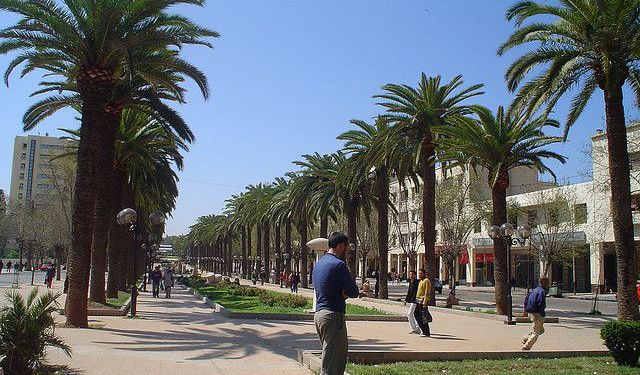
It's fair to say that the New Town of Fes is orbiting around Avenue Hassan II—a wide, confident boulevard laid out by the French after 1912, and still the district’s social backbone. This is where strolling turns into a sport, especially in mild weather and right after sunset, when the city slows down just enough to notice itself.
Back in the colonial period, the city’s major public buildings were deliberately placed along this avenue, and they didn’t settle for a single look. Instead, you get a mix of styles that jump neatly between neo-Moorish curves, Art Deco geometry, and Neoclassical balance. Arcaded façades line both sides, sheltering cinemas, cafés, restaurants, terraces, ice-cream counters, and pastry shops.
It’s a stretch that knows how to entertain visitors, but it also caters to locals who treat it as an everyday address. Along the way, you’ll spot established hotels and contemporary shopping and leisure spaces, adding a modern layer to the historic layout.
Running straight down the middle of the avenue is a long, tree-lined park strip, stretching for roughly two kilometres. It’s an unexpected pocket of green, offering shade, benches, and a pause from the steady flow of traffic on either side. This central promenade turns the boulevard into a place to linger, walk, or simply reset before moving on. Grab yourself a café table, lean back, and let the passing parade do the work for you.
At the northeastern end of the avenue, the scene opens into Resistance Square, a large roundabout anchored by a central fountain and loaded with historical symbolism. Heading south, the boulevard meets Florence Square, a broad, leafy square originally planned as a public garden and still used as a breathing space between busy streets. Continue further, and you arrive at Ahmed El Mansour Square, marking the southwestern edge of the avenue.
Taken together, these spaces frame Avenue Hassan II as more than a route but a sequence of urban scenes—part timeline, part social stage, and one of the clearest ways to understand how the New Town moves, relaxes, and shows itself off.
Back in the colonial period, the city’s major public buildings were deliberately placed along this avenue, and they didn’t settle for a single look. Instead, you get a mix of styles that jump neatly between neo-Moorish curves, Art Deco geometry, and Neoclassical balance. Arcaded façades line both sides, sheltering cinemas, cafés, restaurants, terraces, ice-cream counters, and pastry shops.
It’s a stretch that knows how to entertain visitors, but it also caters to locals who treat it as an everyday address. Along the way, you’ll spot established hotels and contemporary shopping and leisure spaces, adding a modern layer to the historic layout.
Running straight down the middle of the avenue is a long, tree-lined park strip, stretching for roughly two kilometres. It’s an unexpected pocket of green, offering shade, benches, and a pause from the steady flow of traffic on either side. This central promenade turns the boulevard into a place to linger, walk, or simply reset before moving on. Grab yourself a café table, lean back, and let the passing parade do the work for you.
At the northeastern end of the avenue, the scene opens into Resistance Square, a large roundabout anchored by a central fountain and loaded with historical symbolism. Heading south, the boulevard meets Florence Square, a broad, leafy square originally planned as a public garden and still used as a breathing space between busy streets. Continue further, and you arrive at Ahmed El Mansour Square, marking the southwestern edge of the avenue.
Taken together, these spaces frame Avenue Hassan II as more than a route but a sequence of urban scenes—part timeline, part social stage, and one of the clearest ways to understand how the New Town moves, relaxes, and shows itself off.
2) Artisanal Ensemble (Artisanal Centre)
The Artisanal Centre of Fes is a calm, well-lit showroom for traditional craftsmanship: government-run, well-organized, and refreshingly straightforward. Artisans work here on site, visitors watch the process, and the finished pieces come with fixed prices. No haggling, no pressure—just a clear look at what Moroccan handicrafts are made of, how they’re produced, and what they usually cost. It’s a smart warm-up before diving into the livelier, more chaotic souks of the Medina.
The centre dates back to the early 20th century, when the French Protectorate began reshaping parts of the city. Instead of hiding workshops behind shopfronts, this place promoted the idea of visibility and order. Set in the New Town rather than the Old Medina, the complex reflects colonial-era planning—open layouts, wide passages, and space to move—while keeping long-established Moroccan craft traditions front and centre. It was created to give artisans a stable place to work, demonstrate their skills, and sell their products without the noise and congestion of the Old Town.
As you walk through, the process is laid out step by step. You’ll see clay turned into ceramics, raw wood shaped into carved panels, leather cut and dyed, looms in motion, metal being hammered, and mosaics slowly taking form. Nothing is rushed, and nothing is hidden. Unlike the Medina, where production often happens out of sight, here the craft is the main event, making the visit especially useful for understanding how much skill and time go into each object.
The centre also doubles as a sales space. Items are sold either directly by artisans or through cooperatives, with clear labels and consistent pricing. Upstairs, carpet weaving and embroidery workshops tend to steal the spotlight, while outdoor areas often host metalworkers, basket makers, and instrument builders quietly going about their craft.
In essence, the Artisanal Centre isn’t just a place to shop. It’s a practical lesson in how Fes keeps its craft traditions alive—by giving them room to breathe, space to adapt, and a place in modern urban life beyond the Medina walls.
The centre dates back to the early 20th century, when the French Protectorate began reshaping parts of the city. Instead of hiding workshops behind shopfronts, this place promoted the idea of visibility and order. Set in the New Town rather than the Old Medina, the complex reflects colonial-era planning—open layouts, wide passages, and space to move—while keeping long-established Moroccan craft traditions front and centre. It was created to give artisans a stable place to work, demonstrate their skills, and sell their products without the noise and congestion of the Old Town.
As you walk through, the process is laid out step by step. You’ll see clay turned into ceramics, raw wood shaped into carved panels, leather cut and dyed, looms in motion, metal being hammered, and mosaics slowly taking form. Nothing is rushed, and nothing is hidden. Unlike the Medina, where production often happens out of sight, here the craft is the main event, making the visit especially useful for understanding how much skill and time go into each object.
The centre also doubles as a sales space. Items are sold either directly by artisans or through cooperatives, with clear labels and consistent pricing. Upstairs, carpet weaving and embroidery workshops tend to steal the spotlight, while outdoor areas often host metalworkers, basket makers, and instrument builders quietly going about their craft.
In essence, the Artisanal Centre isn’t just a place to shop. It’s a practical lesson in how Fes keeps its craft traditions alive—by giving them room to breathe, space to adapt, and a place in modern urban life beyond the Medina walls.
3) Place Florence (Florence Square)
Occupying a strategic spot in the New Town of Fes, Florence Square acts as a key junction, which slows you down just enough to notice where you are and quietly organizes the city around it. Trees line the space, benches invite a pause, and a broad boulevard slices through the middle with a planted central island that quietly channels a steady flow of pedestrians. It’s a key urban hinge rather than a decorative afterthought—and locals know it.
The square’s octagonal shape is no accident either. It takes its cue from the Baptistery of San Giovanni in Florence, Italy, borrowing a touch of Renaissance geometry and dropping it neatly into modern Fes.
Look south, and you’re greeted by the confident presence of the Bank al-Maghrib building. Designed in Art Deco style by French architect René Canu, it leans into symmetry with wide arches and orderly rectangular windows, a design that balances authority with restraint. It’s the kind of building that doesn’t shout, but clearly expects to be listened to.
Now shift your gaze east, across Avenue Hassan II, and you’ll spot the Central Post Office. Its placement here makes sense—this was, and still is, a zone built for communication, administration, and movement. Letters, paperwork, people: all passing through the same urban crossroads.
Drift slightly southwest from the post office, and you reach the Court of Appeals, constructed between 1934 and 1936 by architects Adrien Laforgue and Antoine Marchisio. Solid and formal, it reflects the judicial role it was built to serve, anchoring the square with a sense of institutional weight.
Taken as a whole, Florence Square is less about spectacle and more about structure. It’s a place where design, symbolism, and daily routines quietly converge, revealing a carefully planned chapter of Fes that speaks in geometry, stone, and steady urban rhythm.
The square’s octagonal shape is no accident either. It takes its cue from the Baptistery of San Giovanni in Florence, Italy, borrowing a touch of Renaissance geometry and dropping it neatly into modern Fes.
Look south, and you’re greeted by the confident presence of the Bank al-Maghrib building. Designed in Art Deco style by French architect René Canu, it leans into symmetry with wide arches and orderly rectangular windows, a design that balances authority with restraint. It’s the kind of building that doesn’t shout, but clearly expects to be listened to.
Now shift your gaze east, across Avenue Hassan II, and you’ll spot the Central Post Office. Its placement here makes sense—this was, and still is, a zone built for communication, administration, and movement. Letters, paperwork, people: all passing through the same urban crossroads.
Drift slightly southwest from the post office, and you reach the Court of Appeals, constructed between 1934 and 1936 by architects Adrien Laforgue and Antoine Marchisio. Solid and formal, it reflects the judicial role it was built to serve, anchoring the square with a sense of institutional weight.
Taken as a whole, Florence Square is less about spectacle and more about structure. It’s a place where design, symbolism, and daily routines quietly converge, revealing a carefully planned chapter of Fes that speaks in geometry, stone, and steady urban rhythm.
4) Imam Malik (Tajamouati) Mosque
An architectural heavyweight in Morocco’s spiritual capital, the Imam Malik Mosque rises near the Kennedy roundabout and goes by a friendlier name among locals: Tajamouati. That nickname points straight to its patron, Abdel-Hadi Tajmouati, who financed the project and left the city with one of its most important modern mosques. In terms of size and presence, only the Kairaouine Mosque outranks it, and with room for around 4,000 worshipers, this one was clearly built with big gatherings in mind.
Construction took a full decade, and the mosque finally opened during Ramadan on February 4, 1994—a symbolic moment that immediately anchored it in the city’s religious calendar. Architecturally, it strikes a careful balance. The design is modern and uncluttered, but it doesn’t break away from tradition. Moroccan mosque elements are all here, just interpreted with cleaner lines and a contemporary rhythm rather than heavy ornament.
The building is organized around four main entrances, one set aside specifically for women, reflecting both function and tradition. Inside, practical spaces take centre stage, including rooms for ablutions and other facilities that support daily prayer. Nothing feels excessive, but nothing feels missing either—it’s clearly designed for regular use, not just visual impact.
And regular use it gets. Throughout the day, the mosque fills and empties in steady waves, as each call to prayer draws large crowds. The atmosphere shifts from quiet focus to lively movement and back again, following the rhythm of the city itself. Beyond daily worship, the mosque also serves as a place of religious learning, reinforcing its role as more than just a prayer hall.
In short, the Imam Malik Mosque is not only a landmark you notice but the one you feel in motion, reflecting how Fes continues to build forward without letting go of its spiritual foundations.
Construction took a full decade, and the mosque finally opened during Ramadan on February 4, 1994—a symbolic moment that immediately anchored it in the city’s religious calendar. Architecturally, it strikes a careful balance. The design is modern and uncluttered, but it doesn’t break away from tradition. Moroccan mosque elements are all here, just interpreted with cleaner lines and a contemporary rhythm rather than heavy ornament.
The building is organized around four main entrances, one set aside specifically for women, reflecting both function and tradition. Inside, practical spaces take centre stage, including rooms for ablutions and other facilities that support daily prayer. Nothing feels excessive, but nothing feels missing either—it’s clearly designed for regular use, not just visual impact.
And regular use it gets. Throughout the day, the mosque fills and empties in steady waves, as each call to prayer draws large crowds. The atmosphere shifts from quiet focus to lively movement and back again, following the rhythm of the city itself. Beyond daily worship, the mosque also serves as a place of religious learning, reinforcing its role as more than just a prayer hall.
In short, the Imam Malik Mosque is not only a landmark you notice but the one you feel in motion, reflecting how Fes continues to build forward without letting go of its spiritual foundations.
5) Place de la Resistance (Resistance Square)
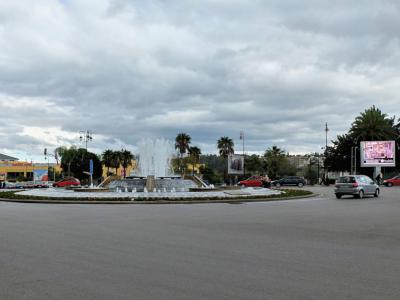
Resistance Square sits right at the handshake point between the New Town and the Old Medina, where modern traffic patterns meet centuries of history. At its heart is a large roundabout crowned by an oversized fountain that clearly enjoys being the centre of attention.
By day, it’s impressive enough; by night, it turns theatrical. Jets of water rise and fall in time with music, while lights flick on to underline the performance, transforming the square into something halfway between a civic landmark and an open-air stage. Locals have long claimed it as a favourite backdrop for wedding photos, and once you see the glow, the motion, and the drama, that choice makes perfect sense.
Now, head about 150 metres toward the Medina. You’ll know you’re on the right track when you pass the unmistakable golden arches.
Just beyond them stands Borj Fez, a three-level shopping complex that feels worlds apart from the narrow lanes ahead. Inside, you’ll find around 60 shops, a Carrefour hypermarket, a food court, and even a children’s play area—all neatly stacked under one roof. It’s the kind of place where air-conditioning, escalators, and retail therapy quietly prepare you for the sensory leap you’re about to make into the Old Town.
Together, this stretch tells a story Fes doesn’t always spell out. On the one side, a choreographed fountain celebrating modern public space; on the other, a shopping centre built for convenience and scale. And just beyond that, the Medina waits, dense, historic, and unapologetically old-school. Pause here for a moment. This is Fes shifting gears in real time...
By day, it’s impressive enough; by night, it turns theatrical. Jets of water rise and fall in time with music, while lights flick on to underline the performance, transforming the square into something halfway between a civic landmark and an open-air stage. Locals have long claimed it as a favourite backdrop for wedding photos, and once you see the glow, the motion, and the drama, that choice makes perfect sense.
Now, head about 150 metres toward the Medina. You’ll know you’re on the right track when you pass the unmistakable golden arches.
Just beyond them stands Borj Fez, a three-level shopping complex that feels worlds apart from the narrow lanes ahead. Inside, you’ll find around 60 shops, a Carrefour hypermarket, a food court, and even a children’s play area—all neatly stacked under one roof. It’s the kind of place where air-conditioning, escalators, and retail therapy quietly prepare you for the sensory leap you’re about to make into the Old Town.
Together, this stretch tells a story Fes doesn’t always spell out. On the one side, a choreographed fountain celebrating modern public space; on the other, a shopping centre built for convenience and scale. And just beyond that, the Medina waits, dense, historic, and unapologetically old-school. Pause here for a moment. This is Fes shifting gears in real time...
Walking Tours in Fes, Morocco
Create Your Own Walk in Fes
Creating your own self-guided walk in Fes is easy and fun. Choose the city attractions that you want to see and a walk route map will be created just for you. You can even set your hotel as the start point of the walk.
Fes Old Town Walking Tour
Fes—also known as Fez—is an ancient Moroccan city gathered around the Fes River like it’s been holding a long, serious conversation for over a thousand years. People have called it the “Mecca of the West” and the “Athens of Africa,” which is a lot of pressure for one place.
Its story began in 789, when Idris I—an Arab emir and founder of the Idrisid dynasty—established the... view more
Tour Duration: 2 Hour(s)
Travel Distance: 3.7 Km or 2.3 Miles
Its story began in 789, when Idris I—an Arab emir and founder of the Idrisid dynasty—established the... view more
Tour Duration: 2 Hour(s)
Travel Distance: 3.7 Km or 2.3 Miles
The Most Popular Cities
/ view all