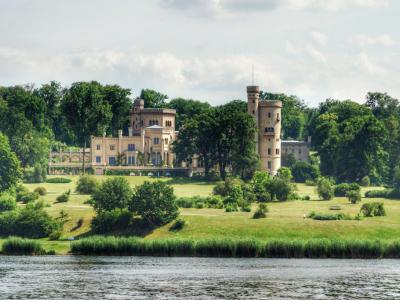


Babelsberg Park, Potsdam
Babelsberg Park, spanning 114 hectares, is located in the northeast of Potsdam, along the banks of the Tiefen See lake on the River Havel. The park was initially designed by the renowned landscape artist Peter Joseph Lenné and later refined by Prince Hermann von Pückler-Muskau. It was commissioned by Prince William, who later became Emperor William I, and his wife, Augusta, as a personal residence and addition to the scenic transformation of Potsdam’s landscape.
The park's origins date back to 1833, when King Frederick William III of Prussia permitted his son Prince William to develop a garden. Karl Friedrich Schinkel was commissioned to design a palace, but due to limited funds, Lenné faced challenges in advancing the landscaping. His work was further complicated by an irrigation failure during a hot summer, which led to significant plant loss, and by disagreements with Princess Augusta over the garden's future design, ultimately resulting in Lenné's dismissal.
In 1843, landscape gardener Prince Hermann von Pückler-Muskau took over the project, adding artificial lakes like Schwarze Meer, Achterbecken, Kindermannsee, and Große See into the park’s landscape. Lenné incorporated the nearby Böttcherberg hill, enhancing the park's connections to surrounding lakes with observation points like the Rondell and Fächeraussicht. Near the park's highest point, Prince Charles built the semi-circular Loggia Alexandra in 1869 to honor his sister.
After the Prussian monarchy ended in 1918 and royal assets were redistributed in 1926, Babelsberg Palace and Park came under the Prussian Palace Authorities. Post-World War II, parts of the park were used for public and military purposes, and access was restricted when the Berlin Wall was built in 1961. Following the Wall's fall in 1989, the park underwent extensive restoration and is now fully open to the public.
The park's origins date back to 1833, when King Frederick William III of Prussia permitted his son Prince William to develop a garden. Karl Friedrich Schinkel was commissioned to design a palace, but due to limited funds, Lenné faced challenges in advancing the landscaping. His work was further complicated by an irrigation failure during a hot summer, which led to significant plant loss, and by disagreements with Princess Augusta over the garden's future design, ultimately resulting in Lenné's dismissal.
In 1843, landscape gardener Prince Hermann von Pückler-Muskau took over the project, adding artificial lakes like Schwarze Meer, Achterbecken, Kindermannsee, and Große See into the park’s landscape. Lenné incorporated the nearby Böttcherberg hill, enhancing the park's connections to surrounding lakes with observation points like the Rondell and Fächeraussicht. Near the park's highest point, Prince Charles built the semi-circular Loggia Alexandra in 1869 to honor his sister.
After the Prussian monarchy ended in 1918 and royal assets were redistributed in 1926, Babelsberg Palace and Park came under the Prussian Palace Authorities. Post-World War II, parts of the park were used for public and military purposes, and access was restricted when the Berlin Wall was built in 1961. Following the Wall's fall in 1989, the park underwent extensive restoration and is now fully open to the public.
Want to visit this sight? Check out these Self-Guided Walking Tours in Potsdam. Alternatively, you can download the mobile app "GPSmyCity: Walks in 1K+ Cities" from Apple App Store or Google Play Store. The app turns your mobile device to a personal tour guide and it works offline, so no data plan is needed when traveling abroad.
Download The GPSmyCity App



Babelsberg Park on Map
Sight Name: Babelsberg Park
Sight Location: Potsdam, Germany (See walking tours in Potsdam)
Sight Type: Attraction/Landmark
Sight Location: Potsdam, Germany (See walking tours in Potsdam)
Sight Type: Attraction/Landmark
Nearby Sights
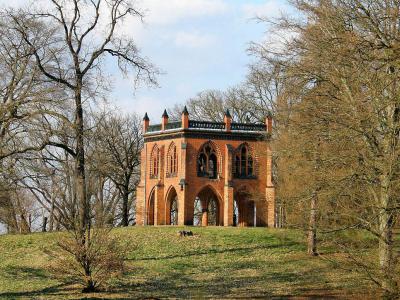
Walking Tours in Potsdam, Germany

Create Your Own Walk in Potsdam
Creating your own self-guided walk in Potsdam is easy and fun. Choose the city attractions that you want to see and a walk route map will be created just for you. You can even set your hotel as the start point of the walk.
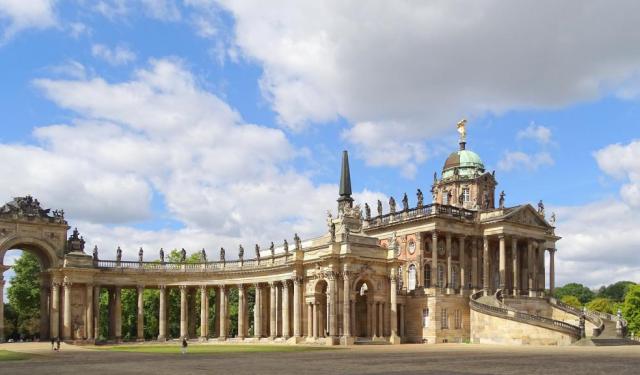
Potsdam City Center and Sanssouci Palace Walking Tour
Potsdam was likely founded during the seventh century by the Hevelli tribe. The town was mentioned by the name of Poztupimi in a document from Emperor Otto III. The name likely came from an old Western Slavonic term roughly meaning "beneath the oaks."
By the early 1300s, a small town had formed with a town charter. By 1573 the town had around 2,000 people living there. Potsdam rose to... view more
Tour Duration: 2 Hour(s)
Travel Distance: 3.8 Km or 2.4 Miles
By the early 1300s, a small town had formed with a town charter. By 1573 the town had around 2,000 people living there. Potsdam rose to... view more
Tour Duration: 2 Hour(s)
Travel Distance: 3.8 Km or 2.4 Miles
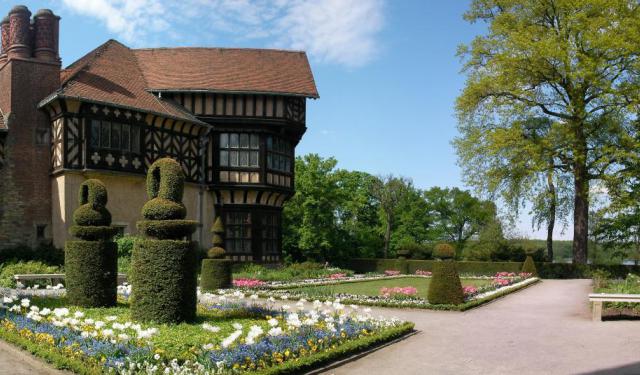
Neuer Garten Walking Tour
Laid out at the behest of Friedrich William II in 1787, Potsdam's Neuer Garten (New Garden) was indeed "new" compared to the already in place Sanssouci Park.
Between 1816 and 1828, the area was modified further as an English-style, open landscape garden, with an aim to reproduce nature – trees and plants were left to grow naturally, unshaped and untrimmed. Rural life was also... view more
Tour Duration: 2 Hour(s)
Travel Distance: 2.8 Km or 1.7 Miles
Between 1816 and 1828, the area was modified further as an English-style, open landscape garden, with an aim to reproduce nature – trees and plants were left to grow naturally, unshaped and untrimmed. Rural life was also... view more
Tour Duration: 2 Hour(s)
Travel Distance: 2.8 Km or 1.7 Miles
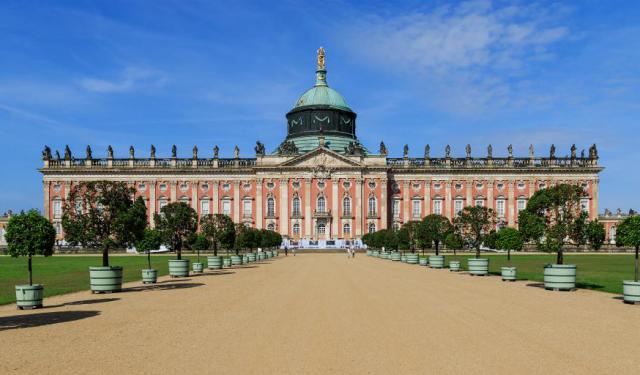
Sanssouci Park Walking Tour
Sanssouci Park is a unique Potsdam landmark that occupies 290 hectares in the heart of the city. The Park is named after the Sanssouci Palace that it surrounds, which in turn takes its name from the French phrase "sans souci", which means carefree, and implies that the palace was designated as a place of fun, rather than a seat of power.
Indeed, the Sanssouci Palace was built in 1747... view more
Tour Duration: 2 Hour(s)
Travel Distance: 3.9 Km or 2.4 Miles
Indeed, the Sanssouci Palace was built in 1747... view more
Tour Duration: 2 Hour(s)
Travel Distance: 3.9 Km or 2.4 Miles