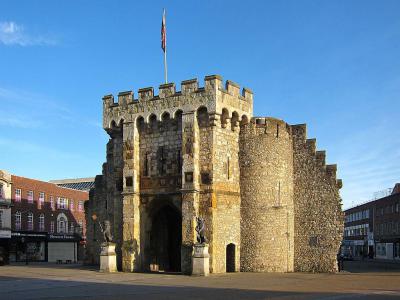


Bargate, Southampton
Bargate once served as the main entrance to the walled town of Southampton. Built around 1180, it is largely regarded as one of the finest surviving medieval gateways in England.
Start on its north side, facing the more elaborate façade. Look at the two massive, rounded towers flanking the central archway. These are the drum towers, added around 1280 to strengthen the town's defenses. Above them, you'll see the imposing north front, which was extended in the early 15th century. Notice how the building combines rough flint with carefully cut stone, reflecting different stages of its construction.
Now, look higher up at the row of 11 heraldic shields decorating the façade. These represent Southampton's historic civic and royal connections. The originals deteriorated over time, so the shields you see today are the result of several restoration efforts.
Next, turn your attention to the stone lion sculptures guarding the gateway. Added in the 16th century and restored in 2020, they're traditionally associated with the legendary Sir Bevois, Southampton's mythical hero. According to one tale, he killed two lions to protect a princess.
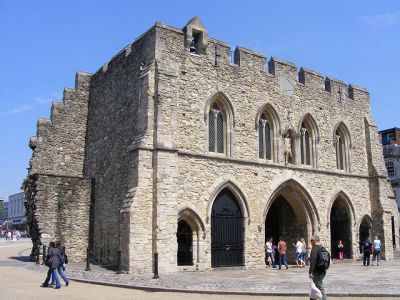
Walk through the central archway and take a moment to examine the thick stone walls overhead. This passage once controlled the movement of merchants, travelers, and goods entering Southampton. On the south side, turn around to admire the gateway's older, simpler façade, which contrasts with the more decorative northern entrance.
Indeed, Bargate was much more than a defensive structure. During the 15th century, parts of it were used as a prison, and a century later, the town's court leet - a local court responsible for maintaining public order and enforcing town regulations - began meeting here. Bargate also served as Southampton's guildhall and a center of commercial activity. Beneath the building are historic vaulted spaces once used by merchants to store goods, including wine, although these are not normally accessible to visitors.
For centuries, Bargate remained connected to Southampton's medieval walls. As traffic increased, proposals to demolish it were debated in 1899, 1914, and 1923. Fortunately, the gateway survived, and instead, sections of the adjoining walls were removed.
During World War II, Bargate even served as an air-raid shelter. Today, standing free of the surrounding walls, it offers a remarkable glimpse into more than 800 years of Southampton's history.
Want to visit this sight? Check out these Self-Guided Walking Tours in Southampton. Alternatively, you can download the mobile app "GPSmyCity: Walks in 1K+ Cities" from Apple App Store or Google Play Store. The app turns your mobile device to a personal tour guide and it works offline, so no data plan is needed when traveling abroad.
Download The GPSmyCity App



Bargate on Map
Sight Name: Bargate
Sight Location: Southampton, England (See walking tours in Southampton)
Sight Type: Attraction/Landmark
Guide(s) Containing This Sight:
Sight Location: Southampton, England (See walking tours in Southampton)
Sight Type: Attraction/Landmark
Guide(s) Containing This Sight:
Nearby Sights




Walking Tours in Southampton, England
Create Your Own Walk in Southampton
Creating your own self-guided walk in Southampton is easy and fun. Choose the city attractions that you want to see and a walk route map will be created just for you. You can even set your hotel as the start point of the walk.

Walking Through Southampton's Historic Old Town
Southampton is one of England’s most important port cities, with a history stretching back thousands of years. Archaeological evidence suggests that people have lived in this area since as early as the Stone Age. The Romans later established a settlement called Clausentum, near present-day Bitterne Manor, which served as a defensive outpost.
By the 8th century, the Anglo-Saxons had developed... view more
Tour Duration: 2 Hours
Travel Distance: 3 Km or 1.9 Miles
By the 8th century, the Anglo-Saxons had developed... view more
Tour Duration: 2 Hours
Travel Distance: 3 Km or 1.9 Miles

Titanic Tour in Southampton
Over a hundred years since the sinking of the Titanic, the echo of that tragedy still reverberates throughout Southampton. Indeed, nowhere else was the pain of the Titanic loss, one of the deadliest in maritime history, felt more intensely than here.
When the ship set sail for New York on April 10, 1912, most of its roughly 900 crew members were locals. Just five days later, in the early hours... view more
Tour Duration: 2 Hours
Travel Distance: 3.9 Km or 2.4 Miles
When the ship set sail for New York on April 10, 1912, most of its roughly 900 crew members were locals. Just five days later, in the early hours... view more
Tour Duration: 2 Hours
Travel Distance: 3.9 Km or 2.4 Miles

Southampton Waterfront Walk
A major seaport on the south coast of England, the city of Southampton abounds in attractions of various sorts. Southampton Waterfront, in particular, holds significant historical and cultural value, offering ample opportunities for sightseeing, shopping, dining, recreation, and entertainment.
At the heart of this vibrant area is the Pilgrims Fathers Memorial, commemorating the departure of... view more
Tour Duration: 1 Hour
Travel Distance: 1.9 Km or 1.2 Miles
At the heart of this vibrant area is the Pilgrims Fathers Memorial, commemorating the departure of... view more
Tour Duration: 1 Hour
Travel Distance: 1.9 Km or 1.2 Miles
City Walks Overview
