

Basilica, Pompei
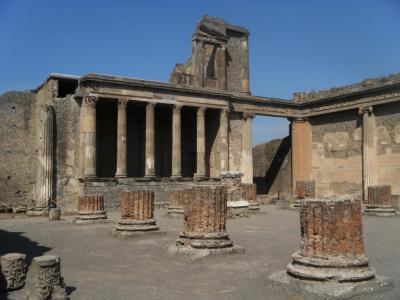
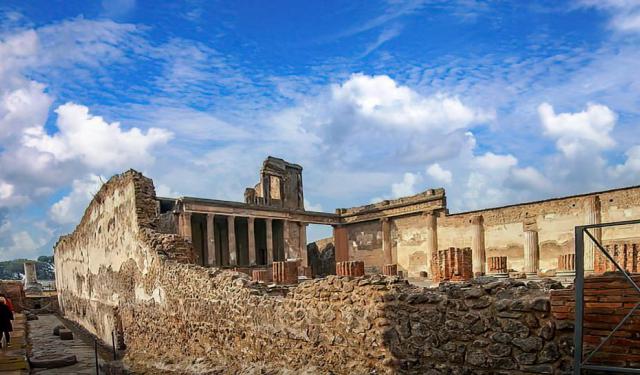
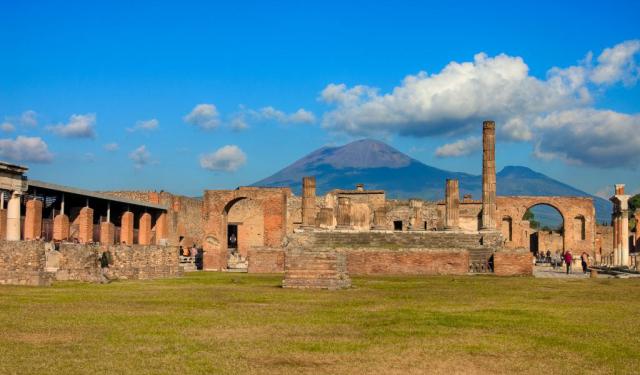
The Basilica stands on the western side of a large square, with the Forum at its centre. It is the oldest Roman basilica ever discovered and has stood here since the 2nd century BC. This was one of Pompeii’s most important buildings, housing the town’s law courts, as well as halls for commercial and financial transactions.
The main entrance was located on one of the building’s two short sides, behind a vestibule. Walk forward from the eastern vestibule through the main entrance into the body of the structure to find the centre of the central colonnaded hall. Here, the vast floor layout contains 28 massive columns made of specially cut tiles. The columns stand as broken stumps today, lacking their upper sections. There is some debate over whether these thick columns supported a complete roof or whether the centre of the building was open to the elements.
Next, direct your gaze straight across the length of the hall to the far short side opposite the entrance. There, standing prominently, is the tribunal, or law court. It consists of a two-metre-high podium originally topped with six Corinthian columns. There are no permanent stairs leading up to the podium, suggesting that temporary steps were used for judges to access it, while also preventing members of the public from reaching the judges during proceedings.
As a final highlight, the walls of the Basilica are decorated with painted stucco, much of which was preserved by the falling ash that buried the city in 79 AD. As you walk along the side aisles of the basilica, look closely at how the decorative plasterwork mimics luxurious marble blocks.
The main entrance was located on one of the building’s two short sides, behind a vestibule. Walk forward from the eastern vestibule through the main entrance into the body of the structure to find the centre of the central colonnaded hall. Here, the vast floor layout contains 28 massive columns made of specially cut tiles. The columns stand as broken stumps today, lacking their upper sections. There is some debate over whether these thick columns supported a complete roof or whether the centre of the building was open to the elements.
Next, direct your gaze straight across the length of the hall to the far short side opposite the entrance. There, standing prominently, is the tribunal, or law court. It consists of a two-metre-high podium originally topped with six Corinthian columns. There are no permanent stairs leading up to the podium, suggesting that temporary steps were used for judges to access it, while also preventing members of the public from reaching the judges during proceedings.
As a final highlight, the walls of the Basilica are decorated with painted stucco, much of which was preserved by the falling ash that buried the city in 79 AD. As you walk along the side aisles of the basilica, look closely at how the decorative plasterwork mimics luxurious marble blocks.
Want to visit this sight? Check out these Self-Guided Walking Tours in Pompei. Alternatively, you can download the mobile app "GPSmyCity: Walks in 1K+ Cities" from Apple App Store or Google Play Store. The app turns your mobile device to a personal tour guide and it works offline, so no data plan is needed when traveling abroad.
Download The GPSmyCity App



Basilica on Map
Sight Name: Basilica
Sight Location: Pompei, Italy (See walking tours in Pompei)
Sight Type: Attraction/Landmark
Guide(s) Containing This Sight:
Sight Location: Pompei, Italy (See walking tours in Pompei)
Sight Type: Attraction/Landmark
Guide(s) Containing This Sight:
Nearby Sights


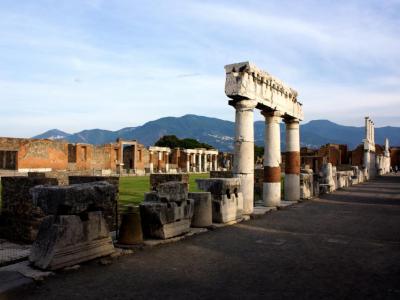
Forum (must see)
Walking Tours in Pompei, Italy

Create Your Own Walk in Pompei
Creating your own self-guided walk in Pompei is easy and fun. Choose the city attractions that you want to see and a walk route map will be created just for you. You can even set your hotel as the start point of the walk.
Pompeii Introduction Walk II
Frozen at the moment it was buried under the thick blanket of ash and pumice, the city of Pompeii (now excavated) remains a unique window into the past, offering a snapshot of everyday life back in the 1st century AD Roman Empire. Aside from causing quick and unexpected death to the city, the huge eruption of Vesuvius in 79 AD did have one positive outcome – it preserved everything (properties,... view more
Tour Duration: 3 Hour(s)
Travel Distance: 2.3 Km or 1.4 Miles
Tour Duration: 3 Hour(s)
Travel Distance: 2.3 Km or 1.4 Miles
Pompeii Introduction Walk I
Modern-day Pompei is best known for its ancient predecessor, the Roman city of Pompeii, that fell victim to the massive eruption of Mount Vesuvius in 79 AD. The ruins of Pompeii, first uncovered in the late 18th century, were declared a World Heritage Site by UNESCO in 1997. Presently, this is one of the most popular tourist attractions in Italy, drawing annually up to 2.5 million visitors.
The... view more
Tour Duration: 2 Hour(s)
Travel Distance: 2.0 Km or 1.2 Miles
The... view more
Tour Duration: 2 Hour(s)
Travel Distance: 2.0 Km or 1.2 Miles