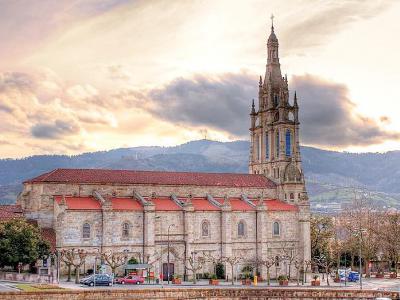


Basilica de Nuestra Senora de Begona (Basilica of Begona), Bilbao
Basilica of Begona is dedicated to the Virgin of Begoña, the beloved patron saint of Biscay province-lovingly referred to as Amatxu, meaning “Mother” in Basque language. According to local legend, the Virgin appeared centuries ago on Mount Artagan, inspiring the construction of a shrine precisely at that sacred spot. The current Gothic-style church began rising in 1511 under Sancho Martínez de Arego architect, with a Renaissance-inspired triumphal-arch entrance designed by Gil de Hontañón complementing the predominantly Gothic aesthetic.
With its commanding position on a hill, the basilica has long served as a beacon of faith and hope. Mariners returning to Bilbao would traditionally greet its steeple and begin to pray-giving the nearby neighborhood its name, La Salve, meaning "The Salutation" -and countless ships have been christened "Virgin of Begoña" in her honor. Its architecture reflects layers of history: richly Gothic interiors, Renaissance touches on the facade, and a 20th-century clock tower with 24 bells designed by José María Basterra added between 1902 and 1907.
Massive pilgrimages occur annually on 15 August , Assumption of Mary, and 11 October, Feast of Our Lady of Begoña, when thousands walk through the night to honor Amatxu, participating in midnight masses filled with reverence and tradition. Beyond its religious role, the building embodies centuries of Bilbao’s cultural evolution; it endured Napoleonic attacks, Carlist sieges, and restoration efforts, each chapter leaving its mark in stone and spirit.
With its commanding position on a hill, the basilica has long served as a beacon of faith and hope. Mariners returning to Bilbao would traditionally greet its steeple and begin to pray-giving the nearby neighborhood its name, La Salve, meaning "The Salutation" -and countless ships have been christened "Virgin of Begoña" in her honor. Its architecture reflects layers of history: richly Gothic interiors, Renaissance touches on the facade, and a 20th-century clock tower with 24 bells designed by José María Basterra added between 1902 and 1907.
Massive pilgrimages occur annually on 15 August , Assumption of Mary, and 11 October, Feast of Our Lady of Begoña, when thousands walk through the night to honor Amatxu, participating in midnight masses filled with reverence and tradition. Beyond its religious role, the building embodies centuries of Bilbao’s cultural evolution; it endured Napoleonic attacks, Carlist sieges, and restoration efforts, each chapter leaving its mark in stone and spirit.
Want to visit this sight? Check out these Self-Guided Walking Tours in Bilbao. Alternatively, you can download the mobile app "GPSmyCity: Walks in 1K+ Cities" from Apple App Store or Google Play Store. The app turns your mobile device to a personal tour guide and it works offline, so no data plan is needed when traveling abroad.
Download The GPSmyCity App



Basilica de Nuestra Senora de Begona (Basilica of Begona) on Map
Sight Name: Basilica de Nuestra Senora de Begona (Basilica of Begona)
Sight Location: Bilbao, Spain (See walking tours in Bilbao)
Sight Type: Religious
Sight Location: Bilbao, Spain (See walking tours in Bilbao)
Sight Type: Religious
Nearby Sights
Walking Tours in Bilbao, Spain

Create Your Own Walk in Bilbao
Creating your own self-guided walk in Bilbao is easy and fun. Choose the city attractions that you want to see and a walk route map will be created just for you. You can even set your hotel as the start point of the walk.
Bilbao's Old Town Walking Tour
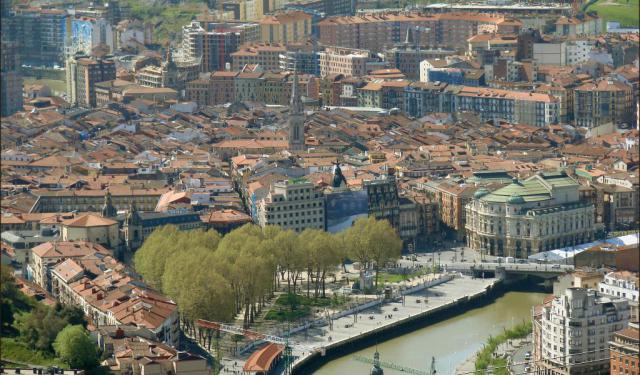
Bilbao's old town, also known as The Seven Streets, is the medieval heart of the city. Indeed, this ancient neighborhood, a place where the city began and which had been fortified by walls until the late 19th century, today consists of seven main streets and many narrow alleys – called cantons (kantoi, cantón) – that connect them.
Often regarded as a jewel of Basque architecture and... view more
Tour Duration: 1 Hour(s)
Travel Distance: 1.6 Km or 1 Miles
Often regarded as a jewel of Basque architecture and... view more
Tour Duration: 1 Hour(s)
Travel Distance: 1.6 Km or 1 Miles
Bilbao Introduction Walking Tour
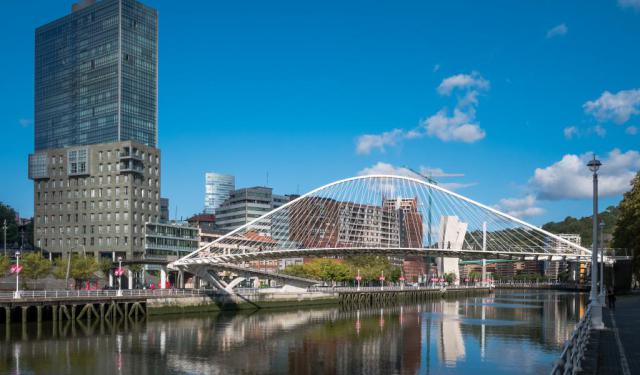
Officially founded in 1300 AD by the Lord of Biscay, Bilbao began as a small port settlement. Its sheltered estuary allowed ships to load wool, iron, and other goods bound for northern Europe, while merchants imported salt, wine, and luxury items. The name "Bilbao" likely comes from the Basque words bil, meaning "settlement," and bao, meaning "estuary"-a fitting... view more
Tour Duration: 2 Hour(s)
Travel Distance: 4.1 Km or 2.5 Miles
Tour Duration: 2 Hour(s)
Travel Distance: 4.1 Km or 2.5 Miles