

Basilica di Santa Chiara (Basilica of Saint Clare), Assisi (must see)
Consecrated in 1265, this basilica is the final resting place of Saint Clare, Saint Francis’s devoted companion and the founder of the Franciscan order of nuns. Born into nobility in 1194, Clare received a deeply religious upbringing. At the age of 18, she rejected her family’s marriage plans and left home to join Francis. In a symbolic gesture, he cut off her blonde hair, and she exchanged her fine clothing for a simple habit. The two remained closely united by their radical commitment to poverty until Francis’s death.
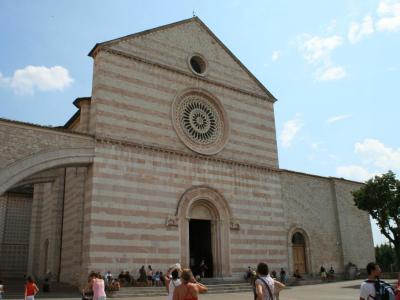
The basilica stands on the site of the former Church of Saint George, where Francis attended school and was later canonized. With its restrained façade and elaborate rose window, it resembles the Upper Church of the Basilica of Saint Francis.
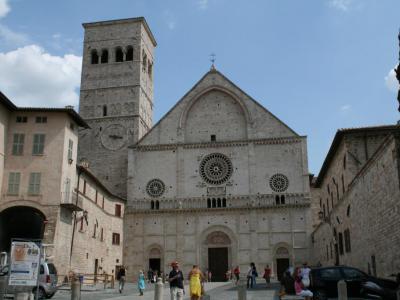
After following Mazzini Avenue, pause in the broad open square in front of the basilica to admire the pink-and-white striped façade, its elegant central rose window, and the prominent exterior buttress arches supporting the northern wall.
Do not remain outside for too long, however. Inside, the atmosphere is dim and austere, partly because of later architectural alterations. In the 17th century, Bishop Marcello Crescenzi, following Counter-Reformation aesthetic principles, ordered the church’s frescoes to be whitewashed. Some fragments of earlier Sienese frescoes have survived, particularly in the transepts and above the high altar.
Notable works include scenes from the Apocalypse and the Life of Christ in the south transept, probably painted by a collaborator of Giotto. Above the high altar hangs a large 13th-century crucifix, surrounded by scenes from the Life of Saint Clare. Meanwhile, the north transept displays episodes from Genesis.
For the next highlight, find the Chapel of Saint George along the southern wall of the nave. Here, you can view the Byzantine-style San Damiano Crucifix, which is famous for speaking to Francis and instructing him to “Repair my Church.” Framing this sacred cross are 14th-century frescoes, dominated by Puccio Capanna’s 1335 masterpiece, The Majesty. The work centers on the enthroned Virgin blessing the Child, flanked on the left by Saint Clare and Saint John the Baptist, and on the right by Saint Michael the Archangel and Saint Francis.
Next, descend into the lower crypt and walk around the central marble shrine containing Saint Clare’s sarcophagus. Her remains rest within the crypt, reached by a passageway beneath the basilica.
After leaving the church, approach the edge of the terrace for a panoramic view across the Umbrian Valley.
The basilica stands on the site of the former Church of Saint George, where Francis attended school and was later canonized. With its restrained façade and elaborate rose window, it resembles the Upper Church of the Basilica of Saint Francis.
After following Mazzini Avenue, pause in the broad open square in front of the basilica to admire the pink-and-white striped façade, its elegant central rose window, and the prominent exterior buttress arches supporting the northern wall.
Do not remain outside for too long, however. Inside, the atmosphere is dim and austere, partly because of later architectural alterations. In the 17th century, Bishop Marcello Crescenzi, following Counter-Reformation aesthetic principles, ordered the church’s frescoes to be whitewashed. Some fragments of earlier Sienese frescoes have survived, particularly in the transepts and above the high altar.
Notable works include scenes from the Apocalypse and the Life of Christ in the south transept, probably painted by a collaborator of Giotto. Above the high altar hangs a large 13th-century crucifix, surrounded by scenes from the Life of Saint Clare. Meanwhile, the north transept displays episodes from Genesis.
For the next highlight, find the Chapel of Saint George along the southern wall of the nave. Here, you can view the Byzantine-style San Damiano Crucifix, which is famous for speaking to Francis and instructing him to “Repair my Church.” Framing this sacred cross are 14th-century frescoes, dominated by Puccio Capanna’s 1335 masterpiece, The Majesty. The work centers on the enthroned Virgin blessing the Child, flanked on the left by Saint Clare and Saint John the Baptist, and on the right by Saint Michael the Archangel and Saint Francis.
Next, descend into the lower crypt and walk around the central marble shrine containing Saint Clare’s sarcophagus. Her remains rest within the crypt, reached by a passageway beneath the basilica.
After leaving the church, approach the edge of the terrace for a panoramic view across the Umbrian Valley.
Want to visit this sight? Check out these Self-Guided Walking Tours in Assisi. Alternatively, you can download the mobile app "GPSmyCity: Walks in 1K+ Cities" from Apple App Store or Google Play Store. The app turns your mobile device to a personal tour guide and it works offline, so no data plan is needed when traveling abroad.
Download The GPSmyCity App



Basilica di Santa Chiara (Basilica of Saint Clare) on Map
Sight Name: Basilica di Santa Chiara (Basilica of Saint Clare)
Sight Location: Assisi, Italy (See walking tours in Assisi)
Sight Type: Religious
Guide(s) Containing This Sight:
Sight Location: Assisi, Italy (See walking tours in Assisi)
Sight Type: Religious
Guide(s) Containing This Sight:
Nearby Sights

Walking Tours in Assisi, Italy

Create Your Own Walk in Assisi
Creating your own self-guided walk in Assisi is easy and fun. Choose the city attractions that you want to see and a walk route map will be created just for you. You can even set your hotel as the start point of the walk.
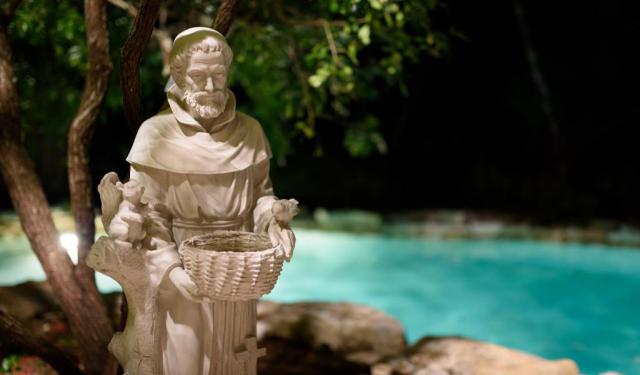
St. Francis' Assisi Walking Tour
Assisi’s identity as the city of Saint Francis began with a merchant’s son who seemed destined for anything but sainthood. Giovanni di Pietro di Bernardone-later known as Francis-was born here in late 1181 or early 1182 into a prosperous cloth-trading family. As a young man, he delighted in fashionable clothes, music, feasting, and dreams of knighthood. Assisi was then a turbulent commune,... view more
Tour Duration: 2 Hour(s)
Travel Distance: 3.2 Km or 2 Miles
Tour Duration: 2 Hour(s)
Travel Distance: 3.2 Km or 2 Miles
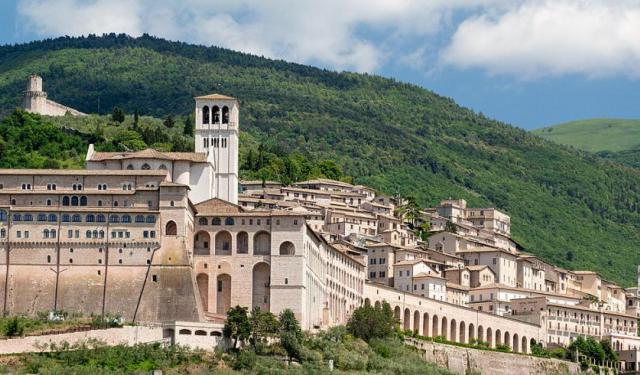
Explore Assisi Medieval Town on Foot
Dante believed that the name Assisi did not fully express the town’s significance. In his poem Paradiso, he suggested that it should instead be called the “East” because Saint Francis rose from its hillside like a new sun.
Assisi stands on the western slope of Mount Subasio, overlooking the Umbrian Valley. Human settlement in the area dates back to prehistoric times, while the town itself... view more
Tour Duration: 2 Hour(s)
Travel Distance: 1.9 Km or 1.2 Miles
Assisi stands on the western slope of Mount Subasio, overlooking the Umbrian Valley. Human settlement in the area dates back to prehistoric times, while the town itself... view more
Tour Duration: 2 Hour(s)
Travel Distance: 1.9 Km or 1.2 Miles