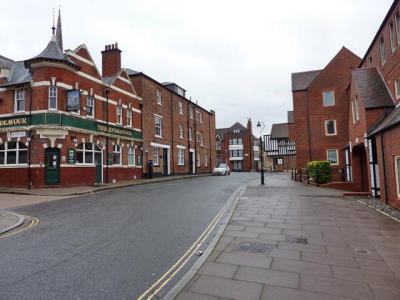


Bugle Street, Southampton
Running south from Saint Michael’s Square to Town Quay, Bugle Street is one of Southampton’s oldest streets, with buildings dating from the 16th to the 18th centuries, and even earlier. The street’s unusual name comes from the Latin word buculus, meaning “young bull.” Indeed, it was once known as Bull Street, while the name Bugle also refers to the horn traditionally made from a young bull’s horn.
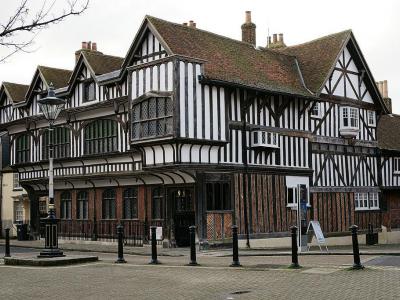
At the northern end of Bugle Street, beside Saint Michael’s Square, look for Tudor House, one of Southampton’s best-preserved historic sites. You’ll recognize it by its black-and-white timber-framed façade, projecting upper floors, and small gabled roofs. Although much of its present appearance dates from the late 15th and early 16th centuries, parts of the building are considerably older. Today, it houses a museum exploring Southampton’s history, along with a peaceful historic garden.
From here, turn south and follow Bugle Street toward the waterfront. As you walk, take time to examine the buildings on either side. Notice the different window shapes, decorative brickwork, and historic façades, which reflect centuries of changing architectural styles.
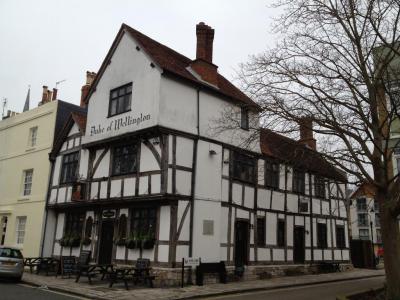
One particularly interesting building is the Duke of Wellington pub, at number 36. Look for its white exterior crossed by dark timber beams, with the pub’s name displayed above the windows. The building has medieval origins, with foundations and cellars dating back to around 1220. It became an inn centuries ago and received its present name following the Battle of Waterloo in 1815. Today, it remains a traditional English pub where visitors can stop for a drink or a meal.
Continue south toward Town Quay. At the end of the street, look for the elegant, pale-coloured building with tall windows and classical architectural details. This is the former Royal Southern Yacht Club clubhouse, now known as Bugle House. Opened in 1846, it once hosted grand social gatherings and sailing events. Its impressive ballroom was a centre of Southampton’s fashionable maritime society, while cannons were used to signal yacht races and mark special occasions. The yacht club later relocated to Hamble, but its original building remains an important Victorian landmark.
Indeed, the mixture of medieval, Tudor, Georgian, and Victorian architecture makes this short street one of the best places in Southampton to appreciate the city’s long history.
Want to visit this sight? Check out these Self-Guided Walking Tours in Southampton. Alternatively, you can download the mobile app "GPSmyCity: Walks in 1K+ Cities" from Apple App Store or Google Play Store. The app turns your mobile device to a personal tour guide and it works offline, so no data plan is needed when traveling abroad.
Download The GPSmyCity App



Bugle Street on Map
Sight Name: Bugle Street
Sight Location: Southampton, England (See walking tours in Southampton)
Sight Type: Attraction/Landmark
Guide(s) Containing This Sight:
Sight Location: Southampton, England (See walking tours in Southampton)
Sight Type: Attraction/Landmark
Guide(s) Containing This Sight:
Nearby Sights




Walking Tours in Southampton, England
Create Your Own Walk in Southampton
Creating your own self-guided walk in Southampton is easy and fun. Choose the city attractions that you want to see and a walk route map will be created just for you. You can even set your hotel as the start point of the walk.

Southampton Waterfront Walk
A major seaport on the south coast of England, the city of Southampton abounds in attractions of various sorts. Southampton Waterfront, in particular, holds significant historical and cultural value, offering ample opportunities for sightseeing, shopping, dining, recreation, and entertainment.
At the heart of this vibrant area is the Pilgrims Fathers Memorial, commemorating the departure of... view more
Tour Duration: 1 Hour
Travel Distance: 1.9 Km or 1.2 Miles
At the heart of this vibrant area is the Pilgrims Fathers Memorial, commemorating the departure of... view more
Tour Duration: 1 Hour
Travel Distance: 1.9 Km or 1.2 Miles

Walking Through Southampton's Historic Old Town
Southampton is one of England’s most important port cities, with a history stretching back thousands of years. Archaeological evidence suggests that people have lived in this area since as early as the Stone Age. The Romans later established a settlement called Clausentum, near present-day Bitterne Manor, which served as a defensive outpost.
By the 8th century, the Anglo-Saxons had developed... view more
Tour Duration: 2 Hours
Travel Distance: 3 Km or 1.9 Miles
By the 8th century, the Anglo-Saxons had developed... view more
Tour Duration: 2 Hours
Travel Distance: 3 Km or 1.9 Miles

Titanic Tour in Southampton
Over a hundred years since the sinking of the Titanic, the echo of that tragedy still reverberates throughout Southampton. Indeed, nowhere else was the pain of the Titanic loss, one of the deadliest in maritime history, felt more intensely than here.
When the ship set sail for New York on April 10, 1912, most of its roughly 900 crew members were locals. Just five days later, in the early hours... view more
Tour Duration: 2 Hours
Travel Distance: 3.9 Km or 2.4 Miles
When the ship set sail for New York on April 10, 1912, most of its roughly 900 crew members were locals. Just five days later, in the early hours... view more
Tour Duration: 2 Hours
Travel Distance: 3.9 Km or 2.4 Miles
City Walks Overview
