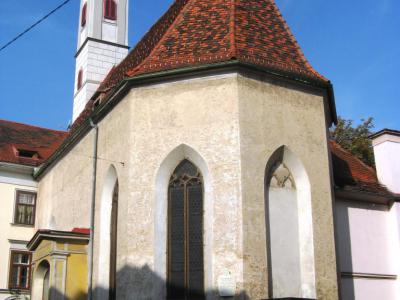


Bürgerspitalkirche (Community Hospital Church), Graz
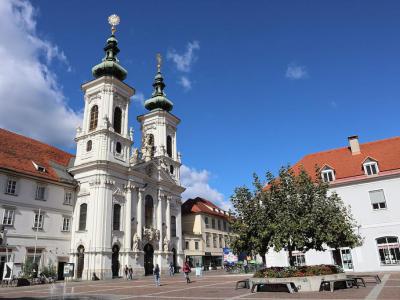
The Community Hospital Church (Bürgerspitalkirche), located in Graz, is a Roman Catholic church situated in the 5th district of Gries. It serves as a benefice attached to the Church of the Holy Spirit within the Community Hospital (Bürgerspital).
This church has strong historical ties to Graz's social and medical progress. In response to city overcrowding, the Murvorstadt neighborhood was established on the Mur River's right bank, now comprising the Gries and Lend districts, historically housing workers, the poor, and those needing medical aid. Unlike typical religious-run care institutions of the Middle Ages, the Hospital of the Holy Spirit notably operated under secular management, overseen by a hospital master, a dairyman, and assistants. Operating from the 14th century until Emperor Joseph II's closure, it stood as one of Graz's oldest hospitals.
The Community Hospital building, alongside the church and its furnishings, is recognized as a listed building due to its historical and architectural importance. The church itself was granted a building site by Emperor Friedrich III in 1461 and consecrated in 1498. Originally featuring a wooden roof turret that was later replaced with a stone tower designed by Josef Carlone, the church displays late Gothic architecture complemented by Baroque furnishings and a Rococo period tabernacle.
Referred to fondly as the "small cathedral" due to its resemblance to the high altar in Graz Cathedral, the Community Hospital Church houses notable artistic works including a late Gothic carving depicting Saint Bernard of Clairvaux's vision, a Gothic Madonna sculpted in natural stone, and a distinctive box-shaped pulpit adorned with symbolic gold balls, pictograms, and depictions relevant to biblical narratives.
This church has strong historical ties to Graz's social and medical progress. In response to city overcrowding, the Murvorstadt neighborhood was established on the Mur River's right bank, now comprising the Gries and Lend districts, historically housing workers, the poor, and those needing medical aid. Unlike typical religious-run care institutions of the Middle Ages, the Hospital of the Holy Spirit notably operated under secular management, overseen by a hospital master, a dairyman, and assistants. Operating from the 14th century until Emperor Joseph II's closure, it stood as one of Graz's oldest hospitals.
The Community Hospital building, alongside the church and its furnishings, is recognized as a listed building due to its historical and architectural importance. The church itself was granted a building site by Emperor Friedrich III in 1461 and consecrated in 1498. Originally featuring a wooden roof turret that was later replaced with a stone tower designed by Josef Carlone, the church displays late Gothic architecture complemented by Baroque furnishings and a Rococo period tabernacle.
Referred to fondly as the "small cathedral" due to its resemblance to the high altar in Graz Cathedral, the Community Hospital Church houses notable artistic works including a late Gothic carving depicting Saint Bernard of Clairvaux's vision, a Gothic Madonna sculpted in natural stone, and a distinctive box-shaped pulpit adorned with symbolic gold balls, pictograms, and depictions relevant to biblical narratives.
Want to visit this sight? Check out these Self-Guided Walking Tours in Graz. Alternatively, you can download the mobile app "GPSmyCity: Walks in 1K+ Cities" from Apple App Store or Google Play Store. The app turns your mobile device to a personal tour guide and it works offline, so no data plan is needed when traveling abroad.
Download The GPSmyCity App



Bürgerspitalkirche (Community Hospital Church) on Map
Sight Name: Bürgerspitalkirche (Community Hospital Church)
Sight Location: Graz, Austria (See walking tours in Graz)
Sight Type: Religious
Sight Location: Graz, Austria (See walking tours in Graz)
Sight Type: Religious
Nearby Sights




Walking Tours in Graz, Austria

Create Your Own Walk in Graz
Creating your own self-guided walk in Graz is easy and fun. Choose the city attractions that you want to see and a walk route map will be created just for you. You can even set your hotel as the start point of the walk.
Graz Old Town Walking Tour
Before humanity understood how planets move, the renowned astronomer Johannes Kepler was studying the skies from Graz between 1594 and 1600. During his time here, he developed ideas that would eventually lead to his revolutionary laws of planetary motion.
Graz, the capital of the Austrian state of Styria, has a history stretching back more than a thousand years. Its name derives from the Slavic... view more
Tour Duration: 2 Hour(s)
Travel Distance: 3.0 Km or 1.9 Miles
Graz, the capital of the Austrian state of Styria, has a history stretching back more than a thousand years. Its name derives from the Slavic... view more
Tour Duration: 2 Hour(s)
Travel Distance: 3.0 Km or 1.9 Miles